Aligarh, 20 May 1857
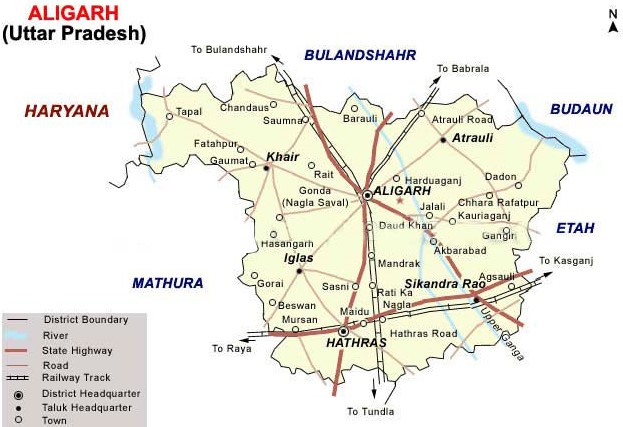
Aligarh commanded the road from Agra and Meerut, and was thus a vital communication link between Simla and Lahore. With the fall of Delhi, this small station had suddenly become vitally important. Generally, it was not considered a thrilling post. Surrounded on all sides by marshes and pools, it was almost cut off from the rest of the area during the monsoon, whereas the rest of the year, it was baked relentlessly in stifling heat. It had the usual accoutrements of any military station – a military cantonment, civil lines and a bazaar. An added feature was the fort.
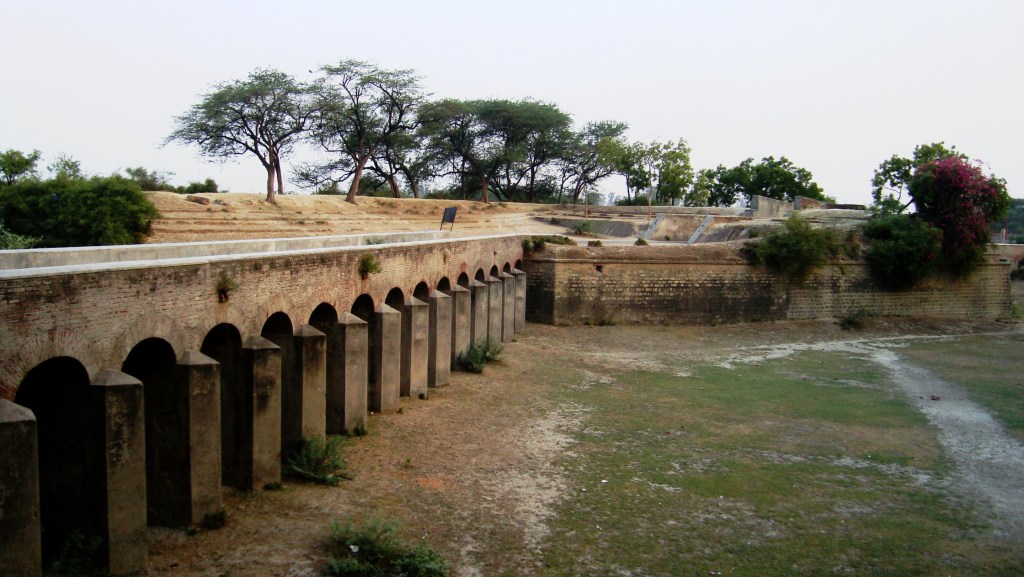
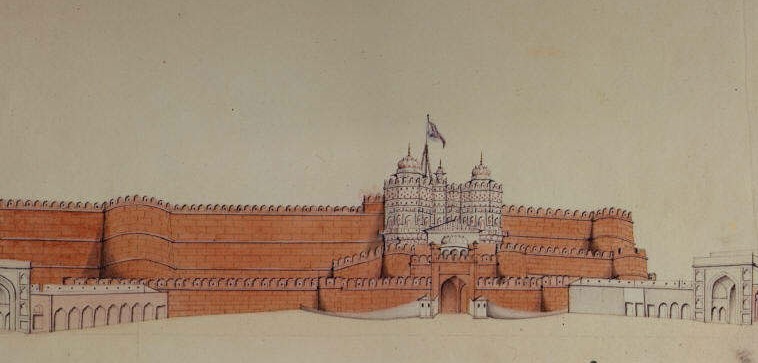
The original structure dated back to 1524, but it had been greatly improved, becoming a veritable fortress under Madhavrao I Scindia in 1759, who used it to great effect as a depot for drilling and organising his battalions with the help of Benoit de Boigne, a very successful French soldier of fortune. By 1803, Aligarh Fort was vastly improved by Boigne and Pierre Cuillier-Perron (another French soldier of fortune in Scindia’s pay) and boasted steep ravines some 30 feet high on all sides and bastions at every angle along the walls. However, this did not prevent it from being captured by the British with Perron’s help. Perron had started out serving the Maratha forces – but at the battle of Ujjain in 1801, he refused to send his troops to assist Scindia against Maharaja Yashwantrao Holkar, rendering his position, post-battle, very precarious. Perron defected to the British side as soon as it was clear that Lord Lake would go to war against Scindia.
The 9th Regiment, Bengal Native Infantry
In May 1857, the headquarters of the 9th BNI – 900 men in all – was in Aligarh, with detachments in Mainpuri, Etawah and Bulandshahr. Until the fateful day when they mutinied, they had shown no signs of disaffection. In what was perceived as an act of undeniably loyalty by their officers, the sepoys arrested a Brahmin pundit of some influence from a neighbouring village who they had caught spreading sedition in the lines. (All the accounts of his capture are tinged with melodrama; the one here is from Annals of the Indian Rebellion and purports to be written by Lieut. Cockburn in a private letter).
“A native non-commissioned officer concealed several sepoys, and induced the Brahmin to accompany him to where the sepoys lay hidden; under the pretence of its being a secluded spot where they might safely concert matters. The Brahmin then made overtures to the soldier and told him that if he could persuade the men of the regiment to mutiny, he would furnish two thousand men to assist in murdering the Europeans and plundering the treasury. At a preconcerted signal, the sepoys jumped up and secured the ruffian.”
The men handed him over to their commanding officer.
The Brahmin was court-martialled by a court composed entirely of native officers who summarily sentenced him to death. Why a civilian would be tried thus is not explained as he was not a military man; it would appear this was a way perhaps for the British to devolve responsibility onto the Indians as any sentence they would pass would have undoubtedly given the wrong impression. By allowing the men who captured him to be his jury, it could at least look like it was an Indian decision and not a British one to hang him. Unfortunately, what the British had sought to avoid by having the native officers try and execute him ultimately backfired, simply by virtue of his being a Brahmin, as events now show.
The sentence was carried out on 20 May in front of the assembled regiment. It was a quiet affair, and there was not a murmur from the men until one of their own broke from the lines and burst out,
“Behold, a martyr to our religion!”
According to Captain Stewart, who we shall meet again, interpreter and quarter-master of the 9th, the situation unfolded thus:
“The men were, after the execution, marched back to the lines and dismissed, and we were all saying how fortunate we were that things passed off so quietly. The words were hardly out of my mouth when I heard that in the Rifle Company (to which Stewart belonged), there was a row. I turned around and saw a Brahmin Sepoy rush out followed by his comrades, and crying out: ‘You have murdered our priest, hang me — hang me!’ He tore off his uniform and arms and rushed up to us, shouting: ‘Hang me — hang me! You have hanged a Brahmin,’ etc.
At first, we thought we should be able to put the matter down, and we went among the men, but gradually, they all got excited, and some of them told us to move off the parade and that they would settle the mutineers. The men began to load their muskets, so we — five in all — walked quietly away, without taking any notice of the men, who were, by this time, in a frightful state. As some Irregular Cavalry had come into the station that morning, we proceeded to join them, and, as soon as I got out of sight of the Sepoys, I cantered off to collect all the married people and Christians in the station. Luckily, the civilians were on the point of going out for their evening drive and had their carriages ready for the purpose. The Dumergues went into their carriage, leaving everything they had, even their watches, on the table. Ten minutes afterwards, the whole of the men in the lines proceeded to the treasury, which they plundered to the amount of 500,000 rupees, and then marched off to join the other mutinous corps at Delhi The city people and villagers, plundered and burnt down our houses; and the following morning there was not an anna’s worth of private property in the station. The ladies and children went straight into Agra…”
The same native officers who had passed the sentence and those who had assisted in the execution had turned on their British officers, but the scenario was almost too bizarre to behold. Instead of murdering them, the native officers simply dismissed their British officers and bid them to go wherever they liked.
Then, the native officers took control of the regiment, who they marched in a body to plunder the Treasury. After opening the doors of the local jail and freeing the prisoners, they swiftly made off towards Delhi. Not a single European officer or civilian was killed. Aligarh was left to its fate. Through the night, the sky glowed a garish red as bungalow after bungalow was torched. The civilians and the officers of the 9th lost everything they possessed except their horses and their lives. The worst had happened – with Aligarh out of British hands, the line of communication between Meerut and Agra was in danger.
Lieutenant Cockburn and his detachment of Gwalior troops had been sent from Agra on 13 May to assist Aligarh in case of an uprising at a moment’s notice, covering the 176 miles in seven marches. They arrived just in time to escort the ladies, their children and the civilians to Hathras, protecting them on their road from the 9th BNI. It was hardly an easy undertaking. “While they were being put into carriages, we shewed a front to the mutineers and hindered their advance. An occasional bullet whistled by our heads, but it was too dark for taking aim. We then heard the inhabitants were rising, so we determined on retreating.” Sir James Outram’s wife, his son Francis, the Judge Mr Dumergue, his family and the magistrate, Mr Watson, did not avail themselves of Cockburn’s services and made their own way instead.
However, now things did not go so well for the Lieutenant. He had 233 cavalrymen under his charge of the Gwalior Contingent, whom he, unfortunately, did not know as well as he thought. Having escorted the fugitives to safety to Hathras, 100 of his men rebelled while he could only look on. “The rebels formed and rode around the camp, they entreated those that who remained faithful to join them, they represented otherwise they remain poor men for life, they adjured them by their religion, but still the men stood firm. Finding that promises were of no avail, they had recourse to menaces and went off to stir off the villagers.“
Now, with a reduced force of 123 men, Cockburn still decided he trusted them enough to put them to work. Mutineers were certainly stirring up the country; reports were coming into Hathras of villages on fire, rampant plundering by all and sundry, and murder. Amid chaos, he saw it as his duty to do something. Procuring a curtained bullock cart, Cockburn persuaded four of his troopers to seat themselves in the cart with their loaded carabines, and, with the curtains pulled down, they were to impersonate ladies. “The cart he sent on in front, and he with about forty troopers followed at a distance, screening his party under the shade of some trees. No sooner did the plunderers see the cart than they rushed forward to plunder the fair damsels they imagined to be concealed inside. But they were woefully mistaken, for the foremost of them, so soon as he had neared the cart, was shot dead, and Lieutenant Cockburn’s party in the rear, hearing the signal, were upon the marauders in an instant. They broke and fled in all directions…” Forty-eight were killed, three wounded, and ten taken prisoner.
The fugitives from Aligarh would finally be escorted to Agra, where they would remain for many months to come. Around Aligarh, things were looking grim. In “A Dreadful Narrative,” we shall take a look at the consequences the Aligarh mutiny would have on some civilians out in the countryside.
Lady Outram Flees
Lady Margaret Clementina (née Anderson) Outram was the wife (and cousin) of Sir James, the “Bayard of the East,” who features widely in the annals of the Indian Rebellion. However, in May 1857, the great soldier was finishing off the Persia Campaign while his wife was visiting their 21-year-old son Francis, who had just taken up his first position for the civil service in Aligarh as assistant to Mr Watson, the magistrate. The hot weather had begun, and Lady Outram was looking forward to spending the summer months in the cooler climes of the hill station of Naini Tal.
While her son was away on district duties, Lady Outram had been living at the house of the Aligarh judge, Mr Dumergue, whose wife and daughters were the “only gentlewomen” in the station, i.e., of the same social strata as Lady Outram herself. On 20 May, with her son back at Aligarh, Lady Outram went over to his bungalow to make the final arrangements for her departure. While thus occupied, her son suddenly rushed in.
He had been at the magistrate’s house when some officers of the 9th BNI had run up, shouting that the regiment had “gone.” Realising there was no time to lose, Outram quickly mounted his horse and rode to his bungalow to gather up his mother. Without any formality, Lady Outram mounted the horse behind her son, and the two of them made for the civil lines. Curiously enough, it was reported, when the sensational press got hold of the story, that Lady Outram was purported to be “barefoot and in her nightdress”; however, nothing could be further from the truth. She was dressed for her evening ride in a light attire with thin shoes, suitable for the hot weather. As she had been waiting for the judge’s carriage at the time, her son did not pick her up from the road with her hair streaming either.
Unfortunately, the horse took objection to the double load and soon refused to move any further. Obliged to walk, the Outrams proceeded on foot through the cantonments, where they witnessed the sepoys “moving excitedly from place to place with their arms in their hands,” but not a single one paid them any mind. They passed on without incident to the civil lines and soon found themselves with the rest of the Aligarh civilians, who were now debating what to do.
The answer – flight – was the obvious one. Cockburn and the Gwalior Cavalry were ready to escort wherever they wanted to go, but the civilians were undecided as to whether Agra or Meerut was the better option. Finally, as it turned out, everyone went a different direction. Those under Lieutenant Cockburn proceeded to Hathras; Lady Outram, with a seat in the judge’s carriage, took off for Agra. Her son, Mr Watson and others headed for Meerut. While Lady Outram would soon find herself safely behind the great walls of the fort, her son would return shortly after to Aligarh with Mr Watson and a party of volunteers to retake the station.
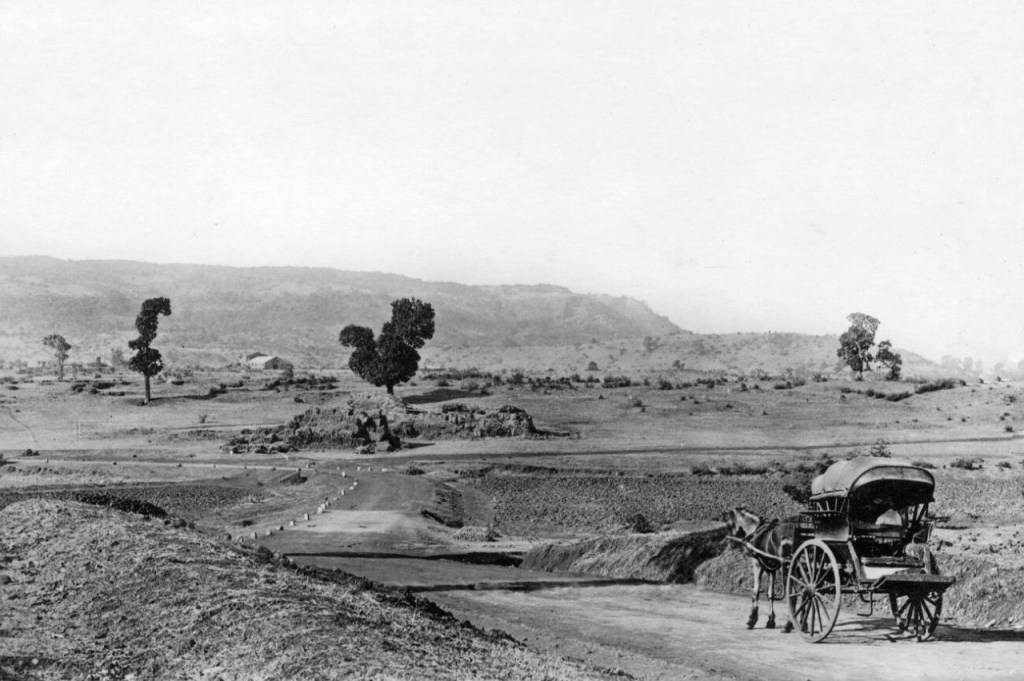
Their venture was short-lived, and at least initially, not completely hopeless. A body of mounted volunteers had been raised at Meerut by Mr Saunders and commanded by Mr Wilberforce Greathed of the Bengal Engineers, along with other men whose livelihoods had been cut short by the rebellion – Messrs. Arthur Cocks, J. O’B. Tandy, Harington and Castle, and Ensigns Ollivant and Marsh. Together with Francis Outram and Mr Watson, they rode back to Aligarh to find the station thoroughly looted, the post office and police station burned to the ground. The station was strewn with broken bullock trains, wagons and vans, all their contents “mischievously destroyed and strewn about the roads.” Not a single bungalow had escaped the conflagration. As news of the party’s approach became known, the citizens of Aligarh were thrown into a frenzy, trying desperately to hide anything and everything they had happened to plunder from the bungalows, while others haphazardly took to depositing items down wells or just flinging them away. It presented a curious sight.
“…the roads for miles round, the jungles, and the wells, were covered and choked by the most extraordinary chaos of articles conceivable, from cases of champagne, down to consignments of Holloway’s Pills of which there seemed to be a carriage load or two), – from splendid kinaubs, down to our old garments, plate, furniture, boxes, supplies of eatables – everyrhing except hard cash.”
This last one, an estimated seven lakhs rupees, had been shared between the 9th BNI and the local rabble. The 9th carried off their loot to Delhi, while the population of Aligarh was left to demolish the station.
By 30 May, the volunteers were joined by another group, some 20 in number, all well-armed and comprising Anglo Indians, indigo planters and Sergeant Major Johnson, an old pensioned band master of the 9th BNI. With them, they began restoring order in Aligarh – their venture was successful enough for Mr Watson to reopen the mail service to Agra and begin court proceedings. The volunteers had work enough, “bullying and frightening the life out of the craven inhabitants” of a nearby village, which had taken an active part in pillaging Aligarh; they also maintained watches on the road and kept an eye out for Government treasure. Mr Watson had promised anyone who found any of it would receive 10 per cent as a reward.
In spite of constant harassment from errant raiders, villagers who were intent on looting each other, roadside bandits and the terrible news from other stations, the volunteers held their own until July 3, when they were besieged by hundreds of “bad characters and mutineers” from Koel. Compelled to retire, they arrived just in time to take part on 5 July in the badly managed Battle of Agra and would find themselves cooped up in the fort.
Sources:
Chick, Noah Alfred. Annals of the Indian Rebellion. Calcutta: Sanders, Cones, and Co., 1859.
Compton, Herbert. A Particular Account of the European Military Adventurers of Hindustan from 1784 to 1803. London: T. Fisher Unwin, 1892. – https://babel.hathitrust.org/cgi/pt?d=coo.31924088940121&view=1up&seq=21
Kaye, John William. A History of the Sepoy War in India, 1857–1858. Vols. 2 and 3. London: W. H. Allen & Co., 1896.
Keene, Henry George. Fifty-Seven: Some Account of the Administration of Indian Districts During the Revolt of the Bengal Army. London: W. H. Allen & Co., 1883.
Malleson, G. B. History of the Indian Mutiny, 1857–1858: Commencing from the Close of the Second Volume of Sir John Kaye’s History of the Sepoy War. Vol. 1. London: W. H. Allen & Co., 1880.
Narrative of the Indian Mutinies of 1857: Compiled for the Madras Military Male Orphan Asylum. Madras: Asylum Press, 1858.
Raikes, Charles. Notes on the Revolt in the North-Western Provinces of India. London: Longman, Brown, Green, Longmans, & Roberts, 1858.
Trotter, Lionel J. The Bayard of India: A Life of General Sir James Outram. London: J. M. Dent & Sons, 1909.
 Mutiny Reflections