The Victoria Cross
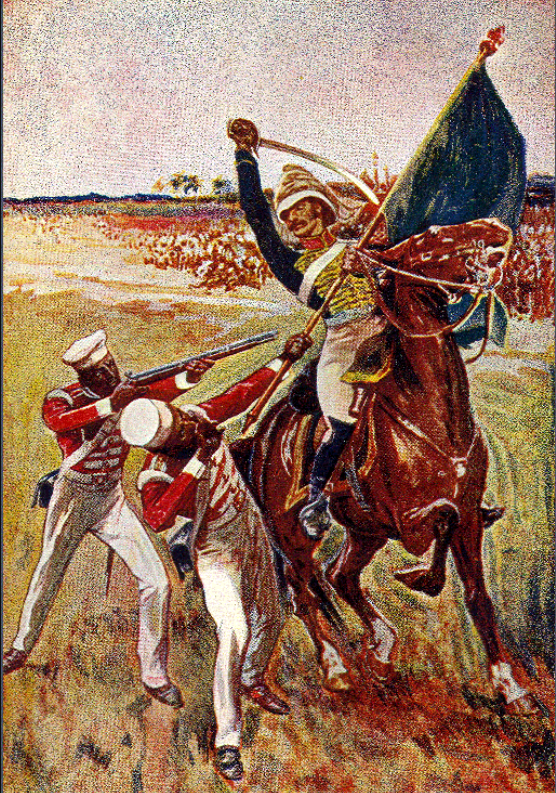
Throughout the mutiny, Roberts appeared to find himself amid hair-raising adventures. From saving guns at Delhi, to the wild charge at Agra, his narrow escape on the march to Alam Bagh, a night ride to procure ammunition before the final attack on Lucknow, then raising the flag on the Kurshid Manzil during the advance to the Residency, it was only a matter of time before he finally caught more complete attention:
“Lieutenant Roberts’ gallantry has on every occasion been most marked. On following the retreating enemy on 2 January 1858, at Khodagunge, he saw in the distance two Sepoys going away with a standard. Lieutenant Roberts put spurs to his horse and overtook them just as they were about to enter a village. They immediately turned round, and presented their muskets at him, and one of the men pulled the trigger, but fortunately, the caps snapped, and the standard-bearer was cut down by this gallant young officer, and the standard taken possession of by him. He also, on the same day, cut down another Sepoy who was standing at bay, with musket and bayonet, keeping off a Sowar. Lieutenant Roberts rode to the assistance of the horseman, and, rushing at the Sepoy, with one blow of his sword cut him across the face, killing him on the spot.” ( “No. 22212”. The London Gazette. 24 December 1858. p. 5516).
In a letter to his father, dated Camp Fatehgarh January 12 1858, Roberts wrote of the affair:
“The infantry and guns advanced on the village, out of which the rebels were soon driven and then our Cavalry followed up in two lines led by General Grant. I accompanied the first line, and in the scrimmage captured a very pretty Standard which I will send hone to adorn Suir View, the first opportunity. A great piece of luck my getting it, was it not?”
And then to his mother, on 11 February, Camp, 10 miles from Cawnpore,
“My own Mother, I have such a piece of news for you. I have been recommended for the Victoria Cross. The letter says for ‘repeated gallantry in the field more especially on the 2nd Jan. 1858 when Lieut. Fred. Roberts captured a rebel standard, killing the Standard Bearer and on the same day saved the life of an Irregular Cavalryman by cutting down a Sepoy who was attacking him with a musket and Bayonet.’ Is not this glorious? How pleased it will make the General. Such a Medal to wear with ‘For Valour’ scrolled on it. How proud I shall be, darling Mother, when I show it to you – better than all the other Medals put together. All get Medals for a campaign, but few, very few, this glorious Cross.”
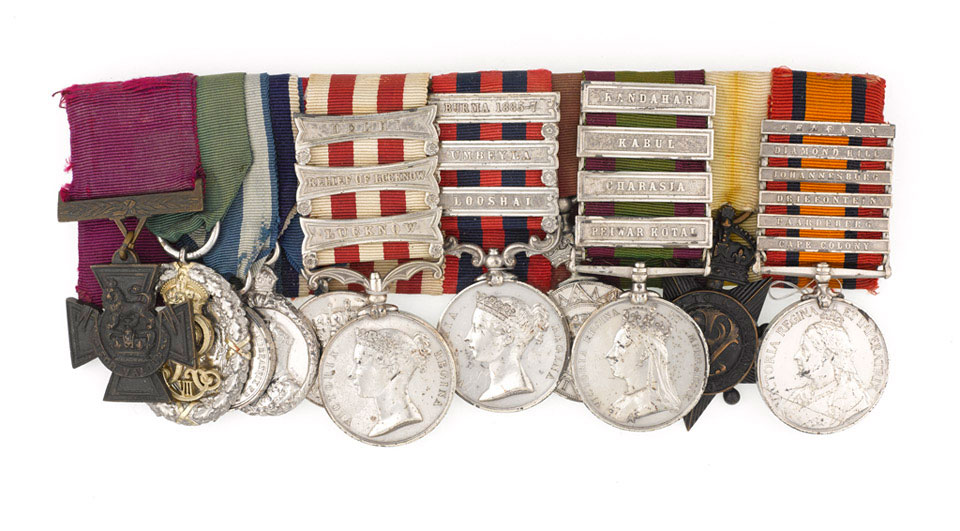
[Image number: 156589]
However, strain and overwork were beginning to tell on Roberts. Following the fall of Lucknow in March he continued on with Campbell’s force but finally on 1 April 1858, placed on the sick list, he made over his position of DAQMG to Garnet Wolseley. It was a disappointed young man who left Calcutta and returned home to England.
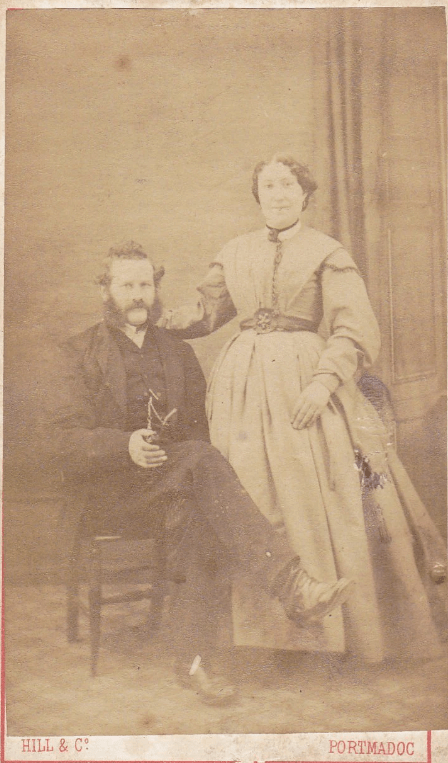
He spent his sick leave, for the most part, at his father’s home in Ireland, where he chanced to meet Nora Bewes, the daughter of Captain John Bewes of the 73rd – she would accompany him back to India and stay by his side for the next 55 years. On June 8, three weeks after his marriage, he presented his VC by Queen Victoria at Buckingham Palace. In July 1859, with his leave over, Roberts set his sights once again on India. On his arrival, it was first intended that he return to active service under Robert Napier in Central India, but Lord Canning was planning his triumphant march through India, and as such, it would be Roberts who would accompany him. Again, he was tempted to leave the quartermaster general’s department for a lucrative position in the revenue department, but it would have meant bidding goodbye to soldiering, something Roberts was loath to do. So it was off with Canning to look after the pageantry through the lately mutinous districts. “The gigantic procession was one of the most imposing ever seen in India. Lord Canning was accompanied by a strong escort of artillery, cavalry, and infantry. This was, however, but a small part of the great pageant. A long line of camels, bullocks, and elephants extended for miles along the dusty road. An endless throng of coolies toiled among them, carrying portions of the camp equipment. Where native soldiers or servants went, their families had to go too, and women and children trod through the dust, or were borne on the baggage accompanying Lord Canning’s procession. At least 20,000 people were in the column on this peaceful march on the shot-scarred city that had made so many heroes. For all this vast crowd Frederick Roberts had to make provision. It was hard work, but it was an excellent training for the career he was entering on. Every detail of army life was being opened up to him, and to be a successful commander-in-chief and administrator, this wide knowledge was a very necessary thing.” (Marquis)
Following this tour and further smaller ones, he returned to Simla and became immersed in the mammoth task of reorganising the army, now that the EICo had ceased to exist. He was promoted to second captain in 1860 and to brevet major. In 1861, he transferred to the British Army and would see active service again in the Umbeyla and Abyssinian campaigns of 1863 and 1867-1868, respectively. He fought his way through the Lushai campaign of 1871-1872 and on 5 July 1872 was promoted to major, receiving his CB the same year. In 1875, he was appointed Quartermaster General of the Bengal Army. The command of the Kurram Valley Field Force in 1878 was given to Roberts, and he saw action again in the Second Afghan War, securing himself the thanks of Parliament and the rank of Major General the same year. The KCB followed in 1879.
The murder of the British envoy to Kabul, Sir Louis Cavagnari, set off the second phase of the war. Roberts was placed in command of the Kabul Field Force to give the Afghans another what for – unfortunately, his force was besieged in Sherpur Cantonment outside Kabul – although he raised the siege himself and reoccupied the city, Lieutenant General Sir Donald Stewart arrived from Khandahar in May 1880 to take the Kabul command from Roberts. Nothing, however, is simple in Afghanistan. The Battle of Maiwand saw the defeat of the British brigade, and Roberts was again appointed commander, this time of the Kabul and Kandahar Field Force. With 10,000 troops, he marched across the devilish terrain and fought the Battle of Kandahar, where he defeated Ayub Khan on 1 September 1880. With another thanks from Parliament and the GCB, Roberts was appointed CIE the same year.
Then it was off, albeit briefly, to Africa. Roberts served as the Governor of Natal and Commander-in-Chief of the Transvaal Province and High Commissioner for South Eastern Africa, all to take effect from March 1881, but he became a baronet in June and was offered the position of Commander-in-Chief of the Madras Army in November, which finally culminated in his appointment to C.-in-C. of India in 1885. In 1892, now General Roberts, he was created Baron Roberts of Kandahar and of the City of Waterford. He finally relinquished his command in India in 1893 as Knight Grand Commander of the Order of the Star of India and left the subcontinent behind him for the final time, after 41 years of service.
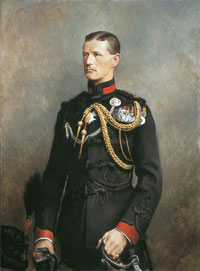
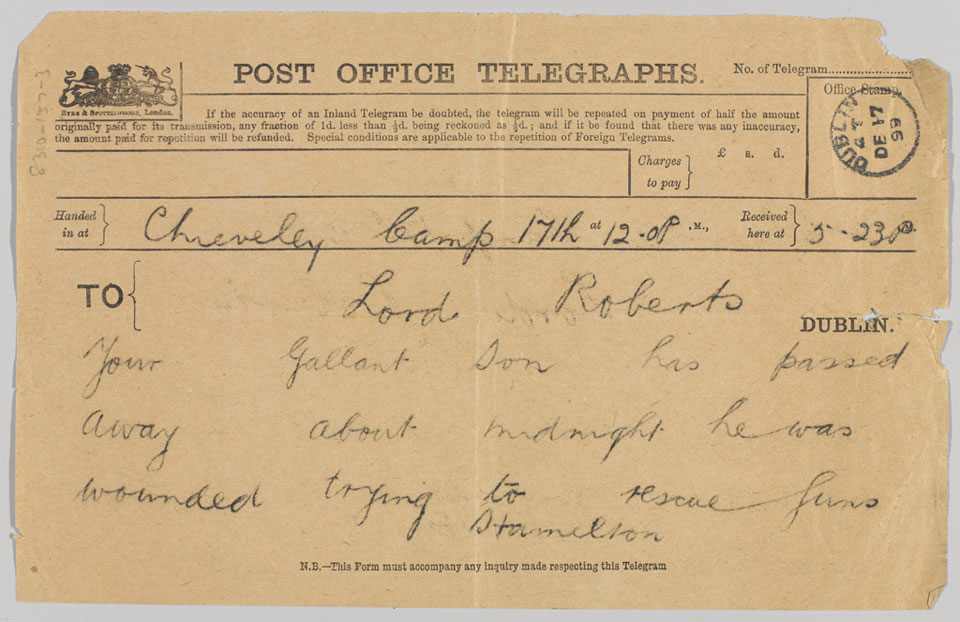
He settled himself in Ireland as Commander-in-Chief of the British forces, was promoted to field marshal in 1895 and finished writing his two-volume autobiography, “Forty-One Years in India: from Subaltern to Commander-in-Chief.” However, war was never far behind, and in 1899, he returned to South Africa with his chief of staff, Lord Kitchener, to command the British forces during the 2nd Boer War. His eldest son, Frederick Hugh Sherston, would receive his Victoria Cross posthumously for his actions during the war. He died of his wounds, just aged 27.
[Image number: 132795]
After the disastrous actions in the Boer war in South Africa in December 1899 at Magersfontein, Stormberg and Colenso, where his only son was killed, Lord Roberts was sent out as Commander-in-Chief. He arrived at Cape Town on the 10th of January 1900, and after organizing his force, advanced with sound strategy on Bloemfontein, the capital of the Orange Free State, and soon changed the aspect of affairs. The sieges of Kimberley and Ladysmith were raised, and the Boer general Cronje, flying towards the capital, was overtaken at Paardeberg and, after a fine defence, compelled to surrender, with 5000 men. on the anniversary of Majuba Day, the 27th of February 1900. Roberts entered Bloemfontein on the 13th of March, and after six weeks’ preparation, advanced on Pretoria, the capital of the Transvaal. Mafeking was relieved on the 17th of May, and Pretoria occupied on the 5th of June. The two Boer states were annexed, and the war gradually assuming a guerilla character, Roberts handed over the command to Lord Kitchener and returned to England to fill the office of Commander-in-Chief of the Army in succession to Lord Wolseley. (Orans)
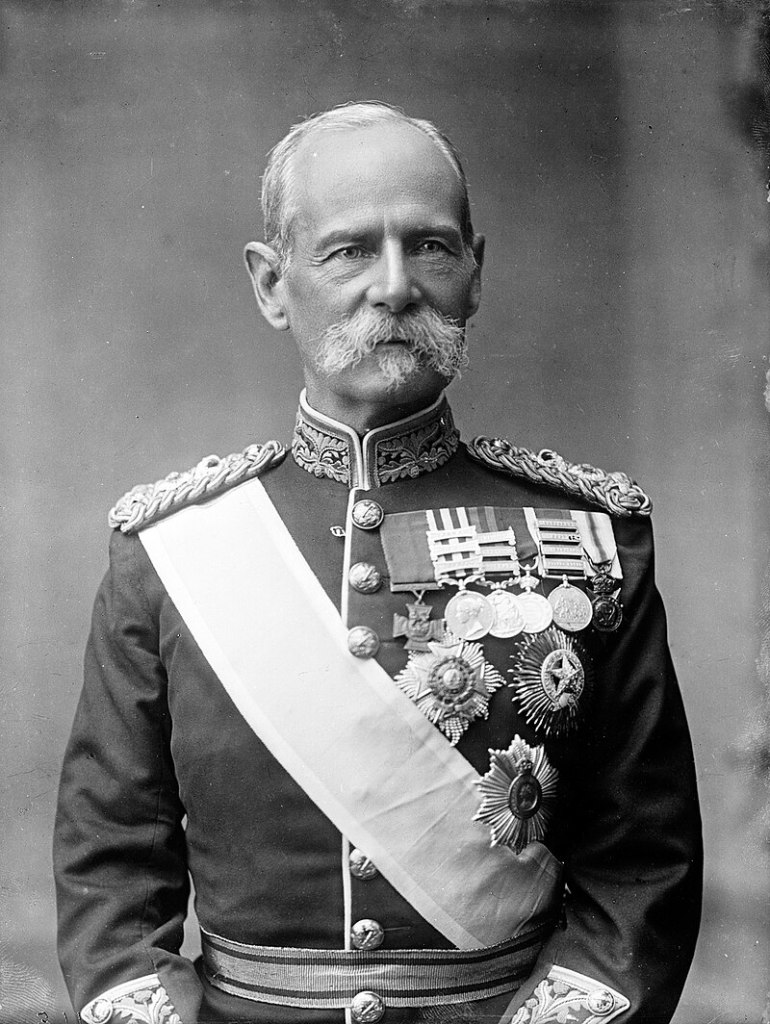
The Earl Roberts
VC KG KP GCB OM GCSI GCIE VD PC FRSGS
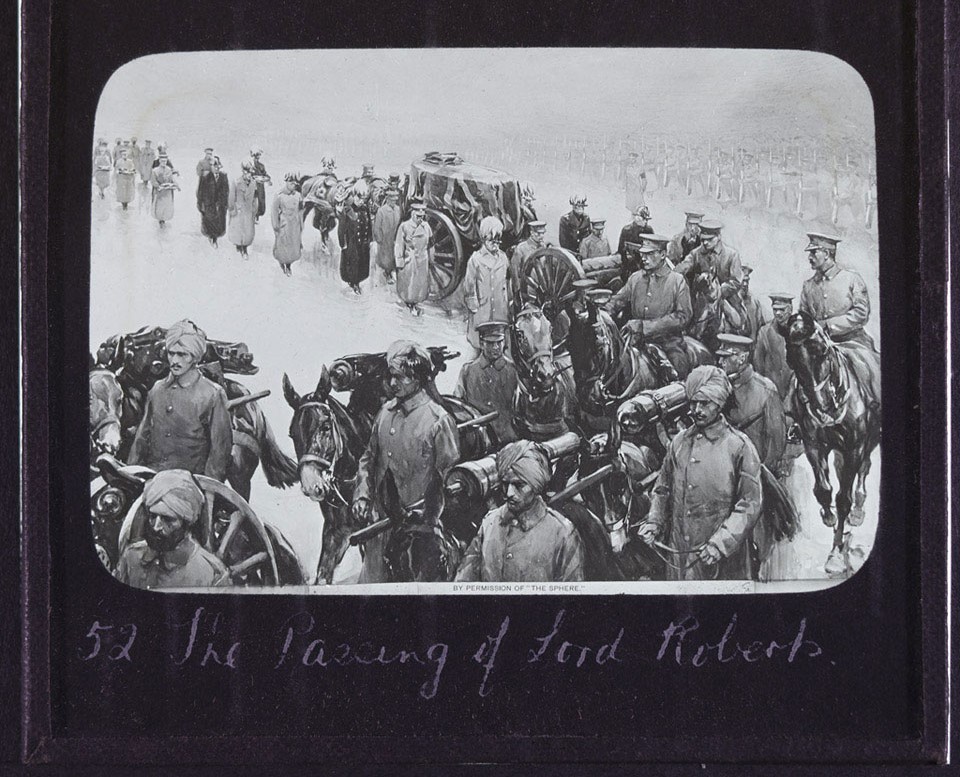
By nature, Roberts was a kind, courteous and unassuming man, well-loved by the troops – he was very popular with the British public at large and became widely known by his nickname, ‘Bobs.’ His long life came to a close in 1914 when he died of pneumonia at St Omer, France while visiting the Indian troops serving in the 1st World War. His body was brought back to England where it lay in state in Westminster Hall before its final interment in St. Paul’s Cathedral. He was survived by his two daughters, Aileen Mary and Ada Edwina. As his son had died the barony and baronetcy became extinct on Roberts’ death but by a special remainder granted in them, he was succeeded in the earldom and viscountcy by his eldest daughter.
Bobs
There's a little red-faced man,
              Which is Bobs,
Rides the tallest 'orse 'e can-
              Our Bobs.
If it bucks or kicks or rears,
'E can sit for twenty years
With a smile round both 'is ears-
              Can't yer, Bobs?

Then 'ere's to Bobs Bahadur -
              little Bobs, Bobs, Bobs!
E's our pukka Kandahader-
              Fightin' Bobs, Bobs, Bobs!
E's the Dook of Aggy Chel;
E's the man that done us well,
An' we'll follow 'im to 'ell
              Won't we, Bobs?

If a limber's slipped a trace,
              'Ook on Bobs.
If a marker's lost 'is place,
              Dress by Bobs.
For 'e's eyes all up 'is coat,
An' a bugle in 'is throat,
An' you will not play the goat
              Under Bobs.

E's a little down on drink,
              Chaplain Bobs;
But it keeps us outer Clink
              Don't it, Bobs?
So we will not complain
Tho' ‘e’s water on the brain,
If 'e leads us straight again-
              Blue-light Bobs.

If you stood 'im on 'is head,
              Father Bobs,
You could spill a quart of lead
              Outer Bobs.
'E's been at it thirty years
An-amassin' souveneers
In the way o' slugs an' spears-
              Ain't yer, Bobs?

What 'e does not know o' war,
              Gen'ral Bobs,
You can arst the shop next door-
              Can't they, Bobs?
Oh, 'e's little but he's wise,
'E's terror for 'is size,
An–'e-does-not-advertise-
              Do yer, Bobs?

Now they've made a bloomin' Lord
              Outer Bobs,
Which was but 'is fair reward-
              Weren't it, Bobs?
So 'e'll wear a coronet
Where 'is 'elmet used to set;
But we know you won't forget-
              Will yer, Bobs?

Then 'ere's to Bobs Bahadur-
              little Bobs, Bobs, Bobs,
Pocket-Wellin'ton 'an arder
              Fightin' Bobs, Bobs, Bobs!
This ain't no bloomin' ode,
But you've 'elped the soldier's load,
An' for benefits bestowed,
              Bless yer, Bobs!

                                         - Rudyard Kipling
[Image number: 123510]
Sources:
Brooke-Hunt, Violet. Lord Roberts: A Biography. London: George Bell & Sons, 1901.
Forrest, George. The Life of Lord Roberts, K.G., V.C. London: Cassell & Co. Ltd., 1914.
Jerrold, Walter. Lord Roberts of Kandahar, V.C.: The Life-Story of a Great Soldier. London: S.W. Partridge, 1900.
Marquis, T. G. Earl Roberts, V.C., Lord Kitchener & the Great Boer War. Toronto: Roberts & Kitchener Publishers, 1936.
Roberts, Fred. Letters Written During the Indian Mutiny. Preface by Countess Roberts. London: Macmillan & Co., Ltd., 1924.
Roberts, Frederick Sleigh. Forty-One Years in India: From Subaltern to Commander-in-Chief. 2 vols. London: Macmillan & Co., Ltd., 1901.
Wheeler, Harold F. B. The Story of Lord Roberts. London: George G. Harrap & Co., Ltd., 1915
 Mutiny Reflections