The Battle of Cawnpore
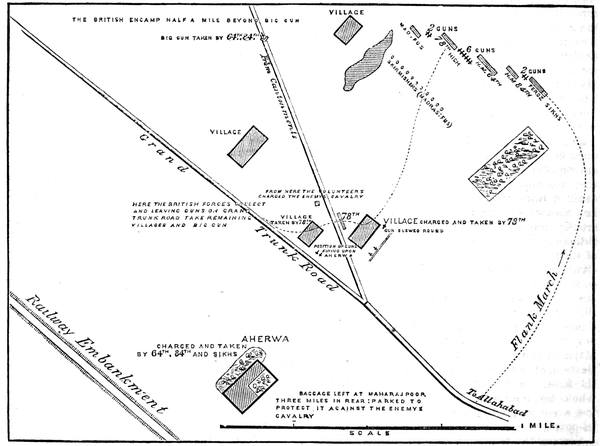
16th. “We left the Camp at 1 p.m and fell in with the enemy, who consisted of upwards of 9000 men. After 4 hours of fighting, we drove them from their different positions and captured 9 guns. As it was getting dark, we halted 3/4 of a mile from Cawnpore and as the baggage was not up, we were obliged to sleep upon the bare ground all night, without food and our arms by our side, as we did not know when we should be attacked. We were all thoroughly knocked up as we had marched night and day. At the first charge, the brutes all ran away, and I was very nearly knocked up by running, when I came upon some muddy water which was in a rut made by cart wheels, and I thought I never tasted anything so delicious. Of my Regiment one man was killed and 15 wounded. On the 14th our Major – Major Renaud – was wounded and it is feared he will lose his leg. It is really quite wonderful how one escapes. At one time were lying down, the enemy were pouring in shot in our front and rear.” (Letter 6, Lieutenant William Hargood)
On the morning of the 16th of July, with Havelock across the river and marching steadily towards Cawnpore, Dandu Pant – the brother of Nana Sahib – took to the field. With him went 5000 men of horse, foot and artillery to welcome the general in the best style they could manage. He selected an excellent position to make the opening salvos tell and all morning his lieutenants busied themselves, placing their guns and moving their troops. If Havelock wanted Cawnpore, he would have to fight for it – and had it been another general, one less read than Havelock, the Moveable Column might never have set foot in the wretched city.
“The bugle notes rang clearly out, through the mango groves on the Pandoo Nuddee, and wakened the weary soldiers long ere the morning of the 16th was grey…They knew the road was long and the fields of maize were heavy and soft. They knew the rain would fall in torrents or the sun would beat on them with scorching heat. They knew that many times their number of well-armed men stood between them and those whom they hoped to save…”
And so they marched towards Cawnpore, still unaware that “those whom they hoped to save” were beyond their help. Instead of the torrents of rain a monsoon provides, they were obliged to greet the fierceness of the Indian sun – at noon, now 6 miles from Cawnpore, Havelock ordered a halt that the village of Maharjpore. Here he waited for his spies to return.
They came and told Havelock the Nana had taken a very strong position at the junction of the roads leading to the city where his whole force was now drawn up. They were hastily building earthworks across the road and posting their guns behind them – a warm welcome indeed. It was clear Havelock was not facing a mindless rabble but leaders of some skill, whoever they might be and for a moment, Havelock had to recall to his mind all he had read of the art of war.
“To Havelock’s Column advancing along the great high road from Allahabad – to the point where it diverges into two broad thoroughfares, on the right to the Cawnpore cantonment and on the left, the grand trunk to Delhi – the sepoy forces presented a formidable front. it was drawn up in the form of an arc, bisecting these two roads. Its left, almost resting upon the Ganges, had the advantage of some sloping ground, and which heavy guns were posted; whilst its right was strengthened by a walled village with a great grove of mango trees, which afforded excellent shelter to the rebels. Here also heavy guns were posted. And on both sides were masses of infantry, with the 2nd Cavalry in the rear, towards the left centre, for it was thought Havelock would advance along the Great Trunk Road.”
Realising it would be madness if not simply suicidal to attempt a frontal attack and not able to rely only on Maude’s guns and Enfield Rifles to clear the way as he had been doing so until now, Havelock remembered, “old Frederick at Leuthen” (viz, an oblique formation of attack, to deliver an assault on the flank of the enemy army. It worked for Frederick the Great and in a modified form, for Havelock, nearly 100 years later). Havelock called together his commanders and explained his plan of attack as his spies quickly drew in the dust “a clever sketch” of the enemy’s position. Pointing to it with his scabbard, Havelock went through the plan of operations and then asked if they understood what he wanted from them. He asked for recommendations, even for improvements but as Maude writes, “his dispositions appeared to us to be admirable.”
At Maharajpore Havelock left his sick, wounded and baggage. One young man, William Tate Groom of the 1st Madras Fusiliers refused to be left behind. Sick from the effects of the sun, Groom had been placed on the sick list but after some heavy pleading with the surgeon, he was allowed, carried in a doolie, to go and watch the fight.
After the men had received their refreshment which included a good portion of Dutch courage in the form of malted liquor, the advance began. They had not gone 500 yards when Maude observed men falling out, lying down on the side of the road, thoroughly done up by the heat. Several of them died from sun-stroke, while others, unable to stagger back to the baggage would later be cut to pieces by the enemy cavalry who came down when Havelock made his flank movement.
They moved forward in column of subdivisions, the Fusiliers in front, followed by two guns, then the Highlanders in the rear of whom were the 6 guns of Maude’s battery. The 64th and the 84th had two more guns in their rear and the Ferozepore Sikhs closed the column. They marched along the road until they came to the divergence. Here the Volunteer Cavalry was ordered to move right to engage the enemy – a ruse to make them believe Havelock was proceeding straight ahead, while the Infantry and the guns, favoured by a forest of trees, moved unseen to the right. While the cavalry continued to draw the fire onto themselves, Havelock’s plan suddenly became clear to the rebels. Observing the movement of the infantry and the guns through an opening in the trees the Nana’s guns opened fire on the advancing columns, raking the 78th Highlanders and the 64th with terrible effect. However, Havelock had managed to turn their left flank.
Maude and his artillery were now at the 900-yard range and commenced to counter the rebel guns on the left. Unfortunately, as these were well protected by the earthworks the rebels had succeeded in erecting, and hidden by a tope of trees, it was hard work for the artillery to silence them. He observed the gunners always ran away from the guns when Maude fired at them; then as soon as they saw him limbering up, they returned and commenced blazing away again. When Maude finally managed to silence their guns, he advanced again, to engage the batteries on the far right, which also happened to be covered by trees. It only took four rounds and the battery was abandoned, the gunners either dead or fleeing. Maude rode up to the guns with the 64th Regiment, straight into the tope and was greeted by a sharp musketry fire – this time from the railway embankment. The rebels had fallen back into a deep ditch between the advancing force and the railway. Calling on the aid of some of the 64th, Maude turned the enemy’s guns on themselves causing the men to disperse with all speed, out of range of what were now Maude’s guns. Calling on a gunner to spike the pieces, Maude moved onto the main road.
Maude halted on the main road, which was to the right. As he halted, up rode Colonel Fraser-Tytler with orders for Maude to form up his battery in line on the road and then stop, as this would be the middle of their camp. The infantry, he said, would advance up and clear a village in front but they were expected then to return and form camp where Maude was standing. As soon as Tytler left, Maude started moving his guns when he was suddenly attacked by rebel cavalry, charging from both sides – they came so close Maude was forced to bring his flank guns into action, right and then left. At the same time, firing started up in his rear coming from the enemy infantry now positioned on the railway embankment. Within a half hour, two of the rebel guns commenced firing at his left front and Maude directed three of his guns to face them, at 1500 yards. “..we were actually facing towards all four points of the compass at the same time, while being utterly without support.” The order to advance did not please Maude, no matter his situation. With his men and artillery bullocks exhausted, the captain hesitated to comply. Turning to Stuart Beatson (DAAG) who, suffering from cholera was lying on one of the wagons, Maude asked him what he should do. Beatson replied he should wait a little but no sooner had he said it, up rode Lieutenant Hargood.
The infantry were terribly pressed and to provide them with support, Maude needed to move, now. He added he had canvassed a good piece of road, easier for artillery – Maude limbered up and, following Hargood, plunged straight into the mud. The cavalry, in the meantime, did not do what Maude expected – they could have at any moment stormed his post and captured all eight guns but they let Maude advance.
He arrived in time to provide much-needed succour to the infantry, a handful of whom were facing off against the rebels who were reforming in order. Quickly, Maude managed to get clear of the men in time to fire a few shots in their direction, emptying a few cavalry saddles in the bargain. The rebel infantry, unable to advance in the face of his guns, broke and ran.
The Highlanders and the 64th had to advance in the devastating fire of the rebel guns in the first few minutes of the battle. As the last subdivisions came out of the woods, they were quickly wheeled into line and now to the irritation of the rebels, moved forward. Maude at that time was nowhere near ready to provide any support; his guns were struggling through the soft ground and when he finally could come up to fire, he was hardly a match for the heavy ordnance of the Nana Sahib. Therefore, at least for a moment, the sepoys rejoiced at what looked like would be their victory over General Havelock. Above the booming of the guns, the British could hear the enemy’s regimental band striking up well-known tunes, a mockery of everything the sepoys had been taught. What the sepoys had not bargained with as the might of an English soldier, fueled by alcohol, resolute and angry, “the teeth clenched and muscles strung, and the heart as hard as a stone.” When the band struck up “Cheer Boys Cheer” the infantry had had enough. The 78th Highlanders, led by Colonel Hamilton, took up the position of honour and charged the guns. In the din, the pibroch from the bagpipes rang out, the shrill sound propelling the men forward, bayonets fixed. No sound came from them – they were a terrifying living wall the rebels had never before seen and amongst them, there was not a single man who would stand. They turned and fled in confusion as the Highlanders carried their guns.
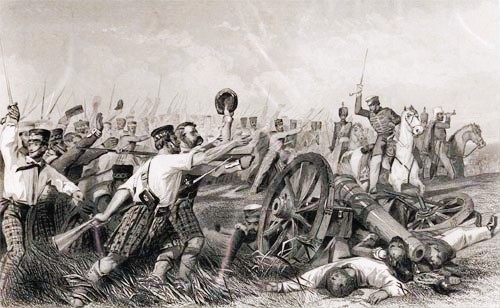
“The opportunity had arrived,” says Havelock, ” for which I have long anxiously waited, of developing the prowess of the 78th Highlanders. Three guns of the enemy were strongly posted behind a lofty hamlet, well entrenched. I directed this regiment to advance, and never have I witnessed conduct more admirable. They were led by Colonel Hamilton and followed him with surpassing steadiness and gallantry under a heavy fire. As they approached the village they cheered and charged with the bayonet, the pipes sounding the pibroch. Need I add that the enemy fled, the village was taken, and the guns captured.”
Throughout, Havelock was with them. As they came to a halt, he called out,
“Well done 78th. You shall be my own regiment. Another charge like that will win the day.”
Behind them came the 64th, charging a village on the left and firing four volleys as they rapidly advanced up the sloping ground, capturing another three guns. Everywhere, the rebels appeared in full retreat. Havelock ordered the fire to cease when a 24-pounder opened up on the Cawnpore road causing considerable loss among his men. Under cover of its fire, the cavalry rode over the plain, rallying the rebel infantry. Havelock looked about in consternation – Maude was struggling to bring up his guns while the 1st Madras Fusiliers, 64th, 84th and 78th detachments, formed up in line were exposed to the galling fire of the 24-pounder.
“I was resolved this state of things should not last, so, calling upon my men, who were lying down in line, to leap on their feet, I directed another steady advance. It was irresistible. The enemy sent round shot into our ranks until we were within 300 yards, and then poured in grape with such precision and determination as I have seldom witnessed. But the 64th, led by Major Stirling and my aide-de-camp, who had placed himself in their front, were not to be denied. Their rear showed the ground strewed with wounded; but on they steadily and silently came, then with a cheer charged, and captured the unwieldy trophy of their valour.”
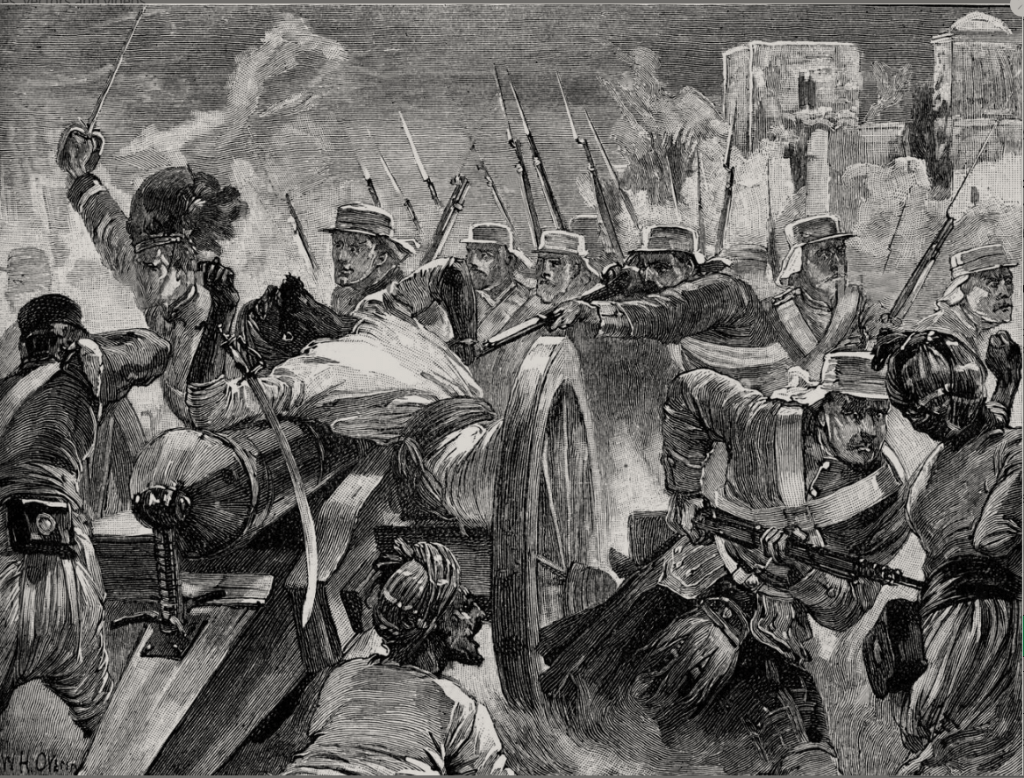
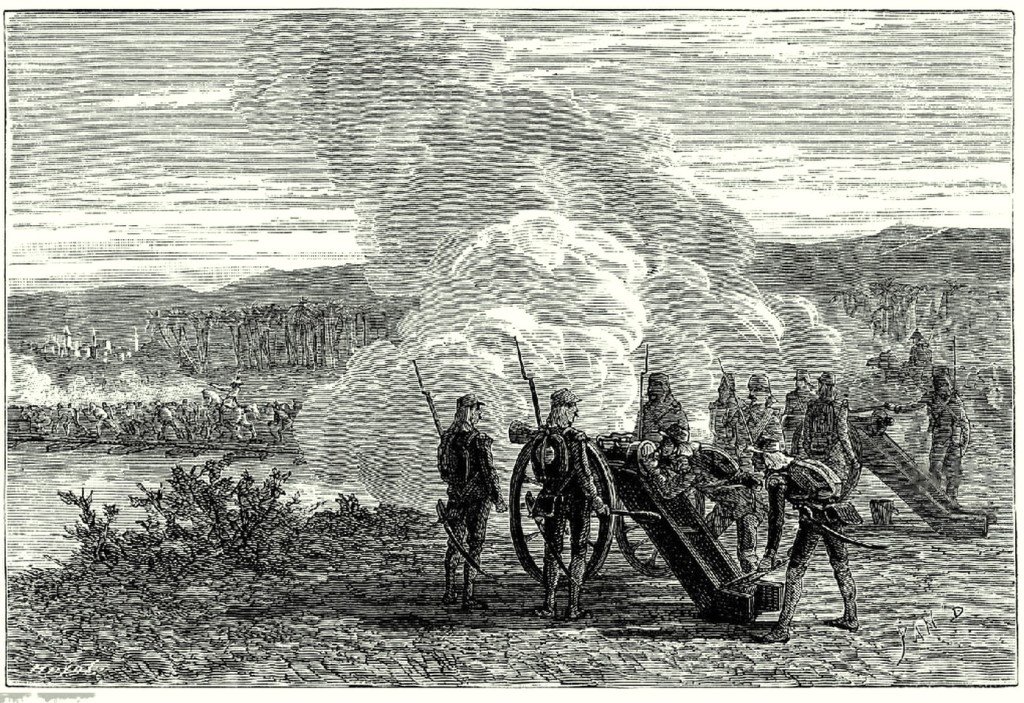
After a last hurried fire of musketry, the rebels lost heart and gave way to a complete rout, with four of Havelock’s guns chasing them off with a final heavy cannonade. Cawnpore had been won by 1000 European troops and 300 Sikhs.
The bugles sounded, and the men fell out, exhausted. The wounded were gathered together and dead comrades sought for along the route of the battle in the growing dusk. Sentries were told off for their nightly watch and soldiers settled down to sleep as best they could, without covers, on hard ground. Havelock retired to pen his General Orders, to be issued the next morning.
“”Cawnpore, won by Lord Lake in 1803, has been a happy and peaceful place ever since, until the wretched ambition of a man, whose uncle’s life was, by a too indulgent Government spared, in 1817, filled it, in 1857, with rapine and blood shed.
When, soldiers, your valour won the bridge at the Pandoo Nuddee, you were signing the death warrant of the helpless women and children of your comrades of the 32d. They were murdered in cold blood by the miscreant, Nana Sahib, whose troops fled in dismay at the victorious shout of your line, on the evening of the memorable 16th .
“Soldiers! Your General is satisfied, and more than satisfied with you. He has never seen steadier or more elevated troops, -but your labours are only beginning. Between the 7th instant and the 16th, you have, under the Indian sun of July, marched 126 miles, and fought four actions: but your comrades at Lucknow are in peril. Agra is besieged; Delhi still the focus of mutiny and rebellion. You must make great sacrifices if you would obtain great results. Three cities have to be saved; two strong places to be disblockaded. Your General is confident that he can effect all these things, and restore this part of India to tranquillity if you only second him with your efforts; if your discipline is equal to your valour…”
The next day, Havelock entered Cawnpore.
Sources:
Annand, A. McK. “The Indian Mutiny Letters of Lieutenant William Hargood, 1st Madras Fusiliers.” Journal of the Society for Army Historical Research 43, no. 176 (December 1965): 190–215. https://www.jstor.org/stable/44226401.
Brock, William. A Biographical Sketch of Sir Henry Havelock, K.C.B. London: James Nisbet and Co., 1858.
Groom, William Tate. With Havelock from Allahabad to Lucknow, 1857. Edited by Helen M. I. Groom. London: Sampson Low, Marston & Company, 1894.
Headley, J. T. The Life of General H. Havelock. New York: Charles Scribner, 1861.
Malleson, G. B., ed. Kaye’s and Malleson’s History of the Indian Mutiny of 1857–8. Vol. 2. London: Longmans, Green, and Co., 1892.
Marshman, John Clark. Memoirs of Major-General Sir Henry Havelock, K.C.B. London: Longman, Green, Longman, and Roberts, 1860.
Maude, Francis Cornwallis. Memories of the Mutiny. Vol. 1. London: Remington & Co., 1894.
My Journal, or What I Did and Saw Between the 9th June and 25th November, 1857: With an Account of General Havelock’s March from Allahabad to Lucknow. By a Volunteer. Calcutta: Baptist Mission Press, 1858.
Sherer, J. W. Havelock’s March on Cawnpore, 1857: A Civilian’s Notes. London: Thomas Nelson & Sons, 1910.
 Mutiny Reflections