Poor Colonel Platt – The Mhow Uprising
For the events at Mhow, we must now return to the 1st of July.
The message from Durand reached Colonel Platt at 10 o’clock in the morning. It was a hurried note, stating, “ Send the European Battery as fast as you can. Wo are attacked by Holkar.”
Platt had heard firing in the distance coming from Indore, but until the note arrived, he had no idea what had happened. He immediately turned the battery out, with two men told off as escorts for each gun and wagon; they were further armed with muskets and mounted on the limber boxes. The affair would have taken longer to organise had Captain Hungerford not turned out his guns earlier and parked them in front of the barracks and organised a nightly guard of men with their horses harnessed, ready to move out.
Hungerford left Mhow at about half-past eleven. The battery had advanced halfway to Indore and had stopped at Rao when a sowar rode up to him with a note in pencil from Colonel Travers stating, “ We are retreating on Simrolw on the Mundlaysar road from Indore.’’ The sowar hastily added that Colonel Durand and the officers and ladies were with Colonel Travers, and Colonel Durand would not retire on Mhow, as Mhow was in Holkar’s territories, and he anticipated the station would be attacked by Holkar’s troops either that night or the following morning. “There being no road to Simrole which I could follow, the battery was brought back to Mhow as quickly as possible.”
Back at Mhow, Platt dispatched two flank companies of the 23rd BNI under the command of Captain Towers and Lieutenant Wesmacott down the Bombay road. They were to bring back to Mhow two of Holkar’s brass nine-pounder guns, which had passed through the station two hours earlier. A troop of 1st Light Cavalry was sent under Captain Brooke and a subaltern to overtake the guns -they charged and captured them. By 3pm, the guns were brought into the fort at Mhow, at the loss of a few of Holkar’s gunners who had valiantly protected the guns to the last.
Colonel Platt, still convinced of the loyalty of the 23rd, who he believed were “khoosh and willing,” devoted himself to defending the cantonments from what he supposed would be an attack from Indore. A picquet of Light Cavalry was sent five miles on the Indore road under two lieutenants, and another of 50 sepoys under Lieutenant Simpson was sent to the north of the cantonments, near a ravine.
Captain Hungerford later wrote, “Colonel Platt met me on reentering cantonments I gave him Colonel Travers’ note, and told him what the sowar had said, requesting permission at the same time to take my battery into the Fort, as the Fort could be defended for any length of time. Colonel Platt would not hear of it. At the artillery barracks, all the wives and families of officers and men had taken refuge. The barracks could not be well defended from their extent and position. I urged repeatedly on Colonel Platt, during the afternoon, the advisability of defending the Fort, but only at the very last moment could he be persuaded to allow me to enter it. At half-past 6 pm. Colonel Platt rode down to the artillery barracks and told me to enter the Fort.”
Platt ordered all the officers to remain in the lines with their men through the night, ready to turn them out at a moment’s notice and keep them under arms. He also increased the arsenal guard to 50 men of his own regiment- everything was ready, in Platt’s estimation, to meet the rascals from Indore. Not everyone shared Platt’s conviction.
Captain Trower of the 23rd tried to warn Platt something was wrong with the regiment. The men were collecting in groups, muttering, some of them clutching their muskets- Trower went to warn Platt, but the poor colonel, besotted with his regiment as he was, thanked the captain and sent him on his way.
At 9.30pm, the officers of the 1st Light Cavalry, having dined at their mess, went to their lines. Captain Brooke and Lieutenant Chapman, whose tent was pitched close to the main guard, tried to get some sleep. Suddenly, at 10 pm, a small bungalow close by burst into flames. Brooke’s companion got up and went to see what was happening. On reaching the guard, he found Lieutenant Martin, the Adjutant, in animated conversation with the guard.
“I joined him and observed one man in my troop — a villain; he had his carbine and began to cavil with Martin about some men Brooke and I had killed in the morning. I, feeling sleepy, said to Martin, ‘ I’ll turn in,’ but good God! -I had hardly turned my back and got to Brooke’s side when an awful shriek arose from the men, and the bullets whizzed round us in torrents.”
Chapman leapt out of his tent and saw Martin running across the parade ground towards him and Brooke. With the thought that their last moment on earth had indeed come, the three men ran for it – the fort was a mile off.
“I led to the fort, a mile off. The men kept following us, and the bullets fell thick. Having got across the parade ground about 500 or 600 yards, we came to the hill with the church at the top, and when at the top, Martin caught hold of me exclaiming, ‘ For God’s sake stop! ’ I caught hold of his arm and said, * Only keep up and follow,’ but at this moment, I felt I was done. “We parted, as I thought, only to meet in death.” Brooke and Chapman rushed on. “ By this time, the infantry had all risen, and as I ran, the ground was torn up with bullets, and they fell thick around me. Their lines were in a direct line between the fort and ours so that we poor fellows had to run the gauntlet of both fires.”
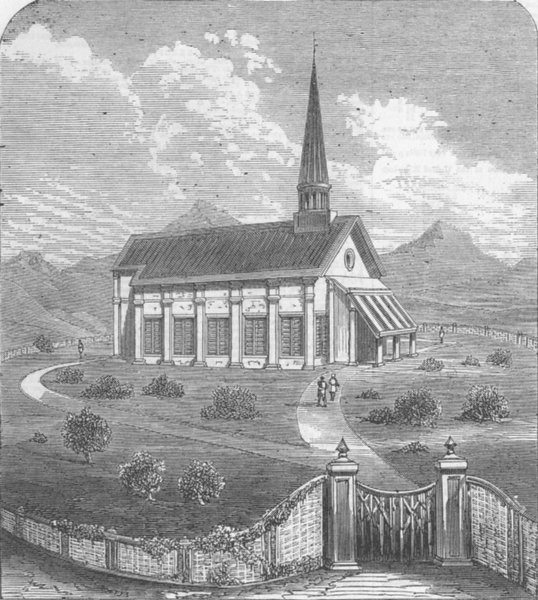
The church was not damaged during the uprising and only the outhouse of the chaplain was burned.
Chapman, about a quarter mile from the fort, ran up to a bungalow; two Indians were standing outside it. The subaltern “simply took their hands, barely able to speak, and said, ‘Save me.’ They did – to them, I owe my life. ”
Bundling him inside, the infantry hard on his heels, they hid him as best they could. Some sepoys came to the door but did not see him- when they had passed, his friends disguised him in their clothes and thus attired, Chapman ran the rest of the way to the fort. “ Can I ever make you feel the deep thankfulness that was in my heart as I ran across the open plain -up the hill to the fort. The artillerymen were manning the walls, and the sentry’s call was never more thankfully received; and I cried friend I friend ! and found myself inside.” Brooke and Martin, too, and they were soon drawn in over the walls of one of the bastions. Shortly after, the riding master arrived, exhausted but unhurt.
As for the loyal 23rd BNI, we shall now see how they behaved.
The officers of the 23rd had dined that night close to the lines in the house of the Sergeant-Major. After dinner, they sat outside, enjoying the cool night breeze for some time and then made off to their beds in their bell tents, positioned in the lines of each of their companies. “As they were moving away, someone said, ‘The report is, the regiment will rise at ten tonight.’ The major answered, ‘Oh, very well; let’s wait and see.’ The words were hardly said when they heard shots from the cavalry lines. They rushed towards their companies.
“Several of them, thinking an attack was made by Holkar’s troops, rushed to the quarter guard and to their own companies to turn their men out to repel it, but the true state of the case soon became evident. The men were not only deaf to their officer’s orders but fired at them as they were standing in front of the lines, and soon the whole parade ground was whistling with bullets fired from every direction. Nothing could now be done, and the officers made their escape to the arsenal, fired on as they went by the men. None of them were, however touched.”
All they received were shots, forcing the officers to retreat in haste to the fort. When they arrived, they found that Colonel Platt first ordered the native guard disarmed and marched out of the fort, and then ordered Hungerford’s battery to turn out. He then called on his officers to follow him back to the lines of the 23rd and try to calm the men. Futility, in this case, can be named Platt.
The colonel was followed by his adjutant, Captain James Fagan, who, having already been obliged the run the gauntlet once that night, nevertheless mounted his horse, remarking only that it really was too late. Platt replied, “You are the man I always took you for.” They rode out of the gates to the lines of the 23rd. Hungerford dismissed the guard as Platt had ordered and then organised his battery.
Within half an hour, the battery moved out. The horses were tired from the morning’s exertions, and several drivers had absconded. As it advanced up the infantry parade ground, they sustained some fire, but they could not see where the shots were coming from. As it was, there was not a mutineer to be seen. The bungalows, burning luridly, illuminated their way, but the sepoy’s huts were quiet and dark. Hungerford halted the battery opposite the centre of the infantry lines to wait for Platt and Fagan. There was no sign of them, and again, the sepoys opened fire. Hungerford unlimbered his guns and fired several rounds of grape and round shot straight into the lines.
“There was some groaning and noise, but nothing visible, and in a few minutes, everything was perfectly quiet,” he observed. By now, without anyone noticing, after Hungerford had fired on them, the whole of the cavalry had trotted away in regular order and was on the road to Indore; behind them, fleeing in some disorder, were the infantry. Hungerford returned to the fort. There was still no sign of Colonel Platt or Captain Fagan, and Major Harris of the cavalry was missing.
The Fort at Mhow
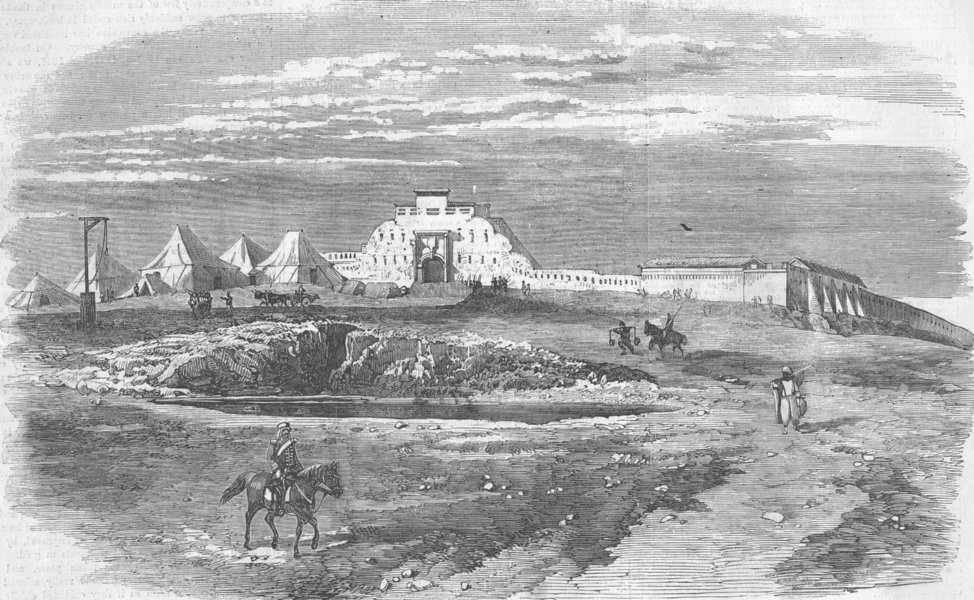
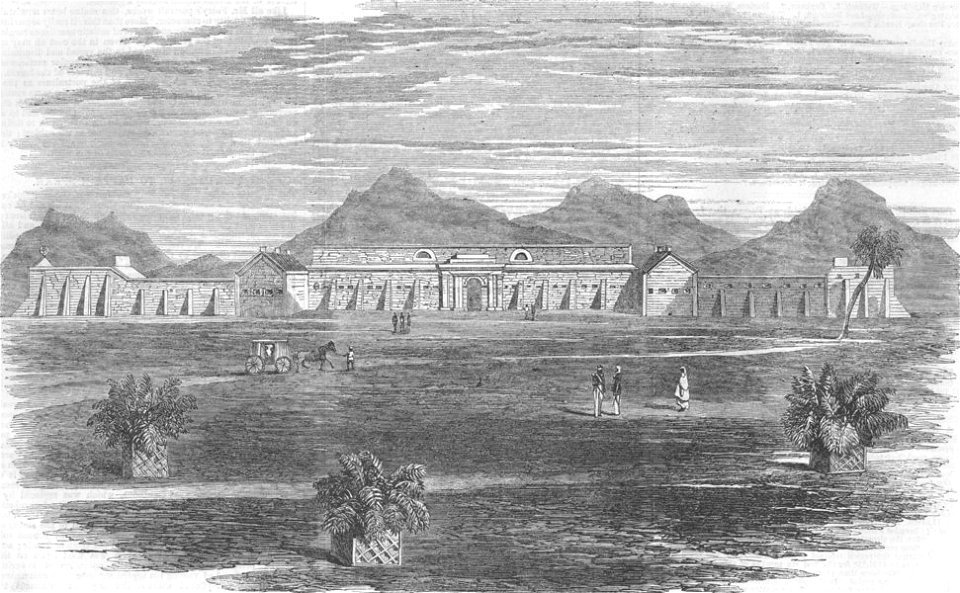
Early the next morning, an officer, who had spent the night hiding in the bazaar, crept up to the fort. On being let in, he told Hungerford that Platt, Fagan and Harris were lying dead. Platt and Fagan had been killed in the lines of the 23rd and Harris on the road, shot by his own men. A detachment, supported by 2 guns with European gunners, escorted by a small party of volunteers and led by Captain Brooke, was dispatched to look for the bodies. It did not take long to find them. He, Fagan and one Indian officer were found lying on the parade ground in front of the bell of arms, next to their dead horses. Brooke was the first to find Platt.
“When we found him … both cheeks were blown off, his back completely riddled with balls, one through each thigh; his chin smashed into his mouth, and three sabre cuts between the cheekbone and temple; also a cut across the shoulder and the back of the neck. Two others were killed – one native Indian and one cavalry officer. Total: three. I never saw such mangled bodies in my life, and never wish to see the like again.’“
Fagan was cut through and through with bullets. Harris’ body, found moments later, was riddled with shot, and he had a sword cut across the throat. No one was sure what had happened.
“It is said by some ten drummers, who made their escape, that the colonel went up to a body of sepoys and commenced haranguing them; and they hearing the guns coming, and thinking he was trying to keep them engaged till they could be opened upon them, let fly a volley at him and the adjutant. Another account says that some cavalry troopers galloped up, saying they had murdered their commanding officer, Major Harris, what were the infantry going to do! When just at that time Colonel Platt appeared, a whisper ran amongst them, and before a moment elapsed, he was shot down.”
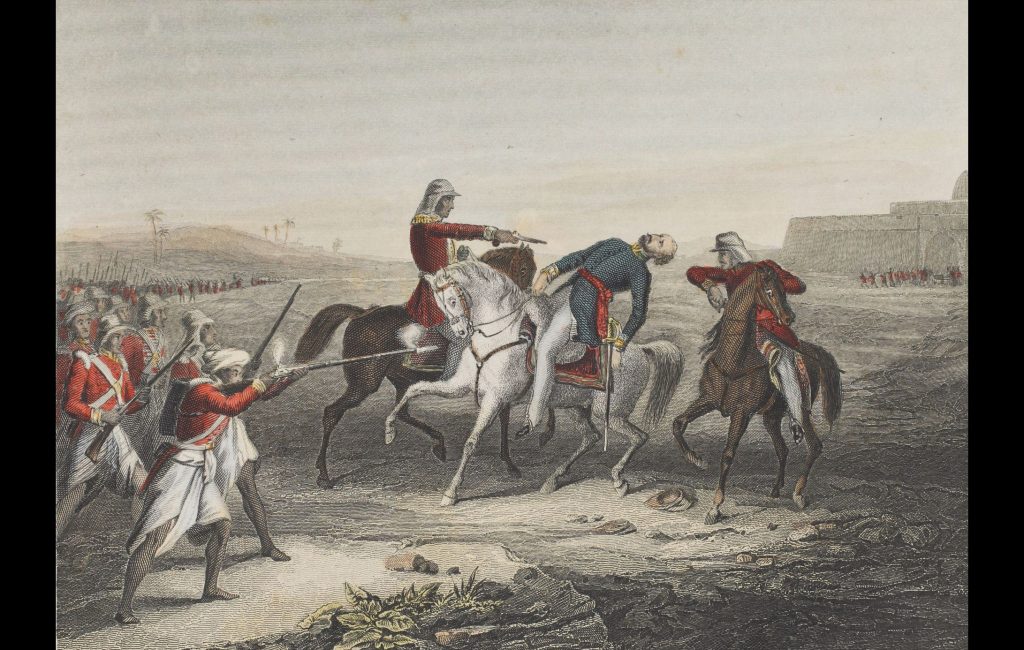
In any case, it appears, that it was the approach of Hungerford and his battery that had pushed the men to kill their officers and after he showered them with shot, the rebels fled from Mhow. Dr. Thornton, of the 1st Light Cavalry, whose house was too far away from the fort, providentially crept into a drain and stayed there until he heard the guns coming.
The bodies were carried back to the fort and buried in the grounds, later they were disinterred and reburied in the cantonment cemetery at Mhow.
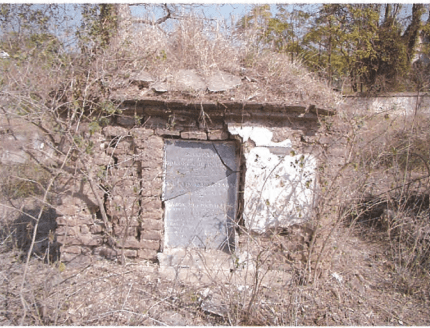
It reads:
‘The above officers were killed in the execution of their duty on the night of the mutiny of the Bengal troops at Mhow, 1st July 1857″
Later that morning, another officer who had been given up for dead, Lieutenant Simpson, was escorted to the fort by two men of the 23rd who had risked their lives to protect his. Major Cooper promised them promotion to the rank of havildar, but both men, after expressing their apologies, said they could not desert their regiment – they had done their duty by their officer but could do nothing more. Their duty now, they said, lay with their regiment, and they left, disappearing towards Indore.
As for Hungerford, he now set about provisioning the fort and writing in the following days, he reported,
“The officers now formed themselves into a volunteer corps and relieved the artillerymen of their night watches, snatching sleep and food when and where they could. The women most of them of gentle birth, were huddled together and they had to do everything for themselves and employ all their time in sewing bags for powder for the guns, well knowing the awful fate that awaits them if the place is taken; there has not been a sign of fear, they bring us tea or any little thing they can, and would like to keep watch ou tho bastions if we would let them.”
He continues,
“From the blown state of my horse in the morning, and the darkness of the night which prevented our seeing anything, it was impossible to follow. The mutineers, and as I had no covering party of any description, I returned to the fort after having fired several rounds of round shot into the lines.
“During the last three days, we have laid in ample stores of provisions for some time, and are prepared to hold our position until relieved; we are threatened by an attack from the rajah of Indore, or the mutineers, and are anxious and quite ready to meet them, but as sudden retribution should reach the scoundrels, who have shown such treachery and ingratitude to their benefactors, I trust that Colonel Woodburn may be ordered to hurry on a portion of his dragoons, by the aid of whom we can amply avenge ourselves for what has been done.
Yesterday and today, I have turned out a portion of my battery, accompanied by flanking parties of officers, to destroy the villages surrounding Mhow, in which many of the mutineers have taken refuge, and from whence they have turned out to burn and pillage the houses in the cantonments. Several villages have been burned, much property recovered and sepoys and troops destroyed.”
Of the men of the 23rd, only the Mohammedan drum major and five Christian drummers remained with their officers. The Colours were carried away by the troops, and the regimental mess house burned to the ground. Captain Hungerford, after securing whatever armaments could be recovered, ordered the regimental magazine blown up. He now had the onerous duty of standing in for Colonel Durand, who was nowhere to be found, and holding the fort at Mhow until someone could relieve him. At his disposal, he had 91 officers and NCOs. The fort was old, but the walls were thick; he had enough ammunition and though they would not live like kings, at least they would not starve. Hungerford declared martial law in Mhow; he now had to wait and hold his position.
The question remains – where was Durand and in all this tumult, what was Holkar doing? The answer is more complicated for nothing in 1857 is simple.
Sources:
Ball, Charles. The History of the Indian Mutiny: Giving a Detailed Account of the Sepoy Insurrection in India. Vol. I. London: London Printing and Publishing Company, 1892.
Behan, T. L. Bulletins and Other State Intelligence for the Year 1858. Part IV. London: Harrison & Sons, London Gazette Office, 1860.
Burway, Muntazim Bahadur M. W. The Life of His Highness Maharaja Tukoji Rao Holkar II, Ruler of Indore. Indore: Holkar State Press, 1925.
Chick, Noah Alfred, comp. Annals of the Indian Rebellion, 1857–58. Calcutta: Sanders, Cones and Co., 1859.
Dickinson, John. Last Counsels of an Unknown Counsellor. Edited by Evans Bell. London: Macmillan, 1877.
Durand, H. M. The Life of Major-General Sir Henry Marion Durand. London: W. H. Allen & Co., 1883.
Forrest, George W. A History of the Indian Mutiny. Vol. III. London & Edinburgh: William Blackwood & Sons, 1902.
Intelligence Branch, comp. The Revolt in Central India 1857-59. Simla: Government Monotype Press, 1908.
Kaye, John William, and G. B. Malleson. Kaye’s and Malleson’s History of the Indian Mutiny of 1857-8. Edited by G. B. Malleson. London: W. H. Allen & Co., 1889.
Lowe, Thomas. Central India during the Rebellion of 1857 and 1858. London: Longman, Green, Longman & Roberts, 1860.
Luard, C. E., comp. Indore State Gazetteer. Vol. II. Calcutta: Superintendent Government Printing, India, 1908.
Malleson, G. B. History of the Indian Mutiny, 1857-58. Vol. I. London: Wm. H. Allen & Co., 1878.
Srivastava, Khushalilal. The Revolt in Central India – Malwa. Bombay: Allied Publishers, 1966.
 Mutiny Reflections
Certainly nothing in 1857 was simple. So many terrible stories. An amazing amount of documentation to assemble.
LikeLiked by 1 person
It is terrible, I think for me the worst was reading about Delhi, Meerut, Fatehgarh and Sitapur. Cawnpore is just one long litany of misery and Lucknow is quite dreadful, but there is something about the surprise and horror of, Fategarh and Sitapur which never fail to be upsetting. Especially since the deaths could have been avoided. But the faith the commanders had in their troops was so heart-wrenchingly and blind. Just like poor Platt at Mhow.
LikeLike
Another staggering piece of research!!! Thank you for sharing!
LikeLiked by 1 person
It’s a tough chapter to write. I have been researching Indore for months and still have much more to do. It is linked to Agra so I have to write before I finish that off. I am not a big fan of Durand, I think the next chapter will show that a bit more. He is harder to decipher than Hodson. I hope you enjoy reading it!
LikeLiked by 1 person
Oh yes, very much!! So much so that I actually scan to see how long the post is and if it seems rich in detail, I go grab a coffee and read it like a book chapter!!!
LikeLike
Funnny you should mention chapters. I was asked recently if my posts would ever be part of a book – what do you think?
LikeLiked by 1 person
I have read a fair few books, in French and English, about this time and certainly feel that your research and commentary is good enough for publication! I would foresee your biggest difficulty being maps and illustrations although would it? Surely, all the 19th century maps and engravings are long out of copyright?
LikeLiked by 1 person
Yes I think you are right – the pictures and maps would be tough, since for publication they would also have to be better quality than what I put up on the site. I will be going to India in the next few weeks – I think I will come back with a little more courage to write that book!
LikeLiked by 1 person
I think the old maps and steel engravings will still reproduce well enough! Especially as it is in a book.
How exciting!! Good luck!!!! 🙏🙏
LikeLiked by 1 person