In Agra, life continued to be as that on a ship; however, it was a curious voyage with no shore in sight. The actual siege had lasted a mere 3 days after which it could be ascertained that the mutineers had indeed left Agra. While the countryside and surrounding towns continued to exist in semi-anarchy, in Agra, nothing was happening. However, those in the fort still had nowhere to go.
In Lucknow, by September, they had already endured nearly two months of continuous shelling with little respite and little hope of relief. In Gwalior, Scindia continued his efforts to hold back the main body of the Contingent. In Bihar, Dinapore had mutinied, Tyler had been superseded and sent into exile, and while Eyre had lifted the Siege of Arrah and routed the mutineers to Jagdispore where he squarely trounced them in battle, he had also destroyed the town and razed a Hindu temple, much to the anger of the authorities in Calcutta. Those rebels who did escape were rumoured to be marching through Bundelkhand, threatening Nagode and Rewa. In the midst of all this, Agra sat in limbo.
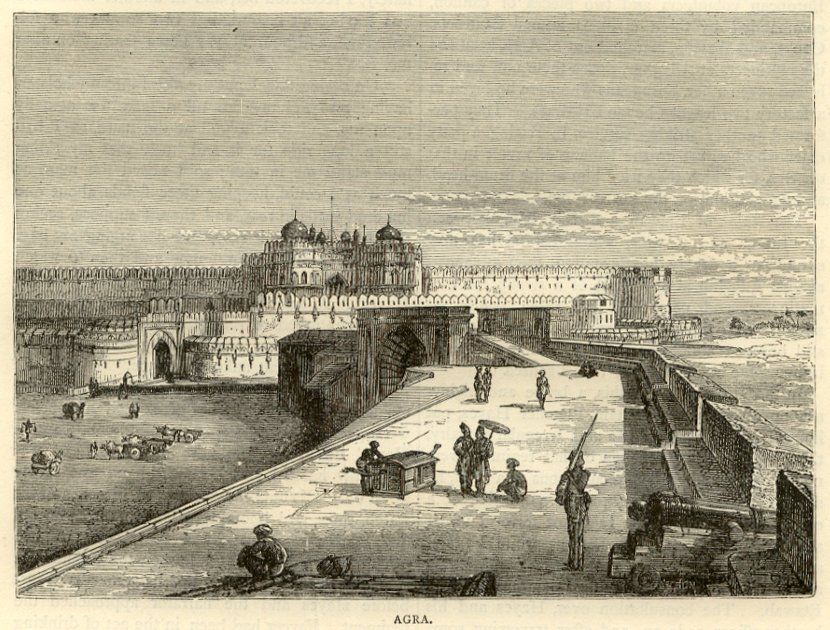
As the situation quietened, some people ventured out of the Fort, a spectacle Ruth Copeland watched from the ramparts:
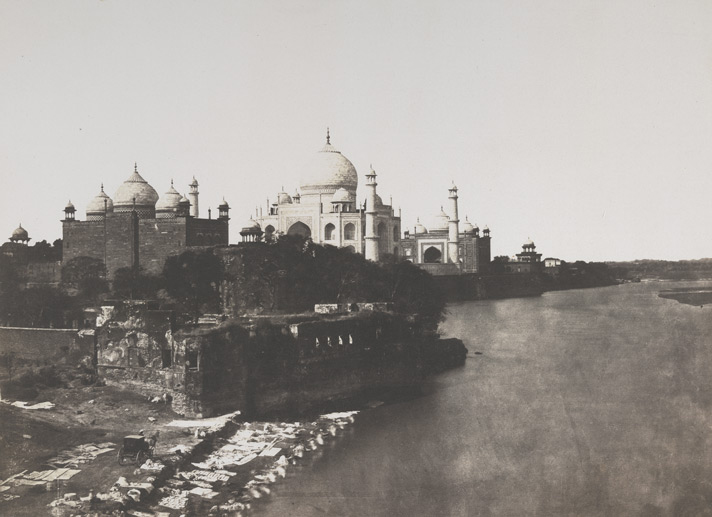
“I used to amuse myself by watching the people going about on the river in boats, people being now permitted to go out of the Fort. These boats were like those formerly employed for coming up the river; they had each a ” chopper ” roof and were divided into two rooms. The Meades, Murrays, and some others took the small quantity of furniture that they had recovered and lived in these boats for a change of air. This mode of life was thought by the doctors to be so healthy that they sent the wounded soldiers to live in boats anchored near the shore. It was a pitiable sight to see the emaciated forms of the poor men, carried in doolies clown to the boats, then placed on charpoys, and carried back to the hospital at night. I could also see the road winding towards the Taj, and people driving and riding on it; for now, they could safely leave the Fort during the day: though sometimes they were fired at.”
There was some fighting but it was not of much consequence.
Late at night on 20 August, a force under Colonel Montgomery left Agra consisting of 3 companies of the European regiment – 150 strong with four officers, two 9-pounders, and a 24-pounder howitzer manned by 30 European artillerymen; accompanying the force were 30 men of the Agra Militia. They also took with them the medical staff, the Commissariat, two priests and a missionary. Their destination was Aligarh, 40 miles distant from Agra, to attack Ghousa Khan, who had recently proclaimed himself Subedar of the King of Delhi. It was also thought necessary to disperse a body of villagers and a few fanatic Ghazis who had collected in the neighbourhood. Intelligence was poor: the blind spy of William Muir “suggested the scheme; the Board of Revenue made all the arrangements…It was characteristic of the state of things in the fort that a measure so purely military should have been originated and carried out almost entirely by civilians…” (Thornhill)
Lieutenant Dewe White commanded a party of the Europeans, mounted on elephants. His instructions were “short and simple…in case of coming in contact with the enemy, to dismount my men, and form them up to resist any attack that might be made, till the main body should come up.” The next days passed without incident, but on the 24th, they attacked the insurgents in the vicinity of Aligarh. Intelligence maintained Ghousa Khan had a veritable army, some 4000 men, but White did not recall seeing more than a handful, mostly “undisciplined armed insurgents and a detachment of the 3rd Cavalry.”
The troops had indeed found the insurgents, posted in a garden, enclosed by a bank and ditch. The Agra Force advanced and sent in a few shots from their guns, which prompted the insurgents to leap up and attack. They were driven back with considerable loss to the force which was neither strong enough to take the garden “nor to advance and leave the insurgents in our rear, nor was it thought quite safe to encamp in front of them on the open..” so the Agra troops retired a few miles out of Aligarh while the insurgents simply broke up their camp and drifted away. Once they were out of sight, the force continued its march to Aligarh but never got any farther than Hattras, 10 miles on the Agra side of Aligarh.
Upon entering the town, they were met “with great demonstrations of loyalty” by the shopkeepers, but the rest of the population was positively hostile. It was considered prudent to fall back ten miles closer to Agra. They were then ordered, once again, to approach Hattras – taking the town was impossible as the Ghazis had once again begun to gather; the force returned to Agra and encamped some 20 miles distant from the Fort on the main road upon which it was anticipated an attack might come. Had the mutineers come across them, there was little hope the little force could have survived the attack, but there they stayed until the middle of September.
Meanwhile, Muir continued to rely on his blind spy, Captain Nixon, and Mark Thornhill had organised their own network, but so had Philipps and Macpherson. That there were rebels on their way to Agra was without question, but no one could agree on who they were and, more importantly, from where they were coming. Macpherson had remained in close contact with Scindia and Dinkar Rao at Gwalior – his information, as first-hand as it could be, ascertained as early as mid-August that a large rebel force had collected at Gwalior. It was not the Gwalior Contingent who were still being held in check by Dinkar Rao and Scindia, but a fragmentary force composed of mutinied regiments from Bhopal, Mehdipore and other states.
Meanwhile, after the fall of Delhi, Thornhill received distressing news by express post from Muttra, sent off “in hot haste” by the police in the north of the district. The message said some 200’000 rebels were proceeding from Delhi towards Agra. Captain Nixon had received the same news. They immediately conveyed their information to the Government of Agra, who decided the reports were neither reliable nor accurate. Muir’s information had concluded the rebel army of Delhi was not approaching Agra but making their way to Rolhikhand and were at that moment in the process of crossing the Ganges.
Three days later, Thornhill was once again besieged by news from Muttra. The mutineers had indeed entered the district – the police had been forced to flee, and the countryside was in an uproar. This final piece of intelligence finally convinced the government that perhaps Thornhill was right after all, and they were quite unprepared for the news. An express was sent to the detachment, still settled in the field, to return to the fort; the militia was ordered to hold themselves in “readiness return to the fort at a moment’s notice,” and all the families who had taken to living outside the walls were recommended to return. It was a repeat of the panic of the 5th of July.
“The military were ordered into the Fort, and after them came hurrying all the English and Christians living outside it….” Mark Thornhill had been spending the day at the Taj when he received the news.
“It was nearly sunset when we approached the gateway. There we found the greatest confusion; for nearly a quarter of a mile, the road was completely blocked by a mass of men, carts and animals. The crowd was so dense that it was hopeless to attempt to get through it in the carriage. We alighted, and even then. surrounded by our servants, it was with the greatest difficulty that we managed to force our way to the drawbridge. There the confusion and struggling baffled description…The crowd…were half frantic with terror and excitement. Each time the gates swung open, they surged in, in such a mass as several times actually carried the sentry with them. I saw him more than once lifted completely off the ground and forced back some yards before he could extricate himself. The crowd seemed to think the mutineers were close behind them. It was perhaps fortunate they were not, for in the confusion, it was quite possible that by a sudden assault, they might have forced an entrance…”
The Delhi mutineers were indeed upon Agra as was another force – from Indore. The Indore mutineers had been in the vicinity for some time but had “sauntered leisurely up the country” and had settled themselves thirty miles away at Dholpore. The presence had become so commonplace in the past month that no one at Agra paid them much attention. Suddenly, they had struck their tents and were said to be marching on Agra – no one could figure out where they were until they appeared, 15 miles away on the far side of the stream called the Kali Nadi. The Delhi mutineers behaved similarly to those from Indore. They came down by forced marches from Delhi and were in Muttra sooner than anyone had expected or the government wanted to believe. The Seths had left the city and the police fled in their wake: left to their own devices, the inhabitants of Muttra charged out to meet the mutineers as friends. Tired from their march, the army settled down in Muttra. They pitched their tents on the parade ground and set about amusing themselves. The story they gave out was that they had not retreated from Delhi but had carried it – all the English were destroyed, and they were on their way, after a rest, to perform the same feat at Agra.“For some days they swaggered about, ate and drank and then they began to quarrel.” Some of the regiments had carried off a good deal of plunder from Delhi – others had nothing, and they wanted their share – before it came to a battle of the regiments, half the force dispersed to another camping ground; the other half stayed in Muttra. The townspeople in the meantime, had started drifting away as did the Ghazis and the mobs. Thornhill heard the army was trying to put together a bridge of boats and was planning to cross the river.
He received his information, once again, from the Seths.
Being forced to flee, they had left their considerable property in charge of their manager, who had, in his wisdom, contrived to befriend some of the regiments by bribing their commanders. The regiments who had not been successful plunderers, decided now the Seths were fair game and contrived to attack Muttra. However, bribery is a swift companion, and the commanders marched their troops down to the city, positioned their guns and threatened to open fire on their comrades if they dared enter. How a truce was made, no one was sure, but the new friends of the Seths remained where they were, and the rest marched away to Brindraban – whether to worship or plunder the temples no one could say for sure, but in the end, they did neither. No sooner had they arrived there, they turned around and set about completing the bridge of boats.
Thornhill was informed they would most likely attack Agra the next day, provided they could finish the bridge, and he hastened to inform the government. “I might have spared myself the trouble. The Intelligence Department, relying on, I believe, on news received from the blind man, had reported the rebels had all gone back to the north and this information was accepted in preference to mine…” It was not completely wrong; the one-half of the army that had marched to Brindaban had been mistaken for the whole army.
Muir had been quite awake to all the events but he had not been listening.
“The news, at last, became so alarming, and the approach so close, that on the evening of Saturday the 8th October, I urged on both the immediate need of sending out a reconnoitring party, and continuous military pickets. By great good fortune, a strong column under General Greathed was just on its way from Dehli to Cawnpore, and when the danger threatening us became known, it was turned aside from Allygurh to relieve us.” His letters were somewhat panic-stricken – on the 9th of October, he wrote to John Sherer:
“ The Indore force is moving steadily on this. It is today at Tehree and is making preparations for bringing its guns across the Kharee River, about ten miles distant. Some hundreds of Sowars have already crossed and are prowling about the country and obstructing the road. A reconnoitring party of our Militia cavalry went out this morning. It was fired on at the river, and followed, though at a respectful distance, by the enemy’s cavalry to within a few miles of Agra.” Essentially, he was not wrong, but the mutineers too had heard a force was coming in pursuit from Delhi – they had little stomach to meet it, and the force broke up. Several of the regiments and what was left of the Ghazis dispersed towards Rohilkhand. The rest went off in the direction of Rajputana. “The fate of these Delhi rebels was never ascertained. Like the rest of the mutineer forces, they melted away. Some, perhaps, returned to their homes, others wandered elsewhere, but as armies, they appeared no more…”
With them out of the way, gone to who knew where, the Agra government had but one force to reckon with and those were the men from Indore, encamped on the Kala Nadi. Again, intelligence was vague and confusing. The Intelligence Department was now convinced they were planning not to attack Agra after all but march off to the Deccan. So confident was Colonel Fraser with the reports, he ordered the Agra militia back to the previous post, to remain there and await further orders. However, rumours, now coming in fast and thick, said they were not going to the Deccan but approaching Agra. Muir maintained they were going to the Deccan, but the spies from the other networks continued to bring in reports that the rebels had crossed the river and were closer to Agra than the government wanted to believe. Meanwhile, the commander of the militia sent his own news – he said the enemy was near, his position was unsafe and a “strange cavalry had been seen very near the parade ground, and that some of his men patrolling the Gwalior road, which led to the Kala Naddee had been chased in by them.” Quarrelling now broke out in the ranks of the Agra officials.
“Colonel Cotton was brave to rashness, he thoroughly despised the rebel enemy – despised them to that degree that he thought it unnecessary to adopt any precautions against them. He was also not on very friendly terms with the Commandant of the Militia. For one or both of these reasons, he paid no attention to his reports or representations.”
Muir himself was unhappy with the situation, writing most indignantly,
“To watch its advance and guard against a surprise had thus become no longer a matter for unarmed and helpless spies. It had passed into the hands of the Military. Why, reconnoitring parties and pickets, as I suggested, were not kept out all night…to prevent surprise, I never could understand but so it was.”
At least, for once, he and Thornhill agreed on something. However, as Thornhill surmised, the dispatch received from Colonel Greathed’s column stated they would enter Agra on the 10th of October – “It was feared, however, that the column had arrived too late to be of any advantage….” It consisted of the 23rd BNI and the 1st Bengal Native Cavalry of the Indore Contingent, from Mhow, a part of the rebels from Delhi and various malcontents from Dholpur and the surrounding countryside. They had been moving on Agra since the 6th of October, deliberately crossing the Kala Nadi, which they finally accomplished on the 9th.
However, fleeting intelligence continued to plague Agra and would follow the Delhi Column right up to the Battle of Agra.
Sources:
Behan, T. L., ed. Bulletins and Other State Intelligence for the Year 1858. Part 1. London: Harrison & Sons, 1860.
Coopland, Ruth M. A Lady’s Escape from Gwalior and Life in the Fort of Agra during the Mutinies of 1857. London: Richard Bentley, 1859.
Dodd, George. The History of the Indian Revolt and of the Expeditions to Persia, China, and Japan, 1856-7-8. London: W. & R. Chambers, 1859
Further Papers (No.5, No.6, No.7) Relative to the Mutinies in the East Indies (1857)
Malleson, Col. G. B. The Indian Mutiny of 1857. London: Seeley & Co. Ltd, 1891
Muir, William. Agra in the Mutiny and the Life of W. & E.H. Muir in the Fort, 1857: A Sketch for the Children. Privately printed, 1896.
Muir, Sir William. Records of the Intelligence Department of the Government of the North-Western Provinces of India During the Mutiny of 1857. Edited by William Coldstream. Vol. 1. Edinburgh: T. & T. Clark, 1902.
 Mutiny Reflections
Eva, I have mentioned your blog as a good resource in a thread on Instagram about the Indian mutiny. These are the people looking for information on Indian mutiny and they have not heard about your blog, before. I mentioned this is one of the best information source that I know of. I hope it brought you some extra views and at the same time, they were able to enjoy all that you share.
LikeLiked by 1 person
Thank you so much!! It is very very appreciated! I will be in India soon and was going to ask if I can put a link to your blog on my travel site?
LikeLiked by 1 person
Sure, you can. I was not aware that you have a travel site as well. Please share the link, would love to hop over and have a look. Where are you headed in India?
LikeLiked by 1 person
My travel writing is in my other blog, called Thoughts Depart. I haven’t updated it in sometime so I will be doing that when I travel again. I will be in Delhi, Agra,Gwalior,Lucknow and Mussoorie, mostly visiting friends and working on my book. It’s going to be an interesting trip, sadly won’t make it to Jaipur this time.
LikeLiked by 1 person
Great. I guess the book is about mutiny!
LikeLiked by 1 person
It is a guidebook to the Lucknow Residency. I did have some success with the first edition but I decided it could be better so hopefully this year a new version will come out.
LikeLiked by 1 person
Great. This is something new for me to know.
LikeLiked by 1 person
thoughtsdepart.wordpress.com
The travel writing is under the menu Odd Guides.
LikeLiked by 1 person
Thanks. I will check it out
LikeLiked by 1 person
Another fascinating read! You have managed to capture the fog of war well – the weak and misleading intelligence, the sheer dumb luck, for good or bad, and the hardships of moving across the land with a baggage train in that heat! 😮
LikeLiked by 1 person
I have especially enjoyed immersing myself in the accounts of Anson and Bourchier – there is a caustic humour in their recollections, makes their lives so much more relatable.
LikeLiked by 1 person
Yes, you excerpts seem well chosen and I had no idea that Roberts had such a gift for the written word either!
LikeLiked by 1 person
Roberts was a wonderful writer, his book, 2 volumes, 41 Year’s in India were the first books I bought when I started my collection of mutiny books. He had a fascinating life. Nearly 60 books later, Roberts is still one of my favorites.
LikeLiked by 1 person