The Sagar and Narbada Territories
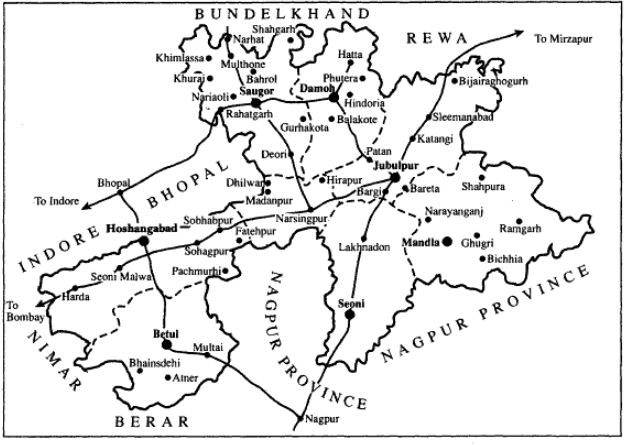
The Narbada Valley and the adjoining districts had come under British administration after the defeat of Sagar and Nagpur in 1818. From 1820, this area was known as the “Saugor and Nerbudda Territories” and was administered at different times either by the governor-general directly or as a commissioner’s division of the North-Western Provinces. There were three military stations in the Sagar and Narbada Territories: Sagar, Jabalpur and Hoshangabad. We will look at Sagar first. The troops in the territories were distributed thus:
Sagar: One Company European Bengal Artillery
3rd Irregular Cavalry
31st BNI
42nd BNI
Damoh: Two companies, 42nd BNI
Jabalpur: 52nd BNI
Mandla: A Havildar’s Guard, 52nd BNI
Seoni: One company, Madras Infantry
Narsinghpur: Four Companies, 28th Madras Infantry
Hoshangabad: Four Companies, 28th Madras Infantry
Betul: Two Companies, 28th Madras Infantry
Sage at Sagar
Sagar was garrisoned by the 31st and 42nd BNI, the 3rd Regiment Irregular Cavalry and sixty-eight European gunners. In Jabalpur, the 52nd BNI was stationed, and at Hoshangabad, the 28th Madras Native Infantry was stationed. The commandant of this district force was Brigadier Sage, who made his headquarters at Sagar. Neither the news of the mutiny at Meerut nor the events at Jhansi appeared to adversely affect the men under Sage’s command. Outwardly, they all appeared calm, and their conduct was unchanged. Some disobedience and mutterings were creeping into the ranks of which Sage was aware, but he was not going to abandon Sagar until the men mutinied in earnest.
The events which unsettled Sagar somewhat were as follows:
On the 14th, some men of the 42nd reported that four men of their regiment had tried to prevent Gaussen’s men from leaving the station. The four were seized, tried by a Native Court-Martial and sentenced to six months in jail. The very next day, on the 15th, Lieutenant Millar of the 52nd had a musket thrust at him while inspecting the guards. However, the man was seized by the Subadar Major and confined to the guardroom, while his comrades remonstrated on his behalf. Interestingly enough, the medical officer declared the man mad, and he was scurried off to Benares to the lunatic asylum, only to be declared sane upon arrival and hanged.
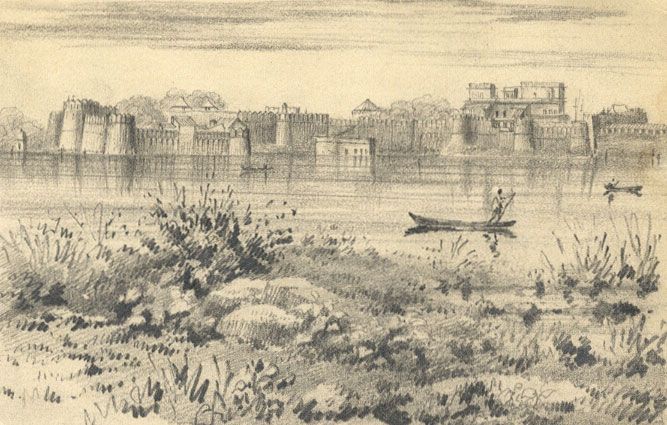
Brigadier Sage was in something of a bind – the station, in the event of a mutiny, would be impossible to protect with only 68 Europeans should the entire force rise. At one end of the station were a fort, the magazine and the battering train; at the other, some three miles away, a position known as Artillery Hill, which Sage knew he would have to abandon. It had neither an adequate supply of water nor anywhere to store provisions- it would be a grave folly to try and keep it, but strategically, an equally terrible loss.
We now return to Major Gaussen. The detachment marched from Sagar in good order and joined Major Gaussen at Malthon on 23 June. Gaussen decided to make a show of force and promptly attacked the fort of Balabet, held by rebels. Successfully storming the position with one European killed and one wounded (Ensign Spens killed while blowing up the gate and Lieutenant Willoughby wounded) and taking 16 rebels prisoner, it seemed like a sure victory, but what Gaussen did not know is his men had promised the prisoners their lives. Two days later, and back at Malthon, Gaussen was forced by his men to give them up to the Raja of Banpur. The Raja, seeing his opportunity had come, entered the British camp and openly offered the sepoys a monthly pay of 12 rupees if they would leave their officers, provided they brought their arms and ammunition with them. The sepoys readily agreed and dismissed Gaussen and the other Europeans, swelling the ranks of what could now be called an army of the Raja of Banpur. Gaussen and the others were forced to return to Sagar with a few exceptions: two companies, 75 Irregulars and two 9-pounders short. It is not recorded what Brigadier Sage said to Gaussen in reply, but in any event, it prompted Sage to take action. He now had a querulous Raja to deal with, besides a mutiny. Yet, Sage had a plan.
“Accordingly, he at once, and in the most judicious manner, began his operations. He first moved the contents of the treasury into the fort; to the same place, he next conveyed the contents of the expense magazine and the artillery magazine; and, last of all, he removed thither the women, the children, and the baggage of the European artillery. As soon as this had been accomplished, he took a guard of Europeans and relieved the Sipahi guard at the fort gate. Thus, by a few decisive strokes, the one following the other with lapidity, Sage gained a place of refuge, secured the contents of the magazine, and saved the treasure.”
On the morning of 30 June, whilst the usual guard mounting was in progress, Sage marched the Europeans and 60 artillerymen to the fort. He then sent a message to all the native officers, frankly explaining why he had taken this decision and adding that they had “suffered acts of mutiny to take place without opposing them, and had forfeited their character; that there was yet one method open to them of regaining it, and that was to have the leading mutineers seized and delivered up to justice.” The officers, taken aback by Sage’s words, quickly promised him everything he asked for, but the very next morning, the 3rd Irregulars and the 42nd BNI broke into open mutiny, plundering the bazaar and their officers’ bungalows. The 31st stood aside and continued to profess their loyalty. Sage remained barricaded in the fort. A stand-off ensued.
Done for a moment with pillaging and general destruction, some of the mutineers left Sagar and made their way to Damoh, intent on convincing the two detached companies of the 42nd stationed there to join the cause. In the meantime, some of the men of the 31st who had accompanied Major Gaussen relieved the Light Company of that regiment, which had proved itself beyond saving and returned to Sagar. Some men of the 31st pled contrition, but 45 of them quickly joined the ranks of the 42nd. The men sent out by the 42nd on the same venture had all joined the mutineers – the six who refused were put to death by their comrades.
In Sagar, a new ruler had now declared himself. Subadar Shaikh Ramzan of the 42nd, styling himself a general, took command of the cantonments. The mutineers seized the large saluting gun on the top of Artillery Hill and brought it down to the quarter-guard of the 42nd, which was now declared their headquarters. Meanwhile, the 31st, except the 45 men, stood back from these proceedings. The native officers of the corps made daily reports to Sage in the fort and even saved much of the European officers’ property, conveying it to the fort.
Things, however, came to a head when a sepoy of the 31st killed a trooper of the 42nd who had opened fire on him. The 31st requested permission from Sage to attack the 42nd. The brigadier did not oppose their plan, but he refused to allow their English officers to join them. Instead, he sent out a strong party of Customs chaprassis, armed with muskets to make a demonstration in favour of the 31st – these were accompanied by the officers of the Customs Department and by Captain Pinkney and by Lieutenant Hamilton, the Assistant Commissioner.
The mutineers, realising they were about to be attacked, took the initiative and fired round shot at the 31st from the saluting gun – the first volley in the battle of the Sagar regiments. The 31st were in a terrible position – besides the saluting gun, the 42nd were making solid use of two further guns. The 31st again sent a message to Sage, this time asking him for guns to dispatch the 42nd, once and for all.
As night was drawing in, Sage replied that although it was too late to send out the guns now, in the morning, he would bring them victory.
The message spread through Sagar like wildfire.
For the 31st, it strengthened their resolve to remain loyal, while it so dispirited the 42nd, they fled the station during the night, actively pursued by men of the 31st, who managed to even capture one gun.
“When the victors returned, it was ascertained that whilst the entire 31st, the forty above alluded to excepted, had remained loyal, fifty of the 42nd had followed their example, and the sixty loyal troopers had been joined by at least an equal number of the same temper from out-stations.”
Brigadier Sage now turned his attention to further strengthening the fort. He had supplies and medical stores for 6 months and enough guns and ammunition. He also had a large contingent of men at his disposal. He further ordered all the civilian men to be drilled, which grew his force by a further 60 men and the total of European fighting men to 123. He still had 190 women and children to look after, but compared to what he had had before, it was certainly a better position to be in than he had been in in June. He was not a man to take attacks lightly – the Bundlea rebels repeatedly opened fire on the fort, and in his turn, Sage sent out a force to pursue them. It was a cat-and-mouse siege that would last three months. It was not simply a battle against the Raja of Banpur. Sage had to contend with every petty chief from the surrounding district who had flocked to the united banners of Banpur and Shahgarh.
 Mutiny Reflections