The 22nd Regiment, Bengal Native Infantry (Bole Ka Paltan)
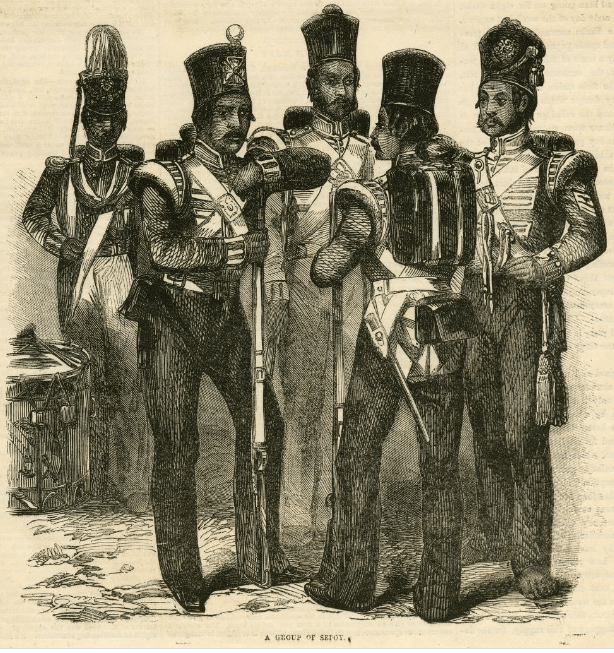
The 22nd had been one of the old regiments of the Bengal Native Infantry and had covered themselves in some glory until their downfall in 1857. Raised in 1778 as the 2nd Battalion, 2nd BNI, they carried the battle honours “Carnatic,” “Dehlee”, and “Punjab” on their Colours. Brevet Colonel Lennox in 1857 had been 36 years in the service of the regiment – it is no surprise the officers of the 22nd had a hard time believing their men would be anything but staunch.
Unfortunately, the 22nd proved treacherous – although they behaved with moderation during the mutiny at Fyzabad itself, even organising boats for their officers to escape with, the 22nd had been in close communication with the murderous 17th BNI, who promptly intercepted the boats and attacked the officers, killing most of them.
After the officers had fled Fyzabad, the 22nd carried on as usual. The subedar major took the colonel’s place; the subedars took on the ranks of majors and captains, while the jemadars were raised to lieutenants. These new officers liberally helped themselves to the horses, carriages, and possessions and property of their former British officers and curiously enough, insisted the band played at mess every night. The musicians were liberally paid with money from the regimental treasury. Their new colonel insisted on drill and parade, and guard duty carried on unabated.
However, soon Lucknow was calling, and the 22nd marched in a body to join the Oudh Irregular Infantry – they arrived in time to take part in the Battle of Chinhat and the Siege of Lucknow. However, whatever they had planned to achieve seems to have gone up in smoke, for after Lucknow, the 22nd was never heard of again.
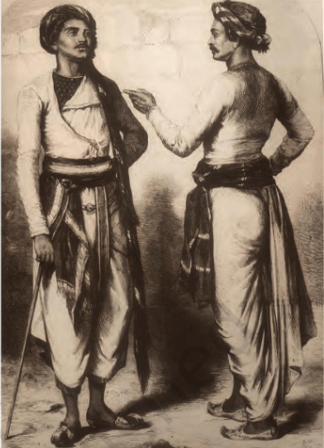
The following interesting account of his escape from Fyzabad, after the mutiny, is by Lieutenant C. S. Fowle, of the late 22nd N.I. Lieutenant Fowle was in the 5th boat that left Fyzabad, and his company was providentially small, consisting of:
Captain Morgan, his wife and child
Lieutenant Fowle
Lieutenant Ousley
Assistant Surgeon Daniel
Lieutenant Fowle begins his tale, not with the escape but with the events leading up to the mutiny at Fyzabad. The time from the 5th to the 8th of June (when Fowle decided it was time to leave) was fraught with uncertainty. The officers, when Fowle takes up the narrative, were sleeping in the lines with their men and were living with the thought that every night could well be their last. On receiving news of the mutiny at Meerut, the taking of Delhi by the mutineers, and the killings at Lucknow, Sitapur and Sultanpur, the officers of the 22nd BNI were ordered to sleep in the lines with their men. News reached Fyzabad that the mutineers from Seetapore or any of the other stations would most likely descend upon Fyzabad and Colonel Goldney, when shaking hands with the officers after mess on the night of June 5, intimated they may not live to meet again.
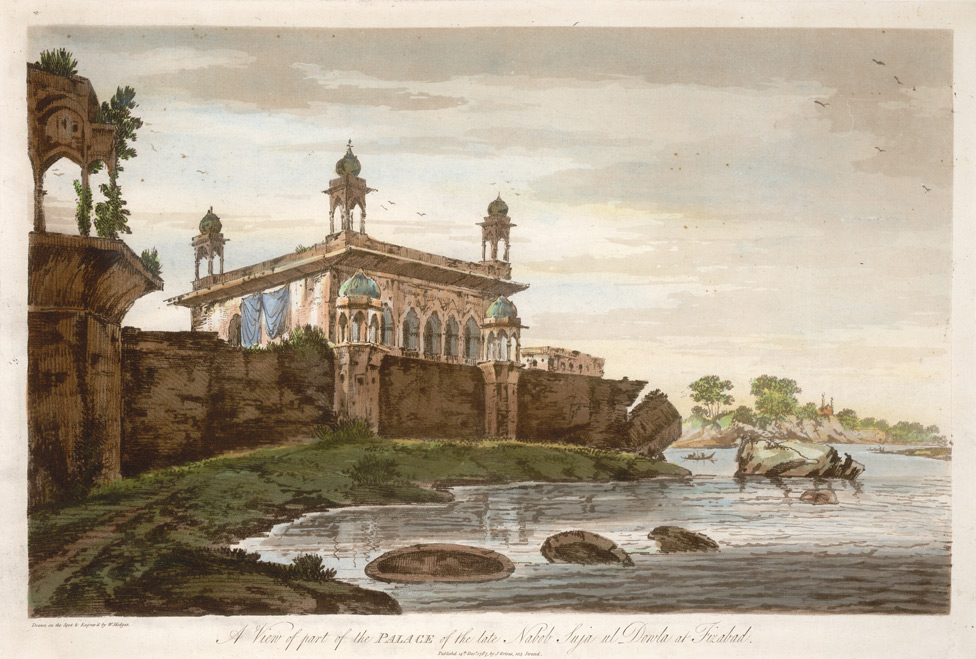
Sunday, 7th.—We again slept with our men, and the night passed off very quietly, so much so that I began to think that nothing would happen, but I was soon undeceived. Being officer of the day, I had to march off the guards and picquets to their respective posts, and having done so, as I was returning from the parade ground to my house, it was reported to me that some person or persons had attempted to set fire to the lines. This had a very bad appearance, as it had always been the forerunner of the mutinies at almost all the other stations. I went home and dressed for the purpose of going over to the mess house where we were to have Divine Service; on my way there I met Major Mills of the Artillery, he appeared to be in a very melancholy mood and said to me, ‘Well, I think our time is short now, for this will most likely be our last night, our troops have plainly shewed what they intend to do.’
The officers collected at the house of Colonel Goldney for Divine Service, after which they assembled for a council of war – it was determined to remain in Fyzabad for as long as possible, trusting their sepoys would not kill them; however, the ladies and children were to be sent off to any place deemed safe. Like at other stations, Colonel Lennox implicitly trusted the sepoys – he allowed the treasure to be brought up from the city and placed in the empty bungalows in the cantonment as the native officers promised they would, thus be better able to guard it. What this ultimately meant, when they finally did mutiny, the treasure was already in their hands without the added hassle of having to fight the city folk for it, but the officers of the 22nd simply saw this as another example of their loyalty to the company salt.
The 8th of June
At 4pm the native officers were called up by Colonel Lennox to explain their intentions. The officers vehemently denied the 22nd would mutiny and swore to stand by their officers to the last. When they had left, one native officer returned and placed a letter the regiment had received from the mutineers – it stated quite bluntly, that they intended to enter Fyzabad the next morning; if the British officers did not leave quietly, they would be put to death. Lennox then asked the officer what he thought of the letter. The man replied with much indignation and claimed the regiment had replied, stating they would have nothing to do with the mutineers. However, they did permit to go through the station but must do so quietly, or else the 22nd would fight them. Satisfied with the answer, the colonel let the man go.
Lieutenant Fowle and others were not quite so confident. Expecting to be killed, Foyle wrote his last letters, placed his writing desk and other valuables in the Bell of Arms of his company and hoped, at least, that his men would protect him.
On the night of the 8th of June, the troops mutinied. The 6th Regiment of Oudh Irregular Infantry sounded a bugle call around 10 pm and was answered by the 22nd BNI. With the battery in their possession, they refused to allow their officers to approach, but at this point, did not offer them any violence either. The men of the 22nd did not “pretend a grievance, but loudly asserted that feeling they were stronger than the English, they intended to turn them out of the country.” The senior Risaldar of the 15th Irregular Cavalry seized command of the brigade and, from his new position, attempted to induce the men to murder their officers. Fowle and the remaining officers were left with little choice but to leave the station, and the only option open to them now was an escape in boats.
“We succeeded in getting the other companies in something like order and remained up with them till 1 o’clock in the morning, when, finding that no good could be done, I went in search of the commanding officer to ask him what he intended doing. For this purpose, I was going up to the guns when I was quietly told that if I went up there, I should be shot. After awhile I found the Colonel, and after telling him what I thought of the state of the Regiment, asked him what he thought of our making a retreat, to which he replied that I had better go and ask my commanding officer, mentioning one of the native officers (and I suppose a bigger scoundrel never trod the earth), for that he had lost all command of the Regiment. I replied, if things, Colonel, have come to that pass, it is high time we should look out for ourselves, you know what atrocities the men of other Regiments have committed upon their officers and officers’ wives, and I have no idea of remaining here till the mutineers come in the morning to be either shot or have my throat cut. So with your permission, I shall leave. Have I your permission to leave the parade ground?
He said, ‘You have my leave to go where you like and do what you like.’
I wished him good morning.
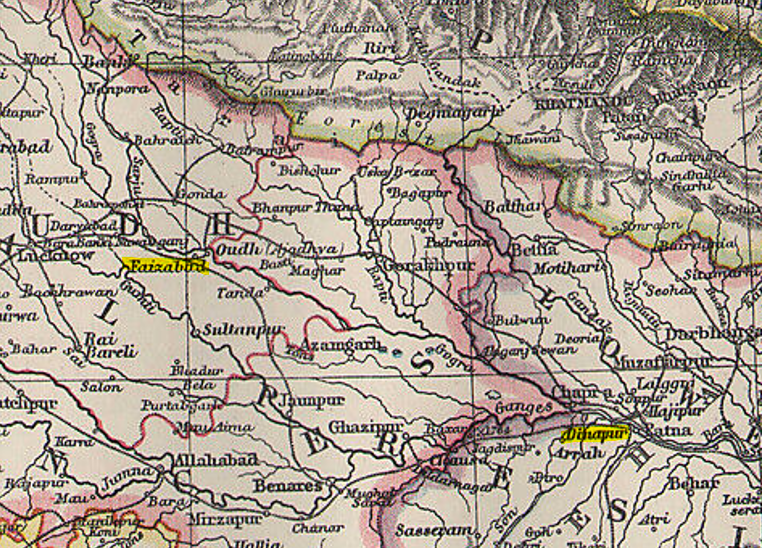
I then went to the 2nd in command and told him that I was off, and asked him and the Doctor if they would accompany me, to which they agreed. Another officer joined us immediately afterwards, which made up our numbers to four. We now found to our horror that the men had cut off all communication between the parade and our houses. This for a few minutes gave me the feelings of utter despair and hopelessness, which I shall not easily forget. However, it was within two hours of daybreak, and there was no time to be lost. We got hold of one faithful man who walked with us through the lines and got us safely to our houses, where we got just such things as we were able to carry in our hands, and then under escort of five faithful men whose services we had engaged, we made all haste to the river (Ghogra) afraid that the slightest delay would cause us to be followed. On our arrival at the riverside, we found, to our dismay, that the rascally Cavalry had seized all the boats and the boatmen. After an hour’s search, however, we succeeded in procuring a boat and one boatman, by which means we managed to get in safety across the river.“
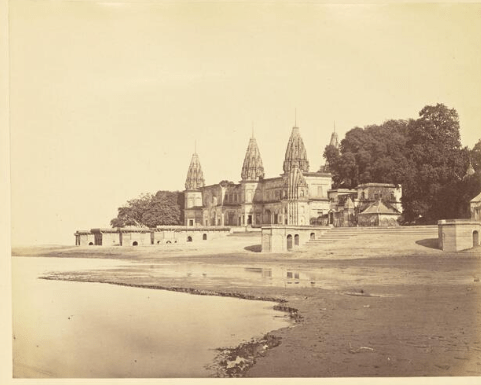
This was the last boat to leave Fyzabad, well behind the others. As such, Fowle and the others were left to their own devices, and their adventures commenced in full form the next day. From here on, Fowle and his companions will face two harrowing weeks filled with treachery, misery and deprivation.
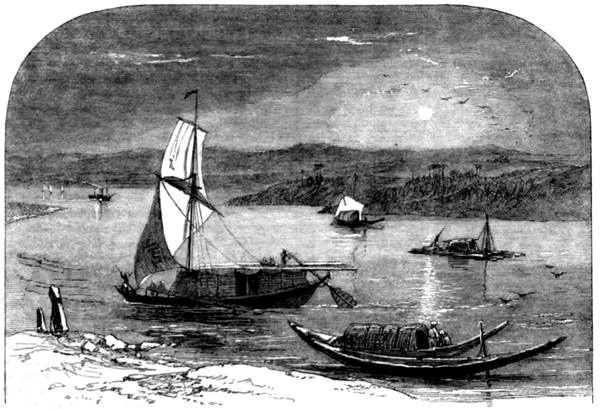
The first day after their escape – the 9th of June – the party managed to reach a village some seven miles distant, on foot. Here they were negligibly treated, allowed by the villagers to remain in a grove of trees and fed little. The villagers promised to procure a covered boat to convey them to Dinapore, but just as it got dark, they were suddenly implored to run for it as the other villages had got wind of their presence and were coming down to kill them. They managed to cross the river and, around 10pm, secured a small boat with a boatman, who, after paying him an exorbitant amount, promised to take them to Dinapore.
The next day, Fowle ordered the boatman to take them to shore so they might try to get some food – the idea was hardly a wise one, for no sooner had they procured a little breakfast than they were warned that sepoys of the 17th BNI were prowling about, looking for them. With much haste, the boat pushed off again.
A short way downriver, Fowle spotted a covered boat which he knew belonged to Colonel Lennox. A sepoy was standing guard. He, too, had seen the officers and beckoned to them to come across to him as he had some important information. With a little hesitation, Fowle agreed to talk. The sepoy gave out that Lennox, his wife and daughter had just left the boat and were now proceeding by foot – Lennox had given the sepoy instructions to give the boat to any party of officers he might see and take it to Dinapore.
The story seemed credible, so Fowle and his party placed their few belongings in the boat and settled down to what should have been Lennox’s breakfast, which included a few small bottles of beer. Not that they would enjoy them.
Within minutes, word came that the mutineers had found them out – instead of remaining in Lennox’s boat, they quickly returned to their own. Fowle left behind his bag of spare clothes and only took a small box, which contained his Bible and a few belongings. As soon as their boat was caught up in the stream, the sepoy called out for them them return, but Fowle had had enough of the man and refused – so the sepoy simply fired on them with his musket as ways of a final parting. Only after dark did the mutineers, who actually were prowling about on the riverbank, give up following the boat.
Facing Death
Not having eaten properly in nearly two days, except for a few handfuls of raisins and dry semolina, the party once again decided to put to shore and find some food. Just then, a small boat passed theirs. The occupants asked the boatman if he had any Banias on board, knowing full well, as the boat was uncovered, he occupants were Englishmen. The exchange was pointless in the context of it: –
“They then rowed as fast as they were able to a large village close by, which they had no sooner reached than, to our dismay, we saw two boats loading as fast as they could with men armed to the teeth with matchlocks, swords and sticks. As soon as the boats were full, as may be supposed, they made the best of their way towards us. Just at this moment, our boat stuck on a sand bank, we saw it was impossible to get out of their way, and gave ourselves up for lost. We all agreed that the only chance we had of escape was to lay down our arms and place ourselves at their mercy which we did, and no doubt that this measure, under Providence was the means of saving our lives, for no sooner did the ruffians see that we wished to make no resistance, than they told us to sit down, and nothing should happen to us. To have made the slightest resistance or to have fired a shot at the bloodthirsty ruffians would have been to ensure the destruction of our small party consisting of four gentlemen and a lady and child.“
Surrounded by “a horrid set of ruffians” numbering 60 or more, the headman curiously told Fowle they had intended to murder them but seeing that the small party was unlikely to put up a fight, he had decided against it. Instead, Fowle and the others were taken as prisoners to his village, where, after enduring some verbal taunts, much shouting and sword rattling, the headman ordered Fowle and the others to be fed. He then proposed to take them to Benares, if Fowle would guarantee to pay him Rs 1000, half up front. Since neither Fowle nor Morgan had any money on them, the headman, rather disappointed, took them to a sandbank on the other side of the river. Here, the party was forced to give up their last possessions – watches, rings, forks (an odd item) and pistols – and then told them to go where they liked. The Rajah of Gopalpore was not far off – they could make it there, the headman said, but he would not guarantee their lives.
Prisoners
Back on their small boat, the party proceeded 20 miles – the boatman, by now, was so tired, the officers took charge of the rowing, with the man went to sleep. Towards morning, they were once again forced to go ashore, this time by villagers who, by way of firing on them, took the party prisoner. Fowle and the others were put into a rude hut while some of the men belonging to the headman sat by the door and
“…and laughed and made all sorts of low blackguardly jokes upon us, knowing as they did, the cowardly ruffians, that being surrounded with armed men, we did not dare retaliate. In the evening we were all marched off to the Bazaar where a bedstead each was put for us in a row outside for us to sleep upon in the best way we could, with a promise that the next day we should be allowed to go to the Rajah of Gopalpore, which they knew to be a diabolical lie the whole time they were uttering it.”
The night was quiet, but the next day, the 13th, it was still evident they would not be allowed go to the Rajah of Gopalpore. Instead, they were kept, without shelter, in the bazaar – eventually, someone brought them a small canopy made of grass, to keep off the sun. An old woman, moved by their plight, provided them with a little of her food and refused any payment. The headman refused to come near them, and the next day, their situation was unchanged. Now, irritated beyond measure, Fowle and another of the officers determined to seek out the headman. One of the sentries showed them the way – a walk of a mile brought them to his house. After enduring a little more abuse from his retainers in the way of taunts and rude jokes, the headman, who initially refused to see them, condescended to an audience and promised they would be allowed to leave the next day.
Released
Monday,15th.—Got up very early to see about getting our boat ready. About 8 o’clock, the Baboo arrived to give orders for our release. He had promised to give us some money for the road which we thought was very liberal on his part; but we soon found that he was not so generous after all, for he had made up his mind that whatever he gave us he would have an equivalent for, so having previously searched us and knowing what we possessed, he determined upon possessing himself of our swords and a pistol which were the only articles that had been spared to us by the scoundrels of the last village we were at. We did not like to part with these things and told him so, but as we had no money wherewith to purchase food for the rest of our journey, and it was very evident that without securing them, the hardhearted villain would not give us a farthing, we were obliged to submit and take what he chose to give us, which was about a 20th part of the value of the things.
By 10 am, they were again on their way and hastily made for the other side of the river. Here, the Rajah of Gopalpore was waiting for them. He treated them “like gentlemen” and provided them with a little money and some supplies before sending them off to the house of an indigo planter. Although the man is not named, it was possibly a Mr. Nicholls who had remained to safeguard his property. Here they remained until Saturday, the 20th of June, when, provided with a covered boat, the party set off again towards Dinapore. A storm during the night cut their journey short and return to shore, but by morning it had blown over, and at daybreak they reached the lands of the friendly Rajah of Burhul, who resupplied their boat, allowed them a brief rest on shore before sending them off again in the evening.
The Journey Continues
Tuesday 23rd.—“Got on pretty well all night and anchored for a short time at a place by the name of Burhuj, where we changed the men of our escort, which had been furnished us by the Rajah of Burhul. Started again, and in the evening arrived at a place by the name of Bhagulpore; here we remained till 10 p.m., changing our escort and dandies and getting other things. Started again, but the wind was so rough against us that we only got blown to the other side of the river and stuck on a sand bank, where we were obliged to remain during the night. Here, the new men of our escort managed to practise upon our fears by telling us that some people had come from the Azimghur side to look at the boat, and finding that there were Europeans on board, had gone away to collect some men to come and attack us. They said moreover, that if we would give them some money they would remain and protect us, but if not they would take their departure; as it was in the middle of the night, and we had no weapons of defence with us whatever, we thought we had better comply with their request, so we gave them some money and they remained, promising most faithfully to remain and escort us to the next place which was about 20 miles off. The next day, we feared that what they had told us the night before was only a lying hoax to get money out of us, and that no person had been near the boat all night.“
The next morning, the escort left them, having taken whatever money the party had left. The boat, unfortunately, struck a sandbank shortly after, and with the wind blowing up a storm, it was hard work getting it back into the stream. When they finally succeeded, the boatmen said it was impossible to steer against the wind, and they were obliged, after only four miles, to put into shore. By nightfall, the wind still showed no signs of abating, and Fowle, not liking the idea of spending the night trapped between two villages, one of the Azimgarh side and the other on the Gorakhpur side of the river, it was decided to return, by foot to Bhagulpore. They arrived on the morning of the 24th.
“On our arrival, the head man of the village sent us some five or six chowkidars for our protection during the night, and told us if we liked to remain there for ten days, nothing should happen to us. In course of conversation with the head man, he told us about ten miles off lived an Opium Agent with his family, and that if we liked, he would convey us there and give us an escort for the road. We immediately sent off a note to this gentleman whose name was Nicolson, Opium Agent of Selimpore, telling him of our difficulties and how we were situated, and early next morning he very kindly sent us a buggy and a shigram with a most kind note requesting us to go to his house, sending us at the same time tea and sugar wherewith to refresh ourselves before starting. We went to his house, and I am sure that no one of us will ever forget the kindness and hospitality that we received from him and his family during the five or six days that we remained there. “
Lieutenant Fowle and the others finally arrived safely in Dinapore, and here the narrative should have ended. After his adventures, Fowle was most likely not in the right frame of mind to take up any new duties, although immediately assigned to the 8th Regiment Bengal Native Infantry. Instead, he applied for leave to visit his sister, Mrs. Simpson and her husband at nearby Hazaribagh.
Mutiny at Hazaribagh
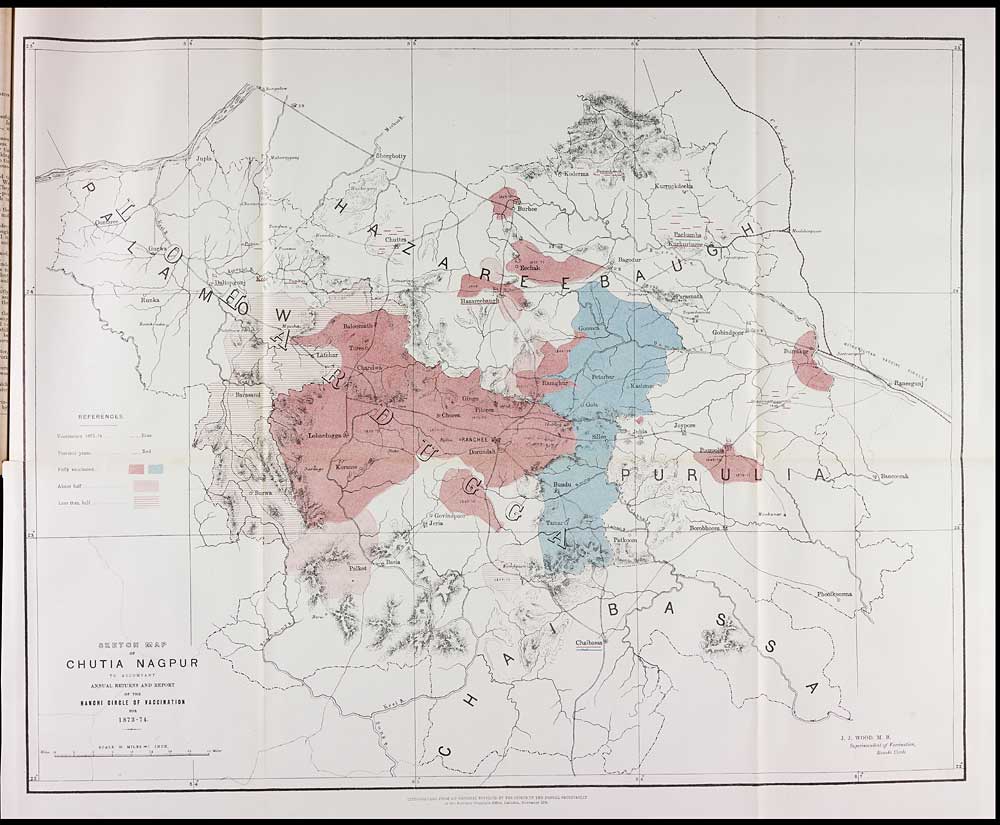
At Hazaribagh, three companies of the 8th BNI were on command duty – it was no secret that if their headquarters at Dinapore mutinied, these would follow suit. Every day, the officers waited for news of a mutiny from Dinapore – in the middle of the night of the 28th of July, it finally came. A sowar rode into Hazaribagh with a note for the Burhi magistrate, Mr. Wilson. All three regiments had mutinied and had gone off with their arms.
Without a moment to lose, Fowle was ordered to accompany his sister and the other ladies to Ichak, eight miles distant, and place them under the protection of the Rajah, who had proved himself to be a staunch friend. The next evening, Major Simpson (Principal Assistant to the Commissioner) arrived to report Hazaribagh was quiet but insisted, as long as the roads were still open, the ladies should be sent to Calcutta. The next morning, Fowle set off with his sister to Burhi, where he managed to procure a carriage from the North West Dak Company and, with the wife of the doctor of Hazaribagh, the party set off.
On the road, a letter from Major Simpson reached them – Hazaribagh was still quiet. This was due in part to the foresight of their commanding officer. Refusing to trust the sepoys an inch, he had, for some days before the Dinapore mutiny, confiscated all mail coming into the station, releasing it only when he had read it himself. He had also put a stop to strangers and visitors to the regimental lines – as such, he managed to keep his men in the dark about events at Dinapore until the 30th of July.
After two days of hard travelling, Fowle, Mr. Wilson and the two ladies arrived at Raniganj, from whence they proceeded by train to Calcutta. While at Raniganj, they received a letter, dated 30 July, from Major Simpson – at 3pm, the two companies at Hazaribagh had mutinied
“As soon as the mutiny took place, the men divided themselves into two or three different parties, one party made for the house of the commanding officer, and another for the house of my brother-in-law, Major Simpson, who was at the time performing cutcherry in his house and was only warned of their approach just in time to take up his cap and depart when the men were actually in his compound. He made for the stables in order to get his horse, but before he could reach them, he saw the fiends let fly a volley through his bungalow in order, no doubt, to catch all three of us whom they knew to have been living in it; they were greatly enraged at finding no Feringhee inside, and immediately looted the bungalow of whatever they wanted, and then setting fire to it, burned it to the ground, thereby causing a loss to the Major including stores, furniture, and the bungalow (which was his own property) of about 6,000 rupees. His pony and a carriage mare, which he had just bought, they took with them, at the same time tearing the lining out of a carriage which had just arrived from Calcutta. They also burnt down the bungalow of their commanding officer and that of the Doctor. They then looted the treasury and let loose all the prisoners from two jails, amounting to nearly 1,000 in number. They then made off for Chota Nagpore, compelling the prisoners to carry their ill-gotten gains, having first distributed 10,000 rupees worth of pice amongst the people in the Bazaar. “
Providentially, the Europeans managed to escape and Hazaribagh, unlike other stations, as soon as the plundering was over, fell silent.
Colonel Charles Stephen Fowle
Charles Stephen Fowle arrived in India in 1842 and, as an ensign, was assigned to the 22nd BNI. On 3 June 1845, he was promoted to lieutenant. He served with his regiment through the Second Sikh War, 1848-49, for which he received a campaign medal. Following his Fyzabad experiences, it is not clear whether Fowle continued fighting in the mutiny, but he was reprimanded for “intoxication” in April 1858. However, he was raised to brevet-captain on 24 September 1857 and full captain on 4 August 1859. Fowle remained serving in India and retired as a full colonel in 1874 while commanding a wing of the 36th BNI.
Sources:
The primary source for this post is an article in the FIBIS journal, issue Number 21, Spring 2009, originally transcribed by Mr. Bill Hall and entitled “Escape from Fyzabad, 1857, ” from a booklet in Mr. Hall’s possession, which, though printed, was possibly never published. Due to the demise of Mr. Hall, I was unable to secure the right to transcribe the whole of the original myself, and as such, have only quoted portions of the article as presented in the FIBIS journal.
Chick, Noah Alfred. Annals of the Indian Rebellion. Calcutta: Sanders, Cones, and Co., 1859.
Malleson, G. B. History of the Indian Mutiny, 1857–1858: Commencing from the Close of the Second Volume of Sir John Kaye’s History of the Sepoy War. Vol. 1. London: William H. Allen and Co., 1878.
Narrative of the Indian Mutinies of 1857: Compiled for the Madras Military Male Orphan Asylum. Madras: Military Male Orphan Asylum Press, 1858.
Thurburn, Felix Augustus Victor. Reminiscences of the Indian Rebellion. London: Privately Printed, 1889.
 Mutiny Reflections