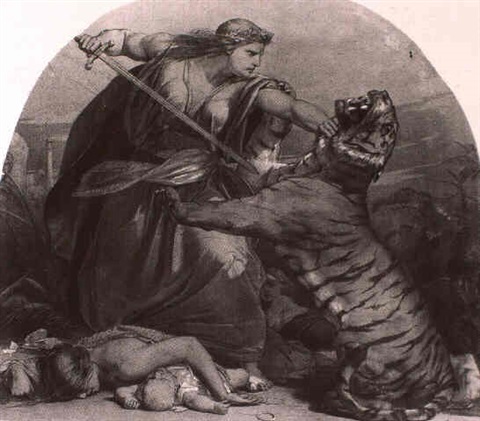
In 1857, news did not travel quickly. The first reports of the uprising at Meerut in May, reached London in June. The news, when it did reach, was terse and to the point.
INDIA AND CHINA
[The following appeared in our second edition of yesterday] By the arrival of the overland mail we have received our private correspondence and papers from Bombay to 11th
May; Calcutta the 2nd of May; and Hong Kong, the 26th of April.
The following is the letter of our Bombay correspondent: –
Bombay, May 11th ‘It is but 10 days since I last wrote to you… I have nothing of any moment to communicate. Peace, … and somnolent tranquillity … broods over India…. As I write there arrives from Meerut, in the North-West Provinces, or rather from Agra, a telegraphic message containing intelligence which rather mars that profound tranquillity … It runs thus: – “The 3d [Bengal] Cavalry are in open mutiny. They have burnt down the lines and the officers’ bungalows. Several officers and men are killed and wounded.” This, if true, is startling news indeed. We may hope that it is exaggerated, but that it has a foundation at least of truth can hardly be doubted…’
(The Times, Tuesday June 9th, 1857)
Further news came 18 days later:
LATEST INTELLIGENCE (by submarine and British telegraph)
INDIA AND CHINA
The steamer America arrived at noon on the 26th of June at Trieste, in 121hours from Alexandria.
Alexandria, June 21
… The dates from India are – Bombay, May 27; Calcutta, May 18; Madras, May 25.
The mutiny in the Bengal army had spread in a most alarming manner from Meerut.
The 11th and 20th Native Infantry had united with the 3d Light Cavalry in open revolt; after some bloodshed they had been dispersed by European troops, but they fled to Delhi, where they were joined by the 38th, 54th and 74th Native Infantry.
Delhi was in possession of the mutineers, who had massacred all the Europeans without regard to age or sex, plundered the bank, and proclaimed the son of the late Moghul Emperor as king.
Disturbances had also broken out at Ferozepore, but had been suppressed.
(The Times, Saturday June 27, 1857)
By the 29th of June, the Times was ready to dramatise the mutiny:
Nor will the severest retribution which it is in the power of military law to inflict be too severe for the treacherous hands which have thus added murder to mutiny and rebellion. At Meerut, the 11th and 20th Regiments of Native Infantry and the 3d Cavalry murdered every officer on whom they could lay hands. At Delhi it is supposed that Mr Fraser, the Commissioner has fallen, with many others, men, women and children. The list of fugitives is given in another place…’
(The Times, Monday June 29, 1857)
Many are already known to have escaped, as will be seen from the list already referred to and which I now subjoin. But it is feared to be only too certain that Mr. Fraser, the Commissioner has fallen, and Captain Douglas, Commandant of the Palace Guard, and Mr. Jennings, chaplain of the station, with his daughter and many others of all degrees…
(The Times, Monday June 29, 1857)
For many in Britain this was how they received the news of their relatives. There was no way for them to verify what was true and what was sensationalised. The horror stories kept coming, and for one young man, it proved to be too much.
Wigram Clifford at the age of 23, was the Assistant Magistrate and Collector in Delhi Division, assigned to Gurgaon. He had not been long in India and he must have been a young man of promise. A graduate of Haileybury, where he had won the Persian Prize for three terms, he arrived in India in 1855. His sister, Mary, aged 18 (or 24, I cannot verify either) had come out to help her brother keep house, and most probably, find a husband. On the 10th of May, the Cliffords traveled to Delhi, where Mary was to help Annie Jennings prepare for her wedding to a Mr. Thomason. Wigram left Mary in the early morning of the 11th, not knowing he would never see his sister alive again.
“It was not until May 12 that C—d heard of the mutiny and, fearing death from the populace of Goorgaon, who had also risen in revolt, he disguised himself as best he could and rode off into the country…”
Mark Thornhill, then magistrate of Mathura, gave the following description of Wigram Clifford:
“..he was quite a young man, armed with sword and revolver, and wore twisted around his hat a large native turban – he looked very tired and exhausted…”
Clifford was on his way to Agra to inform the officials of the events. He related the story of the uprising in Meerut to Thornhill, the events in his district, which had been over-run by insurgents, and the events at Delhi: “When I inquired the names of the victims he broke down altogether, for among them was his only sister, a young girl of eighteen, who had but a few months previously arrived in India.”
C.J.Griffiths, a school friend of Cliffords’, met Wigram in Delhi.
“From what he hinted, I feel sure he had it on his mind that his sister, before being murdered, was outraged by the rebels. However this may be, my old school fellow had become a changed being. All his passions were aroused to their fullest extent and he thought of nothing but revenge. Armed with sword, revolver and rifle, he had been present at almost every engagement with the mutineers since leaving Meerut. He was known to most of the regiments in the camp and would attach himself to one or the other on the occasion of fighting, dealing death with his rifle and giving no quarter. Caring nothing for his own life, so long as he succeeded in glutting his vengeance on the murderers of his sister, he exposed himself most recklessly throughout the siege, and never received a wound.”
Then followed a further encounter with Wigram, which horrified Griffiths:
“On the day of the final assault, I met him in one of the streets after we had gained entrance to the city. He shook my hands, saying he had put to death all he had come across, not excepting women and children, and from his excited manner and appearance of dress – which was covered with blood stains – I must believe he told me the truth.”
Griffiths dined with Clifford the night Delhi was taken. Clifford told him he was going to take part in an assault the next morning on a small village nearby: and recalled, “All my remonstrances at this were no avail: he vowed to me he would never stay his hand while he had the opportunity of wreaking his vengeance…”
Nor did he. Clifford had become a fearsome, vengeful man, committing terrible acts of violence. While assisting in the suppression of the revolt in Mewat, Wigram Clifford was killed in October.
We can only speculate what stories Clifford would have heard. The murders of the girls in Delhi are amongst the many lies that circulated that year and beyond, from the tame assessment of Harriet Tytler – the girls had been flung from a window to their deaths (where she heard this from, is unknown ) – to the most barbarous. The girls had been variously stripped and murdered, chopped into pieces over weeks and as illustrated in an account circulating in Bombay towards the end of May 1857:
“Miss Jennings was stripped by the insurgents, who then danced around her for some time, insulting her with brutal words and gestures. Eighteen of the fiends then abused her and thus exhausted her to death.”
It does not leave much the imagination how Wigram Clifford – already feeling guilty for having left his sister in Delhi just one day before the mutiny – must have felt when even his friend Griffiths seemed to believe this story:
“For what I gathered after the siege from some Delhi natives, it was reported that the ladies were stripped naked at the Palace, tied in that condition to the wheels of gun- carriages dragged up the Chandni Chauk – or silver street of Delhi and there, in the presence of the King’s sons cut to pieces.”
Wigram Clifford, how he died and where is another matter of speculation. That he is said to have burned hundreds of villages and murdered all of the inhabitants singlehandedly, is something of an exaggeration, but the mutiny had turned him into a dreadful man and death probably came as a relief even to himself. Griffiths states Clifford was shot through the heart but this too must remain a matter of conjecture.
The Cliffords had another brother who would serve in India, Robert Clifford. He missed the mutiny altogether as the ship taking him to India broke down and was set down for lengthy repairs on the South American coast, arriving in Calcutta many months too late. Born in 1839, he would have been 18 in 1857. He went on to serve with the Sam Brown Cavalry and later with the 2nd Punjab Cavalry, retiring from India in 1881 and dying at Carn Cottage in 1930. Their other relative, a cousin, Richard Henry Clifford, the deputy collector of Mathura, survived the mutiny, having been hidden away by a loyal servant. Their thoughts and feelings about the fates of Wigram and Mary are not known.
In 1859, Edward Leckey published a book called” Fictions Connected with the Indian Outbreak, Exposed.”
Apparently disgusted by the popular stories, he attempted to put to rest some of the more horrifying tales that were in circulation. Rather than relying solely on eyewitness accounts to disavow some of the narratives, Leckey took a more reasonable approach – common sense. A good example of this is the following:
XVI: “Elsewhere, the sepoys took up living children by the legs, with the heads hanging downwards and tore them up in two. In one instance four children were thus barbarously torn up before the eyes of their father and mother, who themselves were soon afterwards shockingly abused and butchered.” – (The Indian Rebellion, 2nd ed., p.59)
According to Leckey:
“Elsewhere” may mean anywhere. if the name of the station was known, the space it would have occupied when written would have been very little more than that taken up by “Elsewhere.” But it is a very convenient word to use when one does not know where, and when one is indisposed to take the trouble of ascertaining where. ” (p.29)
In my own writing, I try to bear this in mind – if I don’t know where, can I then trust the how?
Anyone who has spent any time reading about the mutiny can easily fall into this trap. Although there are eyewitness accounts, one must always remember that some of these were written well after the fact and others by people who though present were not in any condition to actually remember anything. One well-known eyewitness, Mary Ann, who was present at Cawnpore, is blessed with an “elastic memory“, and subsequently, remembers far more than she could have seen.
Take for example Frances Wagentrieber’s book. Frances was present when her family escaped from Delhi, but she was no more than a year old. Her book is based on what t she had been told by her parents and possibly by her sister, who was 14 at the time. Although I do refer to her book in some of my research, I do try to find secondary references to the same incidents, as in the case of the Leesons. It would be foolhardy of me to take only the word of Frances.
The mutiny at Jhanis is not only portrayed in words but in pictures.
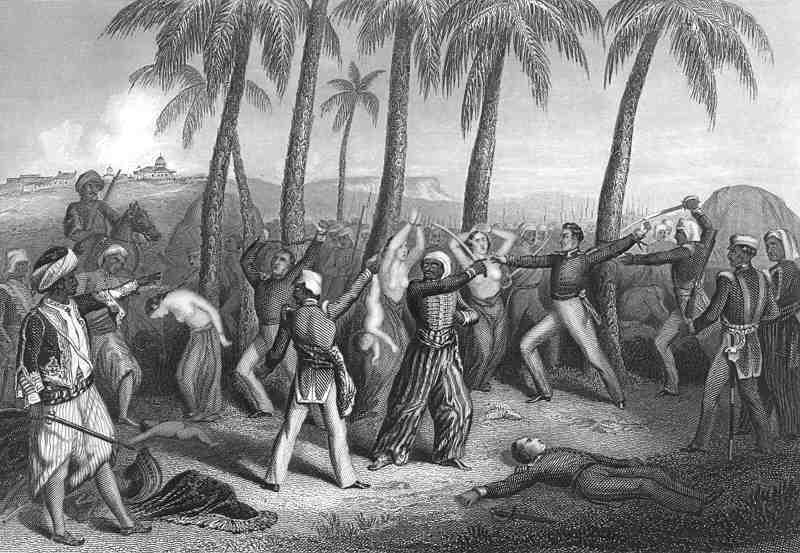
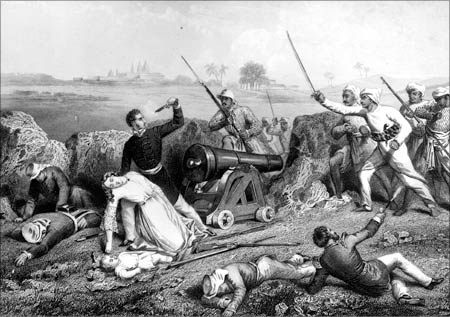
These images would have done n more than horrify the public. A scene depicting the worst Victorian nightmares – women stripped to the waist, awaiting every exquisite torture to befall them, while their babies are held upside down, before finally being dashed to the ground, or stuck up on bayonets. The husbands, in the meantime, are valiantly fighting for their honour, but alas, all is in vain.
Similarly the picture of Captain Skene. here he holds a gun to his own head, supposedly after shooting his wife. However, the truth was far less romantic. Having taken a stand in the fort, and realising their position was untenable, the Europeans at Jhansi surrendered to the mutineers. They were given assurances that nothing would befall them, but things did not quite turn out that way.
The personal servant of Captian Burgess stated in a letter from Nagode dated July 19th, 1857:
“Major Skene marched our first; they were taken to a garden,” drawn up in two rows, the ” men and women separate, the men tied to a rope;” and then every soul, whatever age, rank or sex, was killed by the sword. The men died first, Burgess taking the lead, his elbows tied behind his back, and a prayer-book in his hands. The rest died the same way, They tried hard to get the women and children saved. The women stood with their babes in their arms and the older children holding their gowns. They had to see the men killed, but I believe they were spared any violence save death.”
The bodies were seen the next day by a personal servant of Captain Skene, and even though he does state that they were without clothes, this alone should not be taken as proof of defilement. Nor should the following poem by Christina Rossetti be taken as anything but pure fiction:
In the Round Tower at Jhansi, June 8, 1857
A hundred, a thousand to one; even so;
Not a hope in the world remained:
The swarming howling wretches below
Gained and gained and gained.
Skene looked at his pale young wife:—
‘Is the time come?’—’The time is come!’—
Young, strong, and so full of life:
The agony struck them dumb.
Close his arm about her now,
Close her cheek to his,
Close the pistol to her brow—
God forgive them this!
‘Will it hurt much?’—’No, mine own:
I wish I could bear the pang for both.’
‘I wish I could bear the pang alone:
Courage, dear, I am not loth.’
Kiss and kiss: ‘It is not pain
Thus to kiss and die.
One kiss more.’—’And yet one again.’—
‘Good-bye.’—’Good-bye.’
Another persistent story during the mutiny was related to the daughter of General Wheeler at Cawnpore. Having survived the entrenchment, Miss Wheeler was saved from the massacre at the Satichaura Ghat by a sowar.
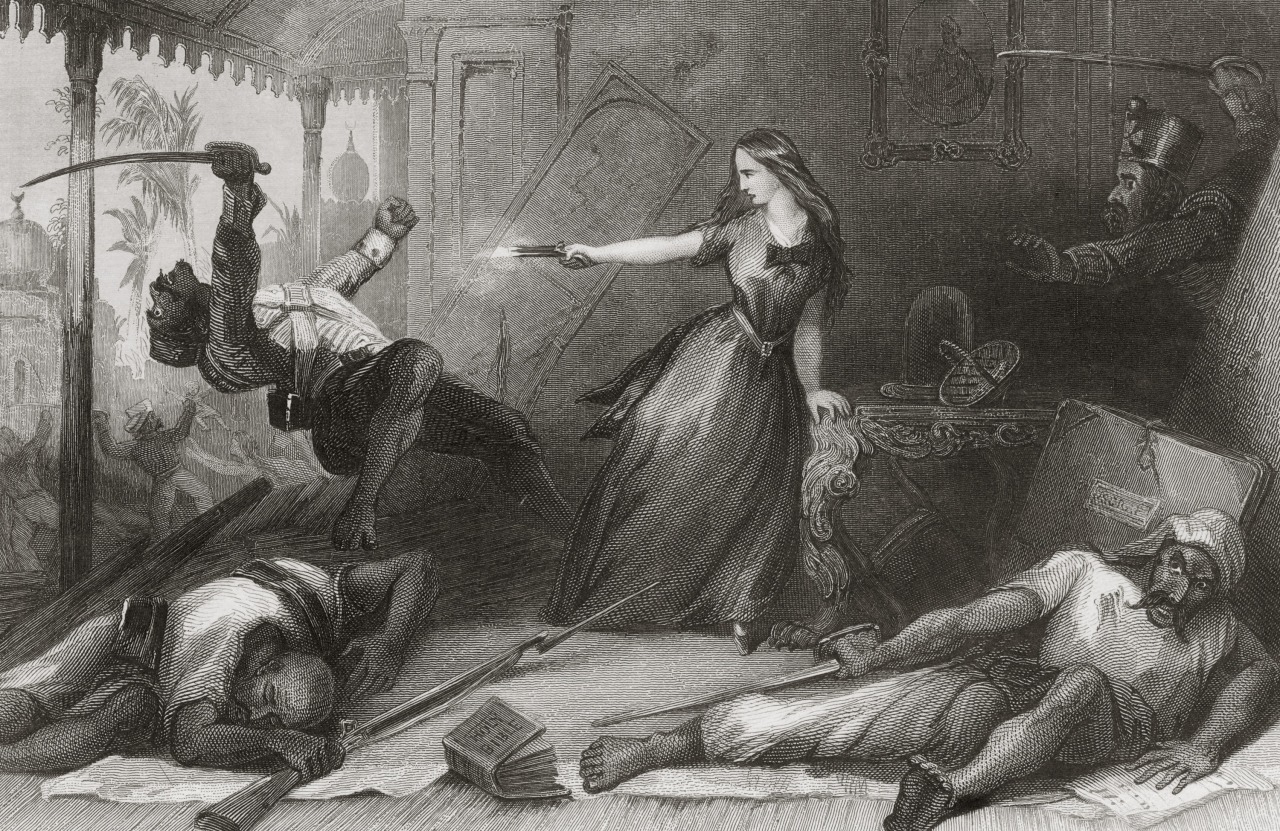
Although band musician Fitchett stated that he “frequently saw Miss Wheeler, daughter of the General, at Futtehghur, and that she travelled with the sowar who had taken her from Cawnpore- nay more, that he was shown into the room where she was…She had a horse with an English side-saddle, which the sowar had procured for her, and she rode close besde him, with her face veiled, along the line of march. When the British approached Futtehghur (in 1858), orders were sent to the sowar to give Miss Wheeler up, but he escaped with her at night. ” (Russell)
However, in the press of the time, a far more elaborate fate awaited Miss Wheeler. Following her rescue from Saticharua Ghat, and always before her impending defilement, she procured the pistols of her captor and shot him dead or he took a sword and not only killed him but his whole family, before throwing herself into a well. There are various other tales attached to Miss Wheeler, however, hers was not the hair the 78th Highlands swore an oath on.
Miss Wheeler remained with the sowar, Ali Khan, not as his captor, but as his wife. She returned to Cawnpore where was acquainted with Mrs. Clarke in the 1880s. As Mrs. Clarke had been contemporary of the Wheeler girls, she recognised her. Miss Wheeler refused to identify herself formally nor reveal herself to any of her living relations. Only on her deathbed, some 50 years after the mutiny, did she confess to a priest that she was in fact Wheeler’s daughter. It is not our place to speculate as to why she chose to remain anonymous, nor should we judge her by the morals of our times. In the 1800’s Miss Wheeler would not have been understood as she would be now and from the social strictures of the time, it was perhaps better she was thought dead.
So what, you may ask, is the point of writing such scandalous lies?
The most obvious answer to this would be to fan the flames of hatred against Indians and spur on the army of vengeance and retribution. In much of the literature of the times, the Indians were seen as swarthy, or dusky heathens, whose minds were ruled by lascivious, impure thoughts. It was impossible for the Victorians to believe that Englishwomen were anything but the fantasy of Indian men, even though this was far from the truth. Despite stories of rape being mostly disproved, the myth persisted. I say “disproved” however, with caution. That no accounts were found to be reliable, is closer to the truth, but we must not forget Amelia Horne or Amy Sutherland.
Another reason for writing horror stories was of course the public’s voracious appetite for them. It was a way to keep the interest in the mutiny alive, and consequentially assure the public that whatever the army did as a result of these tales, was justified. After all, anyone who had read of the vision of Jessie Brown at Lucknow (even though Jessie did not exist) would not have wanted to save the poor wee ones from certain death? Or, thanks to another elaborate story, avenge the owners of the 80 pairs of European feet:
LXXVII ” In mentioning the cold- blooded massacres of the Bengal Mutineers, says the Poona Observer, we have omitted to state, what is perfectly true, that when our soldiers entered the barrack at Cawnpore in which the poor murdered garrison had been, they found, arranged in rows, fifty pairs of men’s feet and thirty pairs of women’s- cut off above the ankle! This was evidently intended to show the deliberate character of their atrocities.” Bombay Telegraph and Courier, 7th September 1857.
Although Lecky gives an elaborate explanation as to why this could not possibly be true (p.189-190), it shows the very character of the writing surrounding the mutiny. With no known witnesses at the time (September, 1857), who was to say this was not true? It is well and good for Lecky to prove the fallacies of the statement in 1859 but when it was written, is it any surprise that the army of retribution acted with such atrociousness against the Indians? Ignorance of the facts is by no means an excuse, but even in our modern times, we too are guilty of that. I can only say we must all learn to read with discernment and not with blind belief.
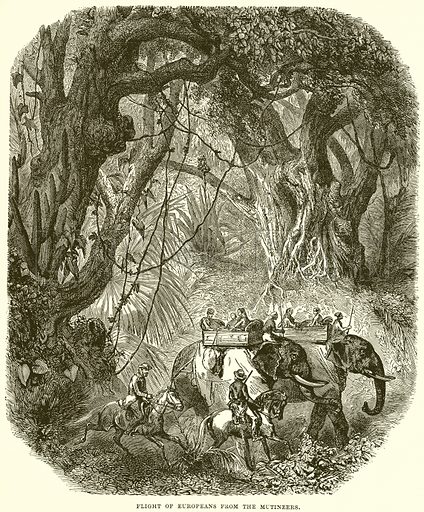
Flight of Europeans from the Mutineers. Illustration from The People’s History of England (Cassell Petter & Galpin, c 1890).
The Fatehgarh Fugitives
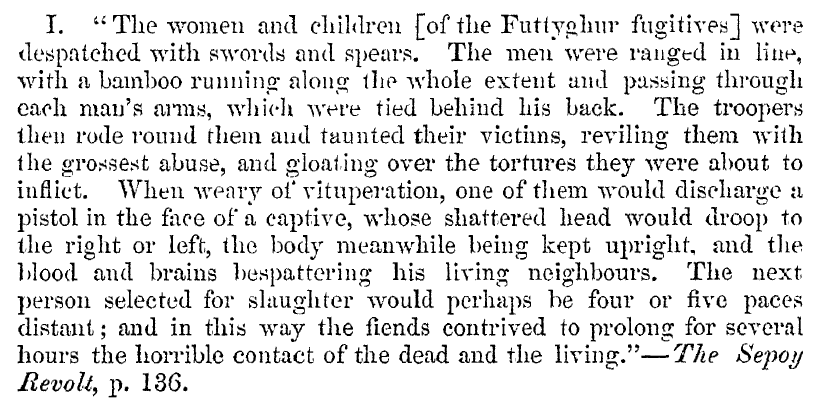
This terrible paragraph can be found in Henry Mead’s work, The Sepoy Revolt, its Causes and Consequences, published in 1858. For all of its failures, such as the description above, it is also drizzled with some very anti-British sentiments, such as descriptions of Canning’s council. Mead had a personal grudge — the Gagging Order had seen him removed as editor of Friends of India and, in consequence, he had little good to say about the government in Calcutta; even Canning did not escape his pen.
“In an evil hour for the country. Lord Canning was appointed to succeed the Marquis of Dalhousie. Such a choice could only have been made under the supposition that government in India was so purely a matter of routine, that it was not of the least moment who occupied the viceregal palace in Calcutta, and took the wages of chief ruler. He had been more than twenty years in the House of Peers and had never exhibited a sign of the capacity for empire. The impression which he left on the minds of men who transacted business with him was that of plaintive imbecility. He could never acquire experience, and he had no insight into character. One man’s opinion was as good to him as that of another. He took counsel from all and received help from none. The last man that encountered him on his way to the council chamber had him as a prey. He was haunted by the idea that the secretaries were supposed really to govern India; and to disabuse the public mind of that belief he would occasionally reverse a conclusion that they had adopted for the best of reasons, or substitute in the wording of a despatch the term expedient in lieu of “necessary.” An honest, courageous English gentleman, he only wanted breadth of understanding and the power of reliance. He would have ruled with credit to himself, but the secret of how to manage widely was never disclosed to him.”
Mead does not cite any sources for his tale, for it is indeed, just that — the work of a very fertile imagination. It is however, worth pointing out, that his book was published in 1857 and while it deals with the mutiny as a whole, especially its causes and the ineffectiveness of government, it is also possible Mead was acting not out of maliciousness or sensationalism, but from unverified tales he had heard that were circulating at the time and was filling in the narrative with ideas popular at the time. The actual account of the fate of the Fatehgarh fugitives would not be clear until 1859 when it would be concluded, through eyewitness accounts, that they were brought out on the parade ground and shot. Those that did not die from the initial volley were summarily despatched with swords. Mead, in other words, made it up. This is interestingly pointed out by Leckey:
“Allowing the average breadth of each man to be 15 inches, which is not overstating the thing, the length of the bamboo necessary, to pass through each man’s arms and keep the whole of the 79 victims close together without any intervening space, would have to be 98 feet, 9 inches. Now, if the mutineers had been able to command, on the spur of the moment, the longest bamboo that India could produce, according to the most eminent botanists — a supposition which is highly improbable — that bamboo would not have exceeded 70 feet in length.”
However, where sensationalism is present, there is rarely a clear head behind it. Unfortunately, this continues in the present.
For further reading, I recommend
“Fictions Connected with the Indian Outbreak of 1857 Exposed” by Edward Leckey, available at archive.org.
Sources:
The Personal Adventures of a Magistrate During the Rise, Progress and Suppression of the Indian Mutiny,” Mark Thornhill, 1884
A Narrative of the Siege of Delhi with an Account of the Mutiny at Ferozepore in 1857.” Charles John Griffiths, 1910
 Mutiny Reflections