The Retreat from Lucknow – November 27th to November 30th
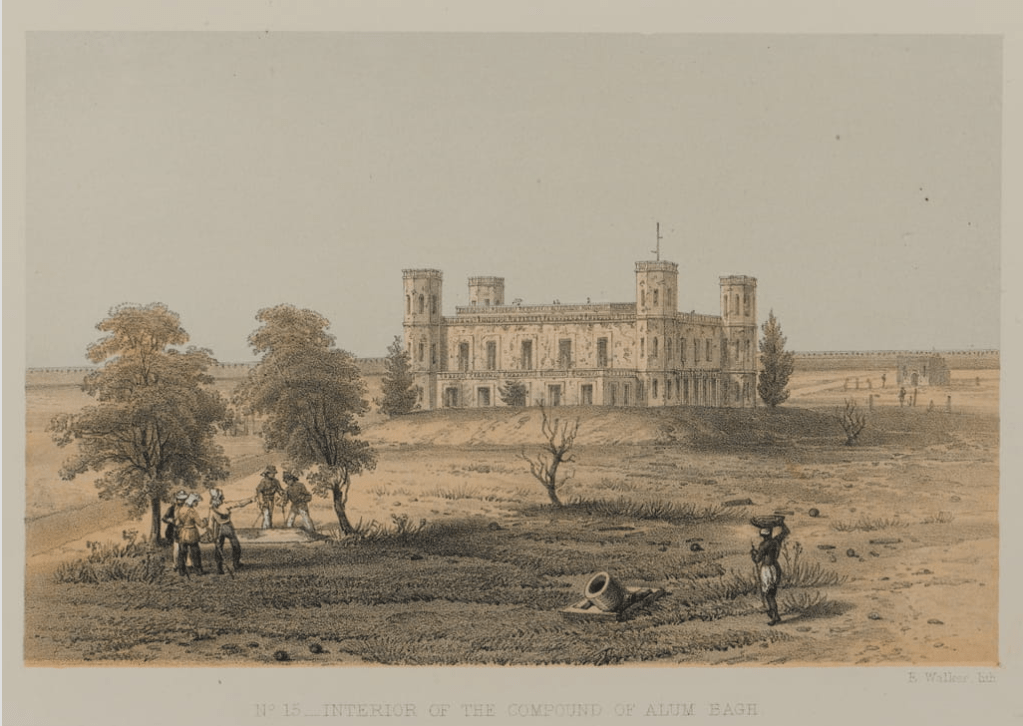
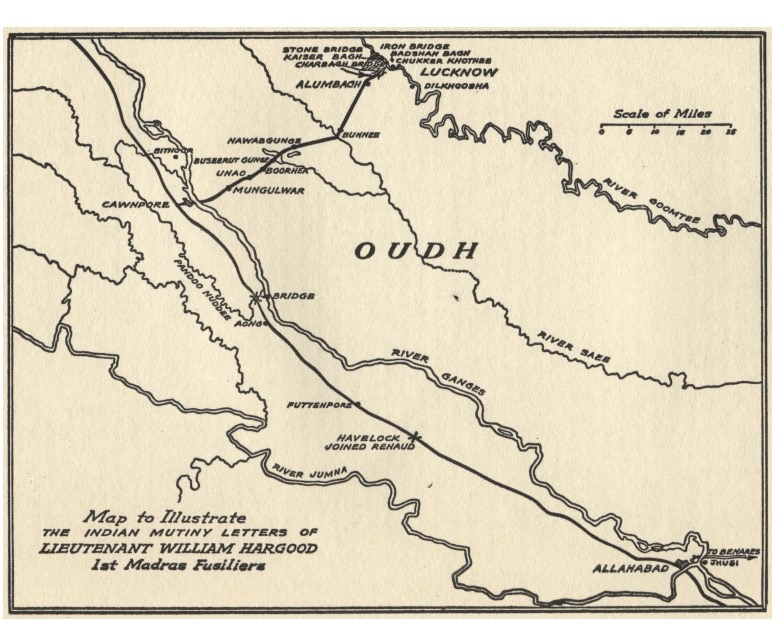
The retreat from Lucknow, was when all was told, a truly remarkable “strategic movement to the rear.” Sir Colin Campbell had managed, between the 23rd and 24th of November, in the face of some 20’000 rebels, to withdraw his men, along with the Lucknow garrison and his wounded — a further 2000 — his baggage, and guns without the slightest molestation to the Alambagh. Covering his retreat had been a division under Sir James Outram. Then gathered together his men and the carriage left behind by Sir Colin and rejoined him at the Alambagh on the 25th. The rebels, but for a moment, showed themselves to Outram’s force, but with the lessons of the past few days apparently still alive in their minds, they swiftly disappeared.
The next two days — the 25th and 26th — would be spent organising the march and planning the defence of the Alambagh, which Campbell insisted be held, come what may. As such, James Outram was left to hold a position that in all covered 10 miles (ca. 16 km) — extending across the Cawnpore road south-eastward to the old Jalalabad Fort. The men chosen for this noble enterprise were chosen from Havelock’s old army, those regiments that Outram had brought up from Allahabad and those of HM’s 75th Regiment. The European force consisted of 332 artillerymen, 292 cavalry, and 2071 infantry, and was further strengthened by 108 Indian artillerymen and 862 infantry. Among his numbers he counted not just Major Vincent Eyre, but that raging tower of a man, “Hell-Fire Jack” — William Olpherts. Over the coming months the Alambagh would play a pivotal role in the story of Lucknow — however, for now, we must turn our attention back to the march.
Sir Colin had several pressing worries, but the three foremost were the safe transportation of the ladies and children to Cawnpore, the movements of the Gwalior Contingent and the situation at Cawnpore. Having had no messages from Windham for nearly a week, he would essentially be marching blindly towards a station which, he sincerely hoped, was still in British hands. If not, the consequences would be dire. However, set off he must. Leaving the 4000 men at Alambagh Sir Colin took the rest of the force back to Cawnpore – 600 cavalry, 5000 infantry and 42 guns. He divided the force into six brigades:
1. Cavalry Brigade, commanded by Brigadier Little. Consisting of the 9th Lancers, parts of the 1st, 2nd and 5th Punjab Cavalry, and Hodson’s Horse.
2. Artillery Brigade, commanded by Brigadier Dupuis, consisting of Captains Peel’s Naval Brigade, Blunt’s, Remmington’s, Bourchier’s, Middleton’s, Smith’s, Longden’s, and Bridge’s Batteries.
3. First Infantry Brigade, commanded by Brigadier Greathed. This consisted of the 8th, 64th, and 2nd Punjab Regiments.
4. Second Infantry Brigade, commanded by Brigadier A. Hope, consisting of the 53rd, 42nd, 93rd, and 4th Punjab Regiments.
5. Third Infantry Brigade, commanded by Brigadier Inglis. This consisted of the 23rd, 32nd, and 82nd Regiments.
6. Fourth Infantry Brigade, commanded by Brigadier Walpole, consisting of the 2nd and 3rd Battalions Rifle Brigade, and a part of the 38th Regiment. (Mackenzie)
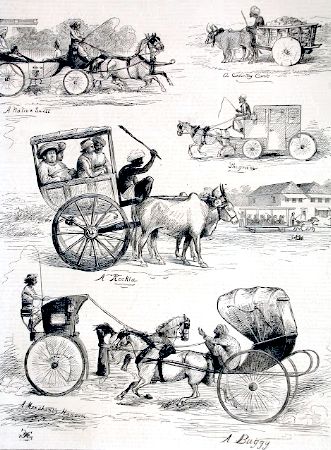
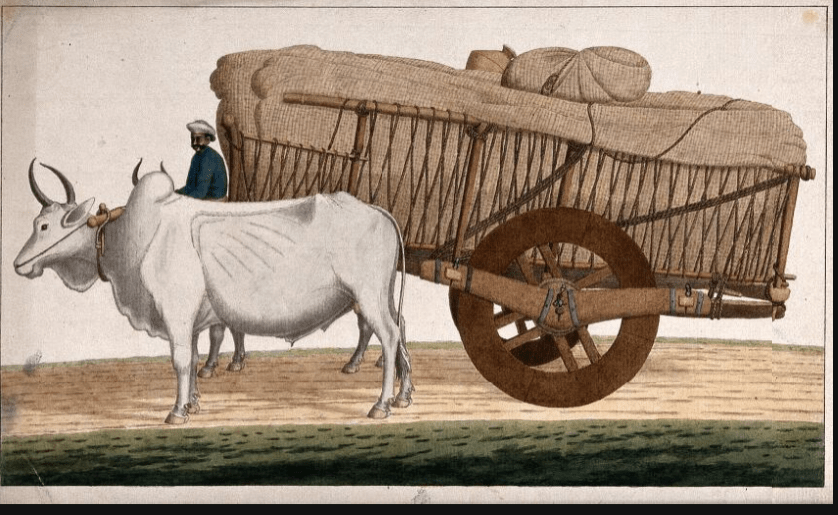
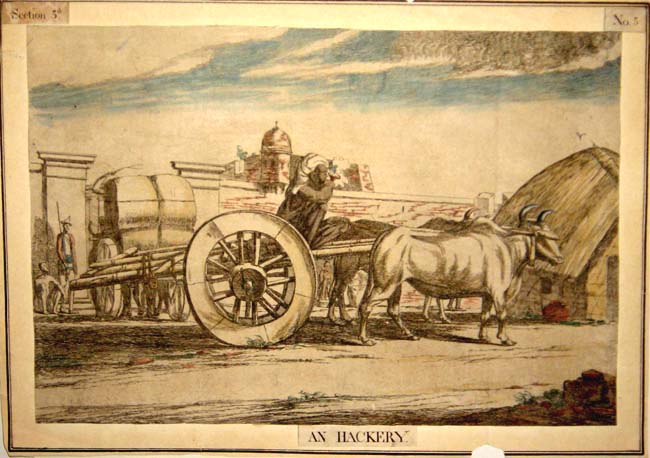
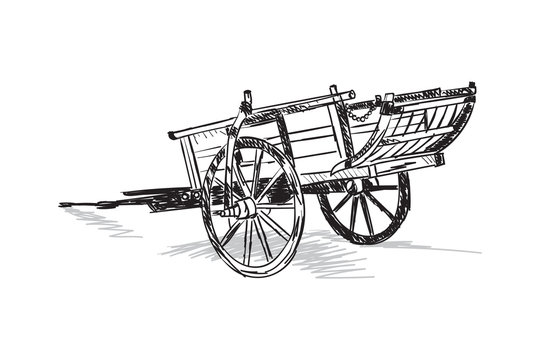
They set off on the 27th of November, and would cover most of the distance to Cawnpore in two days. It was, as Lieutenant Roberts witnessed, a “strange procession.” Every manner of carriage, hackery, and cart had been given over to transport the ladies and children; the camels were laden with baggage, and an endless stream of elephants, bullocks, coolies, and camp followers came in their wake. The narrow road was soon in confusion, but to stray from it was worse, for on both sides the land was, in places, still underwater. The column was soon 12 miles (ca. 19 km) long, “so that the head had almost reached the end of the march before the rear could even start.”
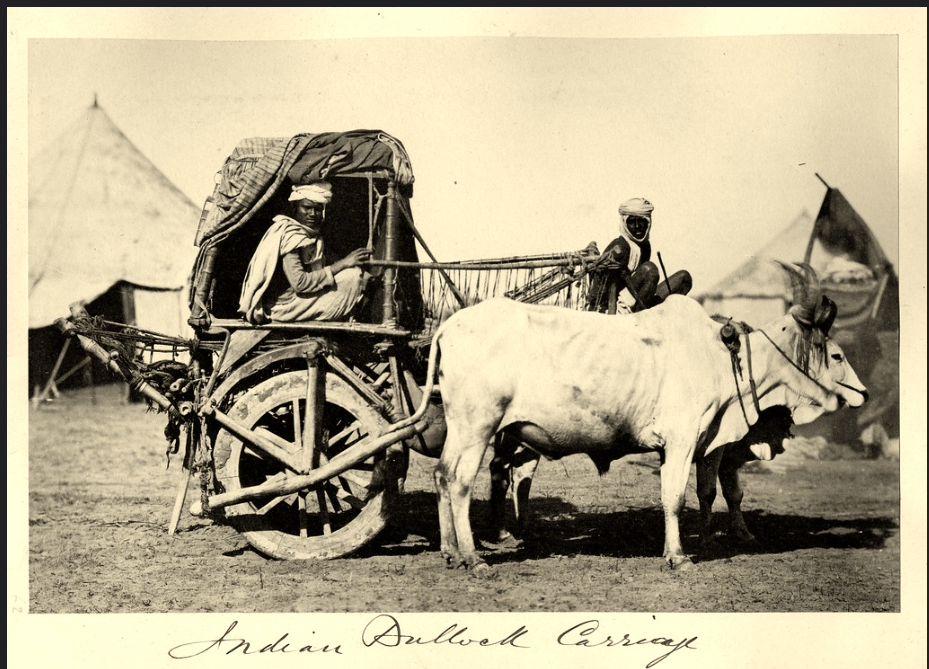
The next days would be the adventure the ladies felt they could have done without. Poor Kate Batrum found she had been left behind with the baggage and would be one of the last women to arrive at the first camping ground— after such an ominous start, she was hardly optimistic things would go well on the road to Cawnpore. The management of the ladies and children had been given over to Captain Edgell and for the next three days, he would be waging a campaign of his own. The carriages were drawn by starving horses and ill-fed bullocks, all of whom would stop along the road unable to move forward from fatigue; yet the worst Edgell had to face perhaps was the very real suffering the ladies felt — now, out in the open, away from the walls that had protected them for so long, they suddenly felt that death at the hand of a terrible foe was a very real prospect indeed.
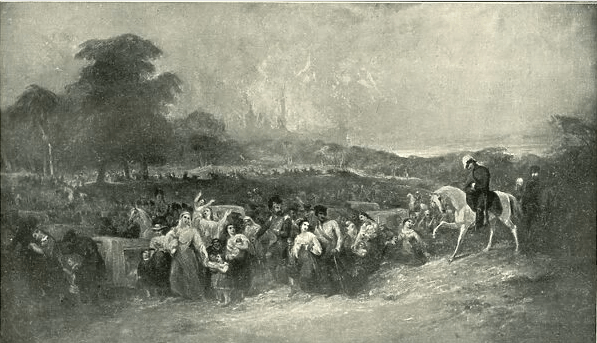
On the first day, things did not quite come together as planned. Leading the way was an advanced guard of Infantry with whom rode General Hope Grant, in command of the first division, with his staff. The intention was the refugees would follow, but only a few of the carriages had managed to get in line. “The rest were intercepted by artillery, baggage carts, and camels and struggling to maintain their place or to push on and join the foremost of their company as best they could.” Officers servants, eager to set up the first camp for the comfort of their employers, almost immediately diverged from the road with their baggage and cut back into the column wherever they found an opening. It sometimes “became necessary to stop a baggage cart at the point of a sword,” to allow the carts of the ladies to proceed.
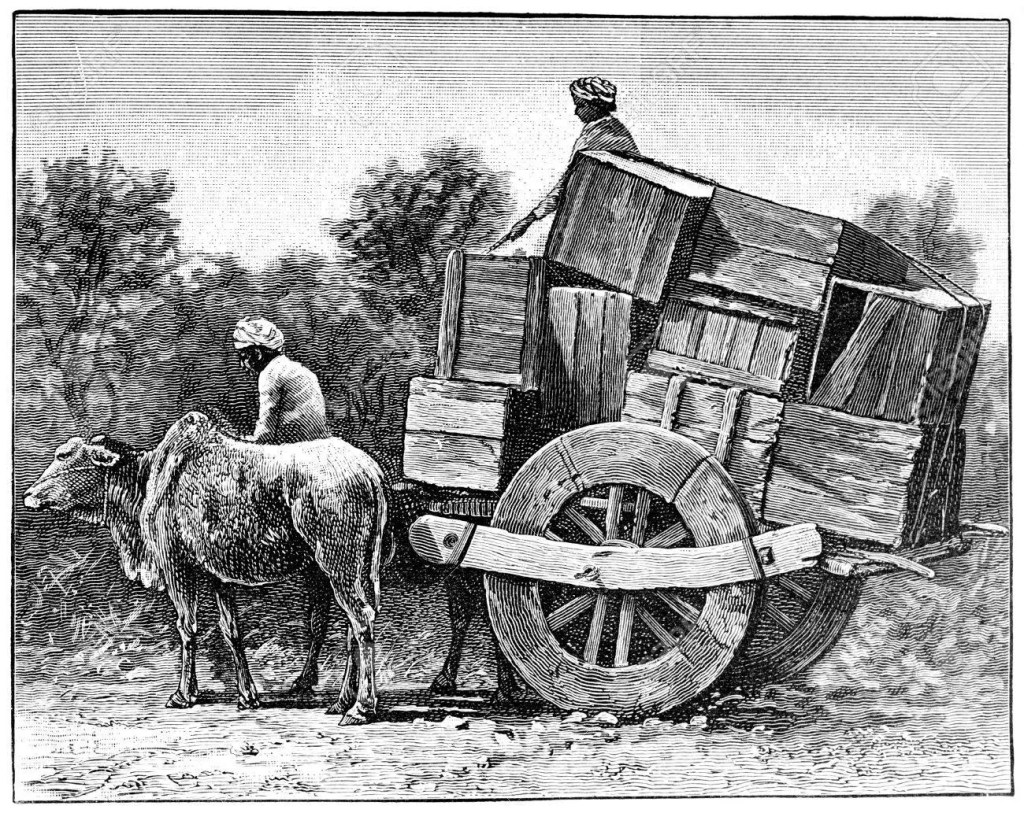
Married officers were allowed to remain with their families — some, like Dr. Fayrer for whom there was no place in the cart as it was occupied not only by his wife and child but other ladies who had sheltered in his house during the siege, would walk the entire route to Cawnpore.
Following on behind the refugees came a long string of 36 carts laden with prize property that included 8 barrels of precious stones, with the King’s jewels and treasure loosely packed in 118 ammunition boxes. The state prisoners (relatives of the ex-Nawab of Lucknow who had been kept for the duration of the siege, if circumstances required, to be used as bargaining chips in negotiations with the rebels) were guarded on the march, along with the carts, by Captain North, the nominated prize agent of the Residency, men of the Uncovenanted Services and Ruutz-Rees. North, for his part, complained he had been deprived of an adequate escort for this particular burden. However, in the chaos that was the march, it is hardly likely he was in any more danger than anyone else. The prisoners would eventually be handed over to the ex-king of Oudh at his residence in Calcutta, and North would hand over the treasure at Cawnpore.

Sir Colin Campbell and his staff on their horses went across the country, keeping parallel to the column at a distance of some 100 yards (ca. 91 m). Behind them rode Martin Gubbins and Lieutenant Henry Havelock. The cavalry was kept to the far left and the far right to keep a lookout. One of the ladies mistook them for rebels but was swiftly corrected before she started a panic. In all, Campbell had 4000 men and 25 guns to guard a column of nearly 2000 souls over miles of treacherous road.
For Alexander of the 93rd Highlanders, the march started thus:
“Paraded at ten a.m., after being on outlying picket since three p.m. yesterday; lay about in the sun till 1.30 p.m., when the 93rd moved off, with occasional halts for hours; then, doubling for miles did not arrive at Banni Bridge (13 miles) till about eleven p.m., too late to have my tent pitched, so bivouacked in the open, feeling the cold very much after the exposure to the hot sun all day. Of course, it was impossible to get anything to eat.”
A camp was pitched a mile beyond Banni Bridge — the first day’s march had only brought the column 18 miles (ca. 29 km) from Lucknow. While most of the ladies arrived by sunset, the stream of baggage, carriages, and animals would continue pouring in through the night. The bridge was fortunately in the hands of a detachment of Madras Infantry, sent by Windham to secure it in the previous days — Gubbins was astonished by the fine countenance and appearance of the Madras sepoys — he sadly remarks, “who had maintained their fidelity while that of our Bengalies had so signally failed…but for the radical defects of organisation and management, it (the Bengal army)would not have been found inferior in the essential qualities of a soldier: military honour and fidelity.”
While the ladies settled in for the night, Julia Inglis remarking she slept in her clothes, “as were becoming old campaigners,” there would be no ease for Sir Colin Campbell. From the direction of Cawnpore, there came the intermittent sound of guns. The Madras men said they had heard it throughout the day, but had no information to give. For Campbell, however, it was clear — the Gwalior Contingent was attacking Cawnpore. His choice was now to detach a portion of the men not needed for escort duty and push them on that night towards Cawnpore; while this would save a few valuable hours, Campbell could not be sure who was lurking before him and risking the men he had on what might prove to be fruitless endeavour was more than he could risk. Should Windham be lost, then the Bridge of Boats and the Entrenchment undoubtedly so. No small force he sent would, at this juncture, make much difference, should Cawnpore be in rebel hands. So, with these misgivings, he elected to wait for the morning, at least to allow for some of the straggling column to join the main body. He ordered the march to resume at 7 the next day. Campbell would need to cover the next 38 miles (ca. 61 km) with as much speed as possible if he was to arrive on time to save Cawnpore.
The march the next morning started as chaotically as the on the previous day. Many of the carts were caught up behind the artillery park, and officers scrambled about, shouting orders, rescinding them, and then giving them again, baggage carts shoved their way to the front of the tangle only to be forcibly stopped to allow for other, more pressing items, such as the guns and ammunition, to push forward. For over an hour, until the road could be cleared, the column stood still.
Meanwhile, the sound of firing from Cawnpore, which the day before had been ominous, now resumed into the long, relentless thunder of guns, growing louder with each mile. Just before noon, a messenger who had been hiding in a hedge sprang up and dashed towards the staff at the head of the advanced guard. The small note, rolled up in a quill, was written in Greek characters and addressed “Most urgent, to General Sir Colin Campbell, or any other officer commanding troops on the Lakhnao road.” It was dated the 26th of November. It stated that unless affairs took a favourable turn, Windham would be obliged to retreat to the entrenchment; the fighting was most severe and the rebels were numerous, and powerful, especially where artillery was concerned.
This in itself is curious: on the 26th, Windham had fought the Battle of Pandu Naddi and hostilities did not commence again until the 27th, so the note may have been dated incorrectly. Two successive messages contained intelligence that Windham had indeed been pushed back into the entrenchment, and the bridge of boats was in danger. Three salvos were fired from Bourchier’s battery to apprise Windham of Campbell’s approach, but it was doubted if they were heard; and if heard, most likely not understood.
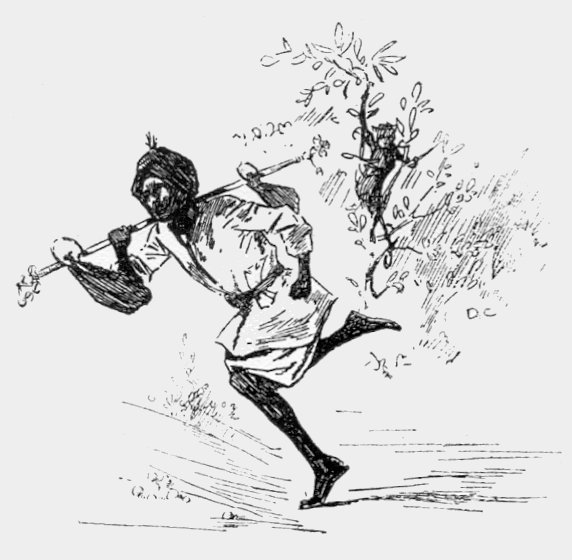
Sir Colin, impatient to find out what exactly was happening in Cawnpore, requested Lieutenant Roberts to ride with all speed to the river – if he found the Bridge of Boats broken, he was to return without delay – if not, he was cross, find Windham and bring back his report. Taking a few sowars with him Roberts rode off. On reaching the river he found a small hut which proved to be the guard house of a few British soldiers, under Lieutenant Budgen of the 82nd Foot. Budgeon’s “delight at seeing me was was most effusively expressed.” The bridge, he said, was not broken but the situation was precarious. Windham was effectively hemmed in on all sides, except the river and the garrison was “at its last gasp.”
Roberts quickly pushed across to the entrenchment and found, to his astonishment everything in the worst confusion. He could hardly make his way through the “mass of men who thronged around his horse,” each one eager to tell him what had been happening at Cawnpore. They were, in Robert’s estimation demoralized by the past day’s events and he quickly tried to reassure them that help was on the way.
When he finally found Windham, he was “in contrast to the excited multitude” a picture of calm, collected and not in the least dispirited by his retreat. He had “his wits about him” as he informed Roberts that although he had lost the city and the cantonment, the rebels were still being held in check at the Assembly Rooms (this would Carthew and his men), and the bridge of boats, due to the continuing efforts of his wholly inadequate force, was still safe.
Roberts, noting Windham’s report, prepared to return to Sir Colin Campbell, when suddenly the entrenchment broke into a loud cheer. He turned around and saw the Commander-in-Chief himself, riding towards him. After Roberts had left him, every minute that passed saw Sir Colin Campbell becoming even more impatient and “fidgety” that he set off after Roberts with his staff officers. Some of the men who recognised Campbell on his entrance had served with him in Crimea – in their estimation, a cheer was hardly enough to greet their beloved chief. They crowded around his horse, grasped at his hands, and more than a few muttered they were now truly saved. Leaving the cheering men behind him, Campbell went to find Windham. As one officer noted, “I will not state the few words I heard Sir Colin say to General Windham when they met, but may I say that he was angry.”

As Sir Colin could now judge for himself how things stood in Cawnpore, Roberts returned to Brigadier Hope Grant, who Campbell had left encamped at Mangalwar. On his way, he stopped to speak to Lieutenant Budgen, whom he found “in a most dejected frame of mind.” He had most unfortunately used exactly the same words to describe the situation in Cawnpore to Sir Colin as he had to Roberts and had so “roused the old Chief’s indignation” that Campbell flew into a rage, as he was apt to do when “seriously put out” and asked him how dare he say that Her Majesty’s troops were “at their last gasp.” Leaving the poor lieutenant to his misery, Roberts rode back to find Grant. Campbell had not left with only his staff; after requesting camp to be pitched on the sandy plain that was Mangalwar, handing over command of the convoy to Brigadier Inglis with Sir Hope Grant in overall charge, he ordered the cavalry and horse artillery to follow in his wake; the 93rd, with the ever- grumbling and persistently hungry Alexander were told at 4pm they were to have 2 hours rest and then proceed on to Cawnpore.
“The day had been oppressively hot, sometimes threatening rain, and the necessity of pressing on quite knocked up the European infantry of the whole force; for, company by company, the battalions seemed to dissolve along the road. Unable to keep together, the men trudged doggedly on, singly or in little groups, and I doubt if there were one hundred men with the colours of my own regiment when they marched on to the camping – ground about ten p.m., where the native followers, as they straggled in with the tents and baggage, proceeded to pitch our camp not far from the Oudh end of the bridge of boats. On to this camping – ground not only ‘the guns, stores, women and sick continued to stream all night,’ but the fighting men of the little column itself kept coming in till sunrise.”
At this point, Alexander had little to complain of. He had neglected to procure himself a pony, as directed to do all those weeks ago at Cawnpore, as at that moment he felt it was wrong for officers to ride when their men walked. Realising now how wrong he had been, as “officers should be fresh enough to first look after their men…before attending their own wants,” he was so tired after this particular march he was “incapable of looking after himself” much less his men. All he could do was sink to the ground, now tentless and supperless, while he waited for the servants to bring up the tents. They did but by the time the tents were pitched, it was midnight.
Many of the ladies arrived shortly after midnight, Maria Germon “nearly had the life jolted” out of her by the springless hackery she was riding on, her husband Charlie dragging himself along beside it until he could no longer bear to walk. It took them another 2 hours to find their allotted tent with “Mrs. B.” – the baggage did not arrive until the next day and all they had for supper was a cup of tea. Kate Bartrum arrived at 3 in the morning, once again with the baggage, and had no tent at all. She sat on the wet ground with her baby boy in her lap until daybreak. “It was a lovely night; the stars were shining so brightly; but it was bitterly cold: no one came to speak to me. Who was there in that host of my fellow creatures to care whether I was living or dead? I felt that night as though I was forsaken by God and man. There was only little baby to care for me.”
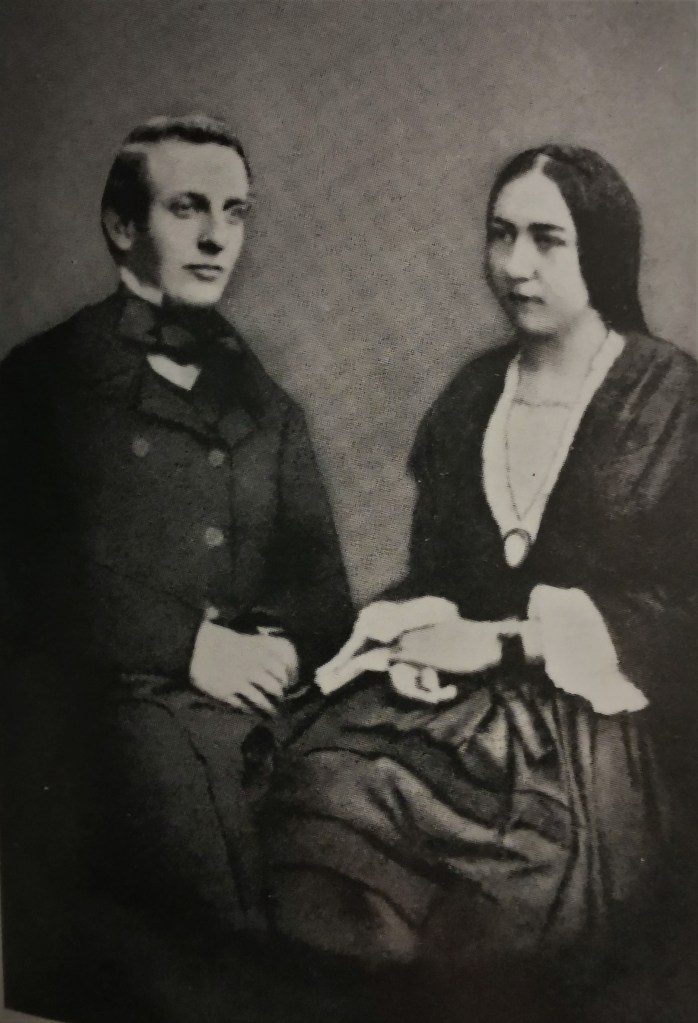
No one indeed noticed poor Kate. Julia Inglis had taken her goats with her from Lucknow and she cooked up some arrowroot for her baby and gave her boys some warm milk. Reverend and Mrs Harris had been able to snatch a few loaves of bread from the Commissariat before the march started and now Mrs Inglis offered them a tin of oxtail soup. Mrs Case offered the Inglis boys some bread and butter. They had been among the first to arrive at the camp – already at 10pm – and went to sleep soundly in their tents, while Kate Batrum shivered on the plain. There is no denying, at this point, although the widow of a surgeon, Kate Bartrum was without those friends who would have helped her in these most trying times. The friend – Mrs. Clarke – she had escaped with from Gonda was dead, kindly Dr Darby was lying in his grave, and the men who had come up with her husband in September were attending to the sick and wounded of their regiments; no one else seemed to remember a poor widow with her baby.
Well after dark, Sir Colin Campbell returned to Mangalwar. He informed his officers that Windham had indeed been driven back into the entrenchment, something they could see for themselves as lurid flames from the burning buildings – the Assembly Rooms among others – leapt up into the night sky. Little did they realise at that moment they were watching their belongings being turned to ash – most of the camp equipment, kits, clothing and personal baggage belonging to most of the regiments that crossed into Oudh had been stored there, something Carthew had given his all to prevent. This disaster would be revealed to them the next day; for now, the issue pressing Campbell the most was the fact the road was now open for Tantia Tope to move his heavy guns towards the Bridge of Boats and Windham’s entrenchment. He would need to act – not just to save Cawnpore but the convoy. As one of his officers put it, “The veil which had so long shrouded us from Windham was rent asunder, and the disaster stood before us in all its calamity.” However, Colin Campbell already had a plan.
The 29th of November
At 2 in the morning, the 93rd Regiment was roused and paraded, “by some ill-judged order to that effect” – after being left standing about for over an hour, they were ordered back to their beds. For his part, Alexander was sleeping so soundly that he did not hear Peel’s guns trundle by at dawn. For their part, Peel and his men, with their lumbering bullocks lugging the 24-pounders behind them, had not reached the camping ground until an hour before sunrise; their bullocks were hardly out of their yokes when the order came to proceed directly to the river bank. Here they rested for one hour and ate their hasty breakfasts.
Tantia Tope once again, was wide awake to what was happening. He had noticed the plain across the river slowly filling up with soldiers, baggage and guns. During the night he had gathered a measure of what army he was now facing and he realised the only way to save his position now and defeat the British would be to break the Bridge of Boats. During the night he brought up his heavy guns to the positions on the river from whence he had driven the 64th the day before and shortly before dawn, opened fire. Unfortunately for him, his gunners were not as able as him and missed the bridge. Sir Colin had reckoned this would be Tope’s opening salvo – he now sent Peel and his guns to a point just above the Bridge of Boats from where they could “play on the enemy’s guns.” Windham had been directed, as soon as heard the first fire from Peel, he was to open up his guns from the entrenchment.
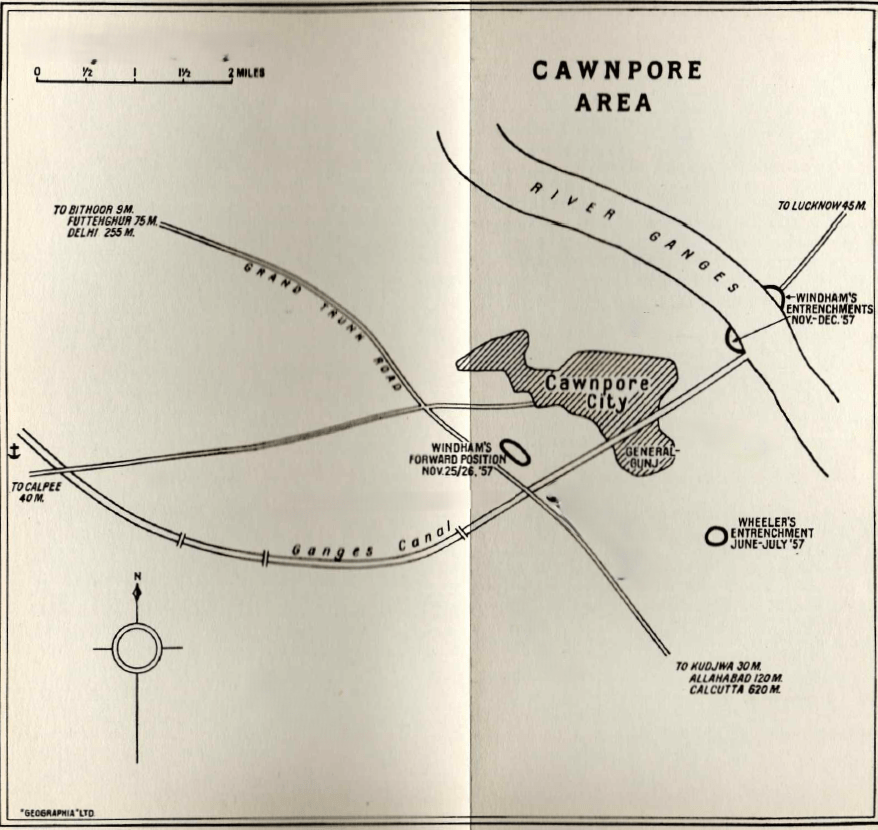
Back at Mangalwar, the ladies had been hoping for a day of rest. Instead, at 10 am they were ordered to change camp, a half mile closer to the river. From a small hill, they could watch as the rebels set fire to what remained of Cawnpore. They were told not to get too comfortable in their new camp – something Maria Germon was positively sorry about as she had found a nice “turfy spot” for her tent – for that night they would move to Cawnpore. All the men, except Brigadier Inglis, the tattered remains of the 32nd and the volunteers of the old garrison who were left to guard the camp, had been withdrawn. As they sat and waited, Mr Gubbins lamented. He had “hoped that we had done with the alarms of war for some time to come; sot that booming of the heavy guns, which continued throughout the whole day of Sunday, the 29th of November, and the smoke of which could be clearly seen across the river, was nowise a welcome sound.”
The danger was hardly over. Sir Colin was playing a very daring game with Tantia Tope. Tope, who had the advantage of the city, and the upper course of the river could very well have attempted to divide Campbell from the near defenseless camp on the other side of the Ganges. Campbell, however, did not allow himself to become trapped.
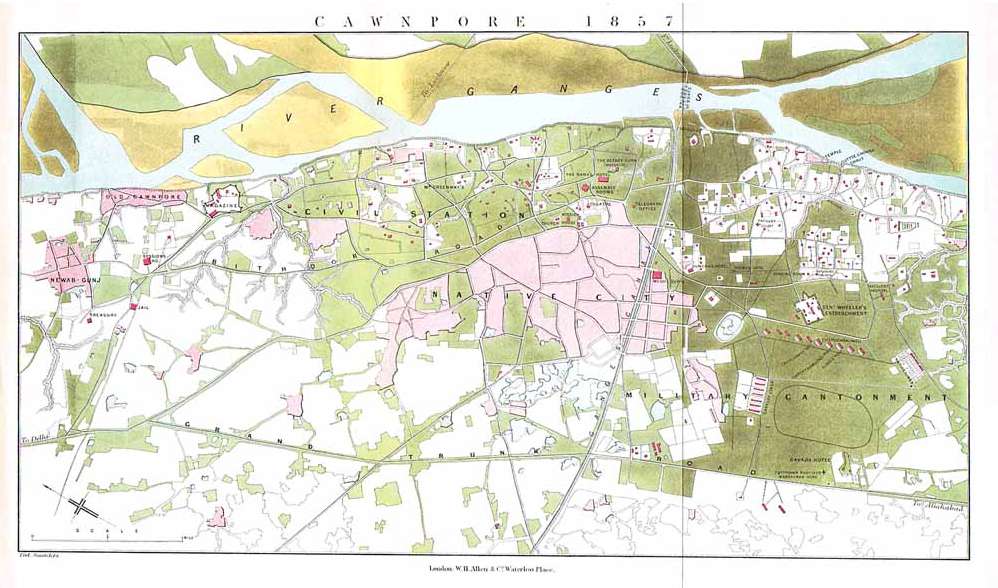
A little after 6 in the morning the 93rd after “some sort of breakfast” the tents were struck and the men moved out. They marched across the Bridge of Boats around 2 hours later, with the rebels still distracted by Peel. As they passed the entrenchment, Windham’s men cheered them “vigorously, whilst we marched steadily past as if on a field – day, with sloped arms, across the glacis, our pipers playing before us, and the enemy attempting to pepper us with musketry and round – shot all the time.” They marched to the ruins of the artillery barracks and near the old native infantry lines, near Wheeler’s Entrenchment. Their tents were pitched during the day. Campbell had accompanied the column as far as the Bridge of Boats. He then directed Hope Grant with the Horse Artillery and nearly all the Cavalry, Bourchiers Battery and Adrian Hope’s Brigade to follow the 93rd to the south-east end of the city and take up a position on the open ground which stretched from the Windham’s Entrenchment on the left, and the extreme left resting on the Grand Trunk Road.
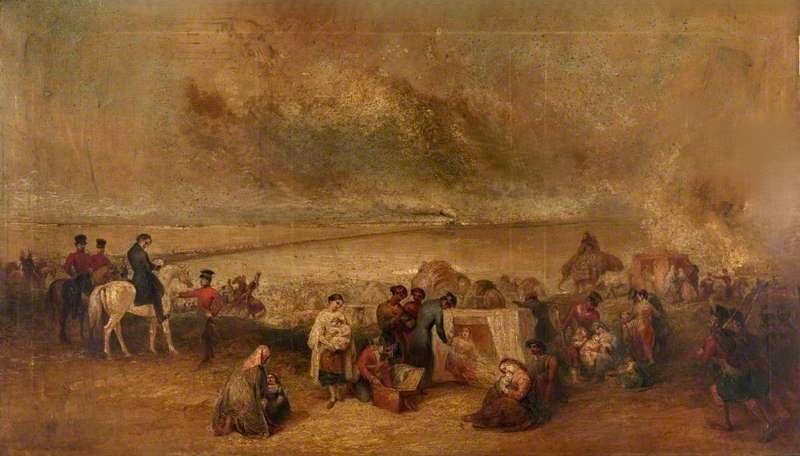
For now, Campbell was satisfied the rebels had been pushed back far enough to allow for the convoy to begin crossing the bridge. The first conveyances approached the bridge at 3 in the afternoon and the procession would only end 30 hours later.
” A procession of human beings, cattle and vehicles, six miles long is coming up…The variety of colour in the sky and on the plain, the native servants, the long train of cavalry, infantry, women, children, sick, wounded, bearers, camp followers, horses, oxen camels, elephants, waggons, carts, palanquins, doolies, advancing on the road; and here, within the entrenchment, the crowd of camels and horses, the rows of cannon, heaps of shot, piles of furniture…produced a very picturesque effect…”
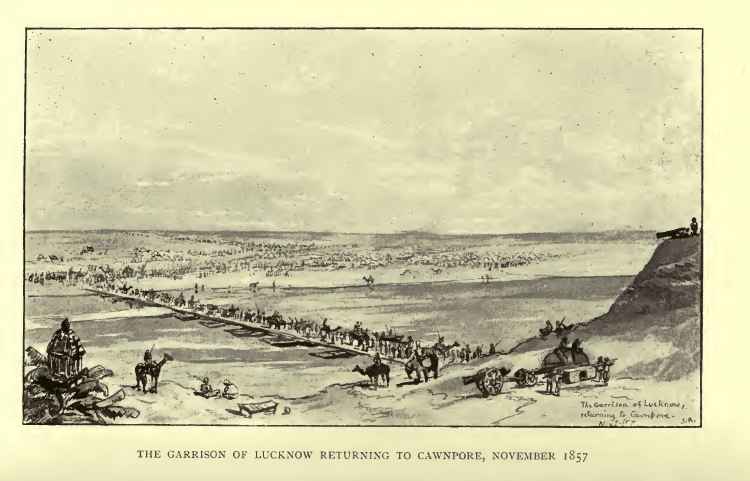
For Mrs Inglis, the crossing was a fright. Although only half a mile from the Bridge of Boats when the column started to move, owing to the sandy road and the crush of carriages, it took her 2 hours to reach it. As soon as her carriage started to cross, a sharp fire of musketry opened from the other side and she could clearly see the flashes from the muskets. Worried the advance guard had been attacked, she was relieved, when halfway over, it suddenly stopped. Brigadier Grant rode over to speak to the ladies – it was not an attack he said and he hoped she had not been alarmed: the firing he said had not been the rebels at all but the British pickets. Somehow, Mrs Inglis found this most reassuring. As soon as they were over the bridge, the column ground to a halt once again. During the interlude, an artilleryman, “who was not very sober” tried to entice the ladies in the carriage to visit the entrenchment. Declining his most sincere offers, the ladies moved on. Behind them, Mrs Harris’ carriage stuck fast in the sand; the bullocks pulling it decided it was high time for rest and “it seemed as if they were going to die; and we were left miles behind everyone else…” With the help of a few sailors, the carriage was pushed onwards and the bullocks prodded back to life. Interestingly enough, for women who had been fired upon almost incessantly for over 5 months, the bridge proved a trial they found the hardest to bear. With only one exception, they all recorded they had never felt more frightened in their lives. The nearness of the musketry fire, even if it was from their own troops, led Mrs Harris to write, “I never, during the whole siege, more thoroughly realised such an extreme sense of near-impending danger, and how very close death might be; one felt as if the very next instant perhaps might be one’s last.” Only Kate Bartrum simply records being fired on at the bridge, but as she took 10 hours to reach the camping ground, the event was no worse than the last few days had been.
The bright moonlit night revealed the horrors of Cawnpore. They passed the ghostly shells of the ruined houses with their broken gates, the remains of gun carriages, and all the trees, which had lined the once pleasant roads had been cut down and were lying on the ground with their branches stripped off. Their camping ground for the night had not been chosen for its beauty – it was the artillery barracks, sadly close to Wheeler’s Entrenchment. For one lady, called “Mrs S.” in Maria Germon’s account, it must have been a most trying night – she had given birth that very morning in her doolie and now, here she was, in what could be called the saddest place on earth holding a new life in her arms. The ladies had arrived in Cawnpore.
Sources:
Adye, John. Recollections of a Military Life. London: Smith, Elder, & Co., 1895.
Bartrum, Katherine Mary [Mrs. R.]. A Widow’s Reminiscences of the Siege of Lucknow. London: James Nisbet & Co., 1858.
Bourchier, George. Eight Months Campaign against the Bengal Sepoy Army during the Mutiny of 1857. London: Smith, Elder, and Co., 1858.
Case, Adelaide [Mrs. A.]. Day by Day at Lucknow: A Journal of the Siege by the Widow of a Regimental Officer. London: Richard Bentley, 1858.
Ewart, John Alexander. The Story of a Soldier’s Life; or, Peace, War, and Mutiny. Vol. 2. London: Sampson Low, Marston, Searle, & Rivington, 1881.
Forbes, Archibald. Colin Campbell, Lord Clyde. London: Macmillan and Co., 1895.
Germon, Maria Vincent [Mrs. R.C.]. A Diary Kept by Mrs. R. C. Germon, During the Siege of Lucknow. London: Waterlow & Sons, 1870.
Gordon-Alexander, William. Recollections of a Highland Subaltern: During the Campaigns of the 93rd Highlanders in India, under Colin Campbell, Lord Clyde, in 1857, 1858 and 1859. London: Edward Arnold, 1898.
Gubbins, Martin Richard. An Account of the Mutinies in Oudh, and of the Siege of the Lucknow Residency. London: Richard Bentley, 1858.
[Harris, G.] A Lady’s Diary of the Siege of Lucknow: Written for the Perusal of Friends at Home. London: John Murray, 1858.
Inglis, Julia Selina. The Siege of Lucknow: A Diary. London: James R. Osgood, McIlvaine & Co., 1892.
Mackay, James [Rev. John]. From London to Lucknow: With Memoranda of Mutinies, Marches, Flights, Fights, and Forays. 2 vols. London: James Nisbet & Co., 1860.
Malleson, G. B. History of the Indian Mutiny, 1857–1858, Commencing from the Close of the Second Volume of Sir John Kaye’s History of the Sepoy War. Vol. 2. London: Wm. H. Allen & Co., 1879.
Norman, H. W. A Lecture on the Relief of Lucknow, Delivered at the Simla Institute on the 7th of August 1867. Simla: Printed at the Government Central Press, 1867.
North, Charles Napier. Journal of an English Officer in India. London: Hurst and Blackett, 1858.
Roberts, Frederick Sleigh. Forty-One Years in India: From Subaltern to Commander-in-Chief. Vol. 1. London: Richard Bentley & Son, 1897.
Ruutz-Rees, Leopold Edward. A Personal Narrative of the Siege of Lucknow: From Its Commencement to Its Relief by Sir Colin Campbell. London: Longman, Brown, Green, Longmans, & Roberts, 1858.
Verney, G. L. The Devil’s Wind: The Story of the Naval Brigade at Lucknow, from the Letters of Edmund Hope Verney and Other Papers Concerning the Enterprise of the Ship’s Company of H.M.S. Shannon in the Campaign in India, 1857-58. London: Hutchinson, 1956.
 Mutiny Reflections