On 15 April 1858, Lieutenant Hamilton of the Sikh Cavalry was having a bad day of it, and as events would tell, it was also his last. Unhorsed and gravely wounded, he was on the ground, still half-conscious that the battle was raging around him. Tulwars slashed at the injured man; helpless and unable to fend off his assailants, Lieutenant Hamilton should have met the fate of many of his compatriots in the Indian Mutiny – hacked to pieces on the battlefield, unrecognisable and very much left for dead.
However, while Hamilton may no longer have realised it, help was at hand. Lieutenant Middleton, according to Malleson, arrived first. Still on his horse, he fended off one attacker after another — it might have told poorly for Middleton had not two men from the Military Train, Private Samuel Morley and Farrier Murphy, put in a timely appearance. From here, the narrative is somewhat confusing. Morley, whose horse had just been shot under him, was on foot; seeing Hamilton’s predicament, he rushed up, sword in hand, to render any assistance, however small, to the wounded man. Almost simultaneously, up came Farrier Michael Murphy, still on his horse. Slashing with his sword, he sent one attacker to his maker and made short work of a few more. With Morley struggling to get Hamilton up, Murphy dismounted and tried to help. Middleton, in the meantime, was doing what he could to keep the assailants occupied, but both Murphy and Morley were badly wounded in their gallant struggle to save what was left of Lieutenant Hamilton. Despite their own wounds, Morley and Murphy managed to carry Hamilton off the field to his last bed on this earth, a doolie. Both men would receive their rewards, but as fate would have it, there was no VC for Lieutenant Middleton, whom no one else recalled seeing, or any accolades for the Sikh troops who finally descended on the rebels. Hamilton, after all, was one of theirs, and they covered his final escape.
Michael Murphy – Farrier, 2nd Battalion, Military Train
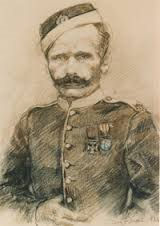
“For daring gallantry on the 15th April, 1858, when engaged in the pursuit of Kooer Singh’s Army from Azimghur, in having rescued Lieutenant Hamilton, Adjutant of the 3rd Sikh Cavalry, who was wounded, dismounted and surrounded by the enemy. Farrier Murphy cut down several men, and, although himself severely wounded, he never left Lieutenant Hamilton’s side until support arrived.” (No. 22268, The London Gazette, 27 May 1859, p. 2106)
Born on 5 September 1831 in Cahir, Co. Tipperary, Ireland, the son of John Murphy, blacksmith, and his wife Honora (née Sheehan). Where he was schooled is unknown, but it appears that at some point he followed his father’s footsteps and took to the anvil. In 1854, he married Mary Ann Walsh, but before happier days could come to pass, Michael Murphy seems to have changed his mind about blacksmithing and perhaps even marriage, for at the age of 22, he enlisted in the 17th Lancers at Cork, receiving a welcome bounty of £ 9. The Lancers themselves were in the Crimea at the time, where they were having a hard time of things; as it was, Michael trained at the Portobello Barracks with the 16th Lancers and then returned to the 17th, who happened to be based in Cahir. On 18 October 1856, along with forty-one other men, Murphy was transferred (or volunteered) to the Military Train. Standing only 5’3″ but experienced with horses and being a blacksmith by trade, Murphy was lucky enough to join this branch of the army, a forerunner of the Army Service Corps, and he received another bounty, this time £21.
Had it not been for the mutiny, the 2nd Battalion Military Train might never have set foot in India, as they had initially been destined for China. They sailed in the direction of Hong Kong in April 1857, but as their luck would have it, their ship was diverted, and they landed in Calcutta instead on 27 August. From here, under Major Robertson, the Military Train took on the role of light cavalry and found themselves in the thick of things, kicking off their India experiences with the relief of Lucknow in November. As events unfolded, the 2nd Battalion would find themselves as a part of the Azamgarh Field Force.
For Murphy, things could have gone better that day. Saving Hamilton cost him his active service, and for his pains, he received agony, with five brutal wounds that would have him invalided to Calcutta for the rest of the year. In early 1859, the 2nd Battalion Military Train left India, and presumably, Murphy sailed with them. However, he would spend some weeks at the Invalid Depot in Great Yarmouth before re-joining his regiment at Aldershot. The London Gazette announced Murphy’s VC on 27 May, and he would receive his medal personally from Queen Victoria at a parade at Windsor on January 4 1860. With the annual payment of £10 for the VC, a promotion to farrier sergeant, which again boosted his pay, Michael Murphy was doing well. It is unclear what happened to his first wife, but on 7 April 1860, he married Mary (née Fox), the daughter of Bernard Fox, a labourer. His wife, presumably a widow, already had at least two children, and together, they would have a further three. His personal life, in this regard, is somewhat unclear, a commotion caused by the entry on his gravestone, but since we have not buried Michael Murphy yet, we shall return to his story.
For the next 10 years, life went well with Farrier Sergeant Murphy. He remained with the Military Train, serving briefly in Canada and at the Royal Military Academy in Sandhurst. When the regiment was disbanded in 1870, he joined the newly formed Army Service Corps, but for reasons unknown, a year later, he transferred to the 7th Hussars, based at Aldershot. He would have been better off anywhere else. On 26 January 1872, Farrier Sergeant Murphy, aged 41 and likely looking forward to a decent retirement, made a terrible mistake, and it changed his life forever, for on that very day, he was arrested and accused of theft. The circumstances were murky at best.
A labourer, named James Green with a horse and cart, was stopped at the Aldershot gates by Farrier Major James Watt. Quick on the uptake, Watt had noticed that Green had arrived with an empty cart, but 20 minutes later, this was no longer the case. On taking a closer look, the cart was found to contain a bag of oats and some hay. When questioned, Green replied Murphy had given it to him. “The feed, kept in the boiler room, was for sick horses. Murphy was questioned and reportedly said, “For God’s sake, look over it, or I shall be a ruined man for life.”
Both Murphy and Green were arrested for theft. On 2 March, both men appeared at Hampshire Lent Assizes, in Winchester, with Murphy wearing not just his India campaign medal, but his VC.
The value of the goods presumed stolen was £1 7s, but the fact that a Victoria Cross recipient was involved was considered shocking. Murphy explained to the court he had “asked for the oats and hay to be moved because they were surplus and he wanted to give them to underfed horses of his own troop.” Green’s story was hardly different from Murphy’s – he had been asked to move the goods from one place to another, and when he was stopped, as then confirmed by Major Watt, he was only two yards from the main gate. The problem was not the story, which was plausible enough, but the judge.
Their case was being seen to by Mr Baron Bramwell, described in legal circles as “domineering, entertaining and consciously concerned to mould the law to ends in which he favoured.” He accused Murphy of making “lame excuses” and then admonished him for wearing his VC in court, presuming he had done so to win sympathy and “win over the court.” While Murphy now looked like a rascal, the judge remarked that Green, in fact, looked innocent. And things only got worse from here, for the jury would find Murphy guilty and let Green go. As reported by the Hampshire Telegraph, “He (the judge) was sorry a man with so excellent a character, and who had seen so much service, should commit such a crime, but it could not be tolerated that sergeants should take corn in this way.”
The jury asked Bramwell for leniency for Murphy; instead, he gave him nine months with hard labour, to be served at the county’s House of Correction. On the same day, Murphy was demoted to private. To add more salt into already sore wounds, on 5 March, his VC and the accompanying pension were forfeit due to his conviction, and Murphy was told to return the decoration to the War Office. However, at some point between the 2nd and 5th of March, his VC disappeared and would remain lost for the next 26 years.
On 30 November, Murphy was released from prison. Clearly, there was not only some sympathy for him, but likely ire at the judge’s ruling for Murphy was allowed to rejoin the 7th Hussars, which had now moved from Aldershot to Hounslow. Unfortunately, Murphy was not well – his India wounds and hard labour had taken their toll on a man who was now into his forties. Hospitalised repeatedly over the next two years, he finally left the 7th Lancers, and in 1874, he transferred to the 9th Lancers, but to his consternation, they were destined again for India. Murphy chose not to join them but transferred to the 5th Lancers instead. With his health broken and his army life effectively over, Murphy was discharged in February 1875 after 19 years and 5 months of service, but 2 years and 2 months were forfeited. His discharge allowance came to 20 shillings.
After leaving the army, Murphy and his family appear to have moved several times, and he took up his old profession once again as a blacksmith and ended his days working as a labourer in an ironworks in Darlington. His wife died, and his children moved away or, as the case might be, died for the Queen in a few more little wars, leaving Murphy alone. However, help did come to him, and it came in the form of Sir Henry Havelock-Allen, who, upon hearing that Murphy was in a dire way, provided him with a cottage on his Blackwell estate near Darlington in 1891. Sir Henry also managed to secure for Murphy a government pension. Michael Murphy died 2 years later on 4 April 1893 of pneumonia and lies buried at North Road Municipal Cemetery in Darlington.
Once again, Sir Henry Havelock-Allen took pity on the old soldier (whom he would have known from the Azamgarh campaign), and instead of an unmarked pauper’s grave, one-time Farrier Sergeant, Private Michael Murphy, VC, was given a handsome headstone, which reads:
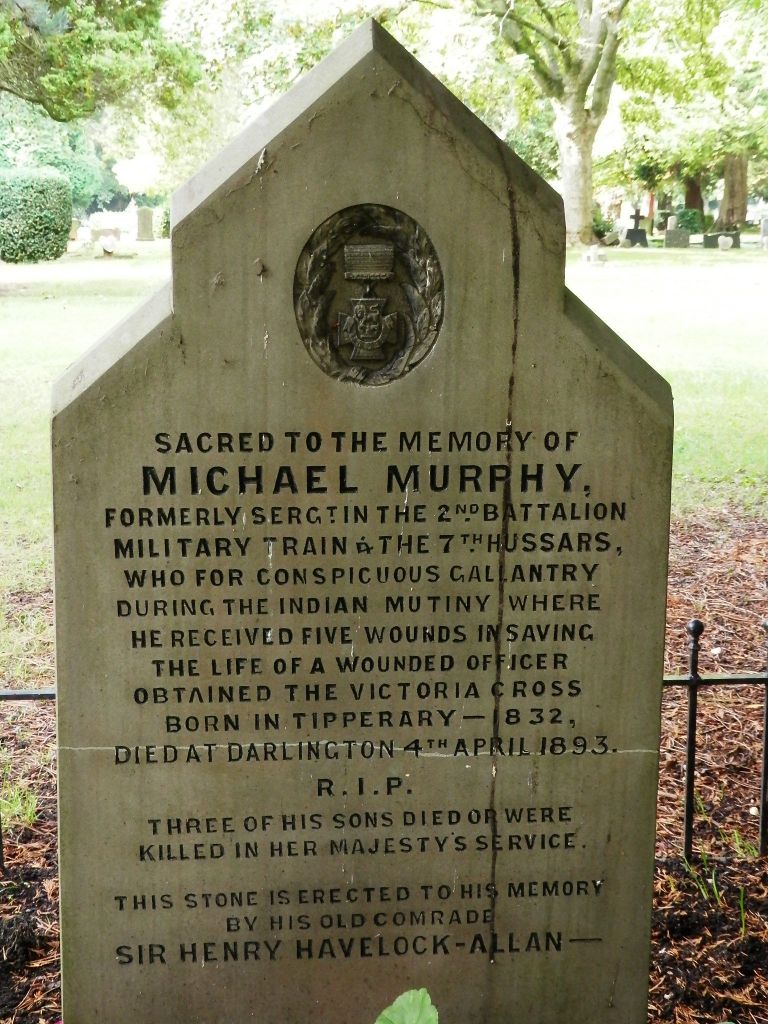
Two questions remain – who were his sons, and what happened to his VC? Neither question has a simple answer. His only heir at the time of his death was his niece, Bridget Mary Anne Dobson, who, along with her husband, Thomas Dobson of Darlington, was caring for Murphy and even residing under his roof for a time. It is known that Murphy had three other children, all of whom were still alive at the time of his death. So the three sons mentioned on his gravestone were either from his previous marriage or may even have been his stepsons. It is unlikely something as worthy of note as this would have been an error, but as yet it has proved difficult to accurately identify them. The current belief is as follows:
James Ballard, an alleged stepson of Murphy and a colour-sergeant of the 1st Battalion 24th Regiment of Foot, who was killed at the Battle of Isandlwana on 22 January 1879
A sergeant of artillery who was killed at Tel-el-Kebir on 13 September 1882
A corporal of the Durham Light Infantry who died on the Nile in 1885.
As for his VC, it suddenly reappeared in June 1898, when it was offered, anonymously, for sale by auction. Where it had been in the intervening years is a mystery, although the Cahir Social and Historical Society rather quaintly puts it as being “under somebody’s bed.” Obviously, the old regiment still had regard for Michael Murphy, for the VC finally returned home, and it is still held in high regard.
” It was bought by Master Sergeant Masterman on behalf of the Army Service Corps, at Aldershot. This medal was presented to the RASC, which has since been subsumed into the Royal Logistic Corps, based at the Princess Royal Barracks, Deepcut, Surrey. Murphy’s actual medal is now owned by a regimental trust and can be viewed, but only by prior arrangement with the Royal Logistic Corps Museum.”
On April 15 2008, Trooper James Howell presented the VC at his great-great-great-grandfather’s grave, 150 years to the day of Farrier Sergeant Michael Murphy fighting for life and limb at Azamgarh. Present at the ceremony were other members of his family, the Mayor of Darlington and representatives of the British Legion.
 Mutiny Reflections