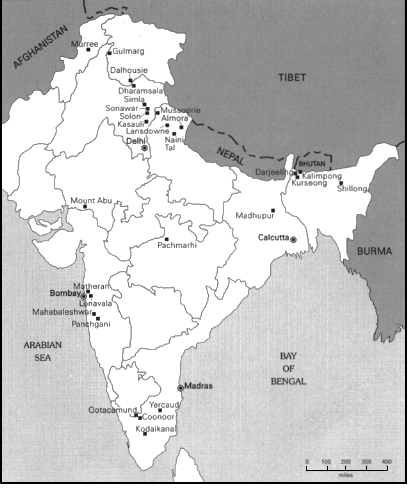
On a wooded ridge at a respectable height of 6,335 feet above sea level, sits the town of Kasauli. One of the three early hill depots of the EICo, its purpose was the same as Simla (but with less lofty residents) – to provide families and some troops an escape from the hot weather in the Plains. Founded in 1842 as a military station, it served, besides the convalescence aspect, as a strategic base for British interests in the Punjab, allowing men to be stationed in a healthier climate but still close enough for duty in the Plains if needs be.
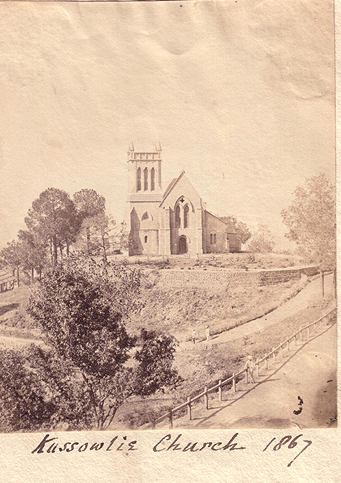
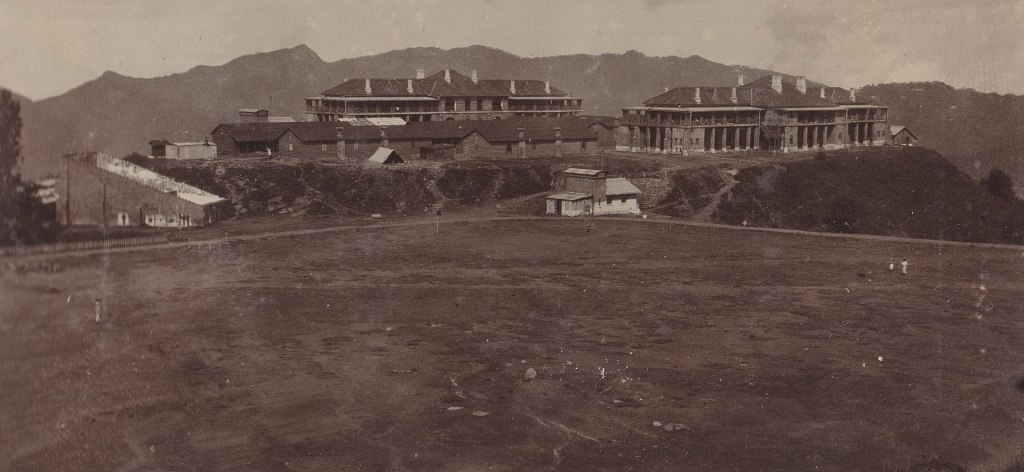
While most of the hill states were returned by the British to their original rulers after the Nepalese rescinded control of territories they had occupied in the hills viz the Treaty of Segauli, three-fourths of the unfriendly Baghat state’s property (they had not cooperated with the British during the Anglo-Nepalese War and the EICo had a long memory for such grievances) was sold off with the British holding onto part of it, while the rest was sold to the friendlier Patiala State. The rest was restored to Rana Mahinder Singh. Since he died without an heir, the state was treated as lapsed. It was then restored to the brother of the deceased ruler in 1842, but the Kasauli land was bought by the British for a sum of Rs 5000 and an annual payment of Rs 507 in 1842 – in the same year, they built the first structure in Kasauli – the military barracks. The church followed in 1844.
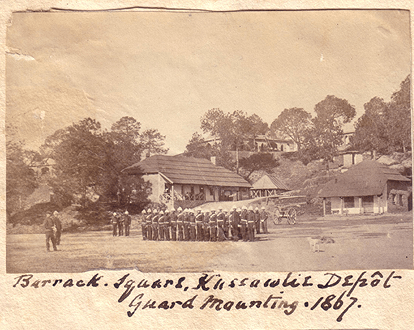
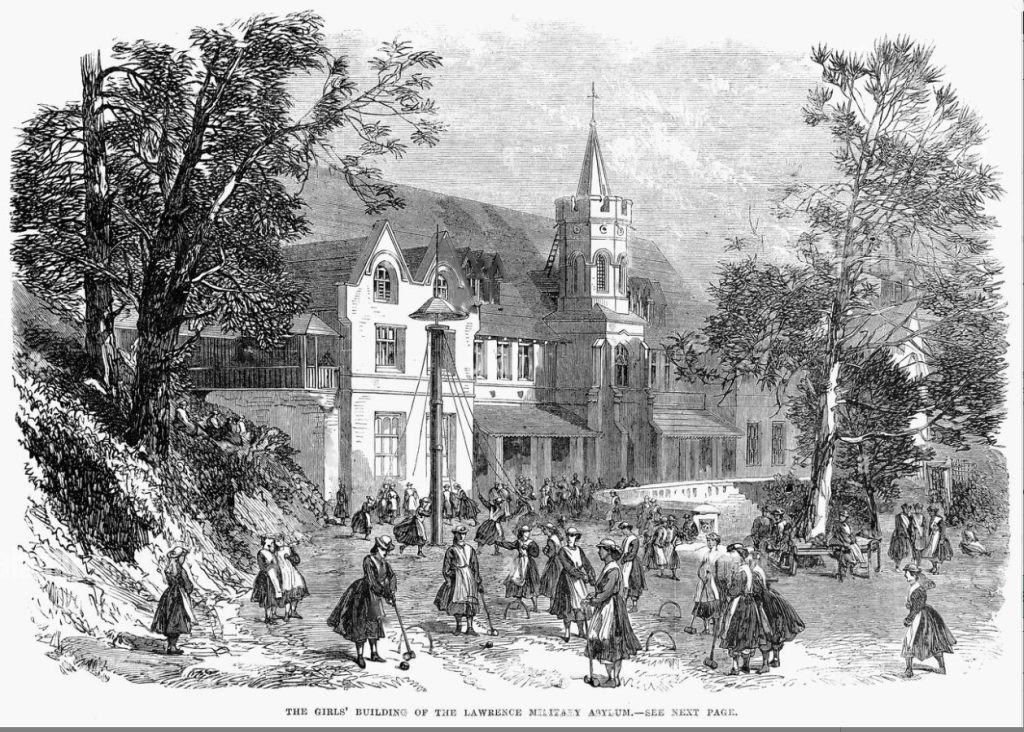
Considered a healthy station, Sir Henry Lawrence founded his first asylum for army children in nearby Sanawar. The land for the school was surveyed by none other than Captain William Hodson, then stationed in nearby Sabathu with the 1st Bengal European Fusiliers. He was chosen by Lawrence for the project specifically, not just because he was a learned man himself, but also because he had a driving passion for outdoor work. The project itself was unusual enough and piqued Hodson’s curiosity. Called the Lawrence Military Asylum, it was Lawrence’s dream project “to provide for the orphan and other children of soldiers serving or having served in India an asylum from the debilitating effects of a tropical climate and the demoralizing influence of barrack life wherein they may obtain the benefits of a bracing climate, a healthy moral atmosphere, and a plain, useful, and above all religious education, adapted to fit them for employment suited to their position in life” While officers and civilians sent their children home, those born in the ranks faced a brutish life of little opportunity. Although the boys could eventually be integrated into the ranks, girls faced a sordid future of early marriage and early death, or in some cases, prostitution.
Sir Henry, keenly aware of the problems soldiers’ children faced, was committed to giving them a future. It was his most ambitious project in an already expansive career and one whose legacy lives on in India today.
Originally, Sir Henry had considered building the school in Mussoorie; however, William Hodson thought otherwise. Sanawar was easier to access from the Plains; it was close to a military station and had the isolation such an institute required. Sir Henry agreed, and the building commenced under Hodson’s supervision.
The Lawrence Military Asylum opened its doors in 1847 to seven boys and seven girls and one member of staff, to provide the waifs with a safe environment and a good education, built on discipline and moral habits. By 1853, it was home to 195 children and would continue to expand.
Subsequently, three more institutions were built at different locations – Mount Abu, Lovedale (Ootacamund) and Ghora Gali in Murree (both Lovedale and Ghora Gali were built after Lawrence’s death) – except Mount Abu, they still continue to flourish as schools today.
The Lawrence Asylum at Sanawar, too, has stood the test of time and today is considered one of the top boarding schools in India, catering no longer to army orphans but to the children of elite Indian families. However, the motto, “Never Give In”, remains, and the school continues its proud tradition of excellence in education.
Now that we know where we are, we can continue to why were are here.
The events at Kasauli, interestingly enough, played out simultaneously with Simla. The aggressors in both cases were the same – the new Gurkha Nasiri Regiment, a part of which was stationed at Kasauli. The difference was that Kasauli also had a complement of European troops, some 200 in number, which should have been enough to stop 50 unruly Gurkhas. Unfortunately, Kasauli was blighted, like so many other stations in India, with poor leadership and even poorer judgment.
When news arrived in Kasauli of the ruckus in Simla, the very first thing the authorities deemed prudent was to secure the treasure, which was under the guard of Gurkhas of the Nasiri Battalion.
There were two options open – one was to overpower the guards, and with a show of force, take not just their arms but the treasure as well; the other was to leave them alone but keep a watch over them. As the officer in command of Kasauli had 200 European soldiers at his disposal, option one would have worked, but it was deemed inexpedient for fear of setting off the Gurkhas at Simla, inciting them to murder the Europeans of that station (something they had no mind to do, but Kasauli did not know that). So option two was resorted to, but Captain Blackall decided to remove a portion of the treasure anyway, telling the Gurkhas it needed to be moved to a safer location. The Gurkhas didn’t buy the lie – after Rs 40’000 had been carried off, they flatly refused to let Blackall take any more. They, like their brethren in Jutogh, had not been paid (the squabble in Simla had started over pay). So they helped themselves, loading “themselves and their women with as many rupees as they could carry..” and then promptly left Kasauli. Weighed down as they were, their progress towards Jutogh was slow, so they took their time to burn down some of Anson’s tents and loot some baggage. At Syree, they stopped to search two English officers and ladies on their way to the Plains and destroyed a postbag filled with outbound letters.
While this renegade group of men from the treasury guard created all sorts of mischief, the rest of the regiment at Simla and the remainder at Kasauli had already resolved to remain loyal – “and accordingly, a party sent out for the purpose came up with the men of the Kusowlee Guard close to Syree and conveyed them to Jutogh, where they were secured, not, however, without much difficulty and not before a shot a was fired.”
The sight of bedraggled Europeans wandering about the hills, staggering into Dagshai and Kasauli, only reinforced in their minds a rebellion as in full swing in Simla – it wasn’t, but no one in Kasauli knew that, not even the Gurkhas. Once they had taken the treasure, they were aware there was no going back, so they resolved the make the “best of a bad case.”
The Commander-in-Chief, having been told of the goings on in Kasauli and Simla, sent back Captain Briggs, “an officer who had long been employed in that neighbourhood on the great Thibet and Hindostan road and thus had gained considerable acquaintance and influence with the Goorkhas,” to deal with the situation. He was further given the power to grant a full pardon to the corps, provided they agreed to march to the Plains without any more delay. He managed to convince the Gurkhas to leave off their petulance and march as ordered, having paid them first and granting them amnesty for their insolence. It was the Gurkhas themselves who placed the Kasauli guard under arrest and relieved them of the treasure, which they promptly gave back. They had been “grossly insubordinate”, but they had never intended to murder anyone. Anson needed the Gurkhas to escort the siege train to Ambala, a far more pressing problem than the loss of some of his tents and a plundered postbag. The men who were thus arrested remained in Jutogh, but the rest of the Nasiri troops left the hills.
Not that things were quite finished in Kasauli.
The Gurkhas were gone but someone still had to guard the treasury. For this, Mr Taylor decided the burkundazes of the Cantonment Police would be fine for the job. Unfortunately, Taylor neglected to check what the new guard was supposed to be looking after and during the night, the burkundazes simply helped themselves to whatever the Gurkhas had left behind. In the morning, when called to account for the empty chests, they “trumped up a stupid story of the Goorkhas returning in the middle of the night, bound them to posts and trees, and carried off the treasure.” One of the burkundazes, more honest than the rest, finally made a clean breast of it, and even brought back the Rs 2000 he had stolen, while pointing out to Taylor where his colleagues had secreted their shares. To his intense relief, Taylor only had to bear a tongue-lashing for the amount he could not recover, fortunately only a negligible amount.
There is only one incident left to explore in these hills and it concerns the Lawrence Military Asylum at Sanawar. Fortunately for us, the excellent Mr C.S.Cooper, the governor of the Asylum left a statement.
Horrified and alarmed by the events in Meerut and Delhi, Cooper was already on edge when he heard of the goings-on of the Nasiri Gurkhas at Simla. He was also watching the hill Rajas with some anxiety – they were all in a state of wait and watch, turning their eyes to the Patiala Raja – if he threw his lot in with the Government, well and good, otherwise Mr Cooper feared the hills would soon be swarming with armed hill men. The Patiala Raja, however, very early on made his intentions clear and Mr Cooper for one was immensely relieved. Yet his problems were still closer than he thought.
“On Saturday the news was brought in, that the Goorkha Guard over the Kussowlie treasury had looted the treasure and made off. One of our chuprassies, who was bringing up a box of clothing to the institution, met a body of twenty-eight Goorkhas at the village below the Asylum on the Simlah road one mile distant. They had with them the treasure and were collecting coolies to carry it to Simlah. They abused and beat him, and threw down the box, asking for rupees; but on finding no sound was emitted by the concussion and being assured there was nothing in the box but clothing, he was allowed to pass…”
This worrisome tale threw Mr Cooper into a state of some anxiety. That night he collected all the women and children in the girl’s house, deemed the best defensible position the Asylum offered. He then told off the male inhabitants of the Asylum including the older boys into alternate watches through the night.
They got through Saturday night alive, but Mr Cooper was not sure about Sunday.
“It was an anxious night for intelligence was received that 200 Goorkhas were en route to Kussowlie to assist the Treasury Guard, who had sent messengers for them. Early on Sunday morning, the 17th of May, I rode off to Dagshai to arrange for a retreat to that station in case matters became serious.”
Whilst in Dagshai, as Mr Cooper conferred with the commanding officer, a very panicked officer rode in from Subathu, claiming that the massacre at Simla had commenced and that he had heard cannons fired from Subathu. No one was sent off to confirm what the man said, and Mr Cooper now believed they were in imminent peril.
It did not help when shortly after orders came for the force at Dagshai and Subathu, and the inmates of Lawrence Asylum to make haste to Kasauli. Initially, the commanding officer was having none of it, but without any other reports to glean intelligence from, he finally agreed to fall back as ordered. Cooper bundled up his staff and the children, and on the evening of the 17th of May, they retreated to Kasauli, finding room in some recently emptied barracks.
Here they remained, for no reason at all, losing some children sadly to cholera caused undoubtedly by the less than sanitary conditions, being cooped up in ill-ventilated barracks like so many chickens. When Cooper could finally be persuaded, the Gurkhas had indeed left the hills, and ten days had passed.
Even though his decisions were based on misinformation, panic and downright lies, Cooper had nothing else to base his actions on. He had 380 children in his care; almost all the troops from Simla, Kasauli, Jutogh and Dagshai were on their way to the Plains, and there were barely 160 soldiers left in all the stations put together, hardly enough to hold off even the smallest attack. Mr Cooper did what he thought best and placed the Lawrence Asylum in a state of siege.
“A little force of police has been organised with a native superintendent at their head (a Poorbeah but a faithful man), and the Europeans capable of bearing arms formed a volunteer corps, and took alternate rounds four times nightly….I must not omit to mention that we were all obliged to evacuate the station and to leave our houses with our property behind us. The males and many other natives voluntarily formed a corps for the protection of the property, and so faithfully guarded it day and night that nothing was missing when we returned. Some Poorbeah coolies wished to loot, but were told by the leader of this little band that if they attempted any such thing, they would have to kill them, the guard, first.”
Mr Cooper would keep the Asylum in a state of siege for the remainder of 1857.
As for Kasauli and Simla, the panics continued off and on. Lieutenant P. Maxwell, assistant commissioner at Kasauli, writes,
“Some apprehended a rising of the bunneas in the bazaar! – some an insurrection of the Mussalehees! – one day were all to be poisoned by our cooks. Again, it was the Bheesties who were to rise and massacre us!
Reasoning and argument had little effect in allaying these alarms, and there were not wanting some sufficiently unmanly or unsensible to do their best to foment them. In this wise, much misery and suffering were caused.”
In June, Maxwell ordered the disarmament of all classes of Indian inhabitants of Kasauli, the neighbouring cantonments and at Kalka. The move had little effect in calming the Europeans, and the panics continued. Shortly after the outbreak at Jullandar, the rumour gained ground that the brigade would attack Kasauli and the other hill stations – a completely illogical and ridiculous fancy, once again spawned by the same “unmanly” rumour mongers who had sown the first Simla panic. Maxwell was even entreated “by some persons to take stringent measures for the seizure of all arsenic and other poisonous substances in the bazaar.” He considered this beyond nonsensical – the measures in place, in his estimation, were sufficient and by July, Maxwell had had enough of this sort of “unusual fuss.”
Maxwell prudently refused to listen to the European residents and their imaginary fears, much to the relief of the Indian populations in the stations. Had he thought differently, the Europeans would probably have set themselves up as judge, jury and executioner and wreaked terrible wrath on people who had done them no wrong. As it was, Maxwell managed to keep the Europeans in hand and Kasauli, as indeed Simla, proved to be the “blest asylums of safety to hundreds…” fleeing the real horrors in the Plains.
Sources:
Cave-Browne, J. The Punjab and Delhi in 1857. 2 vols. Edinburgh: William Blackwood and Sons, 1861.
Chick, Noah Alfred. Annals of the Indian Rebellion. Calcutta: Sanders, Cones, and Co., 1859
Papers Relating to the Mutiny in the Punjab in 1857. London: Printed by Order of the House of Commons, 1859.
Kaye, John William, and G. B. Malleson. Kaye’s and Malleson’s History of the Indian Mutiny of 1857–8. 6 vols. Cabinet Edition. London: W. H. Allen & Co., 1888–1897. Vol II
 Mutiny Reflections