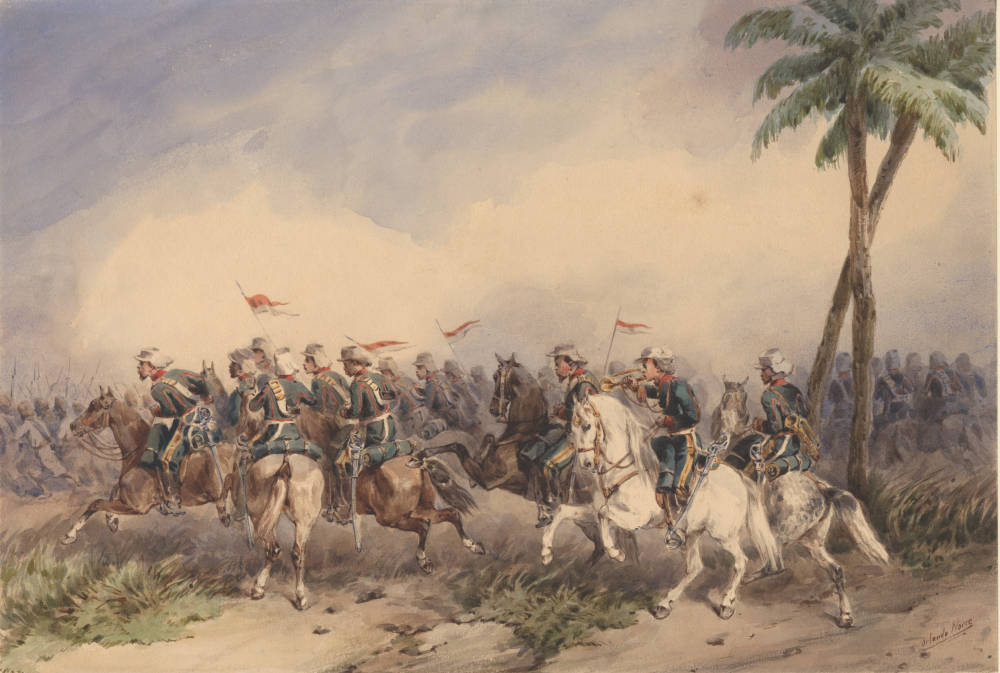
The advance of Sir Colin Campbell en route to Fatehgarh proceeded with little incident, as already told in “Sir Colin Campbell Decides.”
Various detachments had been sent off to clear the road ahead, and on either flank, the British were scouring the countryside for rebels. Seaton, for his part, had cleared the way on the other side of the river, but there was still one outlet left open, and this was Fatehgarh. The quickest access was over the Kala Nadi, and the rebels had been collecting their forces – some fleeing from Campbell, others from Seaton and Walpole. While the C.&C. caught its breath at Gursaharganj, the rebels were gathering their strength.
Of these, prominent in the foreground would be the 41st BNI, one of the more bloodthirsty of the mutinied regiments. In June 1857 at Sitapur, together with the Oudh Irregular Police, they murdered not only their officers but the commissioner, his family and as many Europeans as they could find. Then, as some of the Europeans from Shajahanpore had managed to escape the mutiny there, a party was sent up from Sitapur to intercept and put them to the sword. Of this massacre, only Captain Orr was spared by his men.
The bulk of the regiment then moved towards Fatehgarh, where the 10th BNI had mutinied but had left their officers alive. The 41st crossed the river and found the 10th had already divided up the treasure, but were still unwilling to murder their officers; a fight ensued – many of the 10th scattered and fled while the rest joined the 41st and besieged the fort where 30 men and a good number of women and children had barricaded themselves. After nine days of fighting, however, the 41st was unable to capture the fort, and the garrison made good their escape by boat down the river, only to be massacred in Cawnpore instead. By August, the 41st were with the Nana’s army at Bithur, and some went on to join the besiegers surrounding the Lucknow Residency. When Sir Colin Campbell met them at the Kala Nadi in January 1858, they were still dressed in their red British tunics.
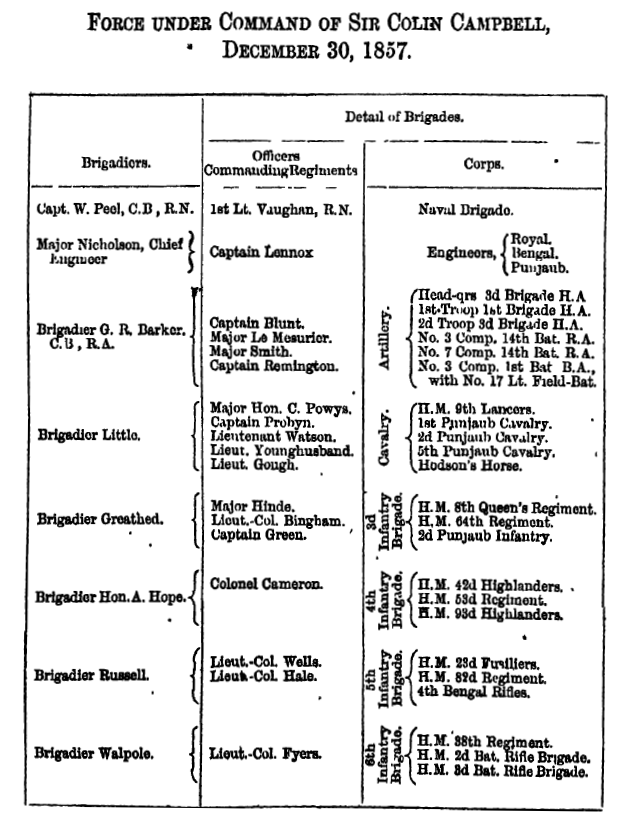
Unfortunately for Sir Colin, the rebels had been somewhat faster in their march. During the night of the 31st of December, they had set out with the best intentions to destroy the suspension bridge over the Kala Nadi. However, they did not finish the job, leaving the piers and main chains intact. They were sorely mistaken if they had the idea of coming back the next day to finish the work. Sir Colin arrived on the opposite bank on the 1st of January. He detached Adrian Hope’s brigade, reinforced with two 24-pounders and one 8-inch howitzer, under Lieutenant Vaughan of the Naval Brigade, and some engineers, sappers, and cavalry, to the river. Their orders were to drive away anyone who approached and repair the bridge. In the meantime, the rebels had returned, and after recovering from the shock of seeing the sappers and engineers hard at work fixing the bridge, they tried a little musketry. But the sight of Adrian Hope and the 93rd caused them to retreat without a fight.
The bridge was repaired, and on the morning of the 2nd of January, the Commander-in-Chief and General Mansfield rode down to the river to inspect the work. To their surprise, they were met with heavy fire from a village on the far side of the bridge. During the night, the force from Fatehgarh, some 5000 men with artillery, had marched down to the river to fight. They had managed, by using the cover of the trees and the village, to effectively stay out of sight. They brought up four guns and opened a brisk fire on not just the pickets sent to guard the bridgehead but the bridge itself.
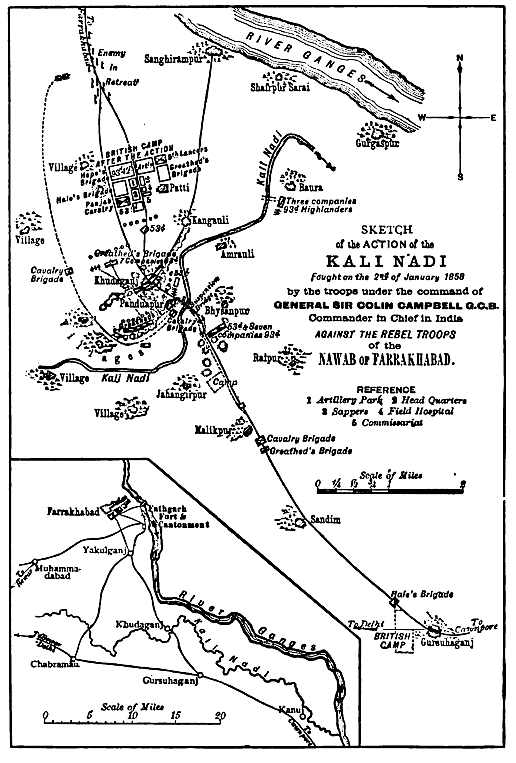
Sir Colin had at once sent orders for the main body of his troops, still four miles in the rear, to push on with all speed; until they could come up, it was up to Adrian Hope to hold the bridge, but not to attack the enemy. Hope quickly detached the 53rd across the bridge to reinforce the pickets — they were to stay under cover of the bank and keep up a brisk fire on the rebels. One wing of the 93rd was kept in reserve just in case they were needed to assist the skirmishers; the other wing was posted three miles downstream, guarding a ford.
The 53rd quickly took cover in the tall grass and surrounding mounds and ridges to do as they were ordered, while Vaughan and three guns crossed the bridge and he “…now pointed and fired one of our guns at the small gun of the enemy, which was concealed behind the corner of a house, and annoying us much. His first shot struck the roof of the house; his second struck the angle of the wall about halfway down, and a third dismounted the gun and destroyed the carriage. Captain Peel, who was standing by, said: ‘Thank you, Mr. Vaughan; perhaps you will now be so good as to blow up the tumbril.’ Lieutenant Vaughan fired a fourth shot, which passed near it, and a fifth, which blew up and killed several of the enemy. ‘Thank you,’ said Captain Peel, in his blandest and most courteous tones; ‘I will now go and report to Sir Colin Campbell.’” (Verney)
Sir Colin Campbell and his staff were all seated on their horses in a group near the bridgehead, waiting for the 93rd to cross, but no sooner was the gun dismounted at the 53rd leapt to their feet, and disregarding orders, rushed to the front towards the toll-house and cleared it of the rebels.
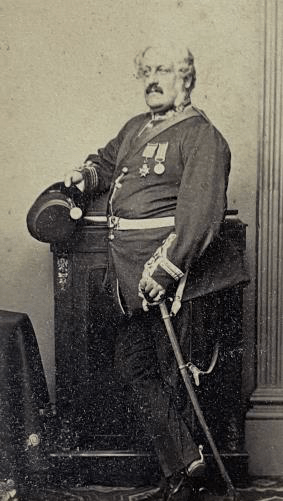
“By Jove!” exclaimed Major English, “What will Sir Colin Campbell say? MacNeil (his adjutant), go and stop them! ” But it was all in vain. Even the little drummer boy was beyond reason – he climbed up on a mound and “too-tooed” the advance and the double with all the breath in his lungs.
Sir Colin Campbell, furious at the disobedience of the 53rd, shouted in vain trying to check their progress. The 53rd had heard the 93rd were coming up to relieve them — and they were not going to let Campbell’s favourite regiment wear all the honours again. They had sworn to avenge Private William Blazier’s death (killed just moments before) and take the gun that had been bullying them. Major Payn, coming back from seeing to the left skirmishers, was astonished to hear a cheer and riding to the font, saw all the men on the right dashing towards the village. They were going to be in front and there was nothing Campbell could do to stop them. Payn of course, rode with them, never dreaming they were in fact advancing without orders. “The guns were taken at once and the men rushed forward to the far side of the village, and there was the enemy, drawn up with cavalry and infantry on the road about 400 yards in the advance.”
Payn suddenly realized that he, as the senior officer, was at the head of 300 men, who were not following any orders but their own, and there was nothing he could do about it. The men would not be denied, and the sight of the rebels made them furious. Payn threw them into skirmishing order again, got together 50 as support, and sent word back to Major Inglis to advance will all speed with the regiment.
“The men still pressed on, the enemy slowly retired and brought a gun to bear on us: instead of stopping our advance, the men rushed on, and after discharging their gun five times, the enemy bolted and we took possession of the gun. Three times during the advance, the A.D.C. galloped up from Sir Colin with orders to halt, but it was just as easy to stay the progress of an avalanche. I stormed, I threatened, implored and I am afraid, swore, but all to no purpose, and it was only in God’s mercy that the Pandies had no pluck, or a charge of their cavalry would have swept us from the face of the earth.”
His plans discomfited, a furious Sir Colin pushed forward Hope’s and Grant’s troops to the support and ordered the cavalry to mount. The 93rd crossed the bridge and followed the 53rd on the right, while Greathed’s Brigade extended the line to the left. The three remaining companies of the 93rd, which had been sent to watch the ford, had crossed, come upstream and rejoined the rest of the regiment. The rebels had begun their retreat before the 53rd charged and now, still in formation, doubled their pace, with the 53rd following in a running walk. However, the infantry could not keep up with the cavalry nor be of any help, they were soon a mile in the rear – they halted three miles from Khudganj – the day would be won by the cavalry.
Campbell then rode up to the 53rd, who had got through the villages and poured into them, or as Payn says, “We caught it over the face and eyes.” The 93rd, now close up to the 53rd, held back as Campbell insisted on bringing the 53rd’s commanding officer to book who swiftly threw the blame on the men, as the officers had been unable to keep them back. As for the little drummer boy, Sir Colin stared at him sternly and asked what he meant by sounding the advance without orders. “Please, sir,” he said, ” I was afraid the men would lick me if I didn’t!” He then turned his wrath on the men and threatened to send them to the rear as the baggage guard and on fatigue duty for as long as the campaign lasted.
One of the men called out, “Shure Sir Colin, you don’t mean it! You’ll never send us on fatigue duty because we captured those guns the Pandies carried off?”
Sir Colin looked at the man and, with some surprise, asked him what guns he meant. “Shure that’s them guns,” was the answer, “that Sergeant Dobbin and his section are dragging onto the road.” Campbell turned to the commanding officer with some remark that he thought the gun had been withdrawn before the 53rd had rushed the enemy. On this, a man from the ranks called out, “Three cheers for the Commander-in-Chief, boys! I told you did not mean us to let the Pandies carry off those guns!” until Campbell turned away, laughing. Then, shaking his hand at his staff, he said, ” You would cheer too if you weren’t afraid of me.”
The rebels, in the meantime, had retired in an orderly manner for some distance and then formed up to make a stand, apparently thinking the infantry was not going to press them too closely.
“As soon as they faced round again our line (of the 93rd) was halted only 700 yards from the and just then we could see the cavalry debouching onto the Trunk Road about a mile from where we were. My company was in the centre of the road, and I could see the tips of the lances of the 9th wheeling into line for a charge on the enemy’s rear.”
The Cavalry Pursues
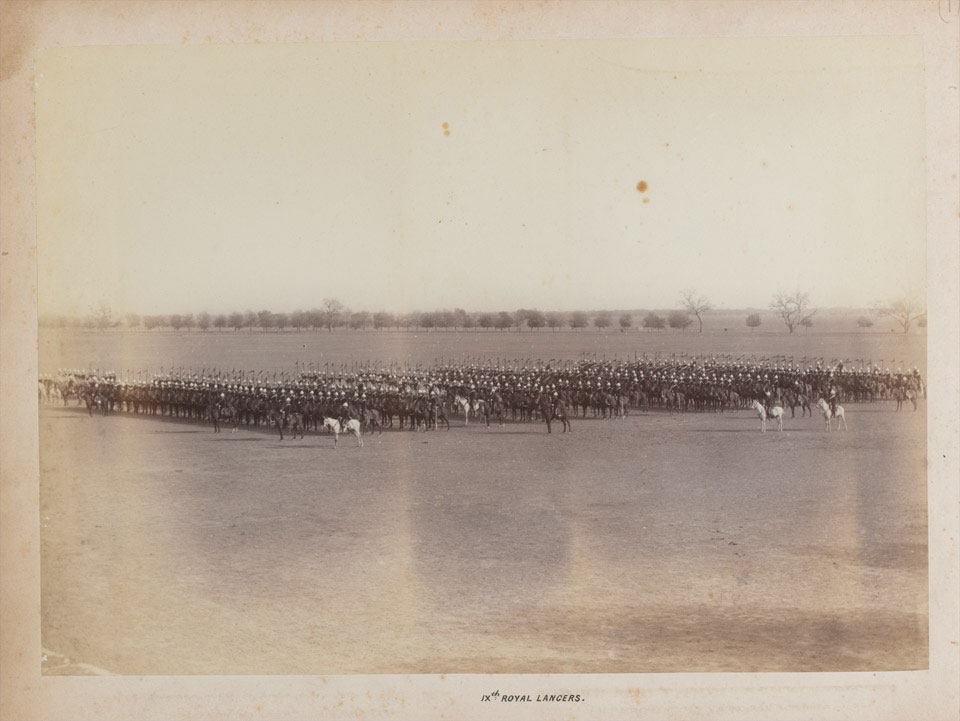
Major Anson of the 9th Lancers had just been relieved from picket and was settling into his breakfast when he too heard the guns, followed shortly after by Captain Little galloping in, ordering the Lancers to turn out.
“We turned out sharp, trotted down about five miles to the bridge, and found both sides pounding away at each other. We got under a cover, behind a village, till we were wanted. While waiting there, some 24-pounder shot came unpleasantly near, and the top joint of the second finger of one of the Irregulars’ hands was taken off by a Minié ball. Younghusband had breakfast up, and there we were all under a tree exceedingly comfortable, with the exception of seeing the poor wounded coming in, till about three, when we were ordered to mount and pursue the enemy. “
When the order came to mount, Surgeon Tyrell Ross hurried up to Hope Grant, pointing out that if there was pursuit cross-country, he would not be of much use in the rear. Grant considered for a moment. “Quite so,” he replied, “I have heard you are a good rider and can use your sword. Ride on my left and help to look after my third squadron.” After a three miles’ canter, we came up with them in very great numbers. Then commenced the work of cutting and pointing, and sights the most bloody that you can conceive. I knocked over three, young Anson seven, Martin some three or four, Fawcett the same, and even that young, gentle lad Sitwell pistolled one. Some 200 and more were sabred. Unfortunately, we had no light artillery up with us, or their casualties would have been much more numerous.” (Anson)
The main regiment of the rebel line drawn up on the road was the 41st BNI. As soon as they saw the Lancers, they formed Square while the rebel cavalry charged the infantry – they were swiftly intercepted by Hodson’s Horse.
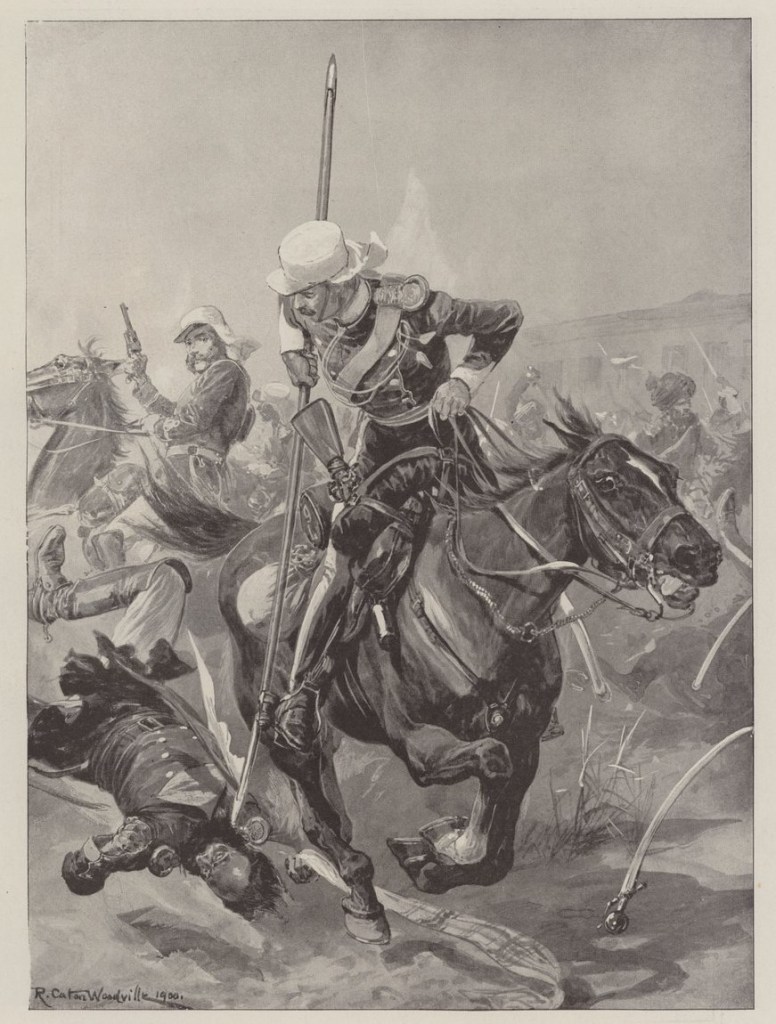
The 9th came down on the 41st’s square, who stood their ground and opened fire. The Lancers charged up to 30 yards, then turned their horses to the right and left from the solid square. Just as the 93rd prepared to charge it with the bayonet, the Lancers were brought around again, and Sergeant Major May dashed the square on his powerful but untrained horse and leapt straight into it, followed by the squadron. The square broke, and the rebels ran.
The rebels, however, were still giving as good as they got — when the 9th Lancers charged, they leapt into deep ditches on the roadside and fired as they passed. One sepoy took aim at Sir Hope Grant but missed, and three of the Lancers were wounded while their horses likewise suffered. Three were killed, four were wounded, and one ran off towards the rebels. In support, up dashed Probyn and Younghusband, sailing into the charge with the Sikh cavalry. A regular mêlée ensued, with sabres flying and clashing — within minutes, 7 guns were captured, but the fight was hardly over. Grant now formed the cavalry into a long line and, placing him at the head of the Lancers, pursued the flying rebels. Roberts rode to his left with Younghusband’s squadron, and next to him came Tyrell Ross, the doctor, next to him. As they galloped along, Younghusband called out to Roberts, with obvious pride, ‘to the admirable manner in which his men kept their dressing.’ (Roberts)
“On the line thundered, overtaking groups of the enemy, who every now and then turned and fired into us before they could be cut down, or knelt to receive us on their bayonet, before discharging their muskets.“
Grant’s 9th Lancer orderly, Corporal Caine, carrying Grant’s bamboo lance, saw a rebel a little ahead, with his musket cocked and ready, defying anyone to approach. Caine, putting his lance at rest, rode at him. When within five yards, the rebel pulled the trigger, but the cap snapped, and Caine ran him through with the lance. “At another time, as a squadron of the 9th Lancers were advancing at a trot, a dismounted rebel Sowar, wearing a red coat, and armed with a splendid long gilded lance, turned round, and with a defiant gesture, presented it towards the cavalry. When they had approached to within a few yards of him, he hurled the lance into the ranks with all his might, striking a horse to the ground. The Sowar was instantly killed.” (Grant)
The chase continued for another five miles until daylight began to fade, and the cavalry had come to what seemed to be the end of the rebels; the cavalry was ordered to wheel to the right and form up on the road. Before the movement was executed, they overtook a group of rebels who faced about and fired into the squadron at close quarters. Younghusband chose his target – a sepoy with a musket to his shoulder. He raised his sword as the man fired. Roberts saw Younghusband fall, but he could not help him for, at the same moment, one of Younghusband’s sowars was in peril as a sepoy attacked him with his fixed bayonet – Roberts dashed to his aid.
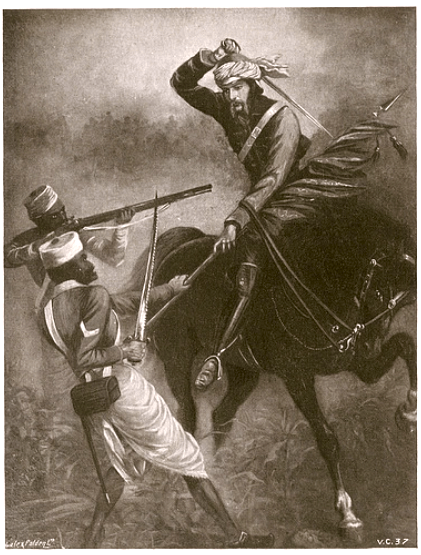
The next moment, Roberts saw, in the distance, two sepoys making off with their Colours, which Roberts now determined to capture. He rode off at all speed, overtook them, and, wrenching the staff out of the hands of one of them whom he cut down, the other put his musket close to Robert’s body and fired. Fortunately for the young lieutenant, the gun misfired, and Roberts could carry off the standard. These two actions would be cited in the Gazette, securing for him the Victoria Cross. The standard he captured had once flown proudly at the head of the Oudh Irregular Horse.
Meanwhile, Ross had found his way to Younghusband, who was lying on the ground in dreadful pain. The shot had gone through his lungs, and there was nothing anyone could do for him. Two days later, he died.
The fight was over as the rebels scattered and fled, leaving behind 8 guns, several Colours and ammunition wagons. It was the end of the 41st Regiment, Bengal Native Infantry, who were wiped out of the ranks of the mutineers.
The cavalry ended the pursuit and turned to return to camp. To their surprise, they came across one gun proceeding up the road; it had been captured earlier in the day but was now drawn by two bullocks and driven by 2 rebel artillerymen, one seated on the limber with his musket and tulwar, acting as the guard. Lieutenant Martin on the 9th Lancers rode up to him and when within a few yards of each other both men opened fire “but in their excitement” both missed. The sepoys stood little chance and soon were counted among the dead. The bullocks sullenly objected to this fracas in their midst, became unmanageable, capsized the gun into a deep ditch and promptly fell on top of it. Injured beyond hope, it was kinder to shoot them both, and it was left up to Peel and his sailors to drag the piece out. The surprises were hardly over – a sergeant-major of the Lancers by chance rode up close to one of the holes on the wayside, and to his astonishment, a shot came out of it, killing his horse. Three sepoys had concealed themselves in it and would have escaped had their friend not fired.
The cavalry unfurled the captured standards and rode back to camp. The Colours were indeed treasure – the exceedingly elegant Colours of the 10th Oudh Irregular Infantry with the Queen’s Colour embroidered in the centre, and a “gay red and green” embroidered Mohammedan standard, both two and a half yards square. The cavalry, however, must have been a strange sight for nearly every man was carrying a trophy of some kind or the other: in their flight, the rebels had abandoned their baggage carts and palanquins and the road was strewn with clothing, arms and everything they had once held dear. In addition, the rebels lost eight guns, several standards and all their ammunition wagons. For some reason that no one could explain, the road was covered, above all, with thousands of shoes as if the rebel army had simply stepped out of them in their flight. The camp followers carefully collected as many as they could for their own use, leaving Alexander to remark that they “set themselves and their families up in shoe leather for life.” During the night, the villagers crept out of their houses and buried the rebel dead.
The return to the camp of the cavalry” was a stirring sight of war. In front came the 9th Lancers, with three captured standards at their head; the wild-looking Sikh horsemen rode in the rear. As they passed the Commander-in-Chief, he took off his hat to them, with some words of praise and thanks. The Lancers shook their lances in the air and cheered; the Sikhs took up the cry, waving their sabres above their heads. The men carrying the standards gave them to the wind: the Highland brigade, who were encamping close by, ran down and cheered both the victorious cavalry and the veteran Chief, waving their bonnets in the air. It was a fair sight and reminded one of the old days of chivalry. When Sir Colin rode back through the camp of the Highlanders, the enthusiasm of the men exceeded description.”
The last cheers died down, and it was back to work. Alexander of the 93rd, just as the sun was setting, rejoined his picket with several boxloads of ammunition that had been picked up on the road and two guns, both of which were sent to the camp. He found the picket had been strengthened by a troop of the 9th Lancers and 2 horse artillery guns; it would be a long night and, above all, with neither food nor shelter, except for some hard biscuits and a tot of rum. Although not exactly grumbling, Alexander found it necessary to explain, once again, a thing or two.
“I do not think that civilians quite understand that on occasions of this sort, British officers very properly and most cheerfully always fare worse than their men. On this occasion, for instance, as the camels could only cross the bridge that evening in single file, no officer’s tent or baggage (with the exception of those belonging to the Commander-in-Chief, the Brigadiers and their respective staffs ), was allowed to pass until all the men’s tents, etc., and field hospital tents and baggage had filed over. Thus, on a night like this, where perhaps all the men and sick and wounded would be housed before daylight next morning, not only would none of the regimental officers be undercover, but, as their native servants, of course, had to accompany their baggage, none of them would get anything to eat. In this case, I did not myself see my tent or baggage till ten o’clock the following night, January 3, at Fathgarh.”
As for the Naval Brigade, they fared no better than Alexander but would be a little luckier. They had reached the camping ground at 9.30 and had parked their battery in the ploughed field but as no baggage or provisions were forthcoming, they simply drank their way through the cask rum that was always carried on some old limbers; under the supervision of the two quartermasters, the casks were always foremost on the march. Then they ate their way through everything in their haversacks when Verney discovered some camp followers making chapatis. Verney speedily bought them for a rupee and shared the bounty with his comrades. The elephants with their tents arrived at midnight, having forded the stream instead of going over the bridge, and an hour later, the Navy Brigade sat down to dinner.
After dark, the spies sent out towards Fatehgarh returned with news that, if true, would make the next days easier for Campbell and his men. Fatehgarh, they said, had been abandoned, and the rebels were in full flight towards Rohilkhand. Many had drowned trying the swim across the river when the bridge of boats became impossibly crowded with panic-stricken fugitives from the city. A Sikh sowar too presented himself in camp – he had been held prisoner at Fatehgarh for the past four months but had managed to escape in the confusion, confirming everything the spies had said. The next morning the column marched to Fatehgarh, only 12 miles distant. Along the route, villagers crowded the road carrying vessels of milk and water which they offered the thirsty soldiers. The 42nd and the 93rd were met with stares and fright, dressed as they were in their kilts and bonnets – Alexander later learned from the servants of the force that they had been fed impossibly horrible stories by the rebels about the “Gogra-wallahs” (petticoated men). It was said they had a liking for curried babies, “especially if we could catch them ourselves,” and would break their backs across their bare knees. As Campbell’s stay at Fatehgarh would be a long one, the citizens would have enough time to see for themselves if these terrible tales were true.
Sources:
Alexander, W. Gordon. Recollections of a Highland Subaltern. London: Edward Arnold, 1898.
Anson, O. H. St. G. With H.M. 9th Lancers during the Indian Mutiny. London: W. H. Allen & Co., 1896.
Cosens, F. R., and C. L. Wallace. Fatehgarh and the Mutiny. Lucknow: Newul Kishore Press, 1933.
Forbes, Archibald. Colin Campbell, Lord Clyde. London: Macmillan and Co., 1895.
Gimlette, G. H. D. A Postscript to the Records of the Indian Mutiny. London: H. F. & G. Witherby, 1927.
Gough, Hugh. Old Memories. London: Blackwood, 1897.
Grant, Hope. Incidents in the Sepoy War 1857-58, Compiled from the Private Journals of General Sir Hope Grant, K.C.B., Together with Some Explanatory Chapters. Edited by Henry Knollys. Edinburgh: William Blackwood and Sons, 1873.
Jones, Oliver J. Recollections of a Winter’s Campaign in India in 1857-58. London: Saunders, Otley, and Co., 1859.
Malleson, G. B. History of the Indian Mutiny 1857-1858, Commencing from the Close of the 2nd Volume of Sir John Kaye’s History of the Sepoy War. Vol. 2. London: Wm. H. Allen & Co., 1879.
Roberts, Frederick Sleigh. Forty-One Years in India: From Subaltern to Commander-in-Chief. Vol. 1. London: Richard Bentley and Son, 1897.
Trotter, Lionel J. A Leader of Light Horse: Life of Hodson of Hodson’s Horse. Edinburgh: William Blackwood and Sons, 1901.
Verney, Edmund Hope. The Shannon Brigade in India: Being Some Account of Sir William Peel’s Naval Brigade in the Indian Campaign of 1857-58. London: Saunders, Otley, and Co., 1862.
 Mutiny Reflections