While the Malwa Field Force marched towards Dhar, in the small town of Jiran, things were about to become very complicated indeed. To understand how this situation came about, we can turn our attention to: The Mutiny Begins.
Late in October, Firoz Shah sent forth from Mandsaur 400 men to intercept a convoy of ammunition bound for Neemuch from Jaora. According to his intelligence sources, it would be easiest to take the carts at Kungetee on the Neemuch road. Informed of their approach, the Thakur of Kungetee wrote hastily to Showers at Neemuch, but the letter fell into the hands of the station superintendent, Captain Lloyd. When he passed it on to Captain Lionel Showers (who we have previously met in Rajputana), he attached a rather disinterested note,
“ It shows that the rebels have not as yet left Mundisore, nor do I believe that they have any intention of coming in this direction. (Forwarded for the information of the Political Agent, Meywar)
(Signed) B. P. LLOYD, Superintendent.”
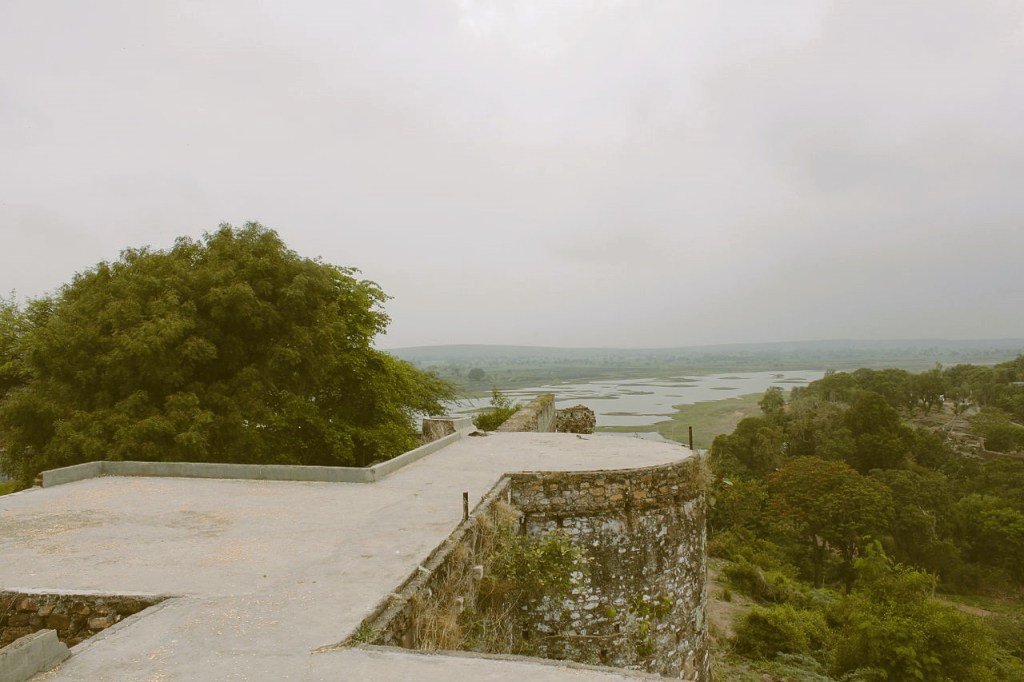
Lloyd must have been rather shocked when, on the 22nd of October, the rebels that had apparently not left Mandsaur had already attacked and seized the town and fort of Jiran, only 10 miles (ca. 16 km) from Neemuch Cantonment. There had been no ammunition carts at Kungetee – the report of such a shipment was erroneous, and the rebel force, consisting of 400 freebooters with an eye for plunder, decided Jiran was fair game. The information was swiftly confirmed to the authorities at Neemuch, who decided, without consulting either Showers or George Lawrence, that this rebel force, hovering so close to Neemuch, really needed to be taught a lesson. The rebels, according to Lloyd’s intelligence, mustered no more than 400 men — they had no guns and had very little small-arms ammunition; the fort itself was dilapidated and had no gates. It was considered that attacking Jiran was really a matter of little importance and quite an“inconsiderable enterprise.” So inconsiderable, in fact, Captain Showers was kept completely out of the loop. So, Lloyd and Simpson assembled their men:
HM’s 83rd
3 officers, 50 rank and file under Captain Read
2nd Bombay Light Cavalry
4 officers, 255 rank and file, under Captain Tucker; Lieutenant Blair and Lieutenant Le Geyt, with Captain Lawrie (attached, 21st Bombay Native Infantry)
12th Bombay Native Infantry
2 officers, 100 rank and file, under Captain Soppitt
Two 9-pounders and 1 mortar.
If the reports were true and the rebels did not have any artillery and numbered only 400 men who were indifferently armed, taking Jiran back for the British really should not have presented a problem. With the news still fresh, that same night, a reconnaissance consisting of Tucker and his cavalry. Two advanced guards, under Captain Tucker and Lieutenant Blair respectively, left Neemuch by different roads. The next day, before dawn, the rest of the force set off towards Jiran in high spirits under Captain Simpson, 2nd Bombay Cavalry (who had but lately taken over as station commander at Neemuch), accompanied by Captain Lloyd in his capacity as political superintendent. They expected to return in glory the same night to Neemuch with incomparable success.
Unfortunately, the reconnoitring party had encountered the rebels sooner than expected, at daybreak, close to Jiran at daybreak. Captain Tucker, leaving a reserve under Lieutenant Le Geyt in“a concealed position,” advanced with a few of his men and approached the rebels, numbering not more than 100. Captain Lawrie attempted to dissuade Tucker — the rest of the force was on the road, he reasoned, the rebels were as yet unaware of the presence of the cavalry; it made sense to remain behind or, all things considered, return towards Neemuch and report on the situation.
Tucker was having none of it.
He charged.
The rebels faced him in perfect order, and even though he managed to ride straight through them, they stood firm. Tucker’s horse was shot, and as he lay on the ground, stunned, he was swiftly attacked and killed. Lawrie, who had dashed on with Tucker, was lanced through the breast and cut about the body with tulwars – he managed to turn his wounded horse around and ride back. Meanwhile, Lieutenant Le Geyt roused the reserves and attempted to take the rebels, but they were not ones to wait. They had already retired well out of reach of cavalry and, owing to the broken ground, impassable for Le Geyt and his men. Tucker’s body was recovered by the 2nd Light Cavalry, without its head, which some claim was taken as a trophy back to Mandsaur. Le Geyt and the remaining cavalrymen rode back to their secluded position to wait for Simpson’s arrival.
At half past seven, Simpson, the infantry and the guns arrived. He found the rebels had taken a position merely 200 yards in front of the fort walls, on the brow of a hill, and appeared to be waiting. Simpson quickly ordered the artillery forward and fired a few shots from the 9-pounders, at which the rebels moved back, albeit slowly, taking shelter in a stronger position behind some huts. Simpson told off Captain Bannister to take a squadron to cut off any stragglers on the other side of the town, as he ordered the infantry to charge. They did not get very far – the rebel position was stronger than anyone had imagined.
Captain Read was killed leading his men; Captain Soppitt was quickly wounded — the men, on seeing their officers fall, faltered and started to retreat. Emboldened by this reverse, the rebels rushed on the infantry. They quickly took possession of the mortar and were nearly on the guns when Captain Simpson, with Lieutenants Blair and Le Geyt and Riding-Master Steers, charged with one squadron and beat them back, retaking the mortar. Simpson was severely wounded in the head, Lieutenant Blair cut by a tulwar, and Le Geyt was shot, though not mortally. Instead of pressing their advantage, the rebels ran back to the fort. With Captain Simpson incapacitated, command fell on Captain Bannister, who, having returned from the other side of the town, quickly called the retreat. Firoz Shah may not have been the most brilliant commander of 1857, but he certainly knew how to make a show — Bannister was informed“all the real fighting troops” of Mandsaur were now marching on Jiran, clamouring around no less than seven standards. There was nothing for the British but to race back to Neemuch before they were overpowered. They left behind a greater part of the ammunition for the mortar, but Bannister felt the loss was justified on account of the strength of the fort and the “fagged state of the men, the want of officers to command the detachments, no breaching guns to take the town and the necessity of returning to protect Neemuch.” Gathering all the dead and wounded, amounting to 95 men, Bannister led the retreat back to Neemuch. Captain Read had suffered the same fate as Captain Tucker — they were bringing back his headless corpse. Tucker’s head would be found nailed to the gateway at Mandsaur.
It was a desperate blow to the already weak force at Neemuch, and to add insult to injury, the rebels had no intention of holding Jiran. They evacuated the place the same night after plundering the town. Captain Tucker reported the whole affair as a victory to Brigadier George Lawrence because the rebels did not hold Jiran, well before Showers could add his two cents to the miserable affair.
“…a party of 400 undisciplined rabble, without a single trained soldier in their ranks, without guns and but indifferently armed, had repulsed in open fight an equal number of our British troops, with artillery, was eminently calculated to encourage hopes of success on the part of the rebel leaders at Mundisore in an attack on Neemuch while under such military command.” (Showers)
As such, Lawrence, who had already had his problems with Showers, took Lloyd’s point of view, and it would be left up to Durand to see the full extent of the dismal picture that was now being painted around Neemuch.
““I am sorry to learn by yours of the 24th that your Neemuch troops had a reverse at Jeerun. This may
embolden the Mundisore rebels to move against Neemuch before we are ready to advance thither. I know well the state of affairs at Mundisore and have as earnest applications from the Chiefs and Scandia’s authorities as from yourself, the same from Saugor, which is probably beset. Ditto from Hoosungabad and Bhopal directions.” (Extract, Colonel Durand, dated Camp Dhar, 29th October 1857, to Captain Showers, Neemuch)
As the Neemuch men were being defeated at Jiran, the Malwa Field Force was laying siege to Dhar. They would take care of the Mandsaur in due time, but for now, Neemuch had to prepare to be besieged. There would be no reinforcements coming, as Durand pointed out — he was receiving “earnest applications” from nearly every corner of Central India. There was nothing for it but to hold out in Neemuch until Stuart and his force could disperse the rebels. However, it was decided, much to Showers’ disapproval, to not hold Neemuch at all but retreat to the fort.
Provisions were laid and plans made. Lloyd felt the force at his disposal was too weak to hold the town, and considering the turn of events at Jiran, he could well expect the rebels would arrive in fine, fighting form. It seemed that if anyone was to get out of Neemuch alive, their only hope rested in occupying a position as small as possible but defensible instead of attempting to defend the whole town. From this standpoint, it made sense. Information was received, and finally believed that the rebels were indeed marching on Neemuch. While everyone rushed to the fort and the citizens of Neemuch deserted the town, Captain Showers, with his Meywar troops and the 2nd Bombay Cavalry, was ordered to meet the rebels. It was, in all, a very unsatisfactory state of affairs.
The cavalry met the rebels as they crossed the nullah to the rear of Neemuch Cantonment. On their approach, they formed line in open single files to show as extended a front as they possibly could, “and showed many flaunting flags.” Showers realised quickly they were no more than 2000, of which only 100 were cavalry, followed by 600 fighting men composed of undisciplined Velayati’s, and the rest, “armed rabble who had come in hope of plunder.” Showers proposed a combined charge directly at the rebels, a move seconded by Colonel Jackson, but as he was in the field without command and Captain Bannister was effectively in charge, it was Bannister who declined. His hands were tied, he said, by Captain Simpson, though still on the sick list, as he was giving the orders. Bannister watched the rebels crossing for an hour and then withdrew from the field. Showers, in the meantime, noticed the rebels breaking again into columns as they continued upon Neemuch. Showers ordered the Meywar troops to proceed towards the bridge to check their entry to the town. Surprisingly, it had the “desired effect.” The rebels brought forward guns, fired a few times and then remained exactly where they were, bivouacking for the night on the opposite side. At nightfall, Showers withdrew the main body of the Meywar troops and left pickets in place to protect the rear of the Cantonment. The opportunity to rout the rebels had been lost.
The Siege of Neemuch Fort
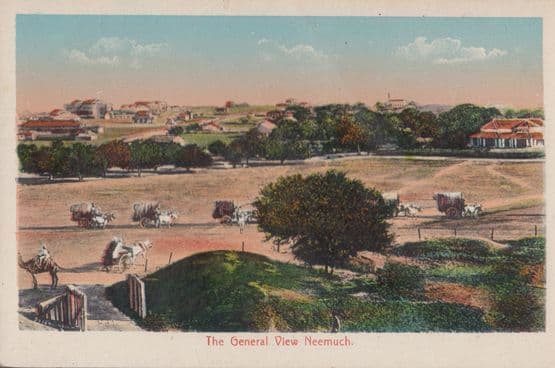
“ The advance of the rebels on Neemuch on the 8th November was a complete surprise. About 2 o’clock, p.m., information was brought that a party of them had occupied a village about five miles from Neemuch, and almost before the Cavalry could move out to meet them, they arrived and formed on the parade ground across the bridge on the south of the Bazaar. I reconnoitred them and they did not appear to me to be more than 800 men drawn up in single line in open files, with their baggage cattle in rear so as to deceive us as to their numbers. A more brilliant opportunity for a glorious success and victory could not have been offered. They were evidently afraid of their own audacity, for they never attempted to advance one pace from their position towards Cantonments, even after the 2nd Cavalry had disappeared out of sight, and only the Meywarees occupying the bridge. Why the guns were not sent out in support of the Cavalry was, and is, an enigma to me. Without crossing the bridge the guns might have poured shrapnel and case into the enemy. Even supposing they had crossed and were compelled eventually to retire on the fort, you know the road is open and free of all obstacles to interrupt a retreat at full gallop. During the night I reconnoitred them again, I found them precisely in their first position. They entered Cantonments in the morning, totally unopposed.” (Colonel Forbes Jackson, late commanding at Neemuch, in letters to Colonel Green, Adjutant-General of the Bombay Army, and to Captain Macgregor, a brother Officer of the 2nd Bombay Cavalry, dated 17th December, 1857.)
Lawrence’s reply to Showers’ report regarding the actions of the Meywar troops in opposing the rebels, was written on the 12th of November from Ajmere.
Sir,— I have the honour to acknowledge the receipt of your letters of the 7th and 8th instant, reporting the advance of the rebel force from Mundisore to the attack of Neemuch, and in reply to inform you that I consider Captain Simpson used a sound discretion in not risking his handful of Infantry and 2 guns against an enemy “seemingly in number about 2,000;” as any reverse would, in all probability, have involved the loss of the Fortified Square and destruction of all the Force.
I have, &c.,
(Signed) G. S. P. LAWRENCE,
Officiating Agent Governor-General.
Rajputana Agency, Ajmere, 12th November, 1857.
It would appear the reverse at Jiran was a lesson learned but the next morning, the Mandsaur insurgents entered Neemuch unopposed, plundered what was left of the station and burned down the remaining houses that had been spared in June. They then set about besieging the fort. Showers decided to remain in the field with the Meywar men while the commander of the regular cavalry decided to take his men elsewhere to search, as he claimed for his baggage and spare horses, but for the next two weeks “never came in sight of the till the siege was raised,” two weeks later. Showers alone remained. He opposed the rebel horsemen as and when they tried to harass neighbouring villages, and from his newly acquired fort at Nimbahera, he could send increasingly irritated letters to Lawrence, Durand and as far afield as Edmonstone in Bombay.
Completely unimpeded now by any opposition from his ranking seniors, Showers simply did what he thought was for the best. On the 11th of November, his men were dispirited by the disappearance of the 2nd Bombay Cavalry. Showers was surprised; just before he broke camp, Lieutenant Farquharson appeared – he had been detached with 60 men of the 2nd Bombay Cavalry to cooperate with whatever it was Showers intended to do next. Reinforced, he decided to take the fight back to Neemuch.
“Advancing from the south, we swept rapidly down upon the villages of Bugana and Nixongunge, their
Head Quarters. Taken completely by surprise, our advance being concealed partially by high-standing
jowarree crops, the rebels fled in a panic. Many were cut up, and some burnt alive in huts that were fired. These villages and the nullah in rear of the fort being completely cleared, we were enabled to communicate personally with the garrison to arrange for a sortie in co-operation. The Cavalry, meanwhile, were to remain halted on the other side of the nullah till the sortie party should be ready. Then the Cavalry, making a demonstration on the enemy’s rear to the south to draw their force off to that side, would have left the way open for the sortie party to dash out and spike the rebels’ only siege gun, which annoyed the garrison.”
Up to this point, things had gone well. Unfortunately, Farquharson misunderstood what Showers intended to do or perhaps thought him a little mad.
The rebel horsemen were moving carefully in groups of two and three, still shocked by the first attack but gradually increased in numbers, collecting on the old parade ground, where the cavalry was now drawn up. When there were 50 of them, Showers urged Farquharson to charge before there were anymore. Instead, he went “threes left” and moved away, his men firing off their carbines. Realising that this paltry force was not going to charge, the rebels, still receiving reinforcements, began to advance on Showers. “It was apparent then that a charge was the only thing that could avert a disaster. So, exercising my military rank, I gave the word ‘Halt, front—Charge ! ‘ placing myself at their head, with Jackson.” Frustratingly, only the horses halted and formed line, but the men riding them broke into column again.
Thereupon Colonel Jackson, solicitous for the honour of his regiment, the 2nd Cavalry, as well as keenly alive to the critical condition of the moment, called out, ‘For God’s sake, charge. Gentlemen, you will lose your names and disgrace the regiment.‘
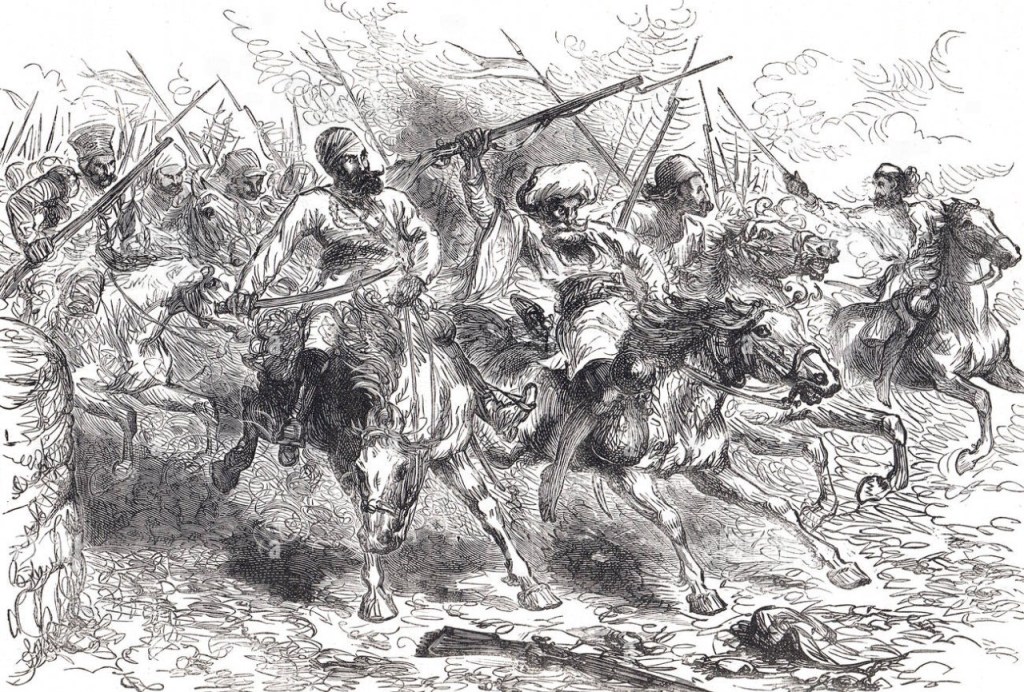
The rebels, on the other hand, continued their advance while the cavalry now continued moving to the flank, firing their carbines. The rebels broke into a gallop as the head of the 2nd Cavalry ” bolted away at speed, the centre followed, and the troop became totally disorganized in flight,” leaving Showers, Jackson, a Parsi clerk named Anderji and a mounted chaprassi Gopal Singh of Showers’ employ all in the fore, to meet the charge on their own. Spurring on their horses, the men dashed towards a wide ditch, and “we pounded our pursuers by clearing it, and gaining the top of the embankment circled round it at speed.” The rebels, unable to follow, contented themselves with sending off random shots and shouting expletives. There was nothing left to be done but retire on Nimbahera and read a thoughtfully worded message from Captain Lloyd, “We are anxious to know how you and Colonel Jackson fared this morning,” and would Showers please note that the garrison was short on ammunition and sheep?
At Neemuch, things could have been going better had they not neglected to stock up small arms ammunition and livestock. Showers told them to husband their ammunition and watch for scaling ladders. George Lawrence did forward ammunition from Nasirabad, but by then, Neemuch was swarming with rebels who were daily increasing. Captain Baumgartner, commanding the detachment, was doubtful he would reach. Midway, Lawrence called him back, but Showers, as ever, had a plan.
Camp in the Field,
10th November (Tuesday).
My dear Sir,—The rebels having attacked Neemuch, I write to request you to move on with all dispatch with the ammunition. The Hakim of Chitore will be directed to afford you every assistance, as also the Superintendent of Neembahera. At this latter post, I will either meet your party or have a strong escort in readiness to strengthen your own. All the cavalry of the Neemuch force is in the field and will join.
The rebels attacked the station on the evening of the 8th but were kept in check all that night. The next morning, as there was no move out against them by the Neemuch force, they came in unobstructed
and burnt what was left of the station and attacked the fort. Their heavy guns came up only yesterday.
By a note from the fort at 7 a.m. this morning, nobody was hurt.
Believe me,
Yours faithfully,
C. L. SHOWERS.
To Capt. Baumgartner,
Commanding Detachment.
Baumgartner took himself and the ammunition with all haste back to Nasirabad.
Back at Neemuch, the rebels duly placed scaling ladders against the walls of the fort and proceeded to climb them with much shouting but, with a little demonstration of force from the garrison, were sent scuttling back down, leaving their ladders behind. The garrison later watched in disbelief as a religious man with a mirror fixed to his chest stated boldly for all to hear that if he could walk one complete circle around the fort, it would fated to fall into the rebel hands. Taking his challenge, the men on the walls opened fire until one shot finally brought him down. To drive the point home, a bandsman went out of the fort and brought in the man’s head and mirror, which he then gleefully showed to the rebels to disabuse them of the pointlessness of superstition. As long as provisions lasted and the ladies could be induced to pitch in making the ammunition, the very strange siege of Neemuch would continue.
Almost as suddenly as the siege began, it ended. The rebels, now numbering 4000, upped and left. The Malwa Field Force was attacking Mandsaur, and things were looking bleak for Firoz Shah.
Wounded at the Siege of Neemuch
Lieutenant R. Williams, 21stB.N.I., Commissary Agent, Neemuch Fort, November 9, wounded by a matchlock ball in the forehead during the I siege.
Lieutenant C. H. Barnes, Bengal Horse Artillery, Neemuch Fort, November 10, severely wounded by bullets in right breast.
Ensign W. V. Davenport, 21st B.N.I., Neemuch Fort, during siege, wounded slightly.
Serjeant J. Cunningham, 2nd Light Cavalry, Neemuch Fort, November 12, bullet wound in the cheek whilst working the guns.
Sources:
Further Papers (No. 6) Relative to the Mutinies in the East Indies
Narrative of the Indian Revolt, from its Outbreak to the Capture of Lucknow by Sir Colin Campbell – Published by George Vickers., London, 1858
Reminiscences of Forty-Three Years in India – Lt. Gen. Sir George Lawrence (1874)
The Life of Major General Sir Henry Marion Durand, Vol I – H.M. Durand (1883)
History of the Indian Mutiny, commencing from the close of the 2nd Volume of Sir John Kaye’s History of the Sepoy War, Vol. II – Col. G.B. Malleson (1888)
A Missing Chapter of the Indian Mutiny – Lieut. General Charles Lionel Showers (1888)
The Revolt in Central India 1857-59, Compiled in the Intelligence Branch (1908)
 Mutiny Reflections