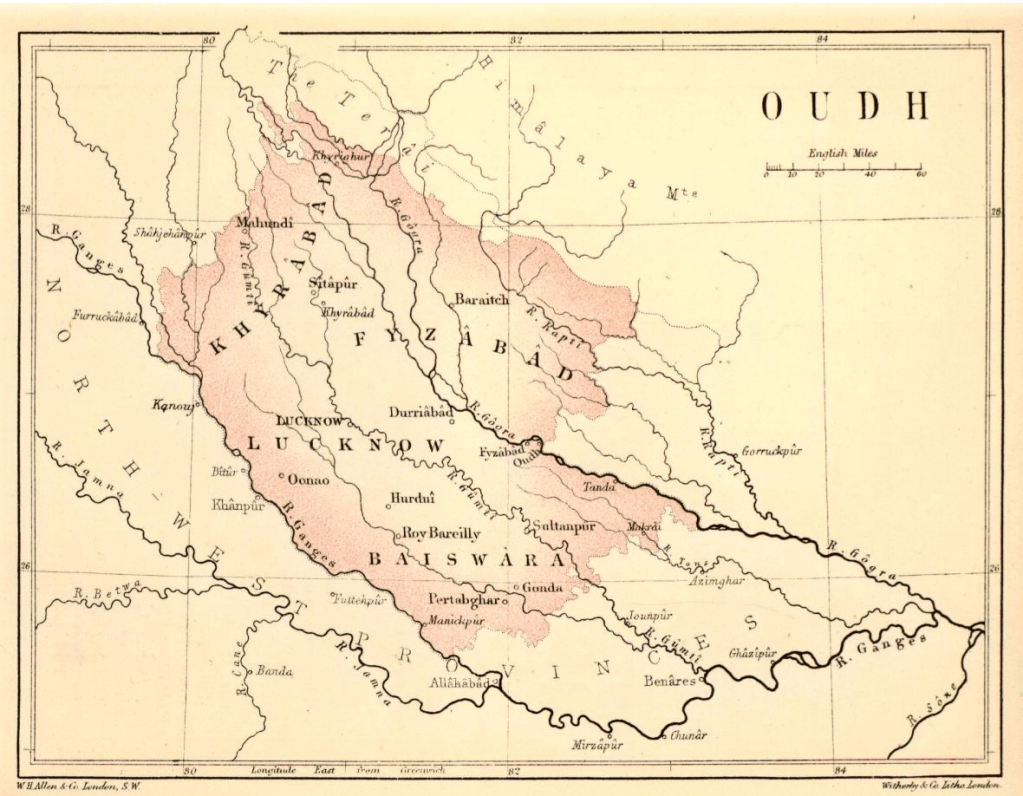
One of the dispatches sent by Colonel Milman from Azamgarh reached its destination of Lucknow on 28 March. That Azamgarh was besieged was not news Sir Colin Campbell, on the cusp of the opening of his Rohilkhand Campaign, needed. There was nothing for it – a column would need to be sent for his relief.
The Articles of War say ‘ Obedience is the first duty of a soldier, ‘ so we cannot grumble whatever comes .” (Diary Entry, Pte. Malcolm, 10th Regt, 29 March 1858)
HM’s 10th Regiment of Foot had seen all they had wanted to see of India. Ever since 1842, they had been guests on her shores, had lived in her cantonments, and had fought in their Queen’s battles in both Sikh Wars; at Sobraon, the Relief of Multan, and the Battle of Gujrat. Then came seven years of comparative rest, with a long halt at Ferozepore that Private Malcolm called “the worst station in India”, where heat, apoplexy and cholera played the devil in their ranks; then it was off to Wazirabad to replace the 29th Regiment that had been decimated by sickness. If nothing else, Wazirabad was certainly a worse station than Ferozepore, for to their horror, on their arrival, their barracks had not been built, and their accommodation consisted of tents over which a shed had been built. The heat was terrific, with temperatures in the tents rising to 110°F during the day, but the torrential monsoon rains turned their camp into a swamp. At Wazirabad, they received the disheartening news that their regiment, which had expected to go home after two years in India, would now remain for another seven. By the time their barracks were built and the 10th had fairly settled into life in Wazirabad, the order came for them to don their packs and march to Dinapore— it was 1856, and there was perhaps some possibility of going home at last, had it not been for that scuffle in Crimea.
“This is the Gravesend of India; it is the last place regiments are stationed in before going home. But I am afraid that in consequence of the continuance of the Russian war, there is no likelihood of any Queen’s regiment being withdrawn from India for a long time, at least, until the war is over; still it is certain that our regiment will return first. The regiment we relieved in Lahore in 1854 left this station last year for England. They are now in England — the 96th regiment.” (Malcolm)
Before mutiny was even a topic, the 10th was also faced with the prospect of being sent either to the Persian Gulf or, worse still, China. What was certain was that they would go home “next spring,” – but it did not happen. Spring 1857 saw the 10th still at Dinapore, and by the time the mutiny rolled about, it was clear they were not going home. Instead, they would witness the mutiny at their station and subsequently be on the receiving end of Dunbar’s fatal attempt to relieve Arrah in July. Those who made it back from Dunbar’s expedition had grisly stories to tell, but when Major Eyre called on the 10th Regiment, they not only relieved Arrah but chased Kunwar Singh from his jungle stronghold of Jagdishpore. Malcolm wrote to his relatives at home in November 1857:
“I don’t think the 10th will leave the Behar district, as we are the only Europeans in it. We have five companies in Dinapore, and five companies here in a jungle, about one hundred miles from Dinapore, waiting to move whenever the rebels rise. “We can get scarcely anything to eat, but we have our health… We certainly shall be very often engaged with the rebels, as the district is very large. You must not be surprised if I don’t write to you so often, for it is only in certain places that we can write.”
The next time he wrote home, it was February 1858 – in the time intervening, the 10th had joined Brigadier Franks’ and his field force; and they would then fight their way through the final capture of Lucknow. Malcolm was still optimistic that the 10th was going home, “We expect in a day or two to be sent to our several stations, and there is talk of our going home. this year.” It came sooner than expected. On 26 March, after 17 years in India, the 10th was ordered to march to Calcutta – they were going home. Two days later, they turned their backs on Lucknow and, with joy, set their faces homewards. The very next day, they were recalled – Colonel Milman was holed up in Azamgarh, writing frantic letters for relief to all quarters, including Lucknow, and it was decided that the 10th were going to meet Kunwar Singh again. So, with the Article of War in mind, the 10th stoically, and undoubtedly with muttered curses, returned to Lucknow. Azamgarh was 15 marches away.
Brigadier Lugard’s Column
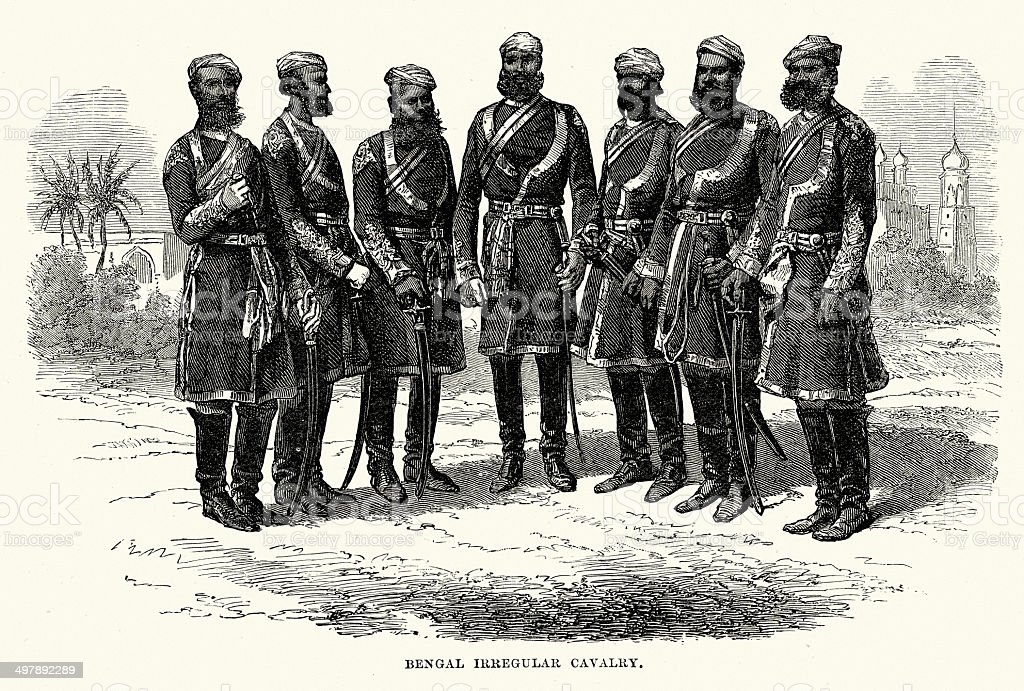
Cavalry
Military Train
3rd Sikh Cavalry
12th Bengal Irregulars (1 squadron)
Infantry
HM’s 10th Foot
HM’s 34th Foot
HM’s 84th Foot
Detachment Royal Engineers
Punjabi Pioneers
Artillery:
1/2 E Troop, Royal Horse Artillery (2nd Captain & Brevet Major J.E. Mitchell)
A/3 Madras Artillery (Captain G.S. Cotter)
Heavy Battery:
8/2 Royal Artillery (Captain J. Thring)
Detachment 5/13 Royal Artillery (Lieutenant W.H. Fitz Maurice)
O.C.A. Lieutenant Colonel C.J.B. Riddell, R.A.
S.O. Brevet-Major N.O.S. Taylor, R. A
The following civilians accompanied the force: from Lucknow, Mr Forbes, C.S., acting for the intelligence department, Mr Jenkinson, C.S., and Mr P Carnegy (Deputy Commissioner) joined the force at Jaunpore.
60 men of the 10th Regiment were mounted, just as they had been in Brigadier Franks’ force, to act not only as scouts but as impromptu cavalry, to follow up retreating rebels and keep them busy until the remainder of the troops came up for an organised attack; the work was not new to the 10th, and their services would prove invaluable. One of the men was Lieutenant Montague Battye, whose brother Quinten had been killed at Delhi leading the charge of the Guides. Another brother, Charles, was riding with the 3rd Sikh Cavalry. Only four days earlier, they had bid farewell to their younger brother, Wynyard, who was off with Jung Bahadur’s army. For Montague in particular, this return of Kunwar Singh must have been beset with apprehension – he had survived Dunbar’s folly with a crack on the head and had nearly lost his life to a river crocodile (mugger) during the retreat; the mugger had dined on a fellow officer instead, leaving Montague to face the fortunes and fights of the HM’s 10th for many months to come.
Once again, that very intrepid volunteer, Mr Edward Henry Venables, who had, at first opportunity, disentangled himself from Azamgarh, and with fortune on his side, met up with Brigadier Lugard at Sultanpore. He had something of a score to settle with the rebels — after all, they had but lately placed a bounty on his head. Little did he know, his own days were numbered.
 Mutiny Reflections