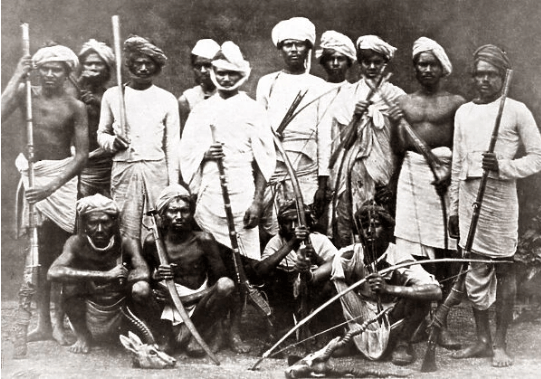
Sir John Malcolm had proposed, in 1818, shortly after the end of the Third Maratha War, that, to bring some semblance of order to Central India, it would be prudent, instead of working against the Bhils, to form them into a corps that would then take care of local policing – however, the idea was shelved and only seven years later, it was taken up again.
Only under Lord Elphinstone were two schemes proposed to solve the “Bhil problem,” as it was then called – the first was to establish agricultural Bhil colonies to bring them from their nomadic ways, and the other was to raise a Bhil corps. The first attempt at this “experiment” was in the Bombay Presidency, where the Bhils lived in the hills and jungles of Khandesh. They had little regard for the EICo, even less than they had had for the Mughals and the Marathas.
“These gangs proved a veritable pest in their immediate neighbourhood. They terrorised the populace through murder, looting and robbery and dacoities. It was, therefore, incumbent on the government to take steps to establish law and order in those provinces where such gangs existed. The employment of regular proved unsatisfactory. It was found that their discipline suffered, being split up into small detachments and that they contracted much sickness by serving in unhealthy locales. Further, it was not always politic to use them, and the cost was prohibitive.
These circumstances led to the formation of Local corps, such as the Khandesh Bhil Corps. The wisdom of the decision arrived at, subsequent events have abundantly proved. The object in raising a Local Corps is to restore order in a lawless District and to preserve it thereafter. This is effected by inducing those who take to the road, as the Bhils did, to join its ranks. At the start, it is a difficult task. Men who have been in the habit of murdering, robbing and looting are most difficult to lure into the net of discipline. ‘I’hey are suspicious and look askance. It must be pointed out to them that an honest livelihood is preferable to one connected with theft, robbery and crime, which punishment is sure to follow.”
It required a very special kind of officer to bring the Bhils into “the net of discipline” and considerable time and effort was made to allay fears and suspicions – for a folk that had been so ruthlessly hunted as the Bhils had been, it was surprising the idea of forming a corps succeeded at all. The officers needed to recruit each man personally, win over their trust and become their friends well before any thought was given to drill and discipline. The Bhils were fortunate that the welfare of the corps fell to one man in particular, and that was James Outram. At the age of 22, he was sent off to Kandesh to raise the first Bhil Corps. As Outram would find, when he finally raised the corps, he had recruited an exceptional class of men – though initially not particularly skilled with guns, they were formidable trackers and bowmen and able to disappear into the smallest patch of jungle, remaining unseen by any enemy until it was too late. It was these traits that had made it so difficult for the EICo and their predecessors to fight the Bhils, as the EICo found out during the Kandesh uprisings.
Local levies did exist in Malwa in 1819, namely the Silani Horse, which belonged to Nadio Singh, a local chieftain and the Nadio Bhils, who were divided between various rulers. However, they numbered barely 300 men, and their loyalties were hardly in the interest of the EICo. They would be formed into the short-lived Nimar Corps, authorised by the government, with the expenses defrayed mainly out of the coffers of Holkar at Indore. Further levies, most notably the Mundlaisair Legion, were raised in 1822, but the idea of recruiting Bhils was not considered until 1835. Like in the Bombay Presidency, the Bhils had continued to work as a law of their own, much to the consternation of the various darbars of Malwa. The proposal of the EICo, to form the Bhils into a corps and thus bring them away from predatory ways, was therefore well received. They would be formed, like at Kandesh, into a regular army unit under British officers, but in the case of Malwa, the states of Gwalior, Indore, Dhar, Amjhera, Jhabooa, and the British government would share the costs. Yet things did not go well – by 1841, the strength of the corps was only 92 men, 22 of which were noted as absent without leave. They would only be considered an actual corps in 1843, with improved recruiting tactics in place, and the men had become so “efficient in drill and discipline” that the NCOs from Bombay who had been sent to train them could be dispensed with. In Rajputana, things were quite different. The Mewar Bhil Corps was raised in 1841 by Captain W. Hunter and proved a success from the start.
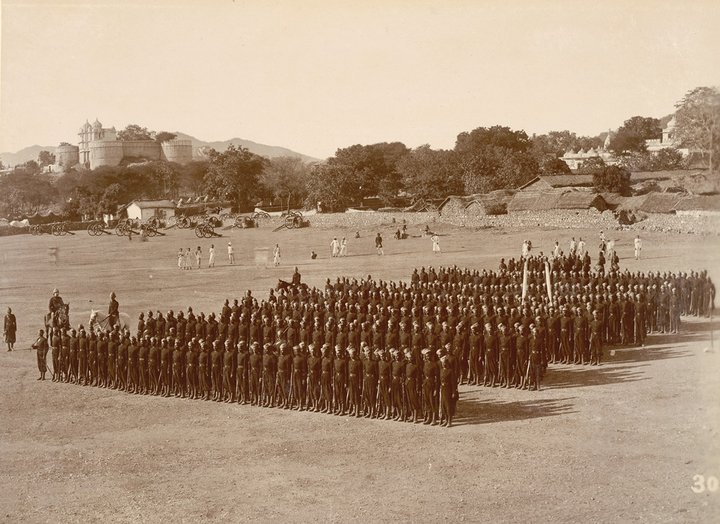
The problem was not necessarily just with the Bhils but with Malwa in general. The EICo had been busy in the intervening years – the First Afghan War, the Burmese War, another against Scindia, and wars in Sindh and against the Sikhs were all terribly time-consuming; nothing of any substance was done to improve conditions in Malwa.
Between 1845 and 1857, several of the Malwa states were under minority administration, i.e. their appointed rulers were too young to take the reins themselves, leaving their courts open to wily dewans, unscrupulous agents, nagging widows and plotting courtiers. The British were mainly concerned with the minority courts of Gwalior and Indore, where their political residents practically became de facto rulers, much to the dissatisfaction of the people of Malwa, who had not been given any concrete reason to trust the EIC.
Malwa benefited little in the early years of EICo rule. The native states did not or could not invest in developing roads or communication; education was not addressed, and the only schools that opened on any scale were those of the Christian missions, which were neither liked nor trusted. Hardly any roads in Malwa were metalled, making operations difficult, and as such, while the soil of Malwa could provide enough food for its population, the constant raids and ravages of the freebooters and tribals terrified the cultivators. Retribution was rare, and compensation for their losses was nil. Malwa had only one interest for the EICo, and that was not rice. It was opium, which, like in Bihar, they exported at great profit to China. The other resources of Malwa remained largely untapped.
The various treaties signed between the British and the states of Malwa were hardly a comfort to the erstwhile population, who believed their rulers had become subordinates of the British. While the British did not openly meddle with the day-to-day running of the internal administration of the courts, they stipulated that every ruler in Malwa had to keep a British Resident and other EICo representatives in their territories. Only two Residents would prove themselves worthy of mention, Hamilton at Indore and Macpherson at Gwalior – the rest drift in and out of the narrative, and rarely in a complimentary light.
The vast armies of the various states had been reduced, and thousands of soldiers were left unemployed. Many of these soldiers were not necessarily men from Malwa but mercenaries, recruited during the warring days, and nearly every state kept their contingents of Afghans, Makrans and Arabs who fought for money and plunder. Since they were professional soldiers, their loyalty was not tied up in tradition or obedience to a ruler. They joined the best paymaster and were known to change sides on a whim if the money on the other side was better. In the states of Dhar and Ali Rajpur, they had become so powerful that they were able to form armies of their own and turn on their employers, especially when pay was not forthcoming. Others were enterprising enough to establish themselves as rulers of their own states, such as Loharu and Bhopal. The EICo had made it a stipulation in all their treaties that employing mercenaries was forbidden, and in the case of Indore, they extended this to “other Europeans and Americans.” The policy was to reduce the strength of mercenaries, particularly Arabs in the armies of Malwa, but what they did not consider was that these men did not leave. In 1857, they would take up arms against British rule.
To keep an eye on Malwa, the British set up cantonments – Mhow for Indore and the Gwalior State, while Gwalior and Mahidpur in their turn watched over Nimar and Jhabua. Another cantonment was established at Bhopawar, and Sihore answered for Bhopal. These cantonments were paid for by the erstwhile state – Indore paid for Mhow, and Gwalior coughed up for not just the Gwalior Contingent but for Mahidpur. Bhopawar was out of pocket for Jhabua and Nimar, while Sihore was paid for by Bhopal.
As for the contingents and armies left to the states, these were funded by the rulers whose duty it was to maintain them, all under British officers, from their own treasuries and within “the limitations of their revenue.” They were regulated regarding scale and armaments, but as we have seen, the Gwalior Contingent proved to be a veritable headache in 1857. The sole purpose of the Malwa Bhil Corps, raised at Indore, was to control other Bhils looting their way through the caravans crossing Jhabua and Nimar. However, the corps would find their place in the upcoming Malwa Campaign.
Sources:
Durand, H. M. The Life of Major-General Sir Henry Marion Durand. Vol. I. London: W. H. Allen & Co., 1883.
Intelligence Branch, comp. The Revolt in Central India 1857-59. Simla: Government Monotype Press, 1908.
Malcolm, John. A Memoir of Central India, Including Malwa, and Adjoining Provinces: With the History, and Copious Illustrations, of the Past and Present Condition of That Country. 2 vols. London: Kingsbury, Parbury, & Allen, 1823.
Malwa Bhil Corps. A Short History of the Malwa Bhil Corps. Indore: Holkar State Press, 1890.
Mishra, Suresh. Shahzada Firoz Shah: A Forgotten Hero of 1857. New Delhi: Sage Publications, 2018.
Simcox, A. H. A. A Memoir of the Khandesh Bhil Corps, 1825–1891: Compiled from Original Records. Bombay: Thacker and Company, Limited, 1912.
Srivastava, Khushalilal. The Revolt of 1857 in Central India – Malwa. Bombay: Allied Publishers, 1966.
Trotter, L. J. The Bayard of India: A Life of General Sir James Outram. Edinburgh: William Blackwood and Sons, 1909.
 Mutiny Reflections