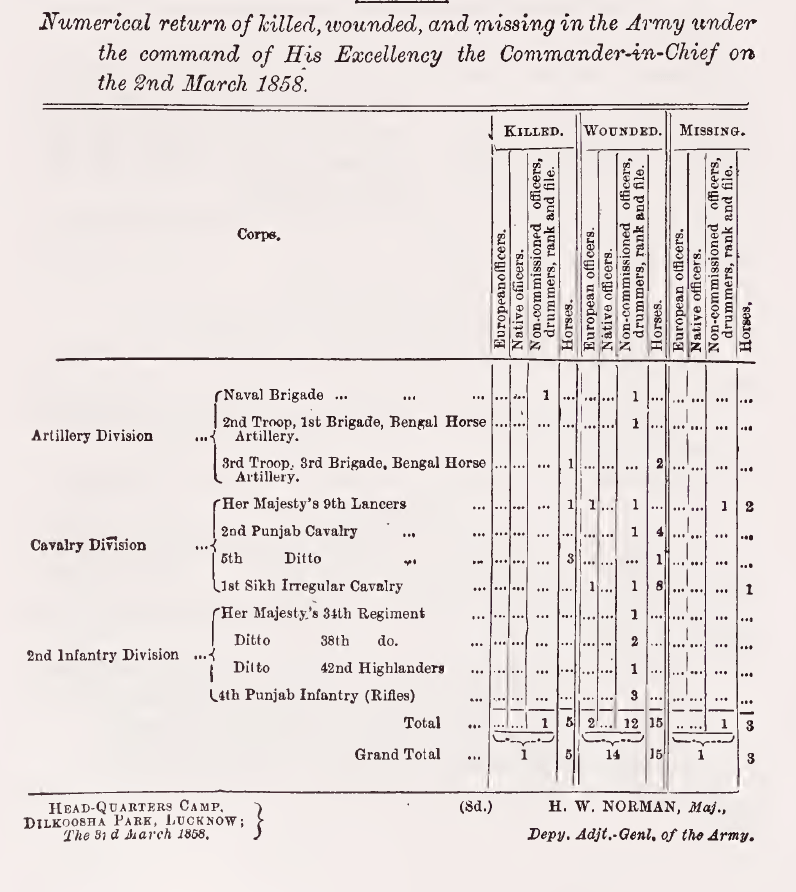
2nd March
“Marched at 4 a.m. on the 2nd, and fought our way to this, driving in a
strong picquet and taking three guns from the enemy. When we got to the Dilkoosha, we found that the enemy’s batteries commanded the place all
round. We were under fire all day. Little was wounded in the left arm, near the elbow, and we had two men wounded, Turner, of G Troop, losing half
his jaw and tongue. One round shot killed two of the Naval Brigade, about fifty yards from us.” (Anson 3rd March)
9th Lancers
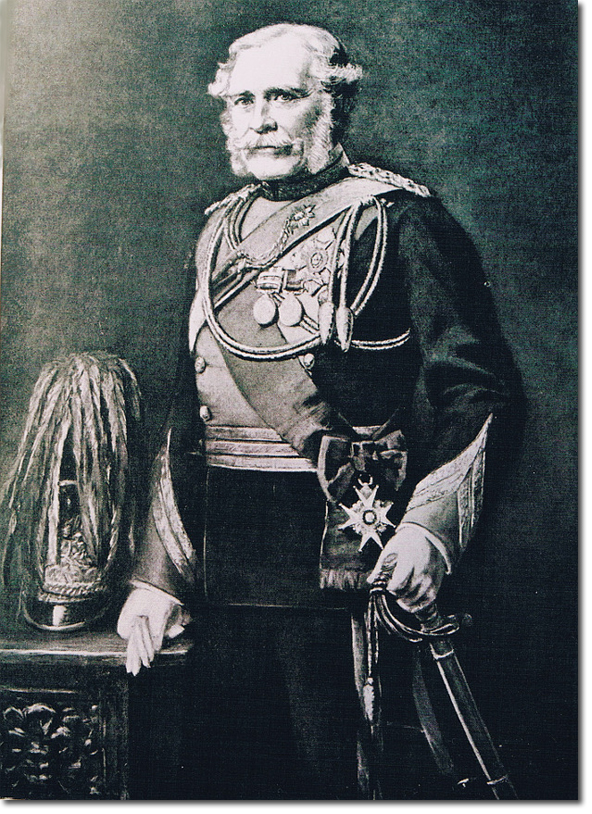
Brigadier Archibald Little, C.B., commanding the 9th Lancers, – severely wounded, shot in the left elbow. It was with some luck that Little was able to avoid amputation; he also narrowly avoided death as the bullet, which shattered his elbow, had it been just marginally higher, would have gone straight through his heart.
Privates
Turner, Turner – severely wounded. Died of wounds 12 May
Whitaker William – missing from hospital
34th Regiment of Foot – Corporal George Bethell – slightly wounded
38th Regiment of Foot
Privates
Page, Thomas – severely wounded
Walsh, Thomas – slightly wounded
42nd Highlanders – Private Alexander McCullum- slightly wounded
Naval Brigade
Boatswain’s Mate, James Terry – severely wounded in the upper part of his leg by roundshot. The same shot wounded the other seaman, carrying away a portion of his skull. Terry did not survive and was buried on March 4.
Able Seaman John McCann -The shot carried away his forehead – “A comrade jumped up and stuck it on again – a large piece of skull and brains…” McCann, though unconscious, was still alive the next day, but died shortly after.
2nd Brigade, 3rd Troop Horse Artillery – Gunner John Fleming – severely contused
4th Punjab Rifles – 3 rank & file wounded
Sikh Irregular Cavalry
Lieutenant A.R.D. Mackenzie – wounded slightly in the advance.
“A hard gallop soon brought us up with the flying enemy were ‘pounded’ by a big ditch, where they abandoned their guns and took to their heels, but too late to save themselves. Here, I had a rather narrow escape from abruptly ending my military experiences. Two ‘Pandies’ whom I was pursuing suddenly turned round and stood at bay, and almost simultaneously lashed at me with their tulwars as I charged between them.
The man on the right brought his sword down on my head, fortunately protected by a thick puggari, many folds of which it divided, and then glanced down on my horse’s shoulder, inflicting a long and deep wound. At the same moment, I delivered a swinging cut on his own cranium, which was covered by a small skull cap. That settled him effectually, but I had barely time to throw my sword round and receive a sweeping blow from the fellow on the left, which partially overpowered my guard and landed on my ribs, luckily with much diminished force; so that I escaped with a trifling flesh wound. He did not get another chance, for I dropped the point of my blade and ran him through the body.”
3 March
42nd Highlanders – Lance Corporal Andrew Morrison – severely wounded
4 March
34th Regiment of Foot – Private Patrick Brennan – severely wounded
1st Bengal European Fusiliers – J. Shipton – slightly wounded
6th Company, 11th Battalion, Royal Artillery – Gunner Francis Lawson
F Troop, Royal Horse Artillery – Gunner William Metcalf
5 March
34th Regiment of Foot
Privates
Campbell, James – severely wounded
Pritchard, John – dangerously wounded. Died of wounds, 7 March
5th Punjab Cavalry – 2 rank & file wounded
6 March
2nd Dragoon Guards
Major Percy Smith – killed in action
Captain P.A.W. Carnegy – wounded
Corporal R. Nicholls – killed in action
Privates
Hall, George – severely wounded
Hart, J. – killed in action
Hunt, C. – killed in action
Searson, Thomas – slightly wounded
Stanley, J.- severely wounded
Wheeler, J. – wounded
34th Regiment of Foot
Privates
Campbell, James – severely wounded
Chappell, Alfred – mortally wounded, died of wounds
Pritchard, John – dangerously wounded
Royal Artillery – Bombardier Thomas McKeon (6/11) – dangerously wounded. Died of wounds
Royal Horse Artillery – Driver Samuel Tims (F Troop) – severely wounded
2nd Punjab Cavalry 3 Rank and File wounded
7 March
9th Lancers
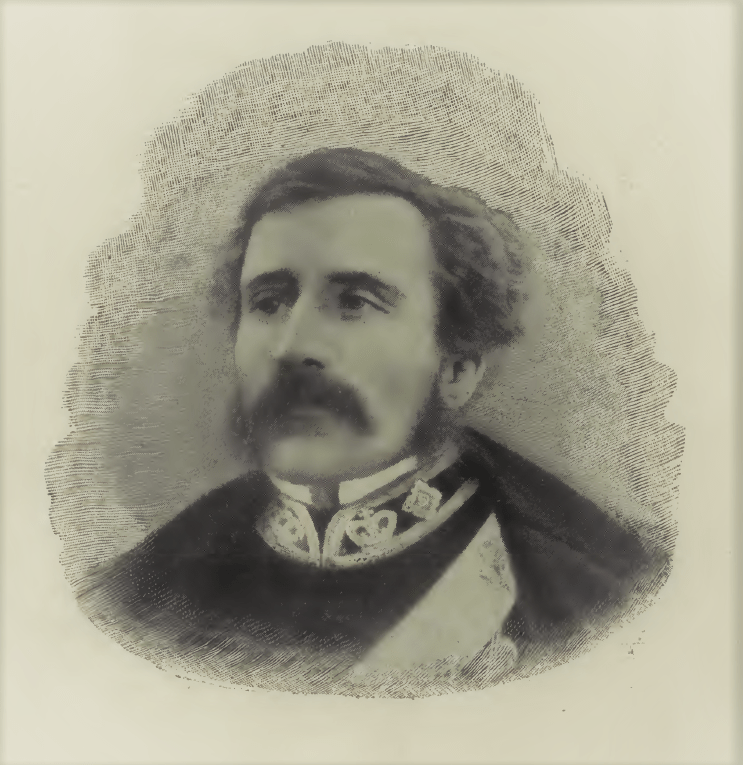
Brevet-Major Octavius Henry St. George Anson – on sick list.
Born in 1817, the son of Lt. General Sir George Anson (4th Dragoon Guards) and Frances Hamilton, he joined Sandhurst in 1832 as a “gentleman cadet,” following which, in 1835, he was appointed to the 3rd Regiment of Foot. Two years later, he proceeded to India and gained his lieutenancy in 1838. Anson served as ADC to the Governor General for three years (1840-1843) when he exchanged into the 9th Lancers. He was present throughout the Gwalior Campaign and fought at Punniar in December 1843. Two years later, he fought in the 1st Sikh War at Sobraon. At the outbreak of the 2nd Sikh War in 1848, Anson was present at the crossing of the Chenab, and at Chillianwallah and Goojerat; in 1849, he was promoted to captain. When the mutiny broke out, he suddenly found himself in command of the 9th Lancers on their march to Delhi as all the senior officers happened to be absent. Anson fought with the regiment in all their battles, from Badli-ki-Serai and the Siege and recapture of Delhi, through Bulandshahr (where he took command of the 9th Lancers again when Captain Drysdale was wounded) and Agra under Greathed, then under Sir Hope Grant through the Relief of Lucknow, and to Fatehgarh. His luck nearly ran out at Meanganj, where he was saved from a tulwar blow by Charles Gough, earning Gough his third VC citation.
After a harrowing 12-hour stretch on horseback on the 6th of March, starting before dawn, and continuing through not only a burning sun and then torrential rain, he returned to camp and took to his bed. On 9 March, he complained of “fever and ague, and a great pain on the right side of my chest, from halloaing, I suppose.” However, it was decidedly more serious than that, and Anson was finally diagnosed with an inflammation of the right lung. The remedies were the best the surgeons could offer at the time, consisting of hot flannel fomentation applied to his aching limbs and the application of leeches, which bled him of up to 12 oz of blood in a single sitting. As soon as accommodation could be found for him, he was allocated a room in the Dilkusha, where he remained until he received his release on sick certificate. On the 25th of March, Anson finally travelled home to his wife and children, who were waiting for him in Mussoorie, and whom he had not seen since May 1857. His health, however, never recovered, and he died at Dehradun on 14th January, 1859, aged just 41.
The 9th Lancers saw more action during the mutiny than any other cavalry regiment, but of its 38 officers, only three received all three clasps. One of those officers was Brevet-Major Anson.
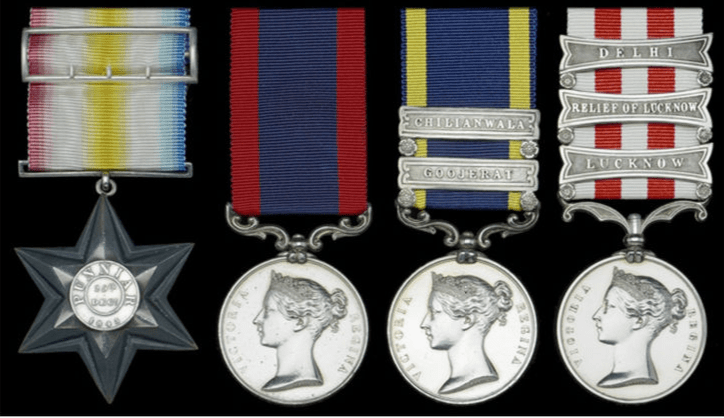
Punniar Star, 1st Sikh War (no clasp), 2nd Sikh War (2 clasps, Chillianwallah & Goojerat), and the Indian Mutiny (three clasps, Delhi, Relief of Lucknow and Lucknow)
2nd Dragoon Guards – Sergeant W. Redmond – killed in action
79th Highlanders – Ensign G.G. Thain (EICo service, doing duty with) – slightly wounded
1st Bengal European Fusiliers
Corporal James Finnigan – slightly wounded
Private Daniel McCarthy – severely wounded
3rd Battalion, Rifle Brigade – Private James Collins – slightly wounded
Royal Artillery
Gunner Robert McGinnis (5/12) – dangerously wounded. Died of wounds
Gunner & Driver Lawrence Power (3/14) – slightly wounded
4th Punjab Rifles – 1 rank & file wounded
2nd Punjab Cavalry – 4 rank & file wounded
5th Punjab Cavalry – 1 rank & file wounded
4th Infantry Division – Gurkha Force – 1 rank & file wounded
8 March
1st Battalion, 23rd Fusiliers – Hospital Apprentice R. Pereira – severe contusion
9th March
Divisional Staff – Captain Robert Stewart, D.A.A.G. – severely wounded in the left foot by a musket ball.
1st Battalion, 23rd Fusiliers
Sergeant Elijah Adams – severely wounded
Privates
Bone, James – killed in action
Walters, George – wounded slightly
42nd Highlanders
Sergeant Alexander Leitch – slightly wounded
Privates
Blaber, William – severely wounded
Brackie, R. – severely wounded
Gardner, J. – killed by grapeshot
Holmes, R. – severely wounded
Lamb, James – severely wounded
Lawson, David- slightly wounded
Mason, A. – killed by cannon shot
McKenzie, R. – dangerously wounded
Smith, P.- slightly wounded
Turner, R. – severely wounded
79th Highlanders
Privates
Darge, Robert – severely wounded
Dick, Robert – severely wounded
Dooley, Patrick. severely wounded
Kyne, Thomas – severely wounded
McBay, Thomas – slightly wounded
Meeney, Michael – severely wounded by the accidental discharge of a musket.
Miller, James – severely wounded
Morgan, John – severely wounded
Rankin, John – killed in action
Ritchie, Thomas – dangerously wounded. Died of wounds
90th Regiment of Foot
Lance-Corporal J. Marshall – killed in action
Private J. Nowlan – slightly wounded in the scalp
93rd Highlanders
Privates
Finlayson, Andrew – slightly wounded
Gough, Edward – slightly wounded
Griffin, James – slightly wounded
McCulloch, John – slightly wounded
McGee, Charles – slightly wounded
Mitchell, W. – severely wounded
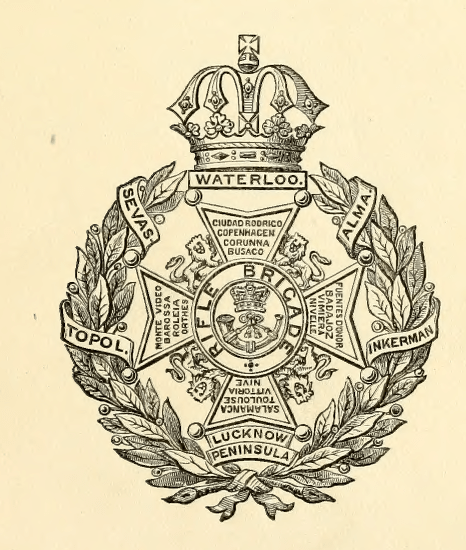
2nd Battalion, Rifle Brigade
Acting Corporal L. Ratican – slightly wounded
Privates
Blackburn, John – slightly wounded
Bone, Thomas – slightly wounded
Loader, Arthur – severely wounded
Lovelock, James – slightly wounded
3rd Battalion, Rifle Brigade
Colour-Sergeant William Hart, slightly wounded
Private William Brown – wounded
1st Bengal European Fusiliers
Captain Etienne St. George – wounded severely
Captain St. George, accompanied by another officer of the same regiment, then entered the house and shot two of the rebels with his revolver. Passing on, he found, as he imagined, the house empty, and concluded that the sepoys were now all killed, but at last he came to a small and very dark room, which he entered, when two men – one on each side of the doorway – fired, and a ball struck him in the lower part of the chest. He walked out, looking giddy and sick, with eyes glazed and heavy, and faintly assisted in unbuttoning his own coat, when it was found the ball had passed completely through his body, from his chest to his back, whence it was afterwards cut out, being found buried very little below the surface was of course imagined that he was mortally wounded, no hopes whatever being entertained by the doctors of his recovery, and keen was the sorrow we all felt for the loss of an officer universally beloved in his regiment and by all who knew him.” (Majendie)
Etienne and his brother George, born in 1827 and 1830 respectively, were the sons of Edmond St. George, a gentleman of substantial private means, and his wife Mary. The boys were privately educated in England and subsequently, in Paris. By 1845, their father was dead and their mother had settled permanently in Paris; the same year, Etienne was put forward for a cadetship in the Bengal Infantry with a recommendation from his aunt, Miss Barwell and Major General Archibald Galloway, one of the directors of the EICo. His brother joined up in 1847, once again, with his aunt’s recommendation and the weightier words of Sir James Law Lushington, another director. He was destined for the 25th Bombay Native Infantry, while Etienne was finding his way in Bengal.
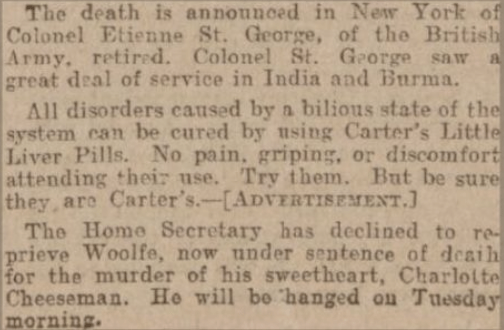
Unfortunately, the year 1858 would bring some grief to the family – George returned home on furlough that year and shortly after, Etienne, who had not only survived his injury but was able to travel home. Both brothers took up residence with their aunt in Brighton, where George, now a lieutenant, suddenly died, aged 27, on July 4. As for Etienne, the bullet was never found and remained lodged in his liver. Although now technically an invalid, he would rise to the rank of colonel and end his career as assistant secretary to the Government Legislative Department, retiring in 1875. In the 1880s, he moved to New York and by 1891 was married to an American lady of some considerable means, Alice Lee Eldridge, the widow of Frederic Eldridge, the president of the Knickerbocker Trust Company. Etienne remained in America, where he died on 1 May 1902, in New York City, of cirrhosis of the liver. His death notice was thus perhaps a boon for Mr. Carter.
Sergeant Thomas White – slightly wounded
Privates
George Castle – slightly wounded
Dillon, James – wounded in the left hand, centre finger amputated.
Doyle, John – wounded in the head
Flannery, Daniel – slightly wounded
Gallagher, Patrick – dangerously wounded
Gibbons, Edward – killed in action
Hair, Alexander – killed in action
Henahan, Patrick – killed in action
Kenwy, Daniel – killed in action
McCombe, William – slightly wounded
McMahon, John – wounded in the head
Woodcock, Luke – severe fracture of the thigh
Royal Artillery (5/12)
Corporal John Douglas – wounded slightly
Gunners and Drivers
Maginnis, Robert – wounded mortally, died of wounds
Sparrow, William – slightly wounded
Robbins, Henry – slightly wounded
Field Artillery
Gunners & Drivers
Black, James – severely wounded
McWhinney, T. – wounded
Oliver, William – severely wounded
Siege Artillery – Gunner & Driver Alexander McNeil – slightly wounded
Bengal Horse Artillery, 1st Troop, 1st Brigade – Gunner William Trenholm
Bengal Horse Artillery 3rd Brigade, 3rd Troop – Officiating Apothecary R.W. Beale – severely contused
2nd Punjab Infantry – Lieutenant Alexander J. Anderson (35th BNI) – killed in action.
Bengal Sappers and Miners – Lieutenant G.R. Forbes – slightly wounded
Naval Brigade
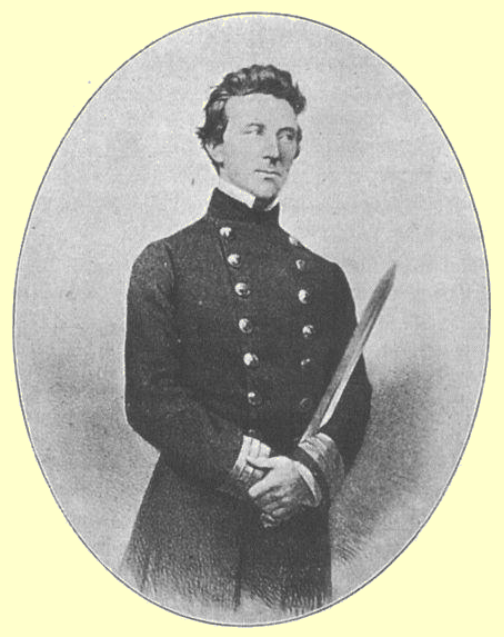
Lithograph by J. H. Lynch
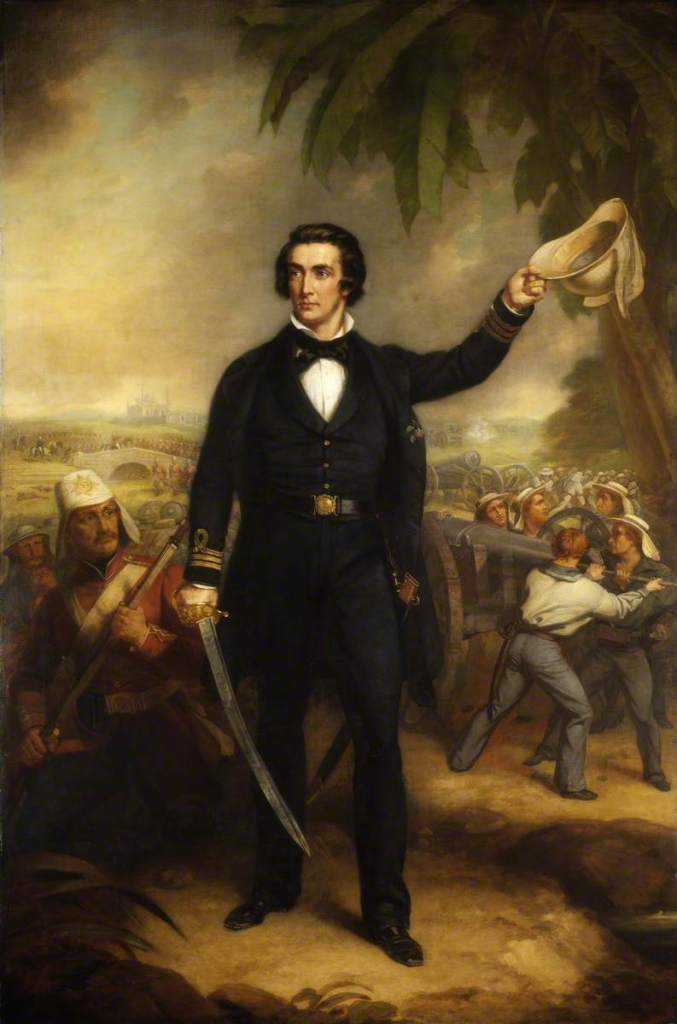
Captain Sir William Peel K.C.B. (VC) – dangerously wounded at the Martiniere. Died of smallpox in Cawnpore on 27 April 1858.
Very few men arrived in India in 1857 with a reputation quite as dazzling as that of Sir William Peel, captain of the illustrious Shannon.
Born on 2 November 1824 at Great Stanhope St, Mayfair, London, the third son of Sir Robert Peel, Prime Minister and Julia, the daughter of Lt. Gen. Sir John Floyd, he was educated first at Reverend F. J. Faithfull’s School, Hatfield, Hertfordshire, and later at Harrow. He began his naval career as a Volunteer First Class on 7th April 1838 aboard the line of battleship Princess Charlotte, the flagship of Admiral Sir Robert Stopford in the Mediterranean. Peel served in her during the Syrian War at the capture of Acre in November 1840. After short service on the royal yacht William and Mary, Peel joined the Cambrian under Captain Henry Chads for the China War (1840-43). With the war at an end, Peel returned home and attended the gunnery school on the HMS Excellence, where he passed all of his examinations in the very short time of 5 instead of 14 months. His father, still being prime minister at the time, was quick to assure the House that his son’s achievement was due to his talents and not due to favouritism. However, young William had not had enough of gunnery yet, and in 1844 joined the school at Woolwich.
As a supernumerary aboard the flagship, Collingwood, Peel set sail once again, this time bound for America, to investigate a settler dispute in Oregon; he was sent home early, via Mexico, to report the findings. Things were certainly going well for William Peel, for at the age of 21, he was promoted to commander on 27 June 1846 and given command of the 12-gun sloop, the Dering, which was serving in the North American and West Indian Station under Sir Francis Austen (one of the two naval brothers of Jane Austen, the writer). Promotions came swiftly to Peel – in 1849, he gained the rank of captain, just aged 25.
A brief stint in Africa allowed Peel time to publish a book, “A Ride in the Nubian Desert” (1852), telling of his adventures as an explorer on what was then the Dark Continent, but it would be the Crimean War that would settle Peel’s reputation once and for all. With his frigate, the Diamond (commissioned by Peel in 1852), shortly after the allied landing in the Crimea and the Battle of Alma, in September 1854, Lord Raglan requested assistance from the Navy. Amongst the ships that answered was the Diamond. Needless to say, Captain William Peel was a brave man indeed, and his Victoria Cross was presented with three citations.
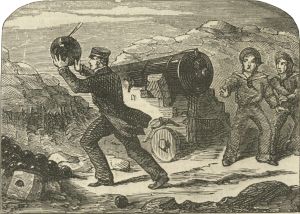
“Sir Stephen Lushington recommends this Officer:– 1st. For having on the 18th October, 1854, at the greatest possible risk, taken up a live shell, the fuze still burning, from among several powder cases, outside the magazine, and thrown it over the parapet (the shell bursting as it left his hands), thereby saving the magazines and the lives of those immediately round it. (Despatch from Sir S. Lushington inclosed in letter from Admiral Lord Lyons, 10th May, 1856). 2nd. On the 5th November, 1854, at the Battle of Inkerman, for joining the Officers of the Grenadier Guards, and assisting in defending the colours of that Regiment, when hard pressed at the Sandbag Battery. (Sir S. Lushington is authorized to make this statement by the Lieutenant-General Commanding the Division, His Royal Highness the Duke of Cambridge, who is ready to bear testimony to the fact.) 3rd. On the 18th June, 1855, for volunteering to lead the Ladder Party at the assault on the Redan, and carrying the first ladder until wounded. (Supplement to The London Gazette of 24 February 1857 – 24 February 1857, No. 21971, pp. 651-2)
Invalided home as his wound refused to heal, Peel arrived in England in August 1855, and a year later, in September 1856, he returned to the sea, commissioning for service in China, the Shannon, and Captain Peel set sail on 17 March 1857.
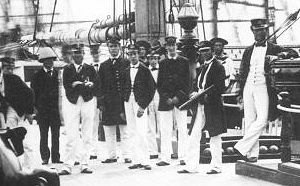
The Shannon’s officers at Calcutta,Peel is standing to the right
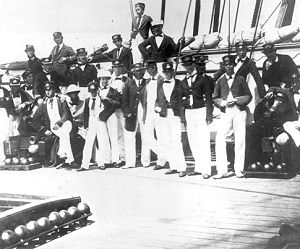
The subsequent career of the Shannon and her gallant crew in the Indian Mutiny has received space in these pages, so we shall leave it here with the words of Colonel Malleson:
Peel was “…a man who would have made his mark in any age. To an energy that nothing could daunt, a power that never seemed to tire, he added a freshness of intellect, a fund of resources…. Bright and joyous in the field, with a kind word for every comrade, he caused the sternest duty ordered by him to be looked on as a pleasant pastime…. Starting from Calcutta on an expedition unprecedented in Indian warfare, he conquered every obstacle; he succeeded to the very utmost of the power to succeed. He showed eminently all the qualities of an organiser and leader of men. Not one single speck of failure marred the brightness of his ermine.” He was remarked for his coolness under fire and for the devotion of his crew, who would follow him the length and breadth of war, unflinching and, unlike many others, uncomplaining. Peel’s men, though sailors through and through, were, to the horror of the establishment back in England, soon trained as infantrymen and the officers, whether they liked it or not, rode horses. There was very little the men of the Shannon would not do when their leader was William Peel.
However, even his life was mortal, and the bullet which found its way into his thigh on 2 March 1858 did enough mischief to put Peel out of the battle for Lucknow for good. Laid up with his wound and in terrible pain, the ship’s surgeon at a loss, for he could not find the bullet, Peel called on Dr. Munro of the 93rd Regiment to put an end to this quandary.
Munro found the bullet, lodged “close behind the large blood vessels, high up on the thigh”, and it took all of the surgeon’s skills to remove the bullet, which he had to cut out from the opposite side of his leg. The last Munro heard of his illustrious patient, he was healing well and preparing to travel to Calcutta. Lieutenant Verney and the men of the Shannon had prepared a grand carriage for their captain, requisitioned from the possessions of the last king of Oudh, sumptuously fitted out with blankets, mattresses, pillows – anything the sailors could find from the loot Lucknow presented was for their captain.
However, possibly a little embarrassed at being presented with such a wonder, Peel once more gained the appreciation of his men by thanking them most kindly, but he would travel in a dhoolie, the same as them – if that was good enough for his blue jackets, it was good enough for him. It was not the wisest choice. Peel arrived in Cawnpore on 17 April, and shortly after the doctors found, instead of a man who was well on his way to recovery, Peel had been stricken down with smallpox. The dhoolie, while a fine gesture of humility in front of his men, had also been used to transport smallpox victims, and the infected bedding proved to be Peel’s undoing. One of the last people to dine with Peel was young Lieutenant Frederick Roberts who found him hail and hearty on the 19th but the next morning,
“I found him in a high fever, and some suspicious looking spots about his face. I went off at once in search of a doctor, and soon returned with one of the surgeons of the 5th Fusiliers, who to my horror, for I had observed Peel was nervous about himself, exclaimed with brutal frankness, the moment he entered the room, “You have got small-pox!” It was only too true. On being convinced that this was the case, I went to the Chaplain, the Reverend Thomas Moore, and told him of Peel’s condition. Without an instant’s hesitation he decided that Peel must come to his house to be taken care of. That afternoon I had the poor fellow carried over, and there left him in the kind hands of Mrs Moore who had as a special case been allowed to accompany her husband to Cawnpore.”
He died seven days later, on 27 April 1858, at midnight, aged just 33. He was buried the same day.
“”I cannot say,” wrote Lieutenant E. H. Verney, “what a sad loss we all feel this to be, and how deeply his death is felt and regretted by every officer and man; the mainspring that worked the machinery is now gone; we never felt ourselves to be the Shannon’s Naval Brigade or the Admiralty Naval Brigade, but always Peel’s Naval Brigade. He it was who first originated the idea of sailors going one thousand four hundred miles away from the sea, and afterwards carried it out in such a judicious manner. I do not doubt that his worth will be appreciated and his death deeply lamented by the people of England.”
Sources:
Anson, O. H. St. G. With H.M. 9th Lancers During the Indian Mutiny. London: W.H. Allen & Co., Ltd., 1896.
Bulletins and Other State Despatches for the Year 1858. Part 1. London, 1858.
Cardew, F. G. Hodson’s Horse 1857-1922. Edinburgh & London: William Blackwood & Sons Ltd., 1928.
Forrest, G. W., ed. Selections from the Letters, Despatches and Other State Papers 1857-58. Vol. 3. Calcutta: Military Department Press, 1902.
Gough, Hugh. Old Memories. Edinburgh & London: William Blackwood & Sons Ltd., 1897.
Lieutenant-General Sir James Outram’s Campaign in India, Comprising General Orders and Despatches. London: Smith, Elder & Co., 1860.
Mackay, Reverend. From London to Lucknow. Vol. 2. London: James Nisbet & Co., 1860.
Tavender, I. T., comp. Casualty Roll for the Indian Mutiny 1857-59. Polstead, Suffolk: J.B. Hayward & Son, 1983.
Verney, Edmund Hope. The Shannon Brigade in India. London, 1862.
Dix Noonan Medal Catelogue: https://content.yudu.com/libraryHtml/A43xjo/Medals21May20/63.html?page=2&origin=reader
 Mutiny Reflections