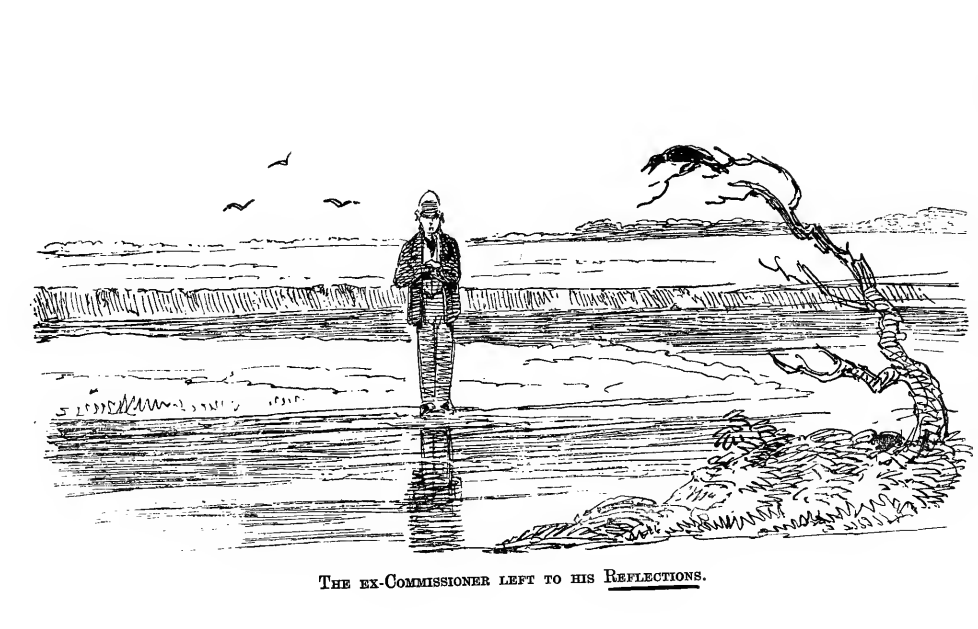
Following the death of Major Holmes and the uprising in Dinapore, a very disheartened William Tayler followed with growing dismay the continued lack of regard Calcutta placed on the problems facing Bihar. He had limited resources to protect Patna, let alone the rest of the division, and he had until now done everything in his power to ensure his division and Patna, in particular, remained calm.
Tayler had reined in his panicking subordinates, ordering them throughout May and June to remain at their posts, believing their limited presence was better than none at all. To his intense irritation, they continued trying to leave – as noted already, even disguised as women from Shahbad – or in complete disorder like Mr Richardson from Sarun in the Chupra District. He had removed the treasuries from the outlying areas, as far as possible, to Patna – firstly to remove temptation that could lead to an uprising and secondly because it could be better protected under his own men.
He had ordered the men at Shahabad to go back to their station, he had supported Wake and Littledale to remain at Arrah, and although he had sanctioned Raikes leaving Champaran, he had made it clear that as soon as possible, he must return. Tayler felt that showing a presence in their districts, regardless of how unsafe they were, helped preserve a sense of confidence. He even gave Richardson and William McDonell on their flight from Chupra the benefit of the doubt – being in bad health and of a nervous constitution, Tayler managed to soothe Richardson enough that he went back to the station of his own will. Insolence and threats from the local population were not reason enough, Tayler felt, to abandon a post. That is, until the barbaric murders at Sagauli and the defeat of Danbar’s relief for sent to Arrah.
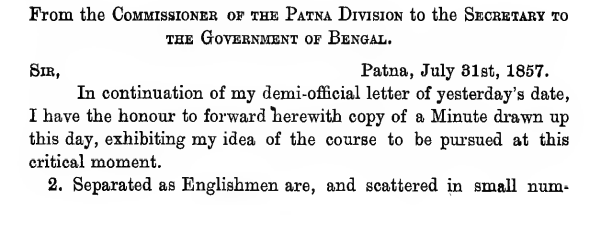
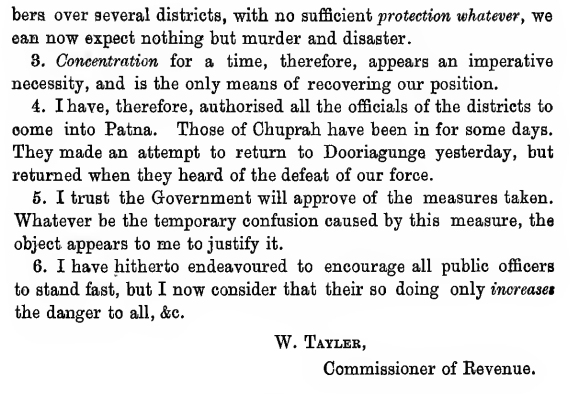
Following the uprising in Dinapore, Tayler was faced with a difficult decision. The crisis, he knew, called for immediate action. If Kunwar Singh was not stopped at Arrah, he would certainly march to Gaya, and Tayler was not willing to have the blood of the men under his charge on his hands. In light of these circumstances, Tayler sent an order to the civilians of the remaining outlying stations of Muzafferpore, Tirhut and Gaya to come without delay to Patna. The officials at Arrah were under siege and could not possibly follow a withdrawal order, and all the functionaries of Chuprah had left their station again of their own accord a few days earlier. Raikes at Champaran had left after the murder of Holmes, a withdrawal Tayler sanctioned after the fact, but as quickly as he left, Tayler approved him going back when the 12th Irregulars were well out of his district.
Lynch and Macdonnell had been chased out of their station by the 12th Irregulars quite nearly to the very borders of Dinapore, and Tayler found them, footsore, tired, but very much alive in that station.
The men at the remaining stations of Mozufferpore and Gaya both complied with Tayler’s orders but in different ways. One was understandable, and the other, ridiculous.
When the order to withdraw was given, Mr Forbes of Mozufferpore and his office complied but were unable to take the treasure – they had insufficient carriages, and their flight was necessitated by the surly 12th Irregulars, lately sent by the now-deceased Major Holmes to help defend the station.
The twelve men of Holmes’ Irregulars revolted shortly after the Europeans left. They ran off with the Collector’s horses and his boots and would have taken the contents of the treasury had the Najibs posted there not put up a strong resistance – the same Najibs who at this point were distrusted by everyone – saved the Muzaffurpore treasury. Being already in the pay of some wealthy local merchants, they gained nothing by joining the mutineers.
The mutineers called on the Najibs at the treasury to come out and divide the treasure with them – the Najibs refused. Their reply in effect was, they were in charge of the treasure and they would keep it. After some rather choice words, the Najibs opened fire on the mutineers, who swiftly turned their horses and fled.
The same merchants had also posted Najibs in the town and in front of their own homes – as the mutineers rode down the street, the Najibs shot at them. Only one person was wounded in this encounter, and that was an elderly woman who got caught in the middle of the fray, suffering a bullet wound to the leg.
Hearing Mozufferpore was now without any European officials, the indigo planters in the district decided to take up the call, and the next day, a party of five rode into the town, armed with rifles and swords, determined to hold it until the Europeans returned. The next day, the magistrate and collector arrived back in Mozufferpore, sent back by William Tayler, who assessed correctly, with the flight of the 12th Irregulars, Mozufferpore was once again safe.
Then there was Gaya and the rather curious Mr Alonzo Money.
Gaya
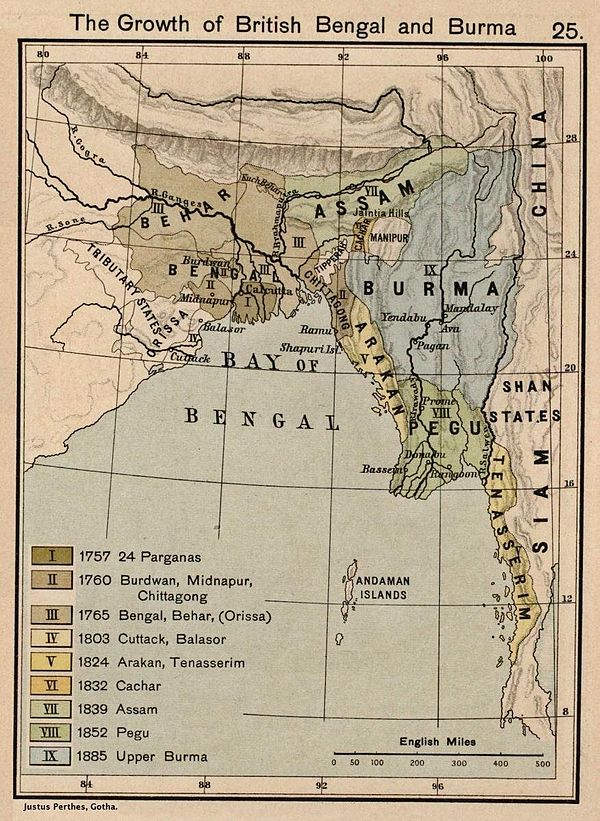
The district of Gaya formed the southernmost portion of the Patna Division. It extended over 4,712 square miles, bounded on the north by the Patna district, on the east by Monghyr and Hazaribagh, on the south by the latter district and Palaman, and on the west by Shahabad, separated from the former by the river Son. The chief town is Gaya, situated 50 miles from Patna.
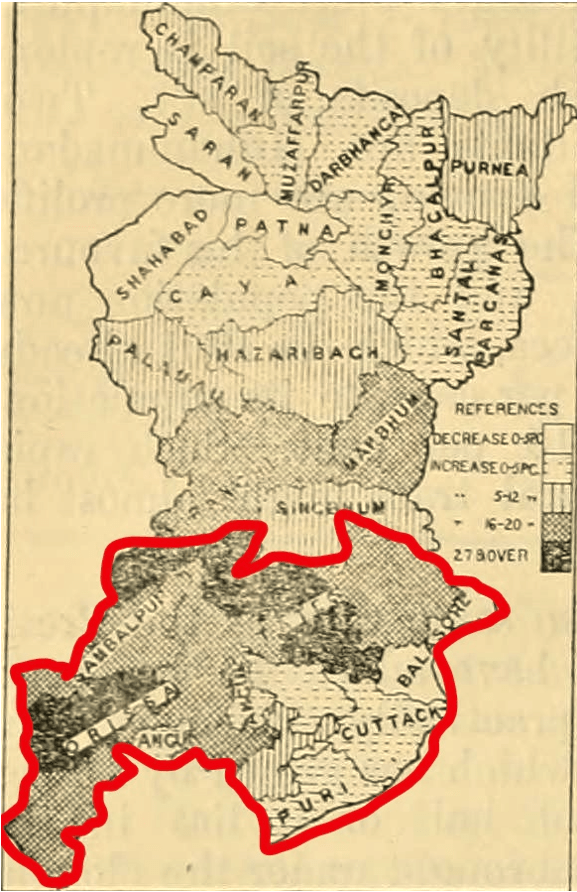
Due to its location, Gaya was problematic – the road served as an ideal connection for mutineers from the east and in consequence, following the uprising in Benares in June, it became imperative to hold Bihar and, in particular, secure the Gaya road. To perform this task, Mr Money had 45 European troops and 100 Sikhs. With the uprising in Dinapore complete, it became clear that the mutineers, if unchecked at Arrah, would proceed to Gaya. However, it must be remembered that the Lieutenant-Governor had stated there was no apprehension of danger in Bihar.
There was indeed an apprehension of danger, but Calcutta was too far away to appreciate it. Mr Money apprised Tayler and the officials of a possible joining of forces between Kunwar Singh, the Raja of Benares and Babu Mondenarain. Had the combination proved fruitful, that could have spelt the end of British rule in Bihar.
20th July 1857. Magistrate.
MY DEAR TAYLER—You tell us to look out; easy advice. You forget, however, that we have but one detachment of English troops, 44 men and 100 Seiks. The former have but sixty rounds a man, the latter twenty.
This is enough, if we had a brush outside with the men, supposing them to be in numbers (or detachments) of 200 or 300. But if they came down in force, say 800 or so, our only chance would be defending a house, and for that the Seiks’ twenty roxmds a man is not sufficient. Moreover, the Irregulars at Monghyr and Bhaugulpore are sure to go, and will probably come by Barh, Behar, and Nowadah this way.
You have now a large force of English at Dinapore, much larger than you can want. It seems to me you might send us a 150 with advantage to the public interests, as the official phrase goes.
Modenarain is in correspondence with Kooer Sing and the Benares Rajah. The latter told him in a letter the other day to ” Jumma hurra Gullah.” This looks suspicious. My authority, though good, did not see the letter. Modenarian has all his guns, about a dozen, nicely cleaned and polished. If we are driven hard and have to defend a house, we shall have some of these guns against us ! ! !
Yours truly,
(Signed) A. MONEY.
Subsequently, before Tayler ordered the withdrawal, even Mr Money admitted Kunwar Singh would make a beeline for the Gaya treasury. As such, he would have no means to stop him. He, like Tayler, believed, should Arrah fall ( and it certainly looked like it after Dunbar blundered), Gaya would be next. It did not help matters that the escaped Ali Karim, still at large, was a Gaya man, and Tayler did not put it past him to stir up mischief in his home town.
Therefore, Tayler felt it imperative for Money to pack up the Gaya treasury and proceed with as much haste as possible to Patna. The order was clear – “Everything must now be sacrificed to hold the country and the occupation of a central position.’’ The order desired him and the other civil authorities to come with all their force to Patna, making their arrangements as promptly mid quickly as possible, and contained an injunction to remove the treasure if their personal safety was not endangered by doing so.”
When he received the order, Mr Money was neither besieged nor threatened. That his position would have been indefensible if the mutineers had descended on his station was clear, but up to that point, Gaya was quiet. So the very first thing Mr Alonzo Money did upon receiving the withdrawal order was to leave the treasure behind in the hands of the Najibs, whom he had recently declared untrustworthy and placed no extra guards at the jail.
When the party had gone 3 miles from the town with Mr Money, Mr Hollings, an officer of the Opium Department, who felt acutely the shame of this abandonment of the station to anarchy and plunder, insisted he would return and see what could be done to preserve order and to save the Government property. Money halted the party and, after some persuasion, went back with Hollings alone.
To their surprise, they found the station in the same order as when they left it three hours before. The treasury was untouched and still guarded: at the jail, the guard was on duty, and all was quiet. Many of the inhabitants welcomed them back, and the more influential among them promised, with the help of the zamindars, to raise a force of 3’000 or 4,000 men to defend the town. As events unfolded, the promise came to nothing- the zamindars were either disinterested or disaffected, the citizens did not really anticipate anyone would attack them, and finally, a force of 100 men, mostly weak and old, was all that could be mustered to protect Gaya from thousands of well-armed and trained mutineers.
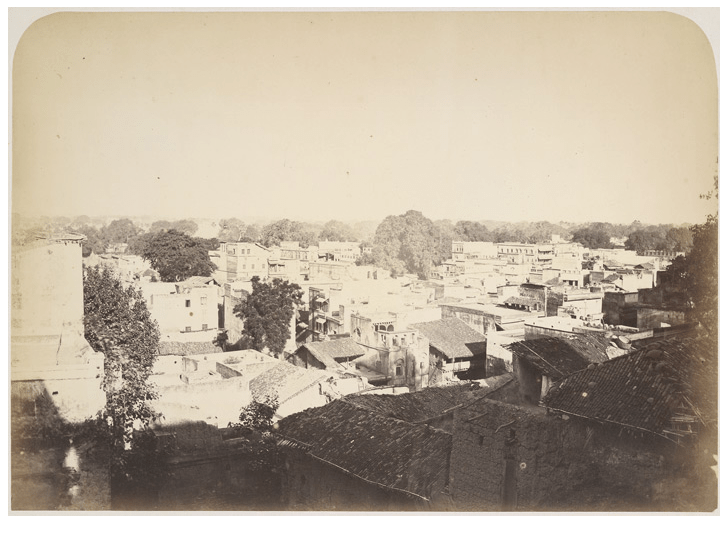
Meanwhile, Mr Money had left the rest of the party on the road. As such, the judge, Mr Trotter, wrote to Tayler in Patna, “intimating…these circumstances, representing the dilemma in which Mr Money’s vacillation had left him and the other officers, and asking whether I adhered to my former order…My reply was that, although Mr Money’s conduct had enhanced my embarrassment, it had not altered the principle on which I had sanctioned the withdrawal…”
For two days, Mr Money remained at Gaya, now without Sikhs and Europeans, still, there was no uprising. He sent a message to Captain Thompson of HM’s 64th who was passing through on their way to Shergatty if they would oblige him and escort the treasure – not to Patna, but Calcutta. It is interesting to note that Mr Money stated in his official letter to the Lieutenant-General that he was initially unable to remove the treasure because he had “no carts and elephants”, which Tayler found this mistifying,
“People do not keep elephants and carts in their houses; and, when I ordered Mr Money to bring the treasure, I of course, and of necessity, contemplated the allowance of such time as was, and always is, necessary for procuring carts and packing treasure.”
The decision to march to Calcutta with the treasure (Money had suddenly found transportation) was based on misinformation that the mutineers must be marching on Gaya, and thus the Patna road was closed; however, the party that had left two days earlier reported the road clear. Even if there had been obstacles, Mr Money had the men of the 64th Regiment with him – 2 nights march to Patna should have been worth more than nearly 300 miles to Calcutta. Before leaving, Money made a great demonstration of burning the Gaya stamp paper for reasons only he himself could fathom. Yet he did nothing to preserve the station’s records.
Consequentially, Money left Gaya on the 3rd of August, when the victory of Major Eyre was already known, and as soon as he turned his back on his station, the Najibs broke open the jail, and together, they looted Mr Money’s house and whatever money he had left behind. The Najibs then left the station, and the prisoners went to their homes, but indiscriminate plundering broke out throughout the town, and for 13 days, Gaya was effectively without either a police force or a government as neighbours murdered, looted and pillaged neighbours. Not even the local zamindars or landed aristocracy bothered to step in and save Gaya from itself. On the 16th of August, Gaya was reoccupied by the British authorities, firstly to restore communication along the Grand Trunk Road and secondly to right the mess Money had made by leaving.
Instead of receiving the rebuke he so rightly deserved for his actions, Mr Money was applauded in Calcutta as a hero for this rather theatrical display for which he eventually received an Indian Mutiny Medal; Mr Tayler was derided as a panic monger. By ordering the withdrawal, had the subsequent victory of Major Eyre not materialised, it would have been the only way for him to secure the lives of the civilians under his charge and with whose help Tayler could have held Patna. None of this was taken into consideration. As it was, Eyre was successful, and Tayler was further accused of meddling.
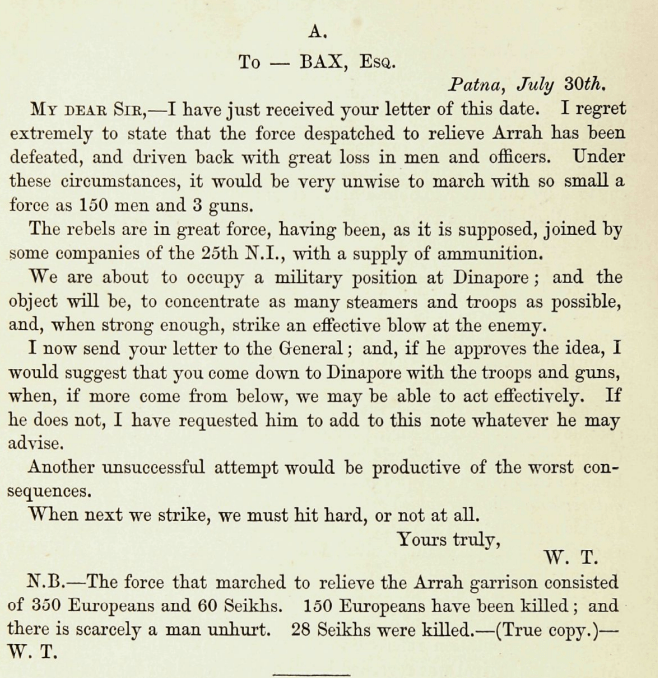
Following the first disastrous retreat, Tayler sent the following letter to one Mr Bax at Buxar:
Back in Patna
Tayler had further problems, and these were at his own door. One was in the form of his
magistrate, John Lowis, who was proving a handful. Lowis had managed, in quite an astonishing way, to not catch Ali Karim twice, and when Tayler demanded his nazir (who had been involved in both the bungled arrest attempts) be dismissed, Lowis baulked. In his official report to Lieutenant-Governor Halliday, Lowis continued to insist he would simply ask the man for an explanation of his odd behaviour and that should put everything to right. Lowis refused to believe there could be dissension in his own ranks and that Tayler was overreacting.
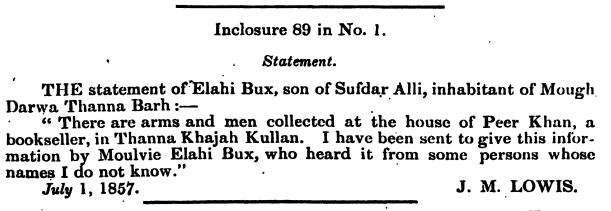
On the 1st of July Tayler received word via messenger from Elahi Bux, (the blind father of one of Tayler’s hostages who had deliberately left in the city) that an uprising, headed by Pir Ali Khan was imminent – being busy with other issues, he requested Lowis, as a magistrate, to investigate. Lowis claimed the messenger sent by Tayler gave answers “so confused and the grounds of his suspicions appeared to me to be so worthless that I directed him to bring me more correct and better information…” He then blamed Tayler. Had Tayler not ordered the detention of his Nazir and thrown his office into “confusion”, he would have been able to investigate the matter. As it was, Lowis didn’t because Lowis felt he couldn’t. The statement Lowis felt was worthless said:
In his defence, Lowis resorted to bleating,
“Had I not been already wearied by inquiring into the truth of endless statements, similar to the one made by Elahi Bux, I should of course have taken more immediate notice…”
Following the uprising on the 3rd of July, a court of inquiry was convened to ascertain the cause and circumstances. Those caught were rigorously questioned; what Tayler would not stand for was abuse. In a letter to Lowis following one such interrogation, Tayler wrote on the 6th of July,
“Sir,
I MUST call your attention to the extreme impropriety of your conduct this morning, in entering to a personal struggle with the prisoner Guseeta, while he was quietly seated before me, with his hands tied, and answering the questions put to him.
2. To seize a man thus situated suddenly by the throat with both hands and throw him to the ground, and then continue to maltreat him in my presence, and in the presence of the Sikh soldiers was a most unbecoming exhibition of useless passion, calculated to bring yourself and the English name, in to discredit, especially at a time when cool determination and dignified manner are on all accounts peculiarly desirable..”
On the 8th of July, Tayler outlined 14 points why Lowis should be removed from Patna, and for once on the 14th of July, the Lieutenant-Governor agreed, citing Lowis was “hardly aware of the grave error he has committed or that he has incurred a most serious responsibility by misconduct, which would appear altogether to disqualify him, not only for the Patna magistracy but for any other similar office…”
He might have succeeded with Lowis, but he was already lost.
The machinations of certain men in Patna did not help Tayler’s case. Mr Robert Birch Garrett, as brother-in-law to Mr Halliday, had had frequent communication with the Lieutenant-Governor in the form of private letters, a practice he continued up to his untimely death at the age of 46 on the 29th of June 1857, shortly before the outbreak at Patna. Although those letters have not been revealed, Halliday was not beyond pointing to Tayler time and time again; he had private knowledge of his doings and he saw fit, as a result, to rely less on what Tayler said.
The arrests of the Maulvies were used as a further means to bring down William Tayler- the men he had placed under arrest to ensure the good behaviour of the Wahabis in Patna were not mere leaders of some obscure sect. They were men of influence and power in their own right, and they had supporters well outside Patna. Halliday considered two of them innocent gentlemen and strongly protested Tayler’s actions. One Mr John Bardoe Elliot, a retired civilian (who is now revered as the man who donated his extensive collection of oriental manuscripts to the Bodleian Library), was the very same aged resident whose favourite concubine had objected to Tayler’s arrest of her Mulvie teacher. Elliot had been a civil servant to the EICo for 45 years and had served as a judge in Patna. As such, he had considerable influence still in Calcutta, even if his lifestyle would have shocked them out of their boots.
Wiliam Tayler, a keen artist, was not beyond putting the situation into pictures:
One of these was entitled “The Bengal Giant and the Behar Chicken” and captioned, “Come Tayler- Knock off bullying these chaps – or you’ll catch it – They’re my friends.”
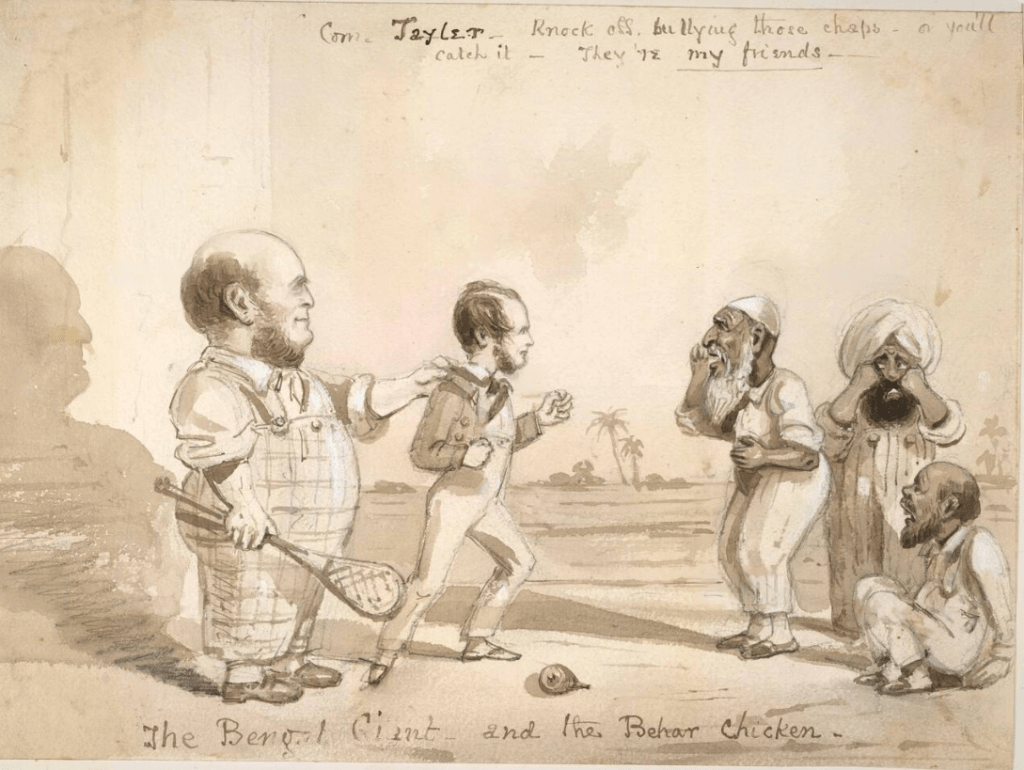
Album containing 17 satirical drawings on the treatment of Tayler at the hands of Sir Frederick Halliday, Lieutenant-Governor of Bengal, and other officials, along with newspaper cuttings relating to the affair c.1859.
The maulvies dressed as children, cower before an energetic Mr Tayler who is being held back by the massive figure of Mr Halliday- the implications are quite clear.
Things only became worse for Mr William Tayler.
The Lieutenant-Governor persisted in reminding Tayler to provide satisfactory reports, timely reports, and to use his own judgement while rebuking him for using the same judgement, Tayler was to desist from insisting there was a crisis in Patna, he was to maintain order but he could only raise a force if it was offered, he was under no circumstances to ask either local rajas or zamindars for assistance, he was to ensure the treasure was safe and the officials likewise, but his withdrawal order at a time when the crisis was at a head, was considered motivated by Tayler’s panic.
On the 4th of August, as the crisis in Bihar was reaching its end, Mr William Tayler was removed as commissioner of Patna. The charges weighed against him by Sir F. Halliday and the government at Calcutta are listed below:
First, then, in regard to my position.
Sir F. Halliday officially declared that there was ” no danger at Patna.”
Secondly, as regards the Dinapore sepoys, that the ” mutiny was inconceivable”
He then proceeds to delineate my character and describe my actions as below :
—
1st. The sole danger of Patna was caused by my “violent and unwise proceedings.”
2nd. That I ” lent myself to a thirst for reckless bloodshed.”
3rd. That I sentenced and executed men who were not convicted of any crime.
4th. That I kept under arrest “innocent and inoffensive gentlemen against whom there was no cause of complaint.”
5th. That I made myself the tool of worthless and designing traitors.
6th. That I showed a ” great want of calmness and firmness.”
7th. That I interfered with the military authorities.
8th. That I concealed as much as possible my acts and intentions.
9th. That I was guilty of a ” quibble.”
10th. That I wrote ” frequent orders to Major Eyre not to advance to the relief of Arrah.”
11th. That I was under a ” panic,”
12th. That I issued a ” disgraceful ” order.
13th. And, finally, that I created universal scandal and discontent by my measures.
If this was not bad enough, the viewpoint of Mr Samuells was published in a local paper is clearly not the thoughts of a rational man. This followed Tayler’s publication of a small book, originally intended for private circulation, called “Our Crisis” in the first edition and later “The Patna Crisis.”
Daubs freely, with the blackest colours, his immediate superior the Lieutenant-Governor and his two successors.
Fuss and parade.
Dishonest artifice. Miserable perversion of facts.
Piece of pure slander.
Could not support this calumny.
Mr. Tayler’s statement is wholly untrue.
Voluntarily making himself the vehicle of the lies and calumnies of a parcel of worthless intriguers.
A simple piece of impertinence and wholly untrue.
Simply talks nonsense. Wholly without foundation.
Silly piece of rodomontade.
Perfect audacity.
Facts and dates manufactured without scruples.
Statements are irreconcilable either with dates or facts.
Pack of impudent and unprincipled libels.
Vague grandiloquences, of which Mr. Tayler is so fond.
Pure romance. Imaginary measures.
Ill-judged measures.
A man of inordinate vanity, singularly bad judgment, and utterly
unscrupulous; venting his spleen on all around him who are not
inclined to take him at his own estimate, or who interfere with the
spurious claims he sets up.
Cap in hand seeks the suffrages of the people.
Wholesale misrepresentation.
Barefaced claptrap.
Rottenness of reputation.
Charlatan.
Misrepresentations and misstatements.
Picks up the dishonourable weapons of his anonymous friends
It is fortunate for Tayler that the society of India was above the likes of Mr Samuell – and the Friends of India concluded, “the special pleading of Mr. Samuells “had not made a single convert or produced any effect whatever, except to place the writer in the ranks of the timid politicians with Mahomedan sympathies.” A more straightforward writer facetiously remarked it was the ravings of an “inebriated cabman.”
And this man had replaced Tayler in Patna as Commissioner. Among Samuell’s first acts in office was to reinstate Lootf Ali, the conniving banker who had funded at least in part the Patna uprising in July, to his former position, and he brought with him Amir Ali, a notoriously unpopular Patna advocate, as his assistant. Few in Patna hailed the move; it even led to one planter leaving the district in fear of what Lootf and Amir would do now they had actual power in their hands.
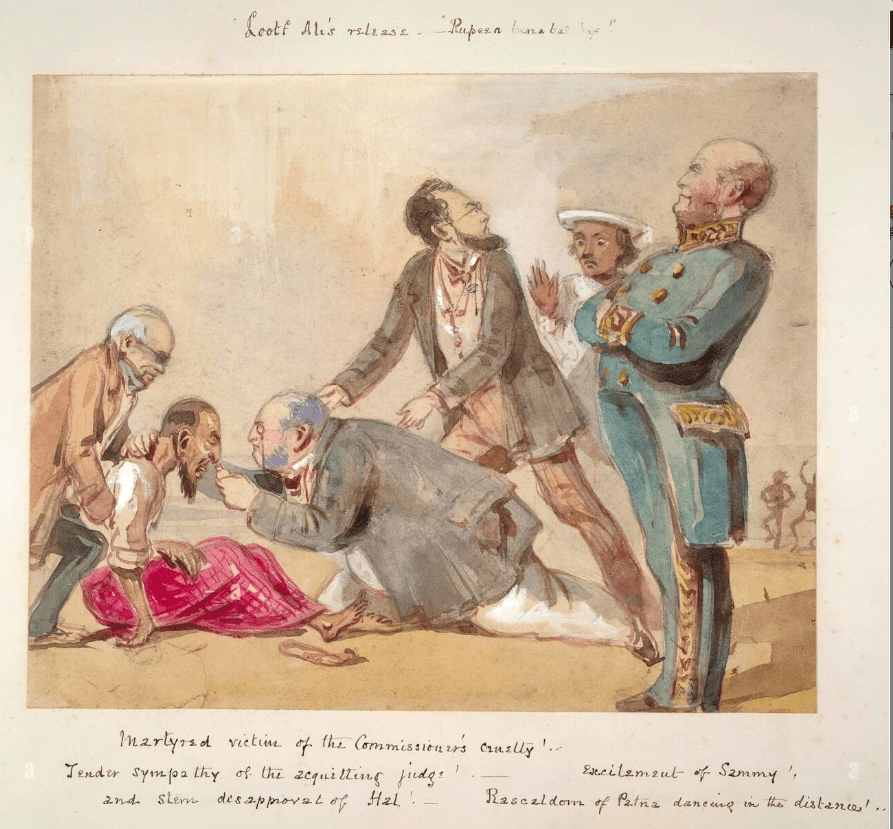
One of Lootf Ali’s Patna supporters was none other than Judge Farquharson who had acquitted the man based on not having enough evidence, even though it was clear he had given money to Pir Ali Khan, one of his own men had led the Patna revolt and he had been found harbouring Aat least one sepoy who had mutinied in Benares, employing him in his house as a servant. To add to Tayler’s humiliation, Lootf Ali was soon paraded around Patna and invited to garden parties by its officials.
Following Tayler’s dismissal,
“Mr. Samuells being appointed in his place, and 200 British soldiers and 2 guns were sent to protect the city. This force was strong enough to overawe the disaffected, but from the moment that the rebels got the upper hand in Gorakhpur, the country round Patna had no peace. Bands of mutineers roamed at will over the country, destroyed public buildings, and levied tribute. These raids, however, did not produce any general rising and were merely local disturbances. “The people of Patna, ” remarked the Lieutenant-Governor, “ had before them the spectacle of the neighbouring district of Shahabad for weeks in the occupation of the rebels, the Gaya district overrun by marauding parties, and Government thanas and private property destroyed within a few miles of Patna itself yet with a merely nominal garrison the city was as quiet as in a time of profound peace.” (Patna District Gazetteers)
It still had not dawned on Halliday that this profound peace had been Tayler’s doing.
Bihar, on the whole, would not return to a state of peace for another year.
Another charge levied against William Tayler was his supposed indiscriminate use of capital punishment. He did, between June and July, hang upwards of 25 people – however, it must be pointed out, as excessive as this may appear, we must not forget he did not do this of his own design. For every hanging, Tayler had approval from the government and in the cases of the men who had been caught inciting mutiny or had mutinied themselves, the law could not be clearer. That Canning was horrified by how indiscriminately Act XIV was utilised is more a fault with Canning and not so with William Tayler. Unlike Neil on his march to Allahabad or the positively mad civilians in Benares and Allahabad who formed hanging parties and actively went out into the countryside stringing people up on a whim, Tayler used corporal punishment within the boundaries of the law set by the service he worked for. We must not forget that William Tayler was not a John Nicholson. He did not simply write on the back of a piece of paper, “The Punishment for Mutiny is Death”, and send it back to his superiors. Tayler was, if anything, too conscientious of his duty and anyone who has read the Parliamentary Papers for 1857 will see that perhaps he tried too hard to please everyone, all the time. Calling him “violent and unwise in his proceedings” could not be more insulting, coming from a government that had given its civilians free rein to act on their own and even presented accolades to those who fulfilled their wishes.
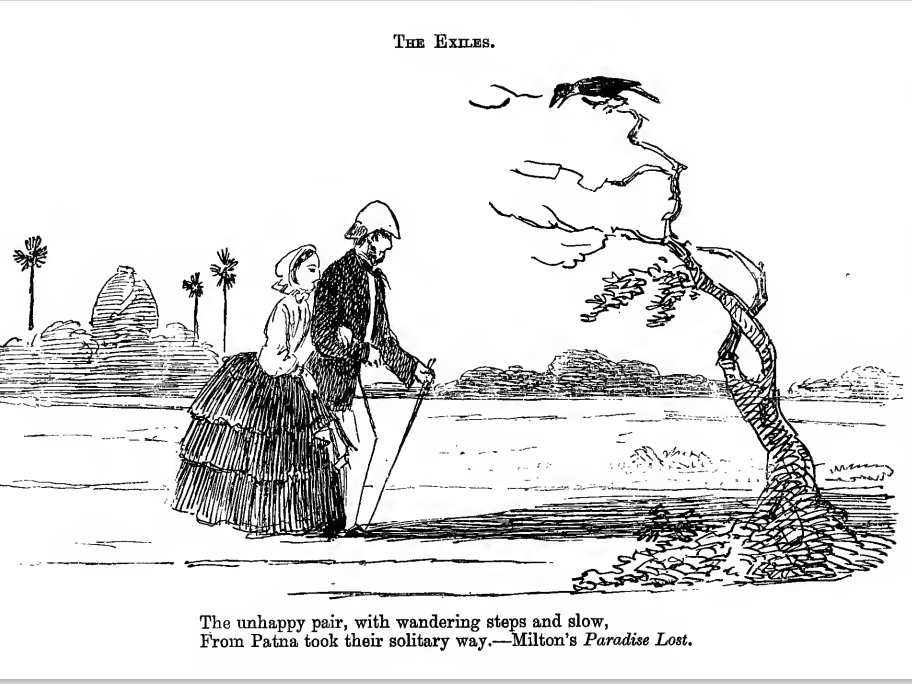
In his defence, William Tayler turned to writing pamphlets and books. Starting in 1858, he gathered letters from well-wishers and from friends who all unanimously agreed that Tayler was right in his dealings in Patna. Not that it mattered. He would repeatedly entreat the authorities to look at his case; he would ask, and he would plead, yet nothing came of it. Although he would win the court of public opinion, he would remain a governmental pariah. The original pamphlet “Our Crisis” so displeased Lord Canning, he was once again suspended from the service for “disrespect.” Willliam Tayler had “committed the unpardonable fault of having been right when his official superiors were wrong, and the vindictiveness and narrow-minded spite which wrecked his career and had followed him ever since was attributable to nothing but that he, being a most clear-sighted and capable Englishman, had met with the censure.” (Henry Havelock-Allen, Hansard Parliamentary Papers for 1888)
It would be shown, nearly ten years later, that William Tayler was not altogether wrong about the Wahabi conspiracy. After Tayler’s humiliating exit from Patna, Mulvie Muhamed Ahmedullah, one of the three who had been held hostage, was “fondled by the Governors of Bengal… it was said that the inoffensive Wahabee gentlemen…were mere bookmen…” But it would be Captain Parsons in 1864 who would arrest several Wahabis on charges of high treason. Ahmedullah, who had been drawing a comfortable government salary for the various positions he held in Patna, was found guilty and sentenced to life imprisonment in the Andaman Islands.
As it was, the decision to remove Tayler from Patna effectively ruined him. His salary was reduced to a mere £360 a year from the lavish £4000, and in consequence, his debts mounted. After six months in Calcutta, this man whom Halliday considered practically a national threat was suddenly sent to the farthest corner of east Bengal (today’s Bangladesh) to an unimportant station in the mofussil called Mymensingh in the position of a judge. All this time, Tayler did not give up in his fight for redress. However, after the abuse he had received at the hand of Mr Samuells and the second subsequent suspension, William Tayler resigned from the I.C.S. Not everything, however, was painted with a tar brush. He would found a successful Law Agency Office and turn his attention to the causes of others maligned by the government he had once served. After seven years as a successful litigator, William Tayler finally left India in 1867.
From 1857 and 30 years onwards, however, he continued to fight for the restoration of his honour and an apology. One of the last debates on his case took place in 1888 in the House of Commons. Although it was agreed he had been mistreated, the case was now too old to be reopened. As such, when William Tayler died in 1892, the condemnation he had received was never recalled. The saviour of Bihar for those few short months in 1857 never received the recognition so many others of that time would for feats less extraordinary than his.
Sources:
Appendix (A) to Further Papers (No. 5) Relative to the Mutinies in the East Indies, Presented to both Houses of Parliament by Command of Her Majesty (1857)
Brief Narrative of Events Connected with the Removal of W.Tayler from the Commissionership of Patna, printed for private circulation – William Tayler (1858)
The Patna Crisis or Three Months at Patna During the Insurrection of 1857 – William Tayler (1858)
38 Years in India Vol I and Vol II- William Tayler Esq., (1882)
The Indian Mutiny of 1857 – Colonel G.B. Malleson, C.S.I. (1891)
Bengal District Gazetteers, Gaya – L.S.S. O’Malley (1906)
Patna District Gazeteers – L.S.S. O’Malley (1907)
History of the Behar Indigo Factories, Reminiscences of Behar, Tirhoot and its Inhabitants, of the Past, History of Behar Light Horse Volunteers – Minden Wilson, (1908)
Links:
https://hansard.parliament.uk/Commons/1888-06-15/debates/139169b8-fe20-462c-932a-7e109b327e5a/EastIndia(MrWilliamTayler)
Gaya in 1857, Proceedings of the Indian History Congress. Vol. 28 (1966), pp. 379-387 (9 pages) Published by: Indian History Congress – S.B. Singh https://www.jstor.org/stable/44140459
 Mutiny Reflections