Weathering the Storm

“It was a lovely night, and by the time that all were assembled, the moon had risen, and the grounds and garden were light almost as day; every room of the house was filled with occupants; in one a bevvy of children of every size, age and disposition, the sleepy, the cross, the silent and the squalling, were stretched in every conceivable attitude on the floor. In another, a group of nervous ladies scarcely knowing what to apprehend! Strange ayahs were stealing to and fro with noiseless step, and bearing unintelligible bundles, agitated gentlemen, cool gentlemen and fussy gentlemen, gentlemen with guns and swords, were holding consultation in groups; outside the house, a body of Nujeebs…were assembled…while a small party of Holmes’s troopers were ready mounted near the door; the rattling of carriages, the screaming of children, men’s hoarse voices, servant’s shouting – formed on the entrance side of the house, a babel of confusion; on the garden side, our daughters, with some other girls and the juveniles among the gentlemen, in spite of the hubbub and ignorant of any real danger, were enjoying the open walks and moonlit grass of the garden, and somewhat scandalised the more nervous portion of the assemblage with their laughter and merriment…all was strange, unusual and exciting.”
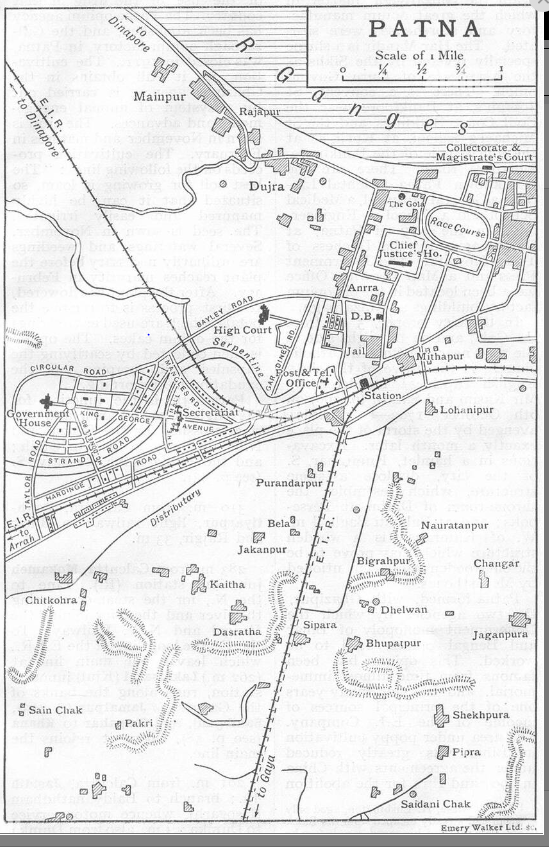
We left Mr William Tayler with his house full of civilians, protected only by Major Nation’s Najibs, who had until quite recently been in touch with the sepoys in Dinapore and a few cavalry troopers. His only hope was one more message he sent to Captain Rattray and his Sikhs, who were still 30 miles away.
The message was sent frantically in an ekka instead of by a dak runner in the hope the carriage would reach Rattray before any mischief could take place. Assembled as they were in one place, Tayler grimly felt the Najeebs, should they feel so inclined, make short work of the Europeans in Patna. His worry was if the regiments of Dinapore arrived before Rattray did, the fidelity the Najeebs had shown would be too severely tested. It was, in his estimation, simply a matter of time, and this was running short.
Captain Rattray, on his part, had received all of Tayler’s messages, and this last one prompted him to turn what should have been an easy march to Patna into a forced one. He arrived at Tayler’s house “in his picturesque dress and long boots” at four in the morning.
At dawn, Tayler sent the cordon of house guests home; Patna, for now, was safe.

The Treatment of Rattray’s Sikhs
In the morning, Captain Rattray was able to apprise Tayler of how the situation was in the countryside, and his news was far from heartening. Along the way, instead of being held in awe at all by the country folk, they were taunted as being traitors of their faith and repeatedly asked if they intended to fight for the infidels or their religion. Upon entering Patna itself, they were accosted by a “wild-looking fakeer” who rushed into the road and, with “savage menaces and threatening gestures, reviled them as traitors and accursed.” Matters were not helped with the high priest of the Sikh temple refusing admittance to the men of Rattray’s regiment, turning them away from the gurdwara with oaths on their heads.
It was imperative then to move the Rattray’s men as far from the townsfolk as possible, moving their camp from the Collectors’ Cutchery to the grounds of the circuit house by the banks of the river on the west end of Bankipore. The subedar of the regiment, Hedayut Ali, was particularly pleased with this arrangement – he had heard several men in the town purporting the Company’s Raj to be at an end and that the true king had been re-established in Delhi. It was a sore trial for Rattray’s men to suffer such abuse without being allowed to raise a hand to protect their honour and their new encampment and at least put the townsfolk out of harm’s way of the angry Sikhs. Several incidents of open insolence against the men were brought officially to Tayler’s notice.
The talk was not restricted to Patna. Mr Vincent, Deputy Magistrate at Barh, some 50 miles away, mentioned in a letter to Tayler it was becoming increasingly common to hear coolies on the road talk of the Padshah of Delhi. Tayler and Rattray both agreed this was more than idle talk; someone in Patna was instigating it.
As such, Tayler started his line of private inquiries as discreetly as possible, and soon there came a flutter of petitions to the European residents, not just to Tayler, of conferences held at night in mosques and private houses, but it was still impossible to catch anyone red-handed.
Specific individuals, however, were repeatedly mentioned in these letters, yet the writers remained anonymous. The letters were frightening enough, however, to convince the Judge Mr Farquharson, the Opium Agent Mr Garrett and others to flee from their houses and barricade themselves in the Opium Godown.
On the 11th of June, accompanied by Captain Rattray and Subedar Hedayut Ali, Tayler set off for Dinapore to confer with General Lloyd and Colonel Rowcroft. His idea was not just to ascertain the situation in Dinapore for himself but to speak to the men of the 8th Regiment, hoping to derive some advantage from a direct appeal to their loyalty. The men listened to Tayler, but whether he had made any impression on them at all, Tayler himself could not ascertain. They listened passively, and when Tayler was done, he could not read a single emotion in their faces.
Disturbed but not disheartened, Tayler, Rattray and Hedayut Ali returned to Patna.

Patna and the Other Stations
Upon arriving, Tayler found letters waiting for him from Mr Wake, “the active and high-spirited” Magistrate of Arrah, informing Tayler that many of the Railway men and other Europeans had upped and bolted for no reason at all except blind panic, abandoning Shahabad, making their way without any excuses to Dinapore.
“Absurd stories were circulated about some of the gentlemen having reached Dinapore in women’s clothes, some said that on an ekka being stopped and challenged with the questions “Quon hie” (who’s there?) a voice replied – “Hum Aurut hie” (we are women) – when the sentry, not having heard so gruff a voice before issuing from a fair female’s lips, lifted up the curtain, and found a bury red-faced Englishman.”
Whether this story was true or not mattered – unfortunately, it showed the people of Patna the British were not just scared, they were cowards. It was not exactly the image Tayler wanted to represent.
Tayler quickly sent a notice to the runaways insisting they return to the district – like General Lloyd, Tayler was worried that since the exodus was thoroughly unjustifiable, it could cause unwarranted alarm. He needed everyone, no matter what the situation, the keep their wits about them. Parading around the countryside in ladies’ clothes was not helping.

In the meantime, the letters sent to the Najib’s were the source of a thorough investigation, and it unfolded that instead of being the hoax some Europeans thought they were, they turned out to be true. The writer and his accomplices were identified – six Sepoys were found that they not only taken part in the conspiracy but had instigated the sending of the letter which was given to Major North. That same night, when it reached Patna, 3 men of the 8th Regiment suddenly deserted when they heard that instead of it being delivered to the Najibs, it was securely with the major.

It was now critical to set the Najibs to right. Tayler determined to reward the three who had brought the letter to Major North, and he would do so in public. On the evening of the 12th of June, three bags, each containing 200 rupees, were made ready, and shortly before sunset, orders were issued for the whole corps to assemble on the parade ground. Tayler rode out to address the men.

“The three bodies of men were drawn up in a square – the Nujeebs in front, the Seikhs on the left, and the Police on the right, spectators on horseback and in carriages formed the fourth line. As I entered the square, Major Nation and Captain Rattray rode forward to tell me that a Nujeeb had been discovered, endeavouring to tamper with the Seikhs and shake their allegiance.”

It was unfortunate to hear such news, but Tayler asked the officers to keep their peace until the ceremony was over. He went ahead with his plan and addressed the men in Urdu. As plainly as he could, Tayler explained the evils of mutiny, the dishonour of disloyalty, and that the government had no intention to convert anyone – in fact, that was the lie they should close their ears against. Thus said, he then called forward the three men, gravely narrated the good service they had done and handed over the bags of rupees.
As soon as the parade was over and the men dismissed, “the culprit who had shirked the muster was seized in the lines and marched off between two stalwart Seikhs to my house, where preliminary enquiries were conducted by the Magistrate, and he was carried off to jail.” The very next morning, Tayler telegraphed the government at Calcutta, requesting what sentence he might pass on the offender, who had, by his admission, gone the Sikh lines and told them the regiments at Dinapore had been forced to use the offensive cartridges – and where, pray tell, did the Sikhs stand? It wasn’t perhaps the most seditious statement since the story he told was not a complete lie. The men at Dinapore were slated to receive the cartridges, but no one had held one, much less been compelled to use one.
As such, after consulting with General Lloyd once again in Dinapore, Tayler wanted the general to try the man by court-martial and in all eventuality, hang him as an example – Lloyd concurred the court martial was warranted, but he refused to have anything to do with the execution. As such, Tayler would hang him. He did not do so without the sanction of the Government:

Like many of his counterparts, Tayler had been given hanging rights – although Canning would recind this in the coming months, for the time being, Tayler was not acting contrary to orders.

In Dinapore, the general excitement was dying down, with officers declaring openly their regiments were staunch and the 40th BNI would never revolt if rightly managed. Fate would prove differently but for now, disarming the regiments at Dinapore was a suggestion no one except Tayler and Rattray dared make. As such, it was ignored.

Tayler was decidedly nervous about the various treasuries in the Patna division – large sums of money, particularly at Chuprah and Arrah – that were, in this perilous time, only sparingly guarded. As such, he ordered the treasure, the sum of 30 lakhs in these two stations alone to be removed to Patna. His intention was to store it at the Opium Godown, but Mr Garrett positively refused to admit it, stating emphatically should Patna be attacked his walls would be the first to go as such a treasure would serve as a temptation impossible to withstand. Tayler agreed and stored it instead in the Collector’s Cutcherry – however, the story quickly spread to ears in Calcutta that it was Tayler who had refused to put it in the Godown – an absurd story with grave consequences.

From the start, an increasing amount of notes and letters arrived in Patna, each speaking of increased distrust and disaffection in all the outlying districts. Some of the Chuprah officials, claiming they were going to be attacked, quickly mounted their horses and fled to Dinapore – Tayler ordered them back. The Deputy Magistrate at Barh was holding his own, but he reported a plot had been discovered to burn down his house and murder him. Letters from Arrah, Gaya and Tirhoot all spoke of impending attacks – at Arrah, their worry was not so much from the townspeople but a powerful landlord named Kunwar Singh who was mustering his own army, and Arrah was on his sights. From Gaya came reports that the disaffection in that town was being caused by troublemakers from Patna, and at Mozufferpore, the Najibs were openly talking of mutiny, prompting the planters to send a petition to General Lloyd for a European guard. The planters could have saved themselves the trouble of asking – Lloyd would not part with a single man.

Rattray and Tayler continued to travel to Dinapore, hoping each time that General Lloyd would finally disarm the native regiments. However, Lloyd had no such intentions. He was in constant communication with the Government at Calcutta, and besides, seeing it was his station and in effect his men, Tayler and Rattray were reminded it was a “purely military” question and not one they were authorised to ask. With this flea in their ears, Tayler and Rattray decided to concentrate on the town of Patna itself.

There Has Been No Storm in Patna

The weight on Tayler’s shoulders was immense. He had no army at his call; General Lloyd in Dinapore would neither disarm the regiments at the station nor send any of the European troops to help Tayler. Tayler’s idea to call on the aid of friendly landowners to send him armed men was quashed by Calcutta in fact, the increasingly irritating Lieutenant-Governor, Mr. Halliday, did not see any danger in Patna at all stating most emphatically, “…in reality, there has been no storm at all in Patna.” He informed Tayler he could accept matchlock men if they were offered by the landowners, but he was under no circumstances to ask for them. The absurdity of this order beggars belief. Halliday still believed, after so many months had passed, that Tayler had coerced the local zamindars to agree with his proposed national education plan, and somehow, this gave Halliday the right to deny Tayler his best means of protecting Patna.

“But Mr. Halliday objected to my asking the Zemindars for any assistance, stating that, with reference to a late correspondence (regarding the Institution), such “asking” might be misunderstood—be added, that I might receive aid and thank the Zemindars for it if given, but that I must not ask! The meaning of this evidently was that, having declared in the Proclamation regarding the Industrial Institution, which I have referred to above, that no assistance on the part of Native Landholders, unless spontaneous and disinterested, was acceptable, Mr. Halliday did not like to involve himself in the inconsistency of asking for such assistance immediately afterwards.
Now this distinction appeared to me so palpably a distinction without a difference—it would have been so complete a piece of hypocrisy in me to tell a Zemindar, that I could not ask him for aid, but I would thank him if he gave it—that I could not lend myself to what appeared a mere subterfuge and a sham, and the plan was abandoned.”

Mr Halliday did sanction Tayler raising an extra police force, comprising mostly of low caste men who would not be bound by loyalty to either Muslims, Brahmins or Rajputs. Each magistrate in the outlying stations was to similarly raise 50 men and arm them accordingly with a shield, a sword and a light spear. These impromptu policemen were not meant for actual fighting but merely to show presence – in other words, keep the peace as far as possible and give the magistrates in Barh and Shergotty a little help. Yet, asking the zamindars was out of the question. He then promptly informed Tayler he was no longer to write to him in a demi-official manner: all correspondence was to go through official channels.
The Lieutenant-Governor put Tayler’s worries and warnings down to an over-active imagination. The very fact that his own brother-in-law, Mr Farquharson, was still hiding in the Opium Godown did not appear to give Mr. Halliday any food for thought. He was determined to make Tayler’s life as difficult as possible from 400 miles away.

But there was a quiet storm in Patna, and Tayler was ready to meet it head-on.

Where Tayler and many residents of Patna saw the problem was not in a possible mutiny of the Najibs or a general uprising of the people. Tayler was repeatedly advised that he needed to address the elephant in the room – the Wahabis of Patna. We will not discuss for long what we understand today who the Wahabis are. We shall take the viewpoint of Mr. Tayler instead in order to prevent misunderstandings with our present century.

“The Wahabees area set of Mohamedans, taking their name from Abdel Wahab, who was born in 1691, and became celebrated in after years, as an earnest and energetic reformer.
The tenets originally professed by the Wahabees, have been described as “Mohameda Puritanism” joined to a Bedouin Phylarchy, in which the great chief is both the political and religious leader of the nation.
The unity of God is the fundamental principle of their faith. They regard the Prophet as a man, though gifted with a divine mission, reject the fables and false glosses of the Koran, but recognise and adopt the traditions of the Soonees.
They hold that all men are equal in the sight of God and therefore condemn the custom of invoking departed saints or paying honor to their remains.
To swear by Mohamed is considered a crime.
They affect great purity of morals, abstain, or at least profess to abstain, from spirituous liquors, and all sensual indulgences.
With the Soonees, the Wahabees are on terms of tolerable agreement, thought differing in certain points, but from the Sheahs, they differ radically, and their hatred, like all religious hatred, is bitter and intolerant.
But the most stiking characteristic of the Wahabee sect, and that which principally concerns this narrative, is the entire subservience which they yield to the “Peer”, or spiritual guide, a subservience, which, if rumour lies not, compensates, at least among the Patna puritans, for many prohibited indulgences and bestting sins.”

Tayler did not have a problem with Wahabis in general; however, where he perceived the threat was from the fact that Patna was home to many thousands of the sect’s followers. Their peer, Mahomad Hussein, was a powerful man in his own right, able to give orders no follower would be able by faith to refuse. He had at his beck and call “tailors, butchers an low-born followers of every description, who would sacrifice everything..” It was also no secret he held practically no real loyalty to the EICo, and Tayler did not put it past him to try his luck in an uprising. Without informing the fussy Mr Halliday, Tayler put his own plan in action.
He would arrest the Wahhabi leaders.

The 20th of June
Now, how he did it would later be considered a stain against his character, however, we must remember that Tayler did not have the means to face an army, regardless if they were sepoys from Dinapore or hundreds of armed townspeople. Cunning was his only weapon, and he should not be judged too harshly for it.
Tayler summoned to his house a circular letter to all respectible citizens of Patna, including three of the Wahabi Moulvies – Shah Mahomed Hossein, Moulvie Ahmedullah and Moulvie Waizul Huq. The letter perported to consult with them on the current state of affairs, and not a single man refused the invitation. In the company was also the Collector, Major Nation, Commandant of the Behar Guards, Captain Rattray, Mr Lindsay the Assistant, Mr Lockwood a civilian, and Hedayat Ali Subadar of the Sikhs. The next morning, the assembly took place around Tayler’s dining table. The only people who were aware of what Tayler intended were Rattray and Nation – and he had only told them moments before the meeting began. To keep them in the clear, he took the responsibility of the action on himself.

The meeting went ahead, and although the company soon suspected something was up, especially when Rattray and the Subedar entered the room with their swords “clanking on the floor” and took up positions uncomfortably close to the three Wahabis. Yet they continued to speak, with some nonchalance even giving Tayler some very sensible proposals on how to best defend Patna. When the meeting was over, Tayler called the dismissal. he politely requested the Moulives to remain. When everyone else was gone and had safely driven away, Tayler returned to the room and explained why he had asked them to stay behind.
“…saying that the present was as time of turbulence, dissafection and intrigue, that I had received several letters and petitions, accusing the Wahabees of complicity in evil designs, and though no proof of guilty connivance, I still thought it my duty to take precautions against the possibility of surprise and had therefore resolved, as a precautionary measure, to keep them, as leading men of the sect, in safe keeping, until matters had settled down, and all cause for precaution should have ceased.”
Instead of protesting Tayler’s actions, Ahmedullah appeared to have understood what the Commissioner intended, “Great is your Excellency’s kindness..what you order is the best…so shall our enemies be unable to bring false charges against us.” Tayler further informed Ahmedullah he had refrained from arresting his father, the venerable Moulvie Ilahi Buksh who was very old and completely blind – although the man wielded considerable influence even in his aged state, Tayler felt it was better to leave him in the city to act as a check – basically, as long as they both behaved, they stayed alive. Removing so revered a man would have caused a tremendous uproar, but as long as he remained in Patna, he could also remind the followers to tow the line for his son’s sake.

The three men were taken to the circuit house and placed under the watchful eye of Rattray’s Sikhs.

Tayler then removed the head of the local city police from his position – Moulvie Mehdi- not because he had been given any reason to fear the man but because he had very good reason to believe he was in contact with certain rebellious elements of the Lucknow court. He also removed Latif Ali Khan, the city’s most prominent banker (and a Shiah no less who had lately taken on a very affected friendliness with the Wahabis). Both men were confined by Tayler.
The next day, Tayler issued a proclamation calling on all the citizens to give up their arms within the next 24 hours “on pain of being proceeded against,” and he declared a curfew in Patna, prohibiting anyone from leaving their homes after 9pm.
Instead of the all-out uprising so feared by the Magistrate and others, several thousand arms were brought in and delivered up even though Tayler suspected this was but a fraction of what they had and rightly surmised that many more had been thrown down wells or buried. A sudden peace descended upon Patna, and until July, Tayler had one less worry on his mind. The fearful Europeans hiding in the Opium Godown elected to go home.

Things might have gone well for Tayler had this not been 1857 – no-one could predict what would happen next. The fall of Mr Tayler however, was already in motion.


Sources:
Appendix (A) to Further Papers (No. 5) Relative to the Mutinies in the East Indies, Presented to both Houses of Parliament by Command of Her Majesty (1857)
Brief Narrative of Events Connected with the Removal of W.Tayler from the Commissionership of Patna, printed for private circulation – William Tayler (1858)
The Patna Crisis or Three Months at Patna During the Insurrection of 1857 – William Tayler (1858)
38 Years in India Vol I and Vol II- William Tayler Esq., (1882)
The Indian Mutiny of 1857 – Colonel G.B. Malleson, C.S.I. (1891)


Links for Further Reading:
The Phantom Wahabi – Liberalism and the Muslim fanatic in mid-Victorian India – Jula Stephens, Modern Asian Studies, Vol. 47 No. 1 January 2013, pp 22-52, Cambridge Universtiy Press https://www.jstor.org/stable/23359778

Hon. Lieutenant-Colonel Hedayat Ali – Some Further Details – Squadron Leader (Retd) Rana T.S. Chhina, IAF -Journal of the Society for Army Historical Research Vol. 80, No 323 (Autumn 2002) pp 221-228 – https://www.jstor.org/stable/44230828