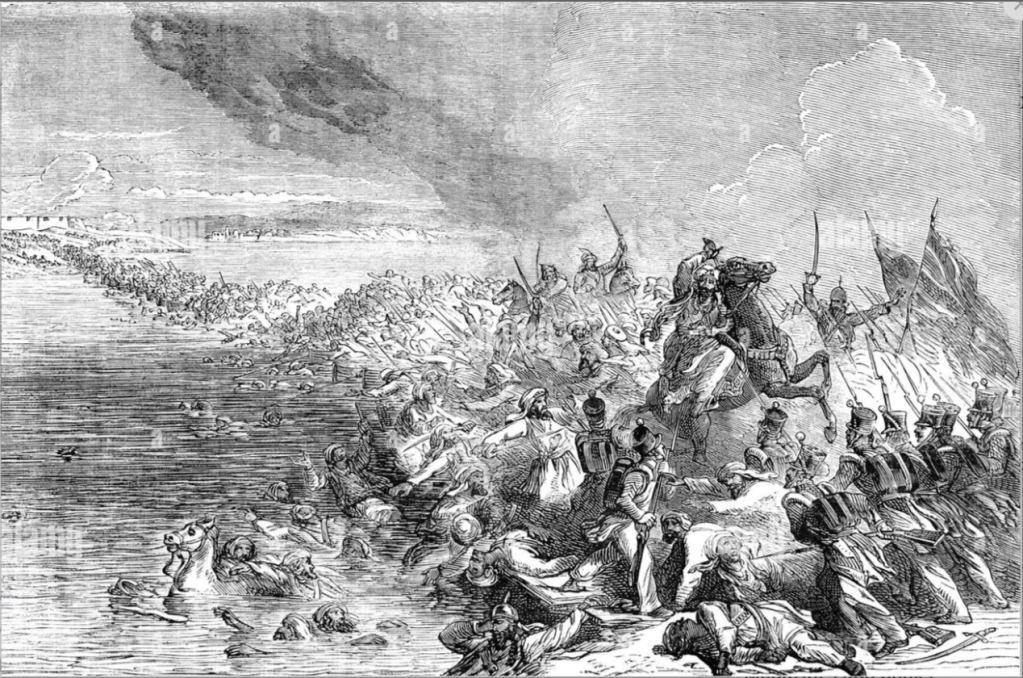
1st of July
1/60th of Foot
Privates
Knight, William – severely wounded
Moore, Henry – died of wounds
3rd Bengal Native Infantry
Lieutenant James Yorke (attached to the 4th Sikhs) died of wounds.
Born in Thrapston, Co. Northampton on 23 August 1828, Yorke entered into the service of the EICo’s Bengal Army in 1845. Before his arrival in 1846, he was already posted to the 3rd BNI, whom he hastened to join in Allahabad. Yorke served through the Punjab Campaign of 1848-49 with the 3rd BNI in the force under the command of Brigadier Wheeler and also took part in the reduction of the forts of Rangal Nagal and Kalawala. His next chance at active service would in the winter of 1852-53 when he served in the expedition against the Hassanzais of the Black Mountains in Hazara; he returned to Jhelum at the end of the campaign to rejoin his regiment.
With his health suffering, Yorke put in for sick leave to Murree, but without seeing any appreciable improvement, he went home on furlough in 1854. After nearly three years, Yorke returned to India in April 1857 and joined his regiment at Phillour; shortly after he was detached to command a company of the 3rd BNI in Ludhiana where he happened to be in June, when the 3rd BNI mutinied at Phillour. The 3rd BNI proceeded then to plunder Ludhiana after which they marched off with the Jalandhar rebels to Delhi – Yorke was distinguished for his “gallant conduct in resisting the mutineers to the last.” A few days later he was attached to the 4th Sikh Infantry for duty and with them, he marched to Delhi. He arrived on the Ridge on the 23rd of June – the very same day, he and the Sikhs fought an action against the mutineers. Unfortunately, on 30 June, Yorke was mortally wounded in the action at Sabzi Mandi; and died the next day.
Bengal Horse Artillery 1st Brigade, 4th Troop
Gunners
Loam, Patrick -wounded
Murphy, Thomas – killed in action
2nd of July
1/60th of Foot
Privates
Knox, William – died of wounds
Smith, John – died of wounds
61st Foot
Private Thomas Peacock, slightly wounded, bullet graze to the leg
2nd Bengal European Fusiliers
Private Lawrence Keen – died of wounds
Bengal Horse Artillery
Brevet Lieutenant-Colonel Murray Mackenzie – severely wounded. Died at Simla, 5th of October.
Aged 44. Born in Middlesex in 1814. Son of John & Helen. Joined the Bengal Artillery in 1828. He served as a captain with the 1st Brigade, Bengal Horse Artillery in the 1845-46 Sutlej Campaign (First Sikh War). In 1847, he married Emily Gershoma Watson, the daughter of Major General Archibald Watson, in Allahabad. During the 2nd Sikh War (1848-1849), he served under General Whish at the Siege of Multan. Captain Mackenzie went on to serve with the 1st Brigade, Bengal Horse Artillery at the Siege of Delhi after his previous command, the 4th BNI had mutinied at Neemuch. It would be reformed, but only with European troops. He would rise to Brevet Lieutenant-Colonel shorly before he was wounded on the 2nd of July.
He lies buried at Simla, New Cemeter,y “Sacred to the memory of Lt. Colonel Murray Mackenzie, Bengal Horse Artillery, died 5th October 1857 from the effect of wounds received at Delhi, aged 44 years.”
1st Brigade, 4th Troop
Sergeant John Green – wounded
Gunner George Cook – dangerously wounded, died of wounds
Sirmoor Battalion
2 Rank and File wounded
3rd of July
Bengal Field Artillery
Corporal George Edwards – dangerously wounded, died of wounds
4th of July, Action at Alipore
In returns, Brevet Major John Coke reported 2 killed, 19 wounded, 7 horses wounded
6th Dragoon Guards
Private Timothy Doolan – slightly wounded
1/60th of Foot
Lance Sergeant Hugh Walmsley – severely wounded by musketball in the left thigh. “A musket ball
entering about the upper third of the left thigh upon the outer side, and making its way out or through on the inner side, shattering the bone…” He was sent back to England with the other invalids of the mutiny- His wound never healed and he died shortly after arriving at Gravesend of chronic diarrhoea , aged 30.
61st Foot
Privates
Harrison, James – wounded
Teehan, Michael – severely wound in right leg
Bengal Horse Artillery
1st Brigade, 4th Troop
Gunner John Crowley – wounded
Bengal Field Artillery
Gunner Thomas Ireland – wounded in shoulder
Guides Cavalry
7 wounded, rank and file
1st Punjab Infantry
1 Non- Commissioned Officer wounded
7 wounded, rank and file
3rd Company, 3rd Battalion, Artillery and No 14 Light Field Battery
1 Rank and File killed
5th of July
1/60th of Foot
Private Patick Cain – died of wounds
3rd Bengal Native Infantry
Ensign O.J. Chalmers (attached to the Guides Corps) – sightly wounded
Bengal Horse Artillery
1st Brigade, 4th Troop
Gunner Michael Lynch – wounded
6th of July
75th Foot
Private Thomas Connor – slightly wounded in arm and hip
2nd Bengal European Fusiliers
Private Richard A. Prentice – died of wounds
8th of July
Bengal Horse Artillery
1st Brigade, 4th Troop
Gunner William Thomson – wounded
9th of July
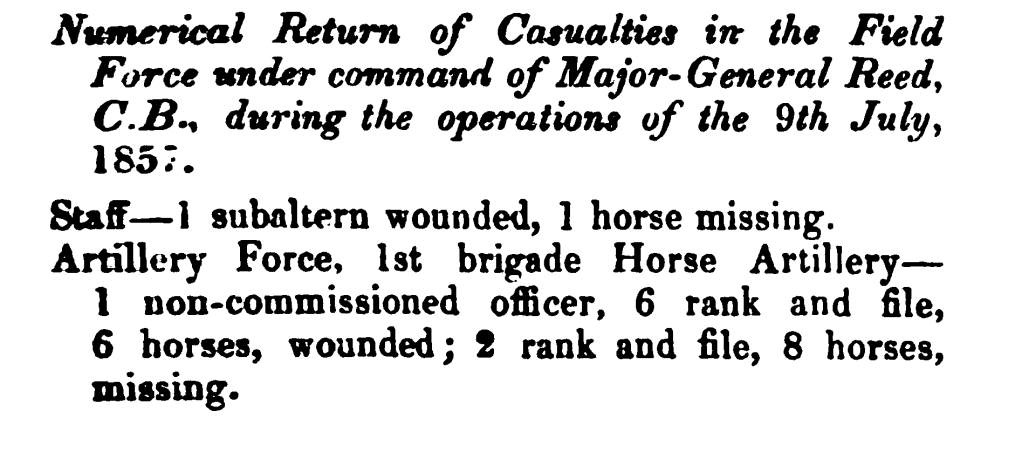
In the numerical return for the 9th of July, Deputy Assistant Adjutant General of the Field Force, R.S. Ewart reports 40 killed, 172 wounded and11 missing
1st Battalion, 8th Foot
Captain E.G. Daniell – severely wounded
Lieutenant William Hext Mounsteven – killed in action. Memorial at St. Petrocs Church, Dartmouth, Devon – “To the glory of God and in memory of William Mountsteven Ensign 8th The King’s Regt killed in action before Delhi 9th July 1857.”
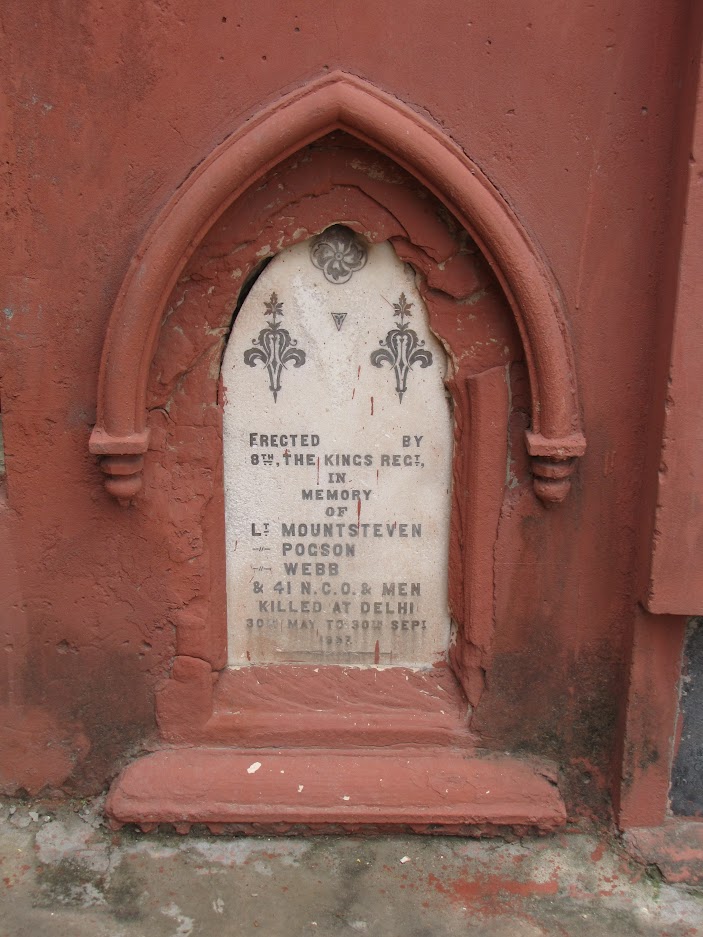
William Hext Mountsteven was born in 1838, the son of Lieutenant-Colonel William Mountsteven, who had been an ensign in the 28th Foot when he was wounded at Waterloo. he exchanged into the 79th Highlanders and served them for many years as their paymaster. Young William entered the Service of HM’s 44th Regiment of Foot on 15 June 1855 and joined the regiment at Walmer. On 3 August, however, he was transferred to the 8th Foot and served for some time at the depot in Chatham. He proceeded to India shortly after, in 1856, and joined his regiment at Jalandhar. Mountsteven was present during the mutiny at that station on 7 June – a week later, he was marching to Delhi with a detachment of his regiment, arriving on the Ridge on the 28th. His field service would be very short. Just 19 years old, Mountsteven received a mortal wound on the 9th of July and died the following day.
Sergeants
Jones, David – killed in action
Ketton, George – killed in action
Laydon, Charles – severely wounded
Corporal John Syme – severely wounded
Privates
Bane, Andrew – dangerously wounded, died of wounds, died of wounds 14th of July
Bishop George – killed in action
Bone, William -wounded
Castles, Richard – severely wounded in the abdomen and hand
Connor, Patrick – killed in action
Curren, Christopher – killed in action
Farrell, John – killed in action
Gallagher, John – killed in action
Garlick, John – dangerously wounded, died of wounds 17th of September
Grieves, William – killed in action
Holt, William – severely wounded in the right arm
Williamson, Hugh – killed in action
1/60th of Foot
Colour Sergeant James Baker, severely wounded
Lance Corporal James Ward – slightly wounded
Sergeant Thomas Brown – severely wounded
Privates
Aldridge, Richard – severely wounded
Cooper, Henry – slightly wounded
Davy, Daniel – slightly wounded
Donnell, John – slightly wounded
Grindley, John – killed in action
McCarthy, Denis – severely wounded
Musgrove, Henry – dangerously wounded
Orme, William – severely wounded
Patmore, James – severely wounded
Rattray, David – dangerously wounded
Richardson, John – severely wounded
Smith, Richard – dangerously wounded
Walsh, John – slightly wounded
Wolfe, Michael – slightly wounded
61st Foot
Captain Henry Edward Hillman Burnside – slight sword cut to the hand
Lieutenants
Griffith, Charles J. – slightly wounded in leg by shell
Hutton, T.B. -slightly wounded
Ensign Edwin Andros – slightly wounded in upper lip at Delhi Camp
Colour Sergeant Major Henry Baker – slightly wounded in leg
Privates
Buckley, Michael – severe sword cut to the hand
Buckley, Timothy – slightly, bullet graze to the hip
Dorrell, George -wounded in the abdomen
Dunne, Michael – severely wounded in the shoulder “…by a musket ball, which entered through the centre of the right deltoid muscle, and passed downwards, fracturing the humerus about its centre, and made its exit at the elbow-joint, where it also appears to have wounded the joint and fractured the olecranon process of the ulna. The arm was placed upon a straight splint . Both apertures of entrance and exit soon healed, but considerable inflammation of the arm and elbow-joint ensued, which was relieved by free incisions. September 5th , 1858.- Wounds made by musket ball healed. There are two sinuses on the outer aspect of the arm, about its centre, leading down to necrosed bone. The fracture at this point is united; the forearm is in a straight position , and the elbowjoint anchylosed. The arm is about one and a half inches shorter than the other.” Invalided, January 13th, 1859, aged 40.
MacFarlane, James – severely wounded, musket ball to the thigh
O’Brien, Francis – slightly wounded, musket ball to the hip
O’Neill, James – slight bullet graze on leg
Shepherd, Major severely wound edin head
2nd Bengal European Fusiliers
Captain David Kemp (5th BNI) severely wounded
Sergeant William Thomas – wounded in the shoulder
Corporals
Asher, Henry – wounded in the leg
Thompson, Joseph – killed in action
Wilson, William – wounded in the cheek
Privates
Conway, Morgan – severely wounded in back
Cull, John – wounded in the head
Gardner, John – dangerously wounded in leg, amputated
Gibbons, Thomas – severely wounded in leg
Hertzell, Frederick – severely wounded in left elbow
Hogan, Michael – severely wounded in arm
Logan, Constantine – wounded in groin
Mahoney, John -wounded in right shoulder
Murray, Hugh – severe sword cuts in back and head
Rourke, Patrick – killed in action
Wake, William – wounded in the leg
Bengal Horse Artillery
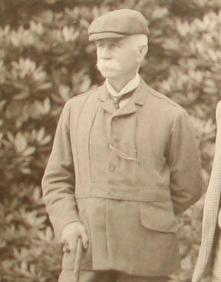
First Lieutenant James Hills – dangerously wounded
Born in 1833 in Neechindipur,Bengal, he was the son of James and Charlotte Hills. Educated in Edinburgh he joined the Addiscombe Military Seminary in 1851 and was commissioned into the Bengal Artillery in 1853. For his action on the 9th of July, Hills would be rewarded with the Victoria Cross. He changed his name to Hills-Johnes, following his marriage to Elizabeth Johnes in 1882.
Bengal Horse Artillery
1st Brigade, 2nd Troop
Gunners
McDonald, John – wounded
1st Brigade, 4th Troop
Stewart, Alexander – killed in action
3rd Brigade, 3rd Troop
Gunner Thomas McDonnell – slightly wounded
Bengal Field Artillery
Corporal James McGowan – severely wounded in groin
Charles Stapleton – severely wounded in thigh
Bombardier John Delaney – severely wounded, right leg amputated
Gunners
Ashford, John – wounded in shoulder
Berry, John – severely wounded, right leg amputated
Males, John – severel wounded in arm
Morrow, William – slightly wounded in arm
Williamson, Adam – slightly wounded in leg
Unposted Recruits – Bengal Field Artillery
Gunner John Baron- slightly wounded in hip
Gunner Charles Kent -killed in action
Gunner John Ward – severely wounded in knee by shell splinter
Artillery
Second-Lieutenant M. Elliott – severely wounded
Corps of Guides
Infantry
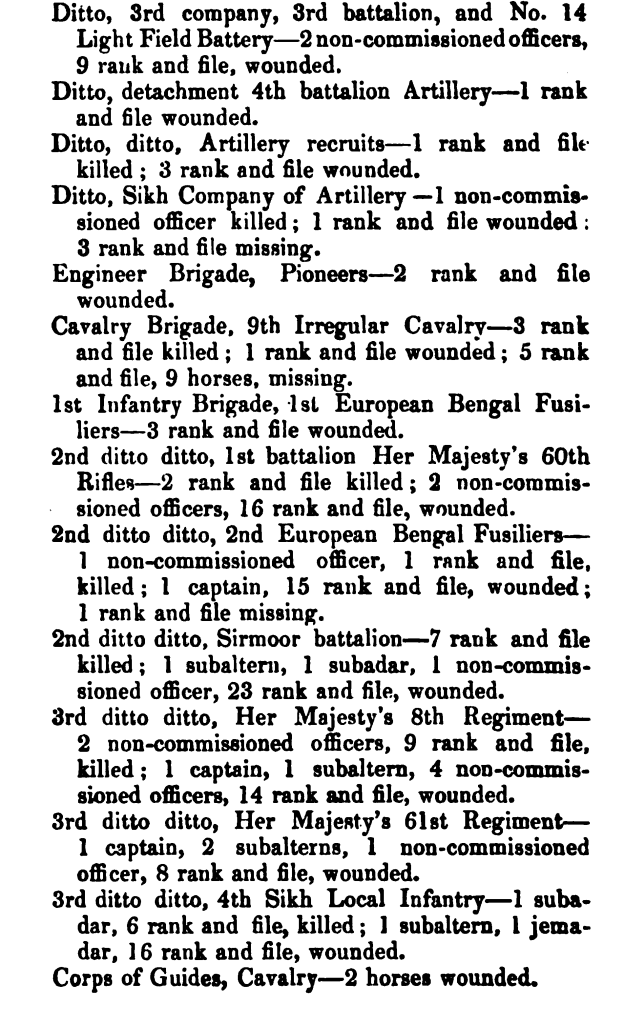
6 Rank and File – killed
1 Subadar – wounded
1 Jemadar – wounded
26 Rank and File – wounded
Sirmoor Battalion
Lieutenant A.H. Eckford (69th BNI) – slightly wounded
7 Rank and File- killed
1 Subadar – wounded
1 Jemadar – wounded
23 Rank and File – wounded
9th Irregular Cavalry
3 Rank and File – killed
1 Rank and File – wounded
5 Rank and File – missing (deserted)
4th Sikh Infantry
Lieutenant A. Pullan – (36th BNI)- severely wounded
1 Subadar – killed
6 Rank and File – killed
1 Jemadar – wounded
16 Rank and File – wounded
Sikh Company of Artillery
1 Non-Commissioned Officer – killed
1 Rank and File -wounded
3 Rank and File- missing
Pioneers
2 Rank and File – Killed
10th of July
75th Foot
Privates
Kelly, John – slightly wounded in right leg
Loughlan, Michael – wounded in hip
Thompson, George – slightly wounded in scalp
Bengal Horse Artillery, 3rd Brigade, 3rd Troop
Sergeant Thomas Murdock – dangerously wounded, died of wounds
11th of July
2nd Bengal European Fusiliers
Privates
McMahon, William – died of wounds
Murphy, Nicholas – wounded in the arm by grape shot
12th of July
75th Foot
Privates
Dinsdale, John – slightly wounded
Knights, Samuel – slightly wounded
1st Bengal European Fusiliers
Private John Gallant – killed in action
2nd Bengal European Fusiliers
Corporal Joseph Thompson – killed in action
Privates
Herbert, William – died
Mannis, Wiliam – died
Webster, James – killed in action
60th Bengal Native Infantry
Lieutenant Frederick Charles Innes – slightly wounded
Bengal Horse Artillery – 1st Brigade, 4th Troop
Sergeant Peter Pindar – wounded
Bengal Field Artillery
Bugler Thomas Beards – slightly wounded in the head
14th of July
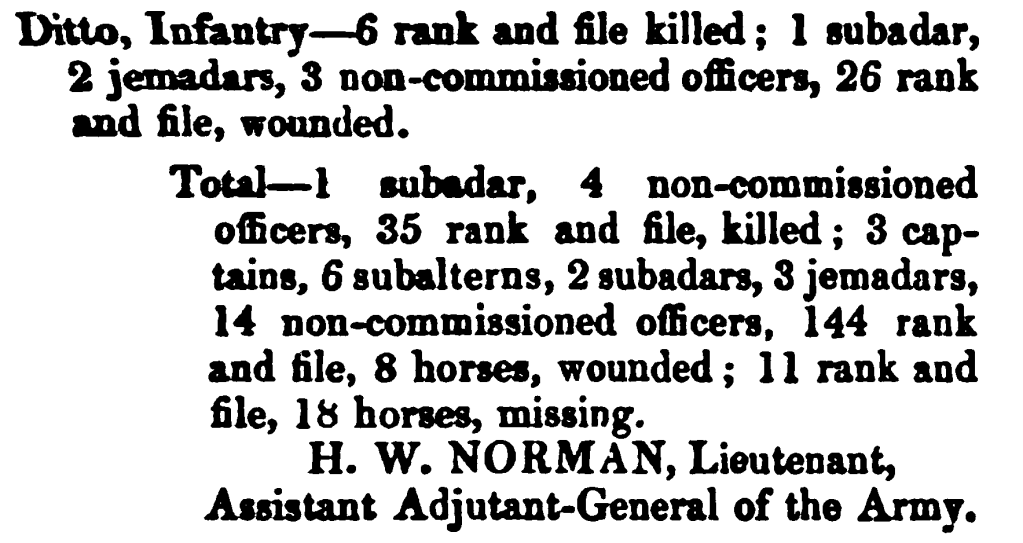
In the returns for the 14th of July, Commander of the Field Force, Major General T.Reed and Deputy Assistant Adjutant General R.S. Ewart report 15 killed, 193 wounded and 2 missing
Staff
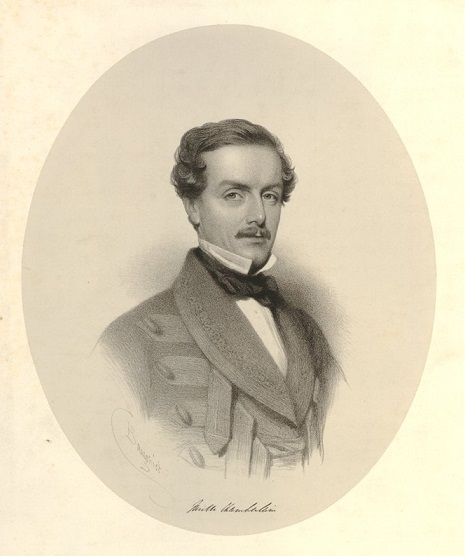
Brigadier-General Neville Bowles Chamberlain (Act.Adj.Gen.) – severely wounded.
Born in Rio de Janeiro in 1820, the third son of Sir Henry Chamberlain, 1st Baronet, consul general and charge d’affaires in Brazil, Chamberlain was raised in England and educated by a private tutor. He entered the Royal Military Academy in 1833, where he earned a reputation for fighting and for his rebellious nature. The academy was not a success, and he was withdrawn in 1834. After threatening his father, he would join the British Legion. his father used his contacts to gain for his son a commission in the Bengal Native Infantry in 1837, and he arrived in India the same year. Although he initially joined the 12th BNI in Barrackpore, Chamberlain was posted to the 55th BNI in Lucknow, but by 1838, he transferred to the 16th BNI in Delhi, who were on their way to Afghanistan. Chamberlain joined in time to see active duty in the First Afghan War, with the Army of the Indus, serving in the 1st Brigade, 1st Division under Sir Willoughby Cotton.
Promoted to Lieutenant in 1842, he transferred to the 1st Cavalry and returned to Afghanistan, taking part in the march from Kandahar to Kabul the same year. He would survive the retreat from Kabul in 1842. A year later, he would take part in the Battle of Maharajpur during the Gwalior Campaign, serving with the Governor-General’s Bodyguard. He became military secretary to the Governor of Bombay in 1846 and Brigade Major with the Bengal Irregular Cavalry in 1848.
Chamberlain would find himself on active service again through the Second Sikh War, after which his career as one of Henry Lawrence’s young men, a more civil nature. However, by 1854, and promoted to Lieutenant-Colonel, Chamberlain was given the command of the Punjab Irregular Frontier Force and led numerous expeditions along the wild frontier.
Lieutenant Frederick Sleigh Roberts – wounded
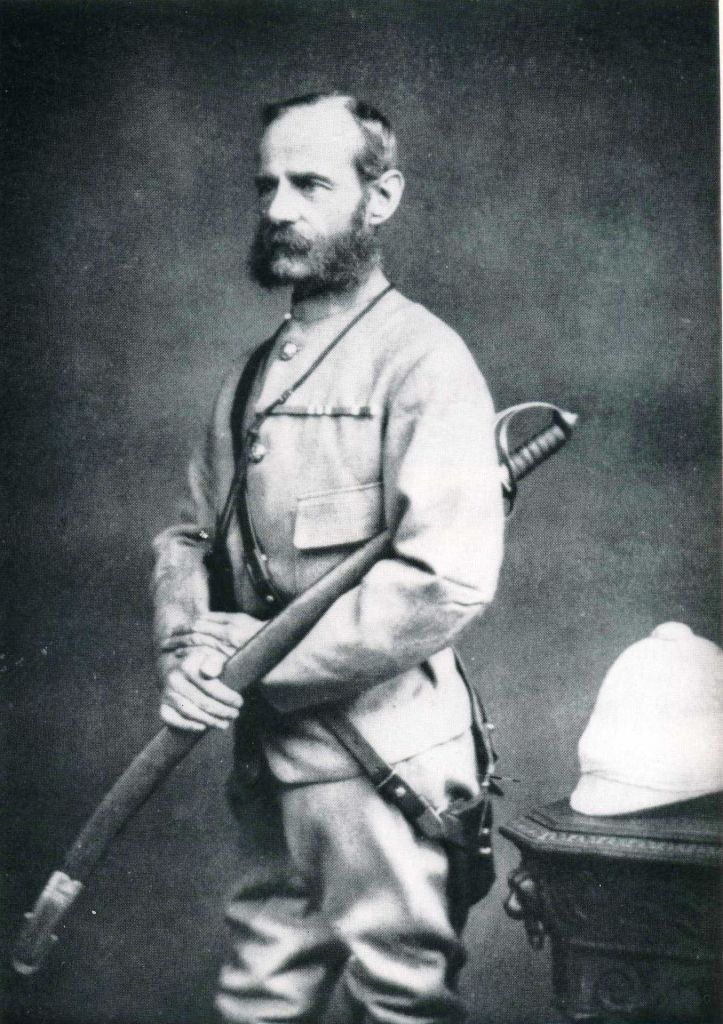
Born in Cawnpore in 1832 to General Sir Abraham Roberts, Frederick was educated in Eton, Sandhurst and the Addiscombe before entering the EICo army as second-lieutenant, Bengal Artillery, in 1851. He served as ADC to his father in 1852 and transferred to the Bengal Horse Artillery in 1854, promoted to lieutenant in May 1857.
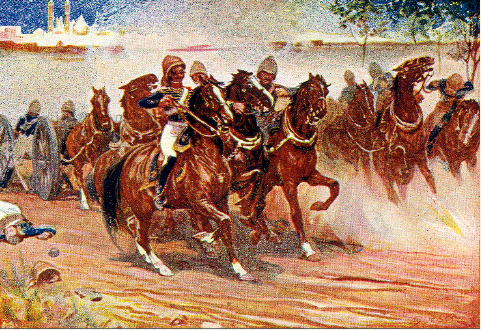
On the 14th of July, Roberts was leading the retreat back to the city, when, realising the horses pulling the guns were becoming increasingly unmanageable, very likely from fear, Roberts endeavoured to settle them, patting their heads and holding their reigns. He suddenly felt a tremendous blow to the back which “made me faint and sic and I was afraid I should not remain on my horse.” He managed to ride back with the guns and return to camp, where he found he had been shot in the back, the bullet just missing his spine. It had struck the pouch he carried for his pistol caps, which had providentially shifted around to his back, and had taken the brunt of the shot.
Frederick Sleigh Roberts would end his career as one of the most successful military commanders of his generation, best known for his exceptionally well-planned campaigns that always resulted in low casualties and had few unexpected crises. Affectionately known as “Bobs”, his career would span 50 years, 41 of which he spent in India.
1/60th of Foot
Privates
Bergin, Dennis – severely wounded
Brigman, John – dangerously wounded at Hindu Rao’s House
Donnell, John – slightly wounded
Mulvany, Thomas – severely wounded
Murphy, Patrick – slightly wounded
75th Foot
Lieutenant George Charles Norris Faithfull – slightly wounded. Died of wounds at Ambala, 31st of October.
Buried at Ambala Cemetery – “Sacred to the memory of Lieut. G.C.N. Faithfull H.M.s 75th Regiment. A soldier zealous and true counting his life as nothing so he but discharged his duty to his Country. He died at Umballa Oct. 31st 1857. Aged 26.”
Private George Cocksedge – slightly wounded
1st Bengal European Fusiliers
Lieutenant J. W. Daniell – severely wounded
1st Bengal European Fusiliers
Privates
McDonald, John – killed in action
Murray, George C. – killed in action
Roy, Alexander – killed in action
2nd Bengal European Fusiliers
Lieutenant F.N. Walker (60th BNI) – wounded
Hospital Sergeant Thomas Hinley – wounded in the leg
Bengal Horse Artillery
3rd Brigade, 2nd Troop
Gunners
Carey, Patrick – dangerously wounded, died of wounds
Lindsay, John -killed in action
3rd Brigade, 3rd Troop
Sergeant Henry Crane – killed in action
Bombardier Joseph Flower – killed in action
Farrier Andrew Murphy – wounded
Trumpeter – William Morrison – wounded
Bengal Field Artillery
Second Lieutenant Penton Thompson – severely wounded
Corporal John Barey – slightly wounded in left side and foot
Corporal Edward Lynam – wounded in left thumb, amputated
Bengal Engineers
Lieutenant H.A.L. Carnegie – slightly wounded
Bombay Engineers
Lieutenant J.T. Walker – severely wounded
Pioneers
3 Rank and File Wounded
Corps of Guides
Lieutenant A.W. Murray, (42nd BNI)- severely wounded
Cavalry
2 Rank and File – wounded
Infantry
Lieutenants
de Brett, Harry (57th BNI) – slightly wounded
Hawes, C.W. (38th BNI), Adjutant – slightly wounded
Shebbeare, R.H. (60th BNI) – slightly wounded in three places
3 Rank and File – killed
3 Subalterns – wounded
1 Jemandar – wounded
2 Non-Commissioned Officers – wounded
19 Rank and File – wounded
Sirmoor Battalion
Lieutenants
Chester, D.E.W. (36th BNI) – slightly wounded
Ross, Sutherland, (9th BNI) – slightly wounded, died of cholera
Tulloch, A. (20th BNI) – severely wounded
3 Rank and File killed
1 Non-commissioned Officer wounded
30 Rank and File wounded
1st Punjab Infantry
Lieutenant Hugh T. Pollock (35th BNI) – severely wounded
4 Non-commissioned Officers – killed
4 Rank and File – killed
1 Subadar – wounded
4 Jemadars – wounded
23 Rank and File – wounded
Major Coke’s Cavalry Troop
2 Rank and File – wounded
Hodson’s Horse
1 Jemadar -wounded
4th Sikhs
1 Rank and File – wounded
1/60th of Foot
Private Denis Bergin – wounded twice, the first time on the 13th of June “by a musket ball, which had entered on the posterior surface of the left arm, about two inches above the wrist, passed between the radius and ulna, and made its exit on the anterior surface of the forearm. On July 14th, he received another wound from a musket ball in the left hand; the ball entered on the posterior surface between the thumb and forefinger and still remains in. July 20th, 1858.-Wounds healed; has lost considerable power of the finger, and the wrist-joint is anchylosed; the ball is felt between the thumb and forefinger. 21st .- Invalided .
15th of July
75th Foot
Privates
Butt, James – severely wounded in right arm
Cocksedge, George – slightly wounded in left side
1st Bengal European Fusiliers
Private Thomas Tupper – died of wounds
16th of July
1/60th of Foot
Private Edward Clifford – died of wounds
2nd Bengal European Fusiliers
Private John Ward – died
Bengal Horse Artillery
1st Brigade, 4th Troop
Gunners
Painter, J. – wounded
Somerville, David – wounded
17th of July
1st Bengal European Fusiliers
Private John Mealon -killed in action
18th of July
In the returns for the 18th of July, Brigadier General A. Wilson and Deputy Assistant Adjutant General E.S. Ewart report 13 killed, 69 wounded and 2 missing
6th Dragoon Guards
Private William Carr – dangerously wounded, died of wounds 20th of July
Tighe, Patrick – slightly wounded
1st Battalion, 8th Foot
Private Henry James – severely wounded
1/60th of Foot
Corporal Thomas Courtenay – dangerously wounded
Privates
Brown, John – killed in action
Chiute, John .- severely wounded
Davy, Daniel – slightly wounded
McGee, John – severely wounded
Reynolds, William – slightly wounded
61st Foot
Lieutenant W.H.W. Pattoun – severely wounded
Sergeant Henry Stephens – killed in action
Privates
Brady, Hugh – killed in action
Gleeson, Cornelius – slightly wounded in left arm
Lonergan, Martin – slightly wounded, musket ball to the left side
Quinn, William – slightly wounded in right leg
75th Foot
Lieutenant William Crozier -shot through the forehead while skirmishing in Sabzi Mandi. The “pet” of the Light Company, Crozier had been privately engaged to a young lady before the mutiny. However, for reasons known only to her, the mother of the girl took a sudden dislike to Crozier and insisted her daughter break off the engagement. She was so intemperate as to say to her daughter, ‘I hope he will be killed before Delhi,‘“‘ and the rather imprudent girl wrote a letter to Crozier telling him her mother’s words. The words preyed so heavily on Crozier’s mind that when he finally took Richard Barter into his confidence, he hauntingly remarked, “And I sure her wish will be gratified.” Barter tried to ridicule him out of the idea, but Crozier was shot a few days later.
William Crozier was born in 1835. He joined HM’s Service on 16 April 1852, initially as an ensign in the 4th Foot. On the 30th of the same month, he transferred to the 75th Foot and set sail for India the following October, joining his regiment at Ambala in early 1853. The 75th was ordered to Kasauli from their station in Rawalpindi at the beginning of 1857; they joined the Delhi Field Force and the outbreak of the mutiny, and Crozier would serve with them at Badli-ki-Serai, just six days after attaining his rank of Lieutenant. He was just 22 when he died.
Lieutenant C.R. Rivers – slightly wounded – died of cholera. Known by the men as “Happy Jack,” Rivers died of cholera. The men took it in turns to rub his cramped legs, and Barter says he has never seen such devotion as the men showed to Rivers. “…many a huge fellow have I seen cry like a child as he came out of the hospital from performing his share of the voluntary work; he had been wounded the day before he died in the afternoon of the 18th of July.“
Privates ( in the official returns, there are 13 rank and file wounded; Tavender only lists 8)
Barry, John – slightly wounded in shoulder
Beehan, Martin – wounded in the forehead by a musket ball
McGloin, Hugh – severely wounded in both hips
McKenna, William – wounded in the right shoulder
Mangan, John – severely wounded in right leg
Moore, James – wounded in left side “…by a musket ball, which entered the thorax, one inch and a half below and a little internal to left mammilla, and after a course of seven inches made its exit behind.” He was 23 years old. Moore survived his injury and was eventually sent on modified duty when he was declared “stout and in excellent health.”
O’Donnell, John – severely wounded in right leg
Purcell, Dennis – killed in action
Scriven, Thomas – killed in action
Shirra, James – severely wounded in left arm and right side
2nd Bengal European Fusiliers
Sergeant James Whyte – died
Ensign Odlarne Coates Walter (45th BNI) – died of sunstroke while in action. Joined the army in 1856 and died at the age of 19.
Sergeant Geoghagan, Michael wounded in leg
Privates
Hamilton, Andrew – wounded in leg
Howarth, James – wounded in arm
Geoghan, Michael – wounded in the leg
McFarlane, Victor – wounded in thigh
Murphy, John – died
Pyne, Thomas – wounded in leg
60th Bengal Native Infantry
Lieutenant T.N. Walker (attached to the 2nd Bengal Fusiliers) – slightly wounded
Artillery
2nd Lieutenant J. Chichester – slightly wounded
Bengal Field Artillery
Gunner John Doyle – killed in action
Bengal Engineers
Lieutenant M.G. Geneste – slightly wounded
2nd Lieutenant Edward Jones– dangerously wounded. Died of wounds, 24th of July.
Grave in Rajpura Cemetery, Delhi – “Sacred to the memory of Lieutenant Edward Jones, Bengal Engineers, who was mortally wounded on the Ridge before Delhi on the 18th July and died on the 24th July 1857.”
Born in 1837, the son of Edward Jones, Esq., of Liverpool, young Edward joined the Bengal Army in 1854 as a cadet. He was “detained in England” at Chatham to take the standard engineering courses required for the service and would not arrive in India until January 1857. By February, he was at Roorkee and attached to the 11th Company, Sappers and Miners. Jones was with the corps when the majority of it mutinied in Meerut but he continued “to do duty with the faithful remnants,” and marched to Delhi under Brigadier Wilson, taking part in the actions at the Hindun River and Ghaziudinnagar, before joining the main army under Sir Henry Barnard for Badli-ki-Serai and the taking of the Ridge. On 10 June, Jones was appointed Assistant Field Engineer, a position he retained until his death. On that fateful day, he was wounded by a cannon shot that tore his legs to pieces. What was left of it was amputated. He died of wounds on 24 July, aged 20.
Engineers, Sappers and Miners
1 Rank and File – wounded
Sirmoor Battalion
2 Rank and File -killed
13 Rank and File – wounded
4th Sikh Infantry
2 Rank and File -wounded
1st Punjab Infantry
8 Rank and File – wounded
Corps of Guides
Cavalry
1 Rank and File – killed
2 Non-commissioned Officers – wounded
3 Rank and File – wounded
19th of July
61st Foot
Private John Dineen – slightly wounded in left arm
75th Foot
Privates
Cates, David – wounded in arm
Horan, John – killed in action
Sexton, Edward – wounded in left arm
1st Bengal European Fusiliers
Private Joseph Seiton – killed in action
2nd Bengal European Fusiliers
Private Martin Shiel – died
Bengal Horse Artillery
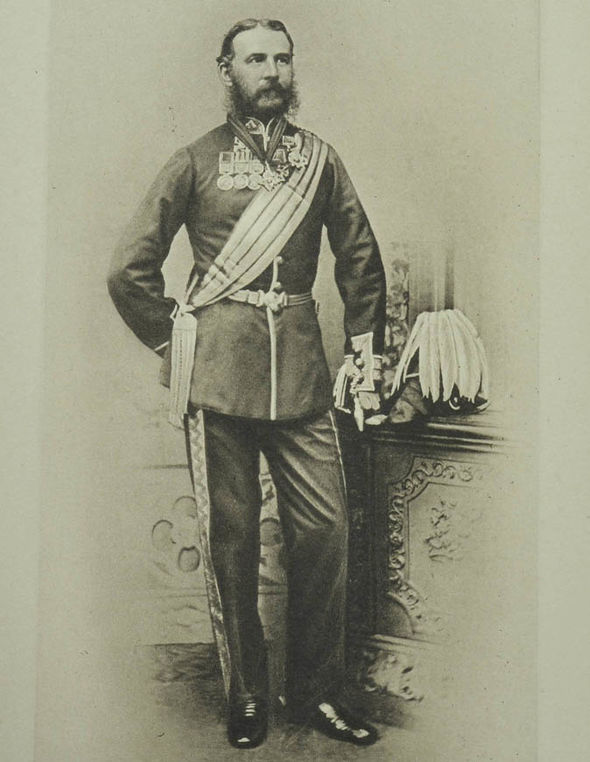
Colonel Henry Tombs – wounded
Bengal Horse Artillery
1st Brigade, 2nd Troop
Gunner William Cochrane – severely wounded
3rd Brigade, 3rd Troop
Bombadier William Livingston – wounded
Rough Rider James Hardwick – severely wounded
20th of July
In the returns for the 20th of July, Brigadier General A. Wilson and Deputy Assistant Adjutant General R.S. Ewart report 1 killed and 11 wounded.
An action not reported in the usual texts is recorded as follows in “Selections of the Letters and Dispatches preserved in the Military Department of the Government of India 1857-58, Vol I, edited by George W. Forrest, pp 337-8
From Lieutenant-Colonel T. Seaton, C.B., Commanding Detachment, to Major R.S. Ewart, Deputy Assistant Adjutant-General, Field Force (Dated Camp Delhi, 21st July 1857)
I have the honour to report, for the information of the Brigadier General Commanding the Field Force, that having assumed command yesterday afternoon of the party named in the margin:
Her Majesty’s 75th Regiment …150
1st European Bengal Fusiliers…400
Guides – ..200
Total 750
I proceeded to carry out the instructions given to me by the Brigadier-General. I moved off at half past three, and on reaching the Trunk Road leading through Subzee Mundee, I threw the infantry of the Guides into the mass of gardens to the south of the road and supported them by a party of the 1st European Bengal Fusiliers. I directed Lieutenant W.S.R. Hodson to sweep through the gardens in skirmishing order, feeling on to the banks of the canal to drive before him any enemy he might find, and to halt when he came in a line with the picquet in the serai.
Whilst this operation was going on, I moved the column slowly down the road, halting at intervals. I rode on to the serai to make observations on the Subzee Mundee village and enquiries as to any enemy it might contain. The skirmishers shortly emerged from the gardens, not having met with any of the enemy or traces of any earthworks or entrenchments of any kind; I then took the column into the Subzee Mundee village and found it utterly deserted.
There now only remained for me to search the upper part of the gardens between the canal and the new escape cut; therefore sending the guns with a suitable guard up the road to the point from whence I started, I proceeded with the column up to the banks of the canal to within a short distance of the Phool Chudder aqueduct. Then, directing the column into a crossroad leading towards the camp and instructing the senior officer to march slowly along, I formed a rear guard of the Guides (those with Lieutanant Hodson), rode up the aqueduct, and examined that small corner of ground. Finding neither traces of any enemy or entrenchments, we rejoined our column.
In the meantime, a small body of the enemy had come out of Trevelyangunge and followed our retiring steps, firing a considerable distance but gradually creeping up.
As we came to an open space in the midst of the mass of gardens, they got to within one hundred yards of us, and some them exposed themselves on the garden walls as if to make a rush at the rearguard; but the Guides, admirably posted by that excellent officer, Lieutenant Hodson, gave them a volley with a cheer, which drove them off precipitately, and I returned to camp without further molestation. The casualties were only 2 men slightly wounded.
1st Battalion, 8th Foot
Private William Regan – wounded
Bengal Horse Artillery
1st Brigade, 4th Troop
Gunner Simon Sneeky – killed in action
Artillery
Lieutenant Thomas Eden Dickens – wounded, died of wounds July 27th. Aged 26.
Grave at Rajpura Cemetery, Delhi – “In memory of Thomas Eden Dickens. Lieutenant Bengal Artillery, who fell mortally wounded before Delhi on the 20th and died on the 27th of July 1857. Aged 25 years.”
The fourth son of William Dickens, of Cherington, Warwickshire, was born 11 November 1831. He entered the Bengal Army in 1850 and sailed for India the following year. Although he arrived in June, he would not be posted to the 4th Co., 3rd Batt., Foot Artillery until December and only joined his regiment at Ferozepore in the spring of 1852. In November 1853, the regiment was ordered to Multan, where Dickens would officate as Adjutant of the Multan Division of Foot Artillery for two months in 1854. It would appear he was a young man of some talent, for in 1855, he joined Thomason College in Roorkee, where he remained at his studies until the autumn of 1856. On obtaining his promotion to First-Lieutenant, Dickens was reposted, in October, to the 4th Co., 3rd Battalion. In the same month, however, as his services had been previously placed at the disposal of the Government of the North-Western Provinces, Dickens remained at Roorkee to officiate as Deputy Superintendent of the Roorkee Workshops. There he still was when the mutiny broke out. Shortly after, he was ordered down to Delhi. On 20 July, Dickens was in the batteries when he was wounded in the head – he died a week later.
24th Foot
Captain Thomas Manning Greensill, Assisting Field Engineer, accidentally shot, died of wounds, aged 29.
The son of John Greensill Esq.,o Co. Waterford and his wife Eliza, the third daughter of Reverend John Roberts, Rector of Kill, St Nicholas, Co. Waterford. From his mother’s side, Thomas was the nephew of General Sir Abraham Roberts and the cousin of Lieutenant Frederick Sleigh Roberts (later, Field Marshal Earl Roberts).
Born in 1828, Thomas Greensill entered HM’s service as an ensign in the 24th Foot in April 1846. Having joined the regiment at Cork, he sailed for India one month later. He landed in Calcutta in August and accompanied the corps to Agra, where they arrived in March 1847. On 20 October 1848, he was promoted to Lieutenant. While his regiment was called for duty in the Second Sikh War, Greensill was left behind at Agra to command the depot. His future brother-in-law, William Douglas Hall Baillie, who was also in the 24th, would see action at the crossing of the Chenab, Sadulapur, Chillianwallah and Gujerat. They would not meet again until the end of 1849, when Greensill joined the regiment at Wazirabad.
It would seem Greensill took the time and effort to pass his examinations as an interpreter: he acted as such for several months between 1850-51 for the 24th, and must have been successful in this venture, for appointment was made permanent in 1851. On attaining the rank of Captain in 1853, he vacated the position of Interpreter, but as there was no other qualified officer present to relieve him, he continued on until the spring of 1854. Subsequently, Greensill would be appointed acting interpreter again for another 15 months from June 1854.
The regiment was ordered to Peshawar in November 1854, and this time, Greensill went with them. Less than a year later, in September 1855, his services were placed at the disposal of the Public Works Department in the Punjab, where he would work as the Assistant Engineer on the Lahore and Peshawar Road, with his headquarters in Rawalpindi. Greensill remained at this posting until the outbreak of the mutiny, when he was Assistant Field Engineer for the Delhi Field Force. He raced down from the Punjab and joined in time for the action at Badli-ki-Serai.
Reverend Rotton would mention he often met Greensill in the cemetery, where the engineer was to be found making arrangements for the deposit of ammunition that was kept buried in one corner of the churchyard. As Rotton had plenty of funerals to attend to, he spent a little time speaking to Greensill, or “chit-chat” as he calls it, “with this very attractive and pleasing officer. It really did one good to witness the sunshine on his face when lighted up with a smile, to experience the cordiality of his manner, and the warmth of the feeling of his heart. There was no one in camp towards whom I was more closely and quickly drawn to than to Captain Greensill.”
On the evening of 20 July, Greensill was coming off duty at the Metcalfe House picquet when he volunteered to join a reconoittring party, made up of men of the 75th. In what would be deemed a deplorable incident, Greensill was accidentally shot by one of them: the man who shot him was none other than Ensign Wadeson, later Lieutenant Colonel Richard Wadeson, VC. (Details of Greensill’s death are contained in the post.) Sadly, Reverend Rotton was not by Greensill’s side when he died; although the officer had requested his presence, the reverend, who was asleep at the time, did not receive the message in time. His bearer, who had been told not to wake the reverend unless a sick or dying man needed him, had misunderstood the note he had been given and, thinking Greensill was already dead, let the reverend sleep. When Rotton heard the news, he rushed to the 75th Hospital, but Greensill had already been dead for an hour. All that was left for Rotton to do was to bury him.
In a letter to his mother, Roberts, who was on the Ridge at the time Greensill was killed, wrote,
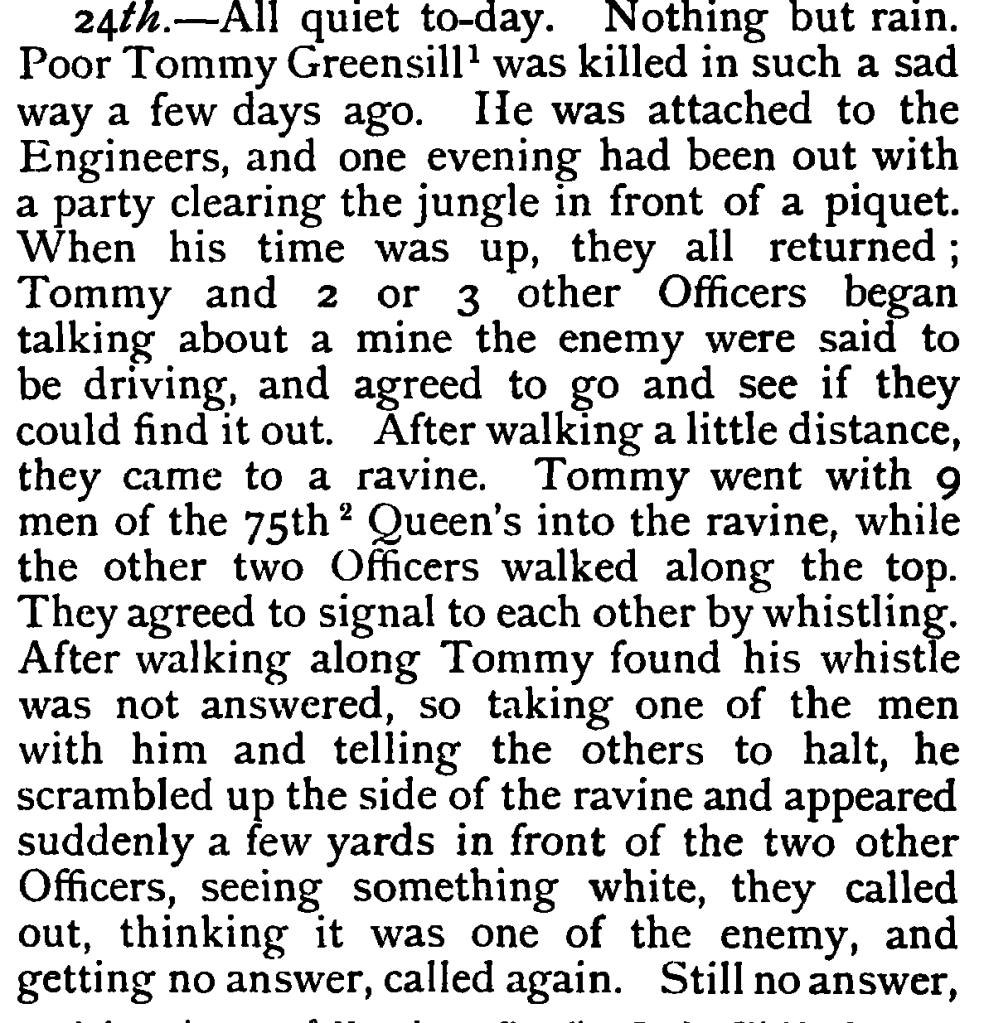
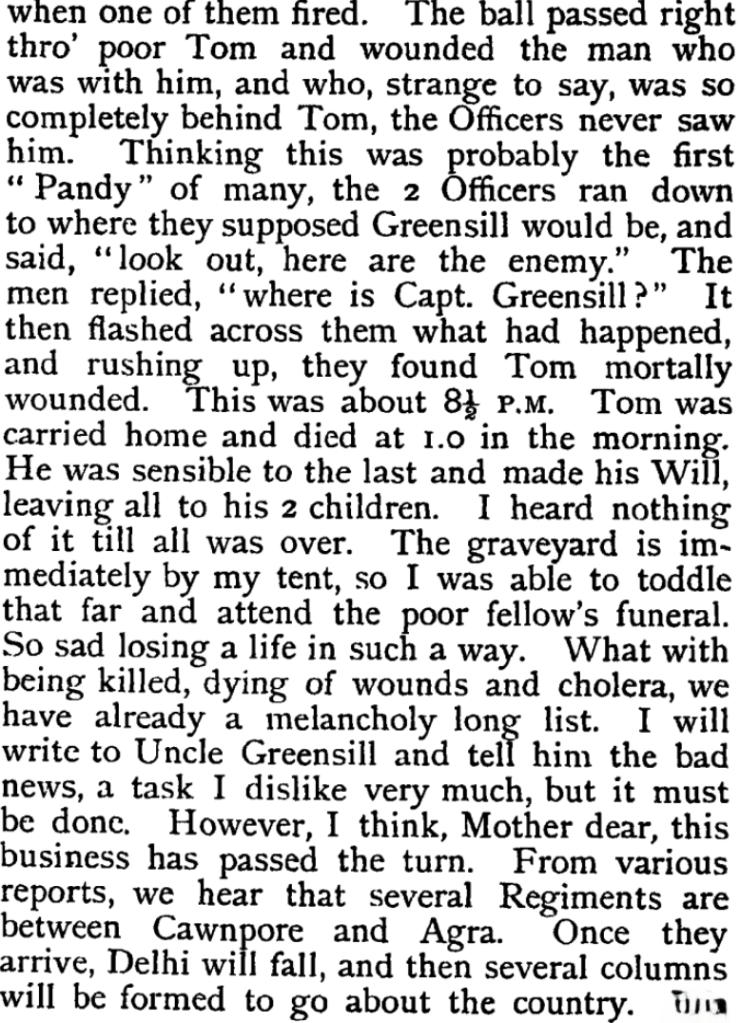
Only Roberts makes mention of the fact that Greensill had two children. His wife may have been Indian born, for a death was reported in ‘Domestic Occurrences’ in the Times of India (Edition 12 May 1904), that states, that
On April 11 1904, at Palampur in the Kangra District, Saidee Greensill, widow of Captain T M Greensill HM’s 24th Foot, died, aged 64.
In a previous journal, ‘Domestic Occurrences’ in the Times of India (Edition, 21 April 1877), another death was reported, that on April 11 1877, Charles Greensill, tea planter (son of the late Capt TM Greensill, HM’s 24th Regt) aged 21 years, at Dharmsala. It is curious to note that both mother and son died on the same day, albeit 27 years apart. Of the second child, until now, there is no record.
2nd Bengal European Fusiliers
Private John Cubbing – died at Delhi
Sirmoor Battalion
1 Rank and File – wounded
Corps of Guides
1 Non-commissioned Officer wounded
3 Rank and File – wounded
1st Regiment, Punjab Infantry
Lieutenant E.J. Travers, 2nd in Command – slightly wounded
1 Rank and File -killed
2 Rank and File – wounded
6th Dragoon Guards
Lieutenant C.J.H. Ellice -died of cholera
21st of July
1st Bengal European Fusiliers
Private William Duffy – died of wounds
2nd Bengal European Fusiliers
Privates
McDonall, John – wounded in the hand
Smith, Arthur- wounded in the leg
Griffin, Daniel – died
McNair, Edward -died
Ready, John – died
22nd of July
Corps of Guides
Lieutenant Alexander W. Murray (42nd BNI) – severely wounded
61st Foot
Private Alexander Mitchell – killed in action
23rd of July
In the returns for the 20th of July, Brigadier General A. Wilson reports 12 killed, 39 wounded and 1 missing
1st Battalion, 8th Foot
Sergeant John Brown – severely wounded in the hip
Sergeant Michael Devitt – dangerously wounded, died of wounds
Privates
Burroughs, William – severely wounded
Edgsill, William – severely wounded in right thigh
Pearce, George – Severely wounded
(The offical returns mention 7 rank an file wounded)
1/60th of Foot
Sergeant George Young – slightly wounded
61st Foot
Privates
Cleary, Thomas – wounded, died of wounds 25th of July
Frawley, Jeramiah – killed in action
Moore, William – severely wounded, musket ball to the leg
64th Foot
Lieutenant William Waldgreve Pogson – wounded
75th Foot
Colour Sergeant Robert Helms – killed in action
Privates
Ferguson, Martin – slightly wounded
Koston, James – killed in action
Murphy, Michael – wounded, died of wounds 27th of July
Thompson, George – slightly wounded
(The official returns mention 8 rank and file wounded)
1st Bengal European Fusiliers
Corporal Adam Green -killed in action
Privates
Chalmers, James – died of wounds
Wilson, James – killed in action
2nd Bengal European Fusiliers
Sergeant Joel Hadfield – died
Privates
Collins, Jeremiah – died
McDonald, John – wounded in hand
McEltoy, James – died
Morton, Thomas – wounded in the breast
Noonan, John – died
Smith, Arthur – wounded in leg
35th Bengal Native Infantry
Lieutenant-Colonel Thomas Seaton – severely wounded
Bengal Horse Artillery
3rd Brigade
Captain H.P. Bishop – slightly wounded
Captain A. Bunney (also Burney/Bunny)- severely wounded
Captain E.K. Money – severely wounded
Sirmoor Battalion
Field Officer, Brevet Lieutenant-Colonel Richard Drought (60th BNI) – severely wounded
1 Non-commissioned Officer killed
1st Punjab Infantry
Captain William George Law (10th BNI) – killed in action on the 23rd of July.
Born in 1823, William George Law was the third son of William John Law, Barrister-at-Law and Chief Commissioner of the Insolvent Court; he was also the grandson of Ewan Law, an uncle of the 1st Lord Ellenborough. The Laws had a long connection with India. Ewan had been a merchant for the EICo between 1763 and 1780; Thomas Law (Ewan’s brother) was an EICo official, and of course, the 1st Lord Ellenborough (Ewan’s nephew) would become Governor-General of India.
Not that these family connections seemed to have mattered much. Law joined the Bengal Army in 1841 and arrived in India in May of the same year. He had already been posted to the 47th BNI, but when he arrived, Law requested a transfer to the 10th BNI, whom he would join in Delhi in June 1842. In 1846, Law was selected for duty with the infantry of the Nizam’s Army, where he remained until 1849, when he resigned his appointment to go home on furlough. Law would not return to India for three years. When he came back in 1852, he joined the 10th BNI for the Second Burma War, for which he received the campaign medal. In 1857, Law was attached to the Ambala Depot of Rifle Musketry but gave up the position due to illness and made his way to Simla to recover. Meanwhile, the 10th BNI was in Fatehgarh, where they would eventually mutiny. Unemployed and with no regiment, Law joined the Delhi Field Force on the Ridge in June and on the 28th found himself attached to the 1st Punjab Infantry. He was killed while engaged with the 1st Punjabis in driving back a force of rebels who attacked the British position between Ludlow Castle and Metcalfe House.
4th Sikhs
1 Subadar -killed
1 Rank and File -killed
4 Rank and File – wounded
Corps of Guides
Infantry
1 Rank and File – killed
24th of July
61st Foot
Private William Young – killed in action
75th Foot
Lieutenant H. Cowell – slightly wounded at Delhi Camp
25th July
61st Foot
Private Thomas Cleare – killed in action
26th July
2nd Bengal European Fusiliers
Private James Dalzell – died at Delhi
27th of July
Staff
Park Sergeant D. Willis – mortally wounded at Delhi Camp
28th of July
1/60th of Foot
Privates
Atwell, John – severely wounded
Brennan, Edward – slightly wounded
Jones, George – dangerously wounded 20th of June, died of wounds 28th of July
61st Foot
Private Denis Sullivan – killed in action
2nd Bengal European Fusiliers
Privates
Private John O’Gready – died
29th of July
2nd Bengal European Fusiliers
Privates
Mechin, Thomas – died
Shea, Thomas – died
Bengal Horse Artillery
1st Brigade, 4th Troop
Corporal John Hamilton – dangerously wounded, died of wounds 4th of August
3rd Brigade, 3rd Troop
Gunner Charles Lineham – wounded
31st of July
Bengal Horse Artillery
1st Brigade, 4th Troop
Gunner Edward Dellow -wounded
Bengal Field Artillery
Gunner John Haden – slightly wounded in right thigh
Richard Barter of the 75th Regiment lists the following men as having left the Ridge due either to cholera or injuries:
Ensigns Pym and Row, who had carried the Colours for the 75th at Badli-ki-Serai
Lieutenant Lionell Dayrell of the 66th BNI, attached to the 75th – he died at Kussowlie
Lieutenant Cowell was accidentally shot in the leg by Lieutenant Webb of the 8th Regiment while on his bed in camp.
“The enemy came out in great force yesterday, with the intention of making a grand attack on front, rear, right and left! They came out of the Ajmere Gate like so many bees! Sorbea, my head look-out man, came to tell me the whole of Delhi had turned out. I went out to take a look round and found it necessary to sound the alarm at once. About ten thousand, with six H.A. guns, four 9-pounders materials for making bridges &c., were seen coming up in my direction. Away I went with my old troops to take up my old position on the right and left of the right flank battery. Presently, I saw another force coming round my right and making for the Rohtuck Road. This was force was evidently intending to make a rear attack, but they had the task before them they did not much relish; viz. constructing a bridge over the canal. They were busy at it until noon…While this force was at work, trying what they could do in our rear, some three thousand infantry, with four light guns, attacked me front and right flank, but they would not come close up…They had the advantage over us, the scoundrels, in point of keep themselves and their ammuntion dry, as they were able to get inth the Kissengunge buildings, whereas we were exposed to the heaviest rain until 5 P.M., when the combined attack was given up as a bad job, and they retreated with the guns, and we, poor drowned rats, to our quarters in Hindoo Rao’s House.” (Major Charles Reid writing on August 1st of the action on the 31st of July).
Contra vim mortis non crescit herba in hortis
“No herb grows in the gardens against the power of death.”
Sources:
Selections of Letters and Dispatches Vol I edited by G.W. Forrest
Extracts of Letters and Notes Written Durning the Siege of Delhi – General Sir Charles Reid, G:C.B. (1858)
The Chaplain’s Narrative of the Siege of Delhi – Reverend John Edward Rotton, M.A.(1858)
Gunshot Injuries from the Mutiny in India with a Description of the Preparations of Gunshot Injuries Contained in the Museum at Fort Pitt – George Williamson, M.D. (1859)
The Siege of Delhi -Mutiny Memories of an Old Officer – Richard Barter, 1869 (London, the Folio Society, 1984)
The Punjab and Delhi in 1857 Vol I- Rev. J. Cave-Browne M.A. (1911)
Inscriptions on Christian Tombs or Monuments in the Punjab, the North-West Frontier Province, Kashmir and Afghanistan, Part II Biographical Notices of the Military Officers and Others Whose Names Appear in the Inscriptions in Part I. – compiled by George William de Rhe- Philippe (1912)
Casualty Roll for the Indian Mutiny, 1857-59: The Casualties to All Regiments of the British Army, Naval Brigade and Europeans Serving in the Bengal, Madras and Bombay Armies” by I.T.Tavender (1983)
 Mutiny Reflections