“It is a matter of deep regret that the detachment of the state troops that had under your orders been stationed for the protection of the Residency, joining with the British forces, adopted a course of direct mutiny, and led on by their unfortunate fate did, on the 1st instant, raise a great disturbance, and having commenced firing guns, killed some innocent beings…” (Revolt in Central India, Appendix I, p 237)
So began a letter, penned by His Highness Maharaja Holkar to the Agent for Central India, on the 4th of July, 1857.
Holkar was in a difficult situation. His warnings to Durand that his troops would not listen to him had gone unheeded; he had only met Durand twice between April and June – it was hardly enough time to begin a relationship with the man, much less solidify it. They neither knew nor trusted each other to any workable degree – and now, with Durand gone, Holkar would have to prove himself innocent of mutiny. The questions remain: where was Holkar on the 1st of July, and what was he doing?
Shortly after the attack on the Residency began, Durand sent a message to Holkar – it remained unanswered, fermenting in Durand’s mind, that Holkar himself had ordered the attack. What Durand did not know was that Jemadar Jeeva Singh, to whom Durand had entrusted the letter, did not deliver it – instead, he used it as an opportunity to leave the Residency to go and hide in his own house in Indore.
Major Travers claims would that Holkar could have seen smoke of the guns from the windows of his palace, the imposing Rajwada Palace, three miles distant, which would have been true had Holkar been at the palace. However, on the 1st of July, Holkar was at a haveli belonging to one of his chief officers, Bhowani Singh Sirnobut, a little distance away from the palace. That building was low-lying and surrounded by houses – Holkar might have heard distant firing, but he would have seen nothing. Even from the palace, unless he had been at the top windows, his view towards the Residency would have been minimal.
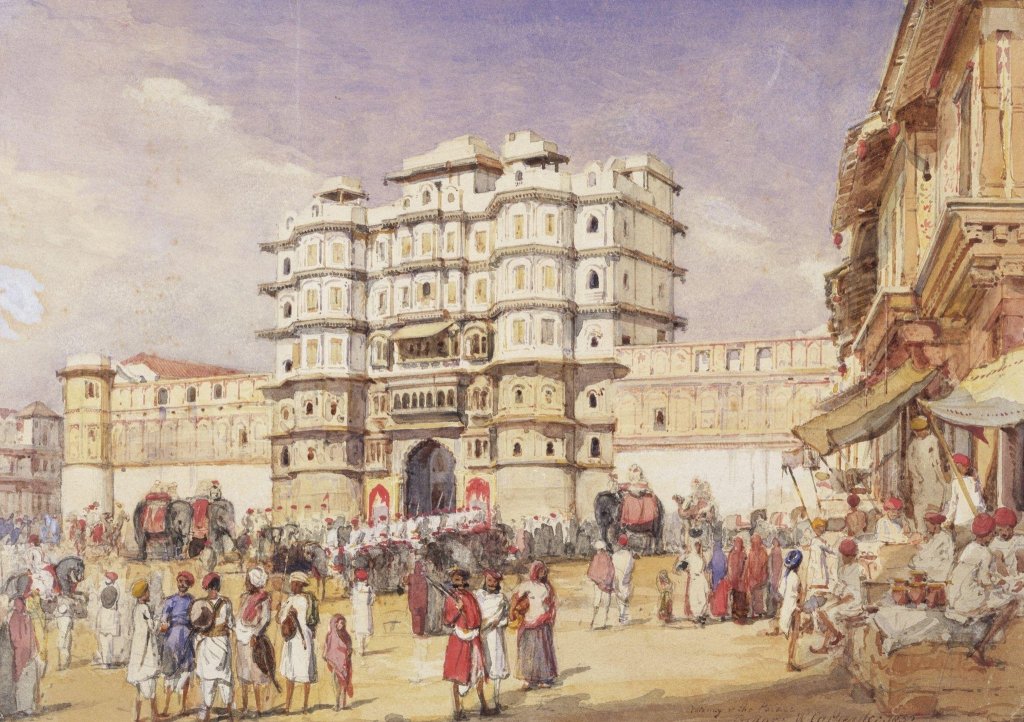
As soon as news of the attack was given to Holkar, without hesitation, he ordered his escort to hasten to the succour of Durand. Unfortunately, at this moment, he was interrupted by Sadat Khan, who arrived “at full gallop, covered with blood from a slight wound he had received in the face, calling on the troops to join in a war of religion, and appealing to Holkar to place himself at their head.” The attack on the Residency had been led by Sadat Khan, a disgruntled half-pay officer with no official position in Holkar’s court – he had been recently suspended not just for incompetence but misconduct from his post in the Customs Department and was also holding a grudge against Holkar personally. His uncle had once commanded one of Holkar’s cavalry regiments, a position Sadat Khan had coveted and was refused.
His sudden appearance threw everything into confusion. Holkar now could not proceed towards the Residency as it would signal to his men he had acquiesced to Khan’s demand, nor could he send his men, knowing full well they would probably mutiny as soon as they were out of his sight.
“Subsequently, the whole Residency was plundered, and the Muhammeadans raised the standard of religion. A total disorganization followed; none of my troops would listen to orders, and quite confused, I had nothing left but to regret. I immediately sent a mission to Mhow asking for aid, but my people could get no admission to the Colonel.” (continuation of Holkar’s letter).
Holkar’s first objective should have been to arrest Sadat Khan but circumstances proved otherwise. With a mutinous cavalry on one side and a population ripe for revolt on the other, Holkar managed at the most to detain him for several hours, but neither openly clapped him in irons nor arrested him. Holkar’s situation was further irritated by the arrival of Bans Gopal, who was in command of the detachment of Infantry and guns at the Residency, who now loudly demanded Holkar’s orders. The mutiny, he said, had been started by Sadat Khan who, with a proclamation of “Deen, deen!” had ordered the Mahomad Ali, Jemadar of the artillery, to unlimber the guns and open fire on the Residency. Bans Gopal insisted he had tried to stop the gunners, but no one would listen to him; they went on “shouting and firing”, ignoring him completely. Holkar told Gopal he would be held responsible for his actions but ordered him, nevertheless, to return to the Residency and regain control over his men.
Having established some kind of authority, Holkar selected his most trustworthy men to hold the mutineers in check, viz, prevent more from joining the ranks of those already at the Residency. Holkar returned to his palace to seek advice. As he alighted at the steps, a message arrived that not only had the British commanded troops at the Residency mutinied, but Durand had retreated. The remaining troops under Holkar’s command, greeting the news as a great success, fell out of Holkar’s control. He had done what was within his means – he had confined Sadat Khan, sent Bans Gopal back to the Residency to order the mutineers to withdraw and prevented the remaining troops from adding to the ranks of the mutineers. It explains why when Durand and the rest of the Europeans retreated, their flight was mostly unhampered – except for some shots fired, they left Indore with no opposition at all. Had Holkar been of a different frame of mind, no one would have escaped, and history would have written about the massacre at Indore.
Although some conjecture was made as to why Durand did not seek refuge with the Maharaja instead of abandoning Indore, it must be realised, at that moment, he could neither proceed through the town nor be sure of what welcome he would receive had he managed to reach the palace in the first place. Had Holkar received the message Durand had sent, it still is doubtful if Holkar could have secured Durand any safe passage within Indore itself. Durand, however, was completely convinced Holkar had ordered the attack – it is unlikely he would have sought the Maharaja’s shelter even if he had been in the position to offer it. So Durand left Indore, and what remained for Holkar was to make the best out of a very precarious situation.
It must be remembered that even Scindia of Gwalior was unable to prevent the mutiny in his domain. The difference is, while Macpherson offered to remain behind and had to be sent away by the regent to safety in Agra, Scindia could still rely on not just the council of Dinkar Rao but on Macpherson. Durand made his retreat so complete that for the next three weeks, no one could say for sure where he was. The troops might have abandoned their allegiance to Holkar, but it can be said Durand shamefully neglected his duty to Holkar. It speaks in Holkar’s favour that at this point, he continued to support the British, as his further actions will tell. He had little hope of stopping the plundering in Indore or at the Residency – instead, he turned his attention towards Mhow.
At 4pm the same day, Holkar sent Rao Ramachandra Rao Bhow, Bakshi Khuman Singh and Ganpar Rao Seetaram Vakil to Mhow to wait on Colonel Platt, inform him of the uprising at Indore and seek his advice in lieu of Colonel Durand in regards to further operations. Their movements, however, were halted at Pivarai, close to Rao.
Finding a European officer, Major MacMullen, in charge of the Pivarai picquet, the three men appealed for permission to proceed to Mhow and were refused. The officer stated he had no orders to allow anyone into Mhow itself – but could be prevailed on, with the greatest difficulty, to send a pencilled note to Colonel Platt.
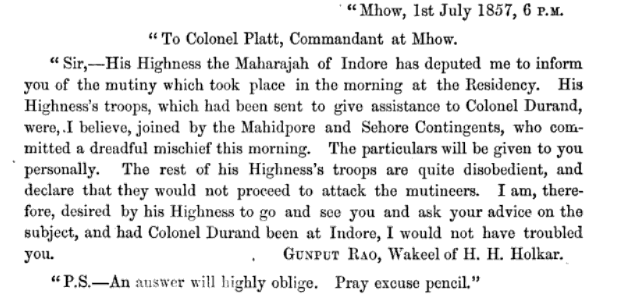
MacMullen, obviously aware of what had happened at Mhow and most likely in an excited state himself, sneeringly asked the Vakil if the note had been “wetted with blood…” The Vakil then asked MacMullen where he could find Durand, at which MacMullen replied, “I shall not tell you.” After two hours, there was still no answer forthcoming from Mhow, and the men despondently returned to Indore. No one would acknowledge receiving the note from the three emissaries, but they would admit they received Durand’s scrawl, “Send the European battery as sharp as you can. We are being attacked by Holkar.” It is no wonder then that his men were not allowed access to Colonel Platt.
“About the same time, the Mhow troops, also mutinying, killed some officers and having burnt some houses marched to Indore where they joined the mutinous, and disaffected here. It is impossible to describe the excitement, plunder, and bloodshed that continued here for the two following days. I had no troops left to think of fighting with the troops of the line from Mhow, who, under the excuse of supplies and carriages, sent their men into the town and were joined by hundreds of bad characters to plunder the people. Although I sent my people to persuade them, yet the mutineers of the Durbar troops that had joined them would not desist from plundering.” ( continuation of Holkar’s letter)
On the same afternoon, Holkar sent a letter to Lord Elphinstone at Bombay, a further one to Lord Canning at Calcutta and one to Colonel Durand – only the one to Elphinstone was received and acknowledged. At 6 pm, Holkar was informed by the Patawari of Tillore that Durand had safely reached his territory. Holkar immediately dispatched a deputation consisting of Raoji Gora Vakil and Teekaram Jemadar, with an escort, to Tillore to ensure the wants and needs of Durand’s party were secured and to inform Durand “his Highness was distressed beyond measure and ready to give all the help in his power.” But Durand continued his retreat, and for the next few days, no one could ascertain in which direction he had gone. Holkar would hear nothing from Durand directly until the 1st of August.
Ordering Sadat Khan to bring the plundering of Indore to an end, Holkar released him from confinement. He promptly joined the mutineers in their march to Agra. He would not be arrested until 1874 when, while living in Pratabgarh in Rajputana, he became embroiled in an altercation with a neighbour over a boundary dispute. The boundary officer sent to investigate the dispute was apprised of the fact that one of the parties involved was none other than Sadat Khan, the rebel leader of Indore. His identity proved Sadat Khan was subsequently arrested and tried. He had been betrayed, not by his kinsmen, but by his opposites in the boundary dispute. Had he had the sense to keep himself quiet, Sadat Khan might have lived to a ripe old age, but the government, for all its ponderous machinations, had a long memory. With the government’s sanction, Sadat Khan was executed in September 1874.
As for Bans Gopal, he too would throw in his lot with the mutineers, but Sadat Khan’s trial would prove he had neither plotted nor instigated it. After taking his share in the plunder, he would march with them towards Agra.
It would further be ascertained that the revolt itself had been conceived and contrived by three men – Waris Mohammed Khan of Bhopal, who was living in the Residency grounds, Maulvi Abd-oos-Samad and Sadat Khan himself, none of whom were directly connected with Holkar’s Court. It is interesting to note, however, that while Sadat Khan was placed at the head of the mutiny and subsequently noted as a man of rank in Holkar’s court, this was blatantly untrue. Ample evidence proved Sadat Khan was a disgruntled man, no doubt, but he held no position either in Holkar’s cavalry and even less so in his court. The part played by Waris Khan was subsequently ignored by Durand, who had failed to appreciate the fierce and fanatical nature of a man who had placed himself at the head of the party opposed to Sikandra Begum, whom he hoped to replace on the throne. Sir Robert Hamilton had had him deported from Sehore to the fort of Mundlasir on the Narbadda, under house arrest, but it was Durand who had allowed him to leave the fort, on a plea of bad health and take up an abode next to his own in the Residency grounds. Durand then promptly forgot to mention this in his governmental despatches. Durand’s intent, as it will be seen, to make up for his own poor judgment, was to throw Holkar to the dogs.
Meanwhile, Holkar was determined to protect the few Europeans who had come to him seeking refuge. Three Europeans – Meesrs Norris, Farrell and Sargon; seven Anglo-Indian clerks and several Indian Christians and two English-speaking Indians in government employ, Dhrum Narrain and Serup Narrain and Captain Fenwick, an Anglo-Indian officer in Holkar’s employ, were all protected by him. He also ordered the bodies of the slain Europeans at the Residency to be buried decently in coffins.
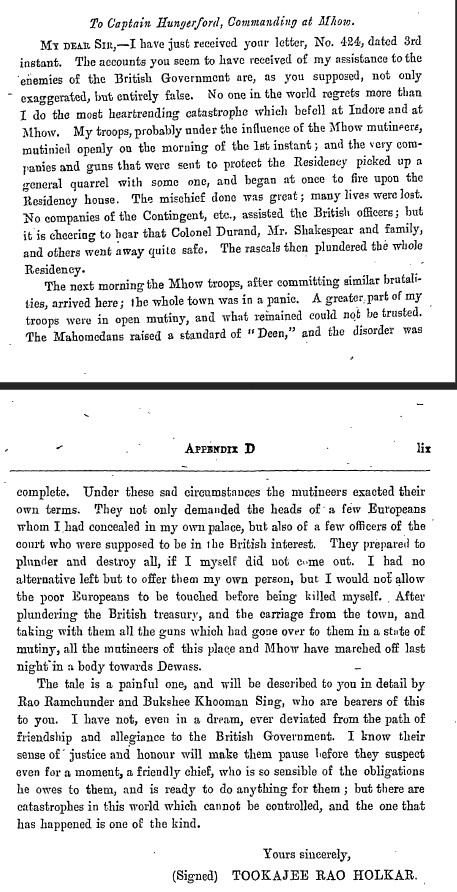
“At length, a message was sent by the mutineers to send them the heads of the few Europeans and Christian women that had found shelter in my own place, and that if this were not done, the plundering would not cease. I replied that the murder of these Christians would not be suffered as long as I live, even if the town were destroyed. The mutineers insisting in their demands, I was obliged in the absence of even a few hundred faithful and trustworthy troops, to go to the mutineers, followed by a few personal attendants, and told them that they would one day be recompensed for what they had done, and wished them to leave Indore. The mutineers had forcibly taken carriage from the town, and with that and some that was supplied them in order to have them removed and the town saved. “ (Holkar’s letter)
Holkar’s attempt to save Indore was misconstrued by Captain Townsend Hungerford at Mhow as a direct acknowledgement of his involvement in the mutiny, but Hungerford, at least, was not a Durand.
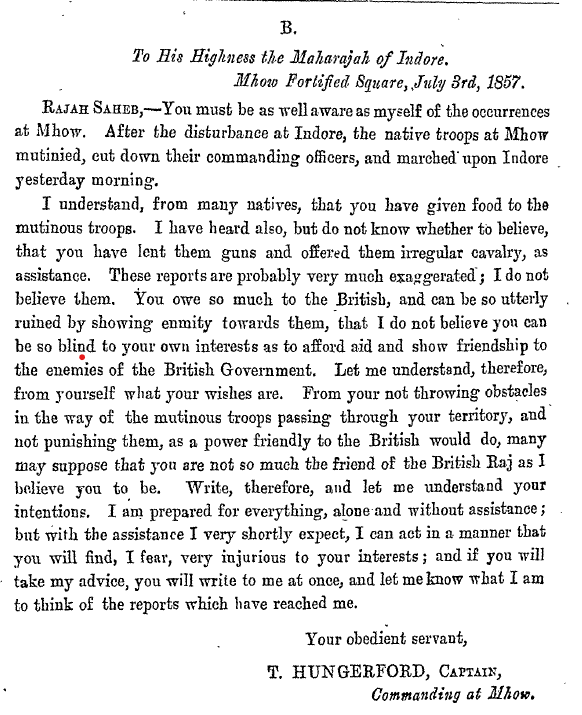
Holkar promptly replied.
These were not the only people Holkar protected. Upon hearing, to his distress that Captain and Mrs. Hutchinson had been placed in confinement by the Raja of Amjheera – it must be noted that Mrs. Hutchinson was the daughter of Robert Hamilton, and Holkar considered her his sister – Holkar wasted no time in ordering three companies of Infantry, two guns and 200 sowars towards Amjheera with orders to “blow up the town, and bring in the Rajah, dead or alive…” should he have further threatened the lives of the Hutchinsons. Holkar was taking a terrible risk – Amjheera was a tributary of Scindia; had he found it necessary to attack, he could have incited a war with the Gwalior State. The threat paid off – the Raja of Amjheera came to his senses and shuttled the Hutchinsons and the other Europeans out of his fort and off to Jhabooa, where, after a short interlude, they made their way to Mhow. Holkar was vindicated in his actions by Mr. Elliot, one of Durand’s assistants who had made his own escape to Mhow –
“I hasten…to thank the Maharaja for the promptitude he had displayed in taking upon himself if necessary, the deliverance of British subjects from enemies, and the punishment of such offenders,” wrote Elliot on the 8th of July to Holkar, “Such proof of friendship is most gratifying, and will be the best proof to evil-disposed persons that the goodwill and friendship that exist between the two Governments will remain unchanged forever.” With Hungerford’s approval, Elliot further concurred that had it been necessary for Holkar to march into foreign territory to persuade the Raja of Amjheera to surrender the Europeans, the “British Government will not fail to support you and accept the responsibility…” Fortunately, Holkar never had to find out if what Elliot and Hungerford so firmly believed would have been true.
It was not the end of Holkar’s worries. Rumours arrived at Mhow on 7 July that the Indore mutineers had returned – enraged with the Mhow mutineers who had left before them taking the treasure, they demanded Holkar recover it for them. With the intelligence provided, Hungerford ascertained they were planning to move on Dewas to attack the Mhow mutineers and take the treasure back from them. In reply, Holkar stated he had ordered an attack to be made on both the Indore and Mhow mutineers as soon as they were far enough away from his city. He wrote to Hungerford,
“The Komisdar of Terana has now, according to the orders, assembled about 1100 men, together with 2 guns and was to attack them at or near Rajwas; an attacking column has also been in pursuit of a few stragglers towards Jamere, a third column, to the strength of 350 horse, was sent on yesterday (6th of July); and fourth column, of 2 guns of horse artillery, 100 sephais and 50 horse dispatched from Indore…Letters have also been addressed to Scindia’s authorities and Shajahanpore and Oojein, as well as the Rajas of Dewass and Nursingur, to send succour…” He further placed a bounty of Rs. 5000. on Sadat Khan’s head, Rs. 500. on that of Bans Gopal, a further Rs. 500. on that of Mahomed Ali and a smaller reward of Rs 150.- for those of any mutineer or officer respectively.
These are not the actions of a regent opposed to the Government. Holkar further dispatched to Mhow what remained of the Residency treasury, anything the mutineers had not been able to carry off, was restored to Hungerford, who charged its safety to Mr. Elliot. With Hungerford and Elliot’s help, Holkar was able to re-establish telegraphic communications and maintain a measure of peace in his territory.
While it is established that Holkar was doing everything within his limited power to restore peace in Indore and assist the British, and Hungerford was placed in the unenviable position of handling affairs in Durand’s absence, what, if anything, was Durand doing?
 Mutiny Reflections