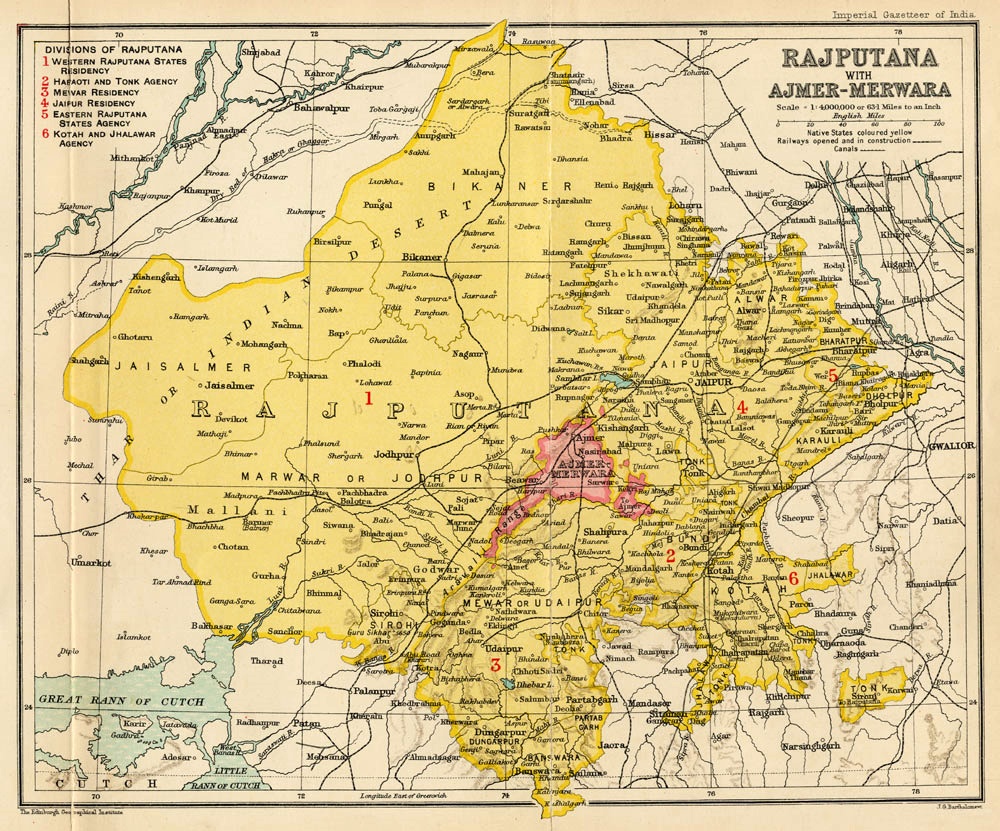
Sir Hugh Rose was, for the time being, in Jhansi. Unable to move as his force was not of sufficient strength to take on the work he had planned for it, and decidedly concerned about the rebels moving on to Chanderi, he was also facing incursions by the insurgents from Kotah.
As Kotah was not on Rose’s line of march, another force had been sent to Rajputana to deal with that particular problem. Following the murders of Major Burton and his sons in October 1857, Kotah had been left to the rebels. An ominous warning was issued by the British: as soon as they had time and a force to accompany it, they would return to Kotah. Brigadier George Lawrence had been requesting troops from Bombay for this particular venture since October 1857. The first detachments arrived only in January 1858, but it would not be until March that there were sufficient troops to march on Kotah.
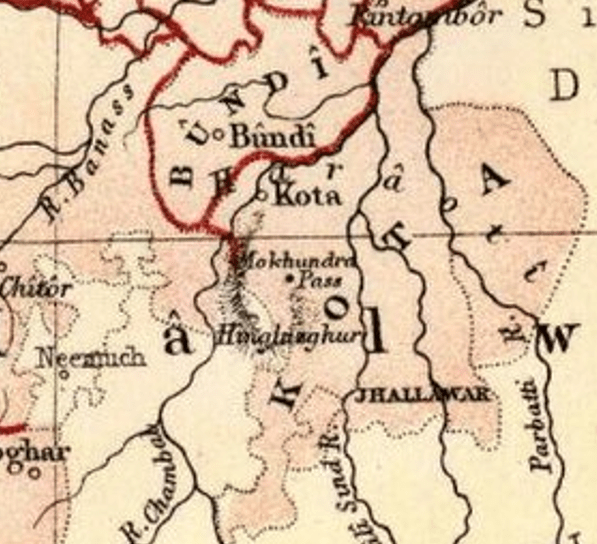
However, it was decided, before any advance on Kotah would be made, two particularly troublesome insurgent strongholds would require immediate attention — Rowa and Auwa.
The 95th Regiment of Foot
The 95th Regiment of Foot had been home barely a year from Crimea when they were ordered for foreign service to the Cape of Good Hope. They set sail from Kingstown, Ireland, in June 1857. The left wing preceded the headquarters and the right wing by a week. Shortly after their departure, news of the mutiny at Meerut reached England, and the orders of the 95th suddenly changed. As soon as the left wing reached the Cape, they were instructed to proceed immediately to India. The right wing followed in their wake.
The left wing of the 95th Regiment of Foot had arrived at Bombay in September 1857, 300 strong.
They would be instrumental in quelling disturbances in the city and, since then, had, with one exception of a detachment being sent to Waghotun to bring back a party of mutineers, they had not seen any active service since. On 22 November, the first column was detailed for field service in Rajputana, comprising the left wing of the 95th Regiment at 400 strong, Captain Cumberland’s Royal Engineers Company, six guns of the 2nd Field Battery of the Bombay Artillery, two squadrons of Scinde Horse and the right wing of the 10th Bombay NI. The column was placed under the command of Major Raines of the 95th. Instead of taking the cumbersome land route, they embarked on the EICo steamer Berenice and sailed for the Gulf of Kutch.
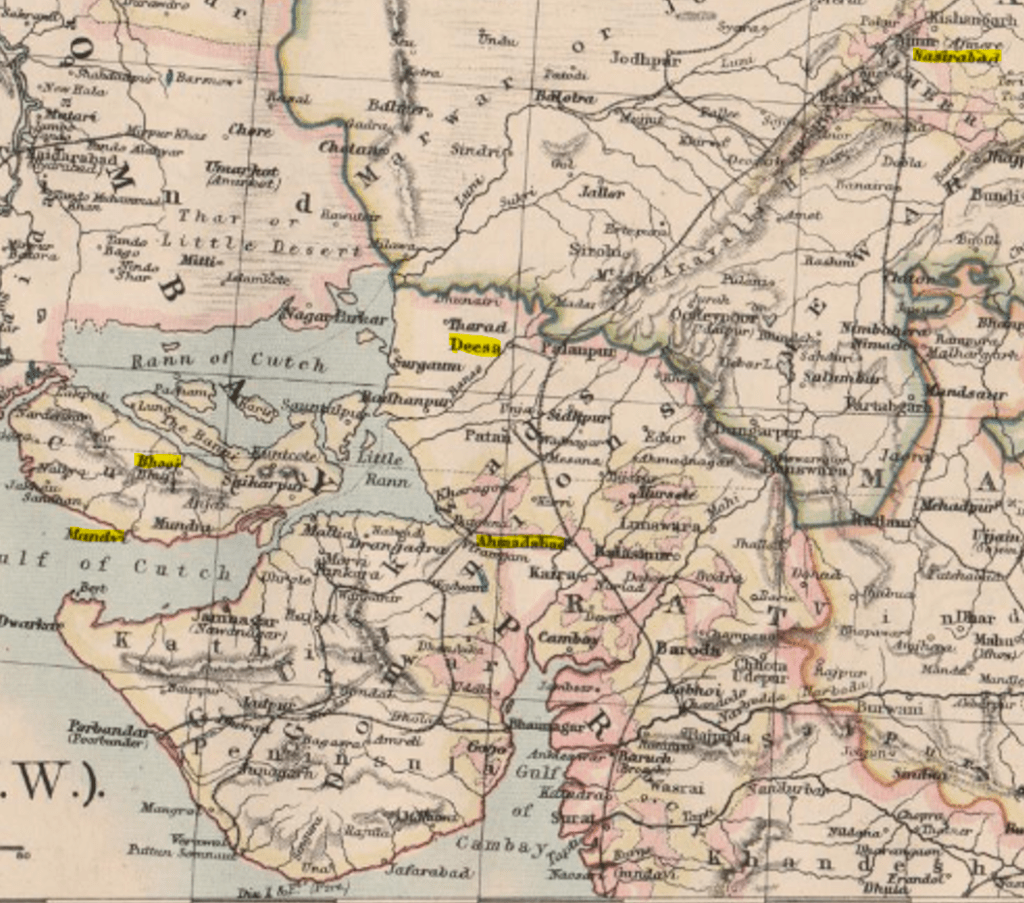
From Mandvi, they marched to Bhuj, where the Raja did his best to accommodate the men. He provided all manner of entertainment for their amusement, which included jugglers, elephants, and wrestlers. The men of the 95th were so enchanted with the latter, they proposed a match between Bhuj’s best wrestler and their own, a man of small stature, named Private Lawler. What Lawler did not expect was that the champion of Bhooj was certainly twice his weight and, in his estimation, one of the tallest men he had ever seen. The enterprise seemed doomed to fail, and Lawler was feeling that the whole thing was quite foolish. However, he decided to give it his best. “He circled warily round the native wrestler, and at last — seizing the opportunity — Lawler ran between his legs and put the giant on his back…” The assembled audience broke out in roars of laughter, and Lawler was declared victorious, the champion clapping him, with much hilarity, on the shoulder.
As pleasant as their sojourn in Bhuj was, there was grim work ahead — on 30 November, the 95th bid goodbye to the hospitable Raja and set off for Deesa, arriving on Christmas Day. They had expected to find the regimental headquarters and right wing already encamped there, but they had been unexpectedly delayed in Bombay, waiting for their replacement regiment. 480 strong, the right wing finally left on 28 December and embarked on two steamers, the Bernice and the Lady Canning, with the grenadiers hauled behind on flats, and arrived in Gujarat at Tankaria on the 31st. There would be no entertainment for them: their march would take them via Baroda and Ahmedabad to Deesa, where they arrived in the second week of January.
At Deesa, a depot was formed under Lieutenant Waterfall, who would remain here with the sick, all the families of the 95th and unnecessary baggage. The right wing then marched to Nasirabad, escorting a heavy siege train consisting of hundreds of pack bullocks, with each carrying substantial loads of heavy round shot and ammunition. On 28th February, both wings of the 95th were reunited in Nasirabad. While the right wing had had a comparatively dull march to the station, the left wing had had a busy time of it.
Leaving Deesa on 3 January, they had halted at Maddar three days later, a short 12 miles from Rowa. Orders had come in to Major Raines that a malcontent petty Thakur had been stirring up trouble with his neighbours. The political superintendent of Palanpur believed the man was in open rebellion, as he had begun raiding adjacent villages belonging to the Palanpur Dewan. The Thakur was most likely not in rebellion as such but had decided to take the opportunity, considering the unsettled state of things, to settle a few scores and reclaim land he felt was rightfully his. However, this was a dangerous attitude to have at a time like this, and the British were not about to let him get away with it.
Rowa
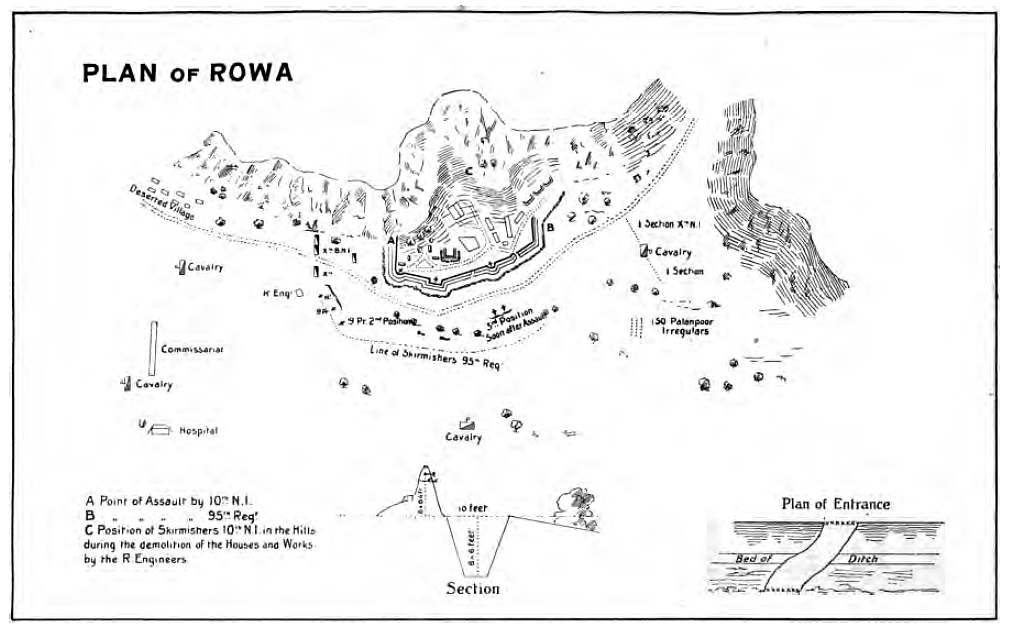
Under Major Raines, a small force comprising four officers and 108 men of the 95th, two companies of the 10th Bombay NI, two guns and a detachment of cavalry proceeded to the entrenched village of Rowa. The Thakur had not taken any chances. The village was defended by a V-shaped ditch some nine feet deep and a mud wall topped with stones to serve as a parapet. He had taken advantage of the geography, so the formation was semi-circular with either end extending up a rocky hill; however, he was a little too complacent in his construction. As the ground was hard and difficult, and the hill very steep, neither the ditch nor the wall was as formidable on the extreme flanks as he considered the steepness of the hill to be a sufficient deterrent. Major Raines, on the other hand, used this oversight to his advantage.
Two companies of the 10th thus made a circuitous route to approach the village on the right flank, on the steep hill. As there was plenty of cover from the trees, they remained unnoticed. Meanwhile, the 95th, using the partial cover of the bushes and trees to mask their movements, were to attack the village from the front. At 100 yards, the line lay down but kept up a steady fire on the wall, distracting the insurgents from events on their flank. As soon as the 10th was in position and had fired their first volley, the 95th rose, and with a cheer scrambled over the wall, through the ditch and carried the place at the point of the bayonet, while the insurgents were suddenly busy with the 10th Bombay Native Infantry. The first officer over the wall was Captain McGowan, commanding the 10th, but he had been a little hasty in his ardour, and quickly found himself separated from his men. Three insurgents turned on him with a vengeance and cut him down with their tulwars. As he lay on the ground defending himself from their blows, Private McQuirt of the 95th dashed to his rescue. He shot one of the attackers and went at the other two with his bayonet, but only wounded one. Sepoy Suddoo Surpuray, seeing McQuirt was now in trouble, rushed over and dealt with the final assailant. For his pains, McQuirt was shot in the arm and had received five tulwar cuts.
A little drummer boy of No. 2 Company of the 95th, too, had his moment. Seeing a private cut down and severely wounded just as the party was about to storm the village, he ran up to the wounded man, and, relieving him of his belts, slipped them on himself, picked up the private’s rifle and ran after the storming party in his place.
In all, the 95th had three privates wounded – Grady, Hennon and McQuirt; the 10th’s losses were Captain McGowan. For his actions, McQuirt would be awarded the Victoria Cross – the first for the 95th – and Sepoy Surpuray promoted the Naik.
It was a curious battle though.
“During this operation, we were assisted by a regiment of native auxillaries armed with bows and arrows, and I believe their flights of arrows, at their full range, did more execution among the ranks of the defenders than the bullets of the 95th, as the arrows with a high trajectory searched the ground immediately behind the parapet, and on storming the place, the first two bodies met with were those men who had been killed by arrows. These auxiliary troops were perfect savages, and later in the day might have been seen returning from the captured village with bunches of men’s heads tied together by their hair.”
The Engineers now set to work on destroying Rowa – the Thakur’s house was blown up, the wall torn down, and the ditch filled in. When the work of demolition was complete, Raines returned with his men to Maddar, but on the 10th of January, instead of resuming his march to Nasirabad, he was ordered to join Colonel Holmes at Jaitpur, a village two miles from Auwa.
Bernard McQuirt, VC
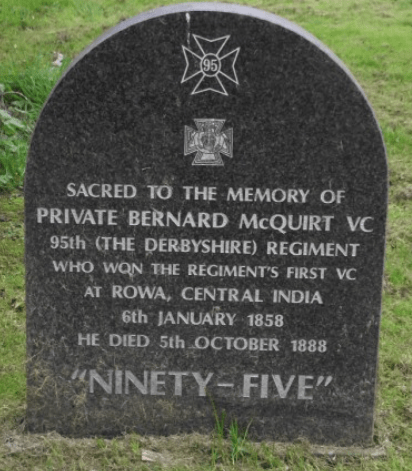
Born in 1829 in Donaghcloney, near Lurgan, County Armagh, Ireland, Bernard McQuirt worked as a labourer until he enlisted with the 95th Regiment of Foot in 1854. He served with his regiment in Malta and then in the Crimean War. Unfortunately, Rowa would be his last fight. The tulwar blows had done considerable damage – he received two cuts to the head, one splitting the left parietal bone, a further two cuts to his left shoulder and another to the ulna of the left forearm. If this was not bad enough, the musket shot through the right arm rendered his elbow joint useless. He would eventually be sent back to England, and on 5 July 1859, he was discharged at Chatham, Kent and invalided out of the army. He returned home to Belfast. He was sufficiently recovered to attend the investiture at Windsor Castle on 4 January 1860 to receive his VC from Queen Victoria; she was so shocked by the wounds to McQuirt’s head, she was afraid to speak to him.
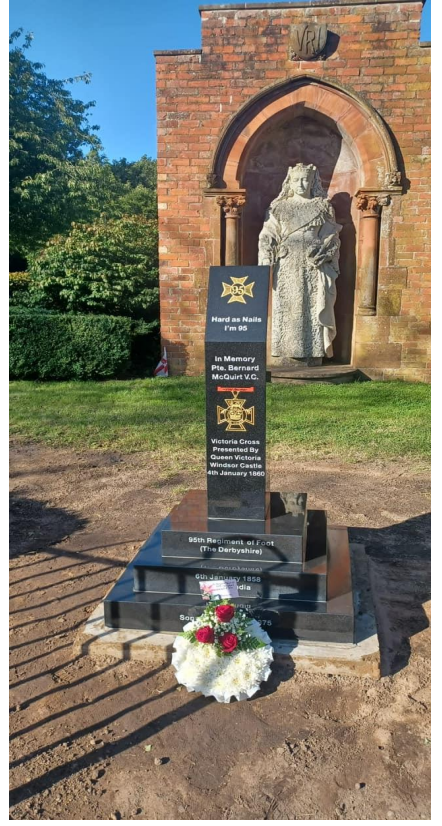
McQuirt returned to Belfast, where he lived with his wife in obscurity; he died aged 58 on October 5 1888, of chronic bronchitis. He was buried at Belfast City Cemetery in an unmarked, public grave – a clerical error had him buried under the name McCourt. Due to various wranglings through out the 1990s with the church who opposed the erection of a stone on McQuirt’s grave as he was not the sole occupant, in 2000, a headstone was placed in Donaghcloney Churchyard, and finally, after a long campaign led by the Sons of Ulster RBP 375, an obelisk was erected in Shankhill Road Graveyard, Belfast, close to McQuirt’s final residence. A memorial service was held at the unveiling, which was attended by several dignitaries, and McQuirt finally received the recognition he so justly deserves.
Auwa
As we have already seen, Lawrence had been given something of a thrashing in September at Auwa. He was now ready to repay the compliment.
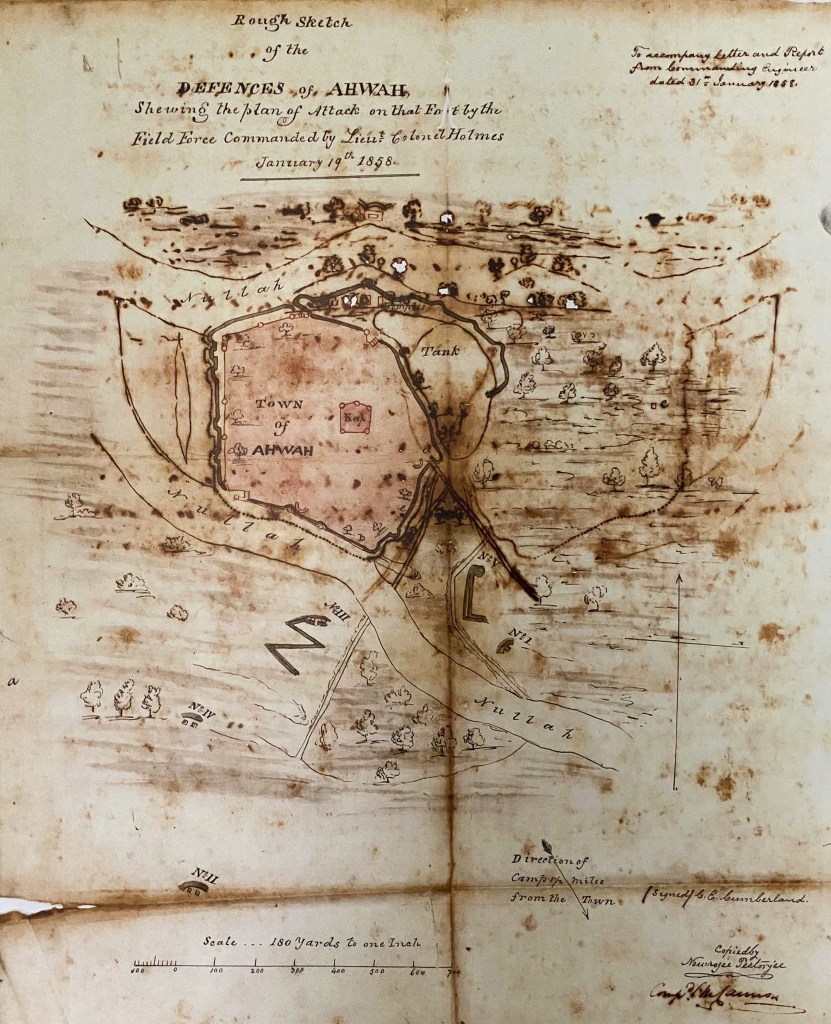
Lawrence sent a detached force under Colonel Holmes of the 12th Bombay Native Infantry to march on Auwa, and he was to take Major Raines and his men along on the expedition. The combined forces numbered 840 cavalry and 1100 infantry, along with 14 guns. It was estimated Thakur Kushal Singh had 2000 men at his disposal and “many cannons.” They arrived before Auwa on 19 January, and Singh was ready. As soon as the 95th passed within a short distance of his walls, his matchlock men opened fire. Holmes replied with Captain Aitken’s Field Battery, which opened up as soon as it was in position, compelling the insurgents to retreat further into the fort.
Holmes invested the place on 19 January, and for the next five days, bombarded Thakur Kushal Singh’s stronghold. This was not a mere house with strong walls as Lawrence had found out four months ago — Auwa was heavily fortified, with a double line of defences, the inner consisting of strong masonry, and the outer of earthworks, both of which were thoroughly loopholed. The mud wall itself was 50 feet high and flanked by bastions on which were mounted two and three guns each, while a strong abattis took care of the rest.
Following a reconnaissance, Holmes ordered the camp pitched at 1500 yards from the fort and then set about besieging the Thakur. He set up his batteries between 1000 and 300 yards from the fort and then set to battering down the Thakur’s walls. The breach was deemed practicable on the 23rd, and Holmes ordered the assault.
“…but that night a terrific storm came on, the darkness was intense, the wind blew a hurricane, rain poured in torrents, and the thunder and lightning overmatched the roar and blaze of our artillery. The camp was truly alive all night, tents heavy with rain, pegs giving way, and the canvas collapsing over half-drenched and sleepy men.”
If Holmes expected to lead a gallant charge through the breaching wall, he was mistaken. At dawn the next day, Brevet-Major the Hon. Edward Sidney Plunkett of the 95th, who had spent an awkward night in the rifle pits some 50 yards from the wall, thought it a little odd the insurgents were no longer making a play for his head. He also thought it strange that the heads he could see clearly above the parapet were not moving, so he crept forward on his hands and knees towards the gate. Not a shot was fired. He pushed open the gate and found the fort had been abandoned.
The Thakur’s garrison, perfectly aware of everything the British were up to, resolved not to wait for his bayonets. Instead, on the night of the 23rd, with the violent storm raging, they crept out and dispersed, under the noses of Holmes’ carefully placed cavalry and infantry posts that regularly surrounded the fort. The insurgents had left behind sixteen guns, three tons of powder and some 3000 rounds of small arms ammunition, besides their stocks of grain and everything the Thakur and his men possessed. Although their defence from the first had been an obstinate one, they had failed to kill any of Holmes’ men but had wounded several of the Bombay Infantry; on their side, they left behind their wounded, and 170 prisoners were eventually taken. Twenty-five were shot following a drumhead court-martial for having “taken up arms and in open rebellion, against the State.” A private of the 95th availed himself of a very special prisoner and was seen, leading into camp, an enormous elephant, whom he had found loitering near the fort.
For the next four days, Auwa was dismantled and thoroughly plundered. The armoury in particular interested the men, and the men of the 95th swiftly added the Thakur’s armaments to their personal trophy collections. Once they had all had their fill, Auwa Fort levelled — the keep, the bastions and every piece of masonry and any buildings considered fortifiable were blown to bits. As for the Thakur, he would eventually give himself up to the British at Neemuch in 1860.
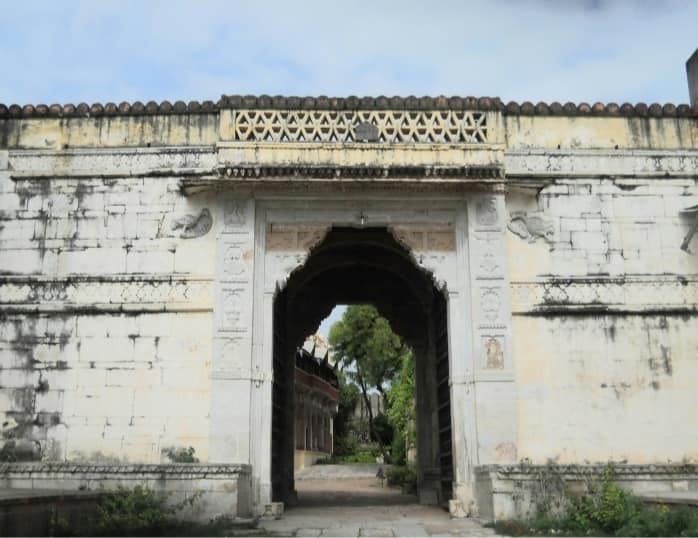
With Auwa levelled, it was time to march to Nasirabad, for here, Major General Henry Gee Roberts was assembling the Rajputana Field Force – their first objective was to take Kotah.
Sources:
Holmes, T. Rice. A History of the Indian Mutiny. London: Macmillan & Co., 1904.
Intelligence Branch, comp. The Revolt in Central India 1857-59. Simla: Government Monotype Press, 1908.
Malleson, G. B. History of the Indian Mutiny, commencing from the close of the 2nd Volume of Sir John Kaye’s History of the Sepoy War. Vol. II. London: W.H. Allen & Co., 1888.
Raines, Julius. The 95th (The Derbyshire) Regiment in Central India. London: Swan Sonnenschein & Co., 1900.
Links:
https://victoriacrossonline.co.uk/bernard-mcquirt-vc/
https://www.memorialstovalour.co.uk/vc232.html
https://www.newsletter.co.uk/news/national/lasting-memorial-at-shankhill-road-graveyard-for-very-humble-ulsterman-who-received-the-victoria-cross-for-his-bravery-in-1860-4735270
https://www.northernirelandworld.com/news/indian-mutiny-action-earns-bernard-the-victoria-cross-2756401
https://victoriacrossonline.co.uk/wp-content/uploads/2024/09/Victoria-Cross-Online-Issue-23.pdf
 Mutiny Reflections