The first Years of the Corps of Guides
Raising the Guides
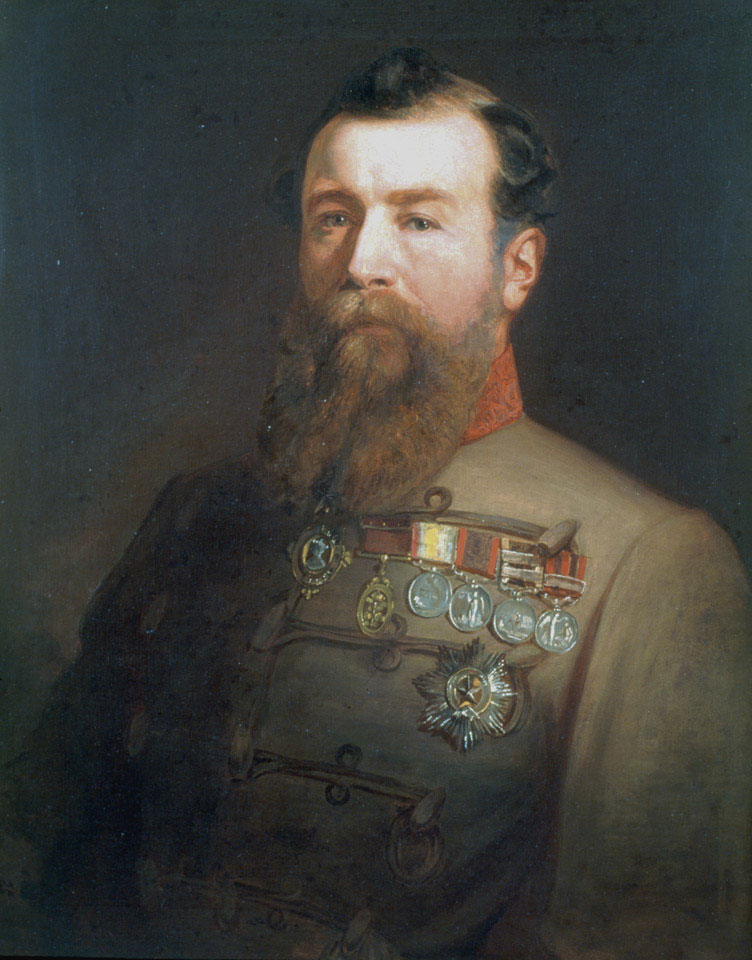
Lieutenant-General Sir Harry Burnett “Joe” Lumsden
The name most intimately associated with the Guides is that of Harry Lumsden – and by some measure, William Stephen Raikes Hodson; however, while these are the men responsible for the early history of the Guides, the idea for raising just such a regiment belongs to Sir Henry Lawrence. We must now momentarily leave the mutiny and take ourselves to the Punjab and the year is 1846.
The First Anglo-Sikh War was fought and the EICO established the Punjab as a so-called “sponsored state” with parts the of the Sikh Empire, namely those territories south of the River Sutlej fell under direct company rule. Daleep Singh remained the official maharaja but he was watched by the British Resident. The Sikh army was permanently reduced, the recruitment of foreign mercenaries stopped and all cannons confiscated. The terms of the Treaty of Lahore were harsh and intentionally so. As this official letter from Governor-General Hardinge points out:
“By the Treaty of Lahore, the Punjab was never intended to be an independent state. By the clause I added, the Chief of State can neither make war nor peace, nor exchange nor refuse us a thoroughfare through its territories, nor in fact, perform any act (except in its own internal administration) without our permission. In fact, the native prince is in fetters and under our protection, and must do our bidding.”
While this history would eventually lead to the 2nd Anglo-Sikh War, it is not the scope of this piece to discuss it. That shall be a topic for a future work. For now, we shall see how this led to the raising of the Corps of Guides.
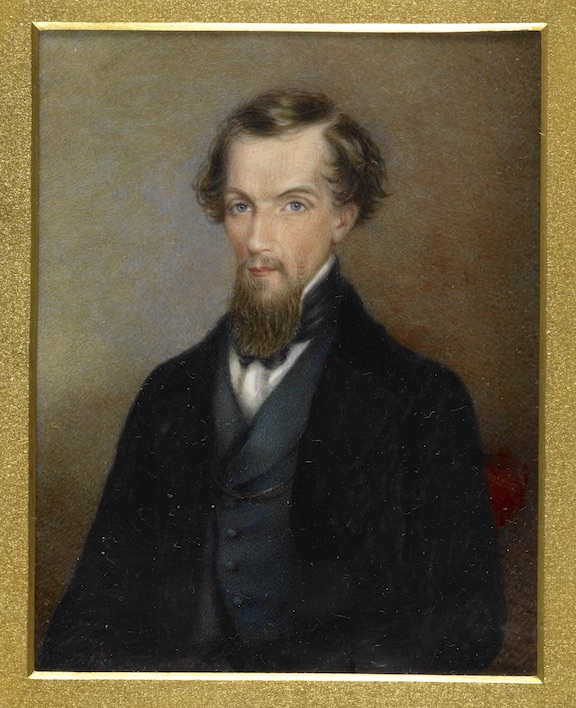
As early as the Afghan War Henry Lawrence had fruitlessly brought the notion of some body of specially selected irregulars to the notice of the Army authorities and he never ceased to impress the need on them. While stationed in Kathmandu, he wrote a memorandum to Hardinge, once again broaching the subject. “It was always of the opinion, that the frontier could best be watched by a corps of irregulars, a sort of legion of horse, foot, and artillery, and two companies of pioneers, under an active sensible man: these men to be employed from Rohilkand to Darjiling; to be intimately acquainted with the forests and jungles, with the paths and rivers emerging from the hills. Every man should be more or less capable of guiding a column, or at least every company and troop should contain a score of men capable of doing so. The frontier is so extensive that, in all senses, this might be considered a general service legion; the men would labour under none of the disadvantages of locals, have no local ties, and yet by general acquaintance with the same description of wild country, and by long looking at high hills, wild glens, and dark forests, would be liable to few of the alarms that so often influence brave enough regulars, when suddenly led into countries abounding in unaccustomed features.’ It was, in his opinion, necessary to learn, “what was happening at Kabul or in the Central Asiatic Khanates, but for accurate and speedy news about robbers, raiders, and murderers, so that they might be followed up and taught that the border peace could not be violated with impunity.”
As soon as Henry Lawrence was posted as Resident to Lahore, he lost no time in making this idea a reality and even Hardinge, sympathetic to Lawrence would not stand in his way. The vast and largely unknown North-Western Frontier was as yet unsubdued and Lawrence, with his handful of trusted lieutenants or as they were known Lawrence Young Men had things very much their own way. Their work was as vast as the land they were sent to pacify – and a corps such as the guides would become, was needed. This was driven home in part by Jacob Abbot However, Hardinge requested Lawrence to proceed with some caution,
“As the Corps is a novelty in the Indian Army, you had better keep down the expenses in every possible way by small establishments . . .” further suggesting they should be treated more as the Resident’s permanent escort and he should “do as he liked.” It was a helpful way of reducing the amount of ruffled feathers just such a corps would undeniably cause in the more conservative sections of the army.
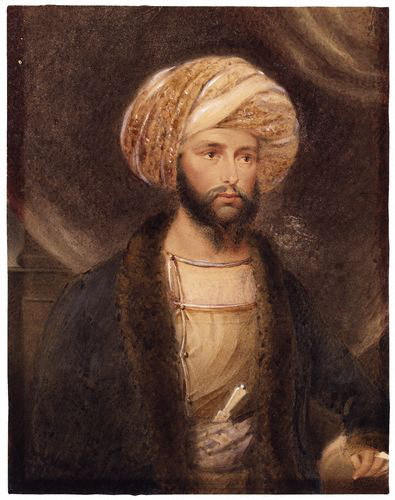
The need was further brought home by James Abbott in Hazara who had incurred immense problems but little in way of success in tracing a party of hillmen, who had, in June 1847, murdered in cold blood three sleeping women and their children. As a footnote, it is most appropriate to mention that James Abbott after whom the city Abbottabad is named, left Hazara 1852 following a governmental dispute which he invariably lost. His last public act was to send messages to every corner of the district, inviting every single citizen to join him as his personal guests at a lavish fest on Nara Hill. He spent all of his savings save one month’s pay to provide food, refreshments and entertainment for his guests. For three days and nights, Abbott walked and talked among them, the people he so long regarded as his own, in what was the largest gathering ever seen in Hazara. When it was all over, he simply handed his papers over to Herbert Edwardes who as his successor watched him pack his scanty belongings and ride away, escorted to the border by “weeping and lamenting crowds of Hazarawals.” As late as the 1930s, Kaka Abbott as he was locally known, was still remembered in legends and stories. When Lawrence’s Young Men shone, they did so in grandstyle but unfortunately, for Abbott, he had committed the grave sin of “going native.”
We shall now return to the Guides.
As we have seen, Henry Lawrence was a very systematic man who never forgot a face or a deed. He carried with him a notebook in which he wrote the names of young men who showed promise and could prove useful – the chosen few would fall into the school of Sir Henry Lawrence and if they were bold enough, would flourish under his teaching. They were men of exceptional ability and talent – amongst them was a young lieutenant named Harry Burnett “Joe” Lumsden.
Born at sea in 1821, aboard the EICo ship “Rose” in the Bay of Bengal, he was the eldest son of Colonel Thomas Lumsden, C.B., of the Bengal Artillery. Colonel Lumsden had served in the the Anglo-Nepalese War, the Third Anglo-Maharata War and the First Anglo-Burmese War where he undoubtedly would have met the very young Lieutenant Henry Lawrence.
As for young Harry, he spent his first formative years in India before being sent to Scotland in 1827 for his formal education, firstly at the Bellvue Academy in Aberdeen and then Mr.Dawes’s School, Bromley, Kent. At the age of 17, he was nominated for a direct cadetship and obtained a commission to the Bengal Army as an ensign, assigned to the 59th Regiment. A talented linguist, Lumsden served as interpreter and quartermaster to the 33rd NI during the Afghan campaign of 1842 marching with the army of George Pollock to Peshawar. He was present at the forcing the the Khyber Pass and subsequently at the recapture of Kabul. During this time, he made two very close friends who would also feature in the mutiny – John Nicholson and Neville Bowles Chamberlain.
Early in 1843, he rejoined the 59th, then stationed in Ludhiana, and made use of his time by indulging in a favourite pastime -hunting. These expeditions led him far and wide through the Punjab, and he learned to speak near-perfect Punjabi, while closely aquainting himself with the local customs and traditions. It was little wonder that Lumsden would join the names in Lawrence’s notebook.
During the First Anglo-Sikh War, Lumsden served as company commander of the 59th and was part of Hugh Gough’s storming division (left flank) at the Battle of Sobraon. Injured by a bullet wound to the foot during the fight, Lumsden would always walk with a slight limp. In 1846, he became Assistant to Henry Lawrence at Lahore.
While Lawrence could have chosen anyone to lead the Guides, he set his sights on Lumsden. He had shown himself as a man of rare ability, cool under fire and above all as leader with that unique ability to hold men under his influence, instilling in them the confidence and devotion that would be needed in the vision Henry Lawrence had for the Guides. The final choice was made after Lumsden – sent by Lawrence – had led a successful reconnoitring mission as commander of the Sikh infantry into the Hazara hills to quell the wild tribes. Lumsden would lead 3000 Sikhs with 6 guns and would fight “every inch of the way…”
“We had before us the operation of crossing a river in the face of some 7000 hillmen, in their own mountains, well armed, but without guns. You may fancy my feelings on finding myself—a griff of a lieutenant—suddenly placed in the position of a general officer, with its accompanying responsibilities,
without any officer to consult, and with troops in whose company I had never been before, except as an
enemy. However, I determined to do my best for the Government, and, if possible, show that I was not unworthy of Lawrence’s patronage and trust, which he has so freely bestowed on me.”
It was also an example of what Lumsden could do at the turn of a hat. The final skirmish was won, not by a magnificent charge but by a stampede caused by one bugler and three herdsmen.
“When the time came a star rocket shot up into the cloudless sky. Bang, bang, bang went the powder pots, the sound of their bursting reverberating through the hills, in the still night air, like salvos of artillery, while the shepherds, who had that day lost some sheep—carried off, it was supposed, by the enemy—sent some large stones bounding down the side of the hill.
The enemy, who had just retired for the night, rushed to their matchlocks, and concluding that the whole of our force had by some mysterious agency been conveyed up the hill above them, instantly took to flight, those in front-firing back on later starters, and each little party thinking his neighbour a pursuing Seikh. We in camp were too much convulsed with merriment at the complete success of our stratagem to attempt to follow them if we had had any intention of doing so.”
While we cannot go into the details, needless to say, after two actions at Doob Pass and Ballokotee and by employing uch skilful strategems as that described above, the hillmen were forced to submit. Lumsden received the thanks of the government and from Henry Lawrence, the invitation to raise the Corps of Guides. He was 25 years old.
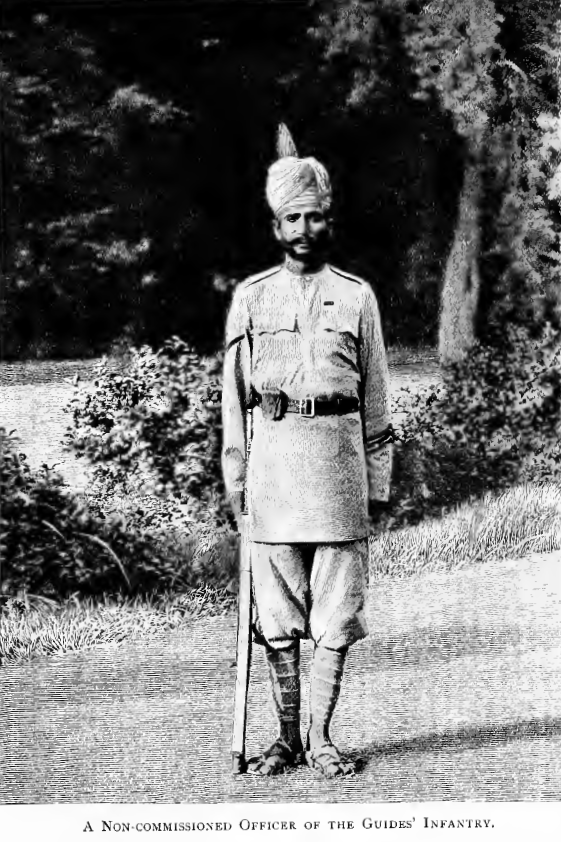
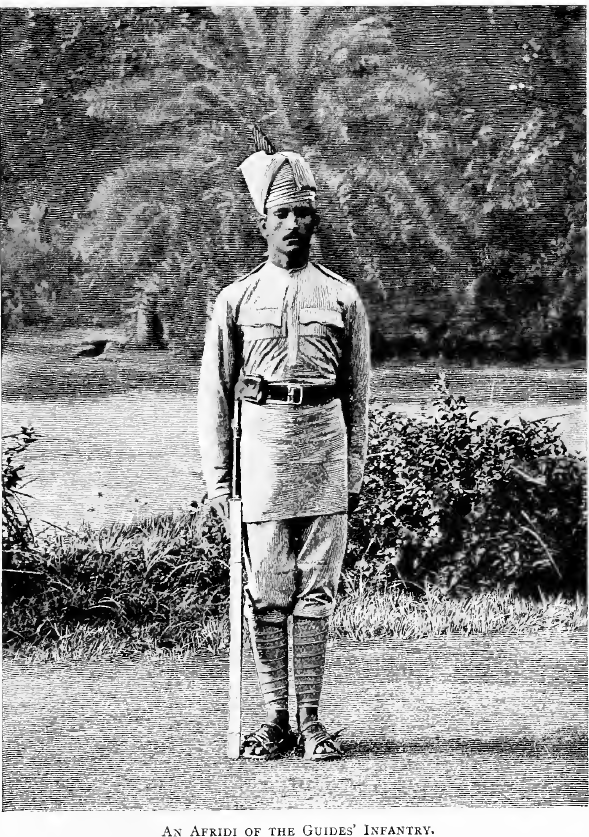
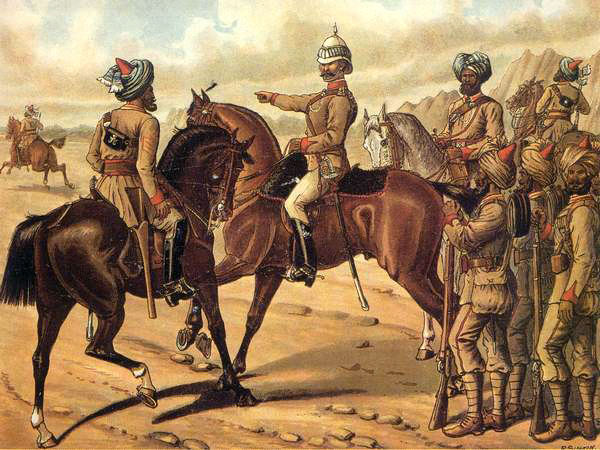
How and why the Guides were named as such is left up to some debate, whether it was suggested to Henry Lawrence or by some hankering for by-gone days and memories of the French Corps d’Elite, the name was a departure from the standard of the times they would also rankle the rigid conceptions of the army by dressing their men, according to Lumsden’s choice and fancy and not in the honourable scarlet of the British army. These men needed to move quickly and work unseen – they needed to comfortably clothed and above all, able to mount their horses without any assistance, something which tight-fitting tunics, high stocks and finedlishly tight strapped trousers over Wellington boots would never accomplish. His men would be dressed in loose fitting clothes and above all, they would never wear scarlet.
In a letter to his father, a rather pleased Lumsden wrote,
“I have just been nominated to raise the corps of Guides, on 700 rupees a month. It will be the finest appointment in the country, being the right hand of the army and the left of the political. I am to have the making of this new regiment all to myself. The arming and dressing is to be according to my own fancy. They are for general service.” He then asked his father for “the very best telescope you can lay our hands upon….so long as it is good enough for the officer commanding “the Guides.” ..” and “…a brace of first-rate pistols to make myself on equal terms with my neighbours in my wanderings.”
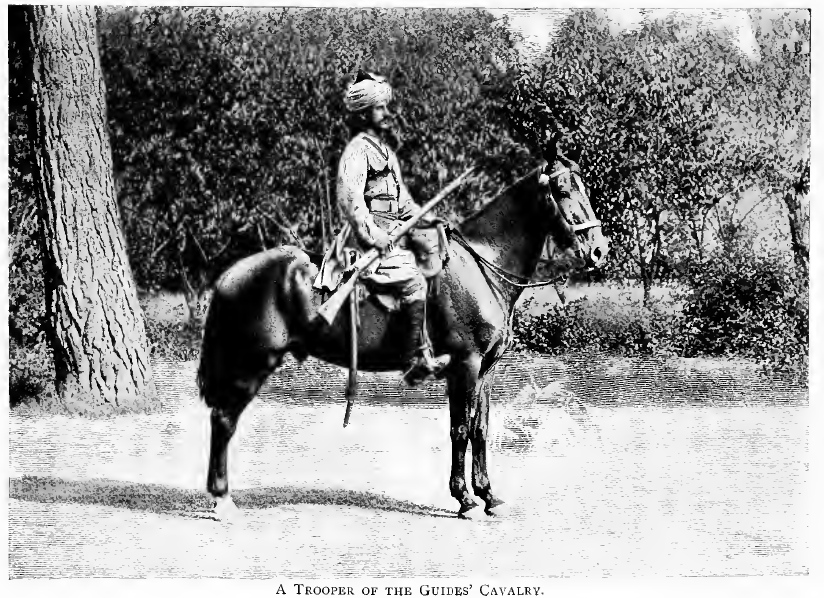
At the start, it was deemed the Guides were not to be an ostentatious corps by any means, comprising of only one hundred cavalry and two hundred infantry. The corps was raised in Peshawar and consisted of Afridis, Khattaks, Yusufzais, Sikhs, Punjabi Mussalmans, Punjabi Hindus, Farsiwans (Persians), Dogras, Gurkhas, Kabulis, Turkomans and anyone else deemed suitable for the work at hand. Lumsden cared little for their religion or indeed for their background and the first recruits he chose were men from the warlike hill tribes, who, in Lumsden’s estimation were “accustomed to look after themselves and not easily taken back by any sudden emergency.” The premise was simple – they would enlist for three years, needed to be willing to do what they were bid to do, and for their pains would receive a fixed monthly salary above that of the regular army.
The call was met with so much enthusiasm that Lumsden soon had a pick of men – from all over the countryside they came, soldiers of fortunes and young men wanting to prove themselves, and at future calls for recruits, as many as thirty could be found on any given day, waiting for a vacancy in the Guides. Lumsden would walk around the men and say,
“Well, here’s a vacancy, and I don’t for the life of me know which of you to give it to. Come along down to the rifle-range, and shoot it off amongst yourselves; the best shot gets the vacancy.” And shoot they would, each vying with the other until one would prove to Lumsden he was the man he wanted – it was as far from regular recruiting as could be found but it laid the first steps into the Guides and from the first day, instilled a sense into the worthy recruit that he was better, indeed the best of the rest. The only stipulation Lumsden had in the process was he would not take washermen and sweepers into the ranks, arguing that a man who was “accustomed to receiving cuffs and kicks” would not readily stand in front of the “fighting classes” in battle. Lumsden recognised bravery and as we shall see this was passed on to the man who would lead the Guides to Delhi. The tale involves just such a man, a humble bhisti and shall be recorded elsewhere.
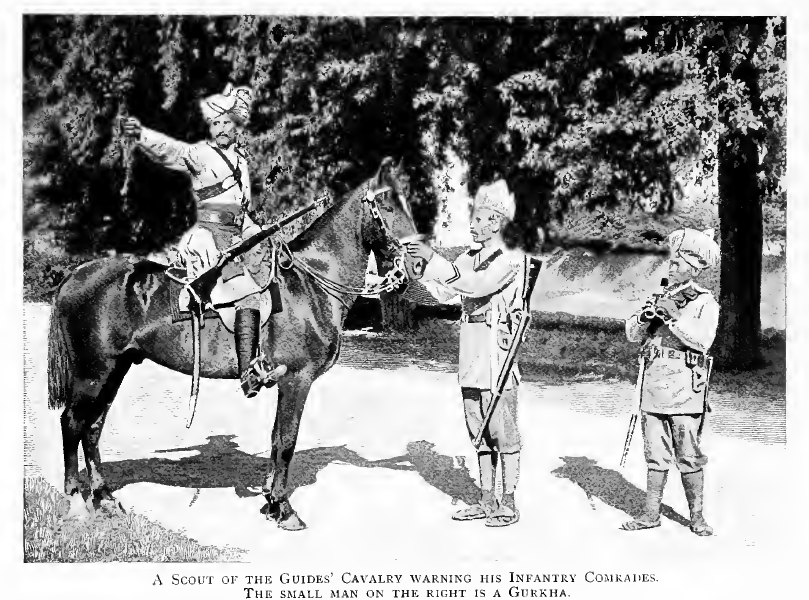
Now that Lumsden had his men, he set about clothing them – they were to be the most sensibly dressed corps in the army; while the choice of dress was Lumsdens, the details were worked out by his second-in-command, William Hodson. From the first, Hodson was delegated the responsibility of equipping and drilling the new regiment and he obtained, from England, an order of 300 rifles, helmets and “drab” coloured cloth for their uniforms, which would “make them invisible in the land of dust.” Although the Guides later found a method in India to dye their clothes what is now familarily called “khaki” there is little to support the rather wonderous tale that Lumsden invented it by dunking white cloth in mud. The helmets however, were discarded, described as “maddening.”
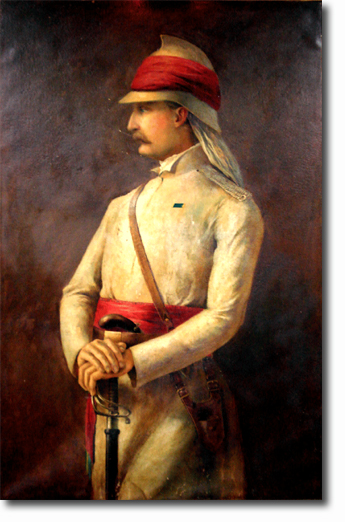
According the History of the Guides,
“The clothing of the Guides was dyed by the men regimentally employed, each soldier contributing a quarter Anna per mensum for his pay…” This practice would continue until early in the 20th century.
However, in the beginning, the cloth was imported from England and in 1848, before the Guides increased in number, Hodson ordered yet more for the current size of the regiment. The first time khaki is mentioned is at the battle at Sangoa in 1849. The camoflaging effect of the uniforms proved successful and by then so had the Guides – the numbers increased from two to six companies of infantry in June 1849 and from one to three troops of cavalry.
As for training, Lumsden, “…upheld the principle that the greatest and best school for war is war itself. He believed in the elasticity which begets individual self-confidence and preferred a body of men taught to act and fight with personal intelligence to the highly-trained impersonality which requires a sergeant’s order before performing the smallest duty, and an officer’s fostering care to forestall its every need.”
It is little surprise then, while holding such views, Lumsden led his men forth to “learn the art of war” in very territory where they were raised. “To march, not through peaceful lanes, but with all the care and precautions which a semi-hostile region necessitated; to encamp, not on the quiet village green where sentry-go might appear an unmeaning farce, but in close contact with a vigilant and active race of hard fighters, especially skilled in the arts of surprises and night-attacks; to be ready, always ready, with the readiness of those who meet difficulties halfway,—such were the precepts which the hardy recruits of the Guides imbibed simultaneously with the automatic instruction of the drill-sergeant.”
Seven months after their inception, the Guides were already on active duty and one of their first ventures was essentially to make contact with the chiefs of the Yusafzai district who had been rather mangled by the Sikh brigades sent to collect the Government revenue. They had taken to the habit of not only taking what was owed but quite a bit more for the benefit of the officers of the expedition – these extractions were resented and most strenuously resisted, usually ending up with a fight. Both George and Henry Lawrence were displeased – the Sikh troops stood at the disposal of the George Lawrence but they retained their own generals and staff officers; there was very little use pretending George had any real control.
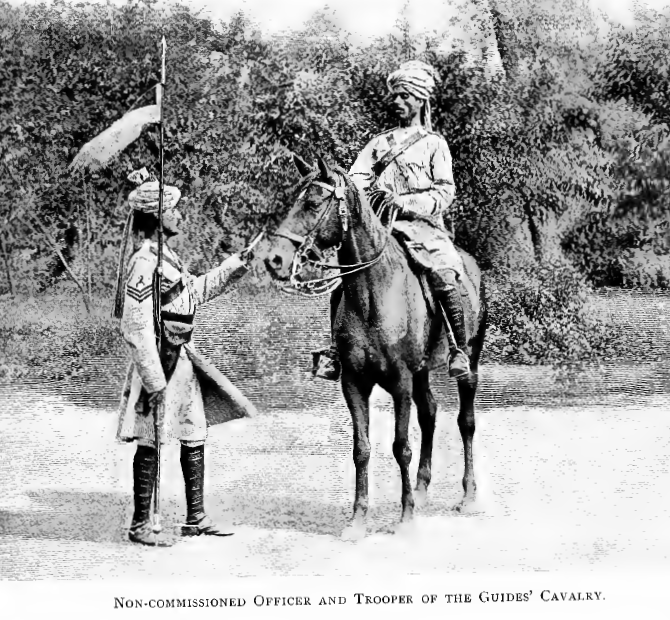
To assess the real nature of things, Lumsden and the Guides were sent out during the cold weather to see if the chieftains could not be reasoned with. During the tour, he made the acquaintance of all the most influential ones in the country and found there would in fact be very little trouble in settling things as Lumsden wanted as long as the “detested Sikhs only kept out of the way.” He also managed to attract new recruits for the Guides – the enthusiastic younger sons and relations of the chiefs.
“All went on well for a time until a village called Babuzai on the Buneyr frontier, which had once gained a high reputation on the border by repulsing an attack of a whole brigade of Seikhs, refused to pay its share of revenue, and obliged Lawrence to come out with a force of Seikhs to my assistance.
The Sikhs attacked the village in front, while the Guides stole up to the crest of the ridge and dropped down in the rear of the enemy, turning all their breastworks and rendering them untenable. Away went the defenders, with my men in pursuit, so close on their heels that Futteh Khan (Khuttuk), then a trooper in the cavalry, got blown up in cutting down a man who happened to be carrying a bag of powder in one hand, and a lighted matchlock in the other. This was the Guides’ first taste of powder, and a most trying ordeal for raw troops, as they had to scramble up the hill in the dark, over stones and rocks, but not a man lagged behind or lost his way.“
The Guides would have much more work to do and they were sent off in pursuit of an errant chief of the Zeda district, one Arsula Khan who had run off to the Buneyr Hills carrying with him the Government revenue. He then took to raiding the caravans plying along the border, more often than not torturing the traders to exhort a ransom. Lawrence sent out the Guides.
“Entering the hills as soon as it was dark, escorted by a troop of Seikh Regular Cavalry and twenty-five Guide sowars, and advancing as rapidly as I could, undiscovered, to the village, I was not a little taken aback to find that my Guides alone had followed me, the Seikhs having remained outside at the foot of the hills.
Fortunately, the discovery was made while it was yet dark so that the villagers could not see the strength of our party, and we put them in a horrid fright by keeping our horses clattering round the place and calling on the men to come out and give up their arms before we opened great guns on them. As the women and children were all in the place, and unable to escape, the men lost heart, and eventually coming out, one by one, were tied up and secured, and marched off with all their cattle to the open plains without a shot being fired; but unfortunately the object of the expedition, Arsula Khan, had left the village the afternoon before we visited the place. “Swagger did the trick.” Half an hour’s warning would have brought two or three hundred matchlockmen on us in a narrow defile.”
In June 1847 Lumsden wrote to his father he had secured excellent drill sergeants from the 59th and he was reported his men were coming along – “hard fellows, full of natural military instincts” who would make excellent soldiers; who took well to the drill and discipline. Things were coming along swimmingly.
Returning from Yusufzai, Lumsden spent 10 days in Peshawar at the end of which he received an urgent message from Lawrence to take care of a problematic set of robbers who had set up camp in a mountain fast called Gundgurh from which they were engaging in the past time of plundering anyone who came in their sights. With no troops available to control them, Lawrence sent for the Guides. He was reluctant to send anyone out in the hot weather but needs must and Lumsden came up with a plan.
On leaving Peshawar, Lumsden decided it would infinitely cooler to take to the Kabul river and float the 40 miles downstream to his destination instead of riding. He sent two Guides ahead to organise a raft but when he arrived at dusk by the river’s edge, he found no Guides and no raft. Somewhat put out by this state of affairs, Lumsden set to work to construct a raft for himself with the assistance of the local zamindars and in half an hour, the kellek was ready. It was not a pretty sight but serviceable, consisting of two blown out bullock hides to which a charpoy had been attached.
To learn more about this age-old mode of transportation, my readers may avail themselves of:
https://itshistoria.com/social-history/kelleks/
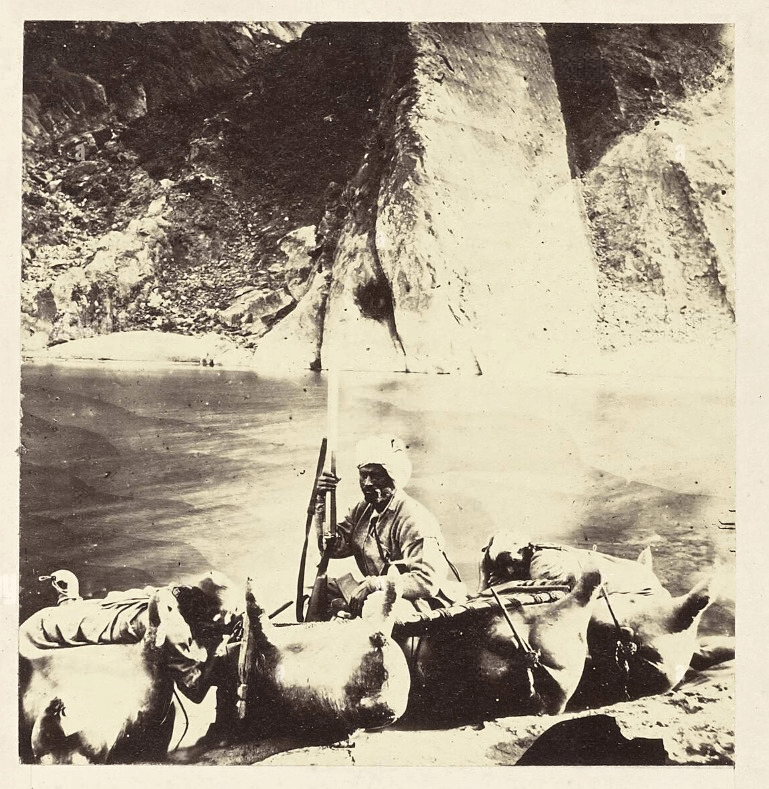
When all was ready, Lumsden and the Guide who had accompanied him settled themselves on the craft and set off. Things went well, the two men smoking cigars and lazily floating along when, shortly before midnight,
“…bang went one of the inflated hides in a thousand shivers with a report like that of an eighteen-pounder, and away flies young Hopeful, head-first, half-way to the bottom of the Cabul river, from which position he had considerable difficulty in extricating himself, as, owing to his being half asleep, slightly astonished, and having all his clothes on, it took a few seconds to realize the situation. However, he did find his way to the surface, and by kicking and splashing about for a little managed to get rid of his inexpressibles, which, however elegant in a drawing-room, are a great nuisance when one has to kick for life.”
Lumsden managed to get rid of the rest of his clothes and then swam after the remains of the raft only to find the Guide, “in the last extremities, unable to swim from fear, and too tired to hold on by the remaining skin.” It was his luck Lumsden had mastered the art of “mussack riding” and he quickly clambered up onto the skin, set the charpoy loose and thus unencumbered, grabbed the pugree off the man’s head, passed the cloth around his chest under his arms and then secured the two ends around his own waist. For the next 2 hours, the two men thus floated down the river – the problem however was not being in the water, it was getting out of it. Lumsden, naked as the day he was born could not present himself thus attired in front of his men, nor could he rightly proceed to the next village to ask for clothes.
“After much laughing and consultation it was agreed that I should take the Guide’s pugree around me and sit like Patience on a monument, smiling at Grief, while the Guide went out and told our story, and borrowed a suit of clothes and a pair of shoes. He succeeded in his mission, and shortly afterwards out came your eldest son, in a blue loongee, for a pugree, round his head, a pair of pyjamas wide enough to make the mainsail of a seventy-four, and a flash blue chupkin. J In this garb I marched down the river till we came to a ferryboat, in which we again took ship and were at last landed at my tent at the village of Akora.”
This misadventure paid out well for the robbers -by the time Lumsden reached his destination, they had vanished.
In the first five years after their inception, the Guides would participate in over 16 operations including the Second Anglo-Sikh War of 1848-49 where they won distinction at the Siege of Multan in their support of Herbert Edwardes. With much pride, Lumsden wrote to his father,
“My Guides have gained for themselves and for me a good name in the British camp. All the Engineers send for Guides as an escort when reconnoitring, in preference to regular cavalry. Only think, when I was on duty elsewhere one day sixty-six of my men rode slap through and through ten times their number in the hope of recovering some camels which the Seikhs had driven off from General Whish’s camp. They did not get the camels, but covered themselves with glory in the presence of the whole army.”
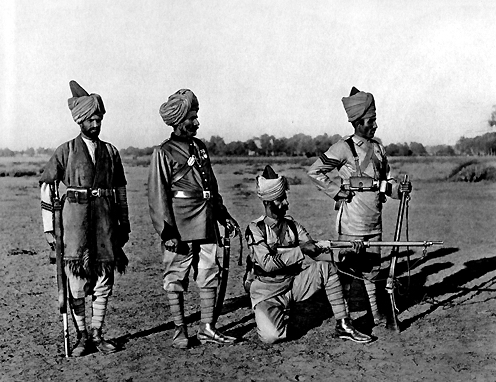
This was recounted in some detail in Blackwood’s Magazine in May 1897 and although lengthy, it well summarises how far the Guides had come in such a short time.
“In the siege of Mooltan, which followed, the Guides again and again distinguished themselves, either individually or as a corps ; but one instance must suffice of the fearlessness and dash which thus early made them remarkable, and for which they have ever been famous.
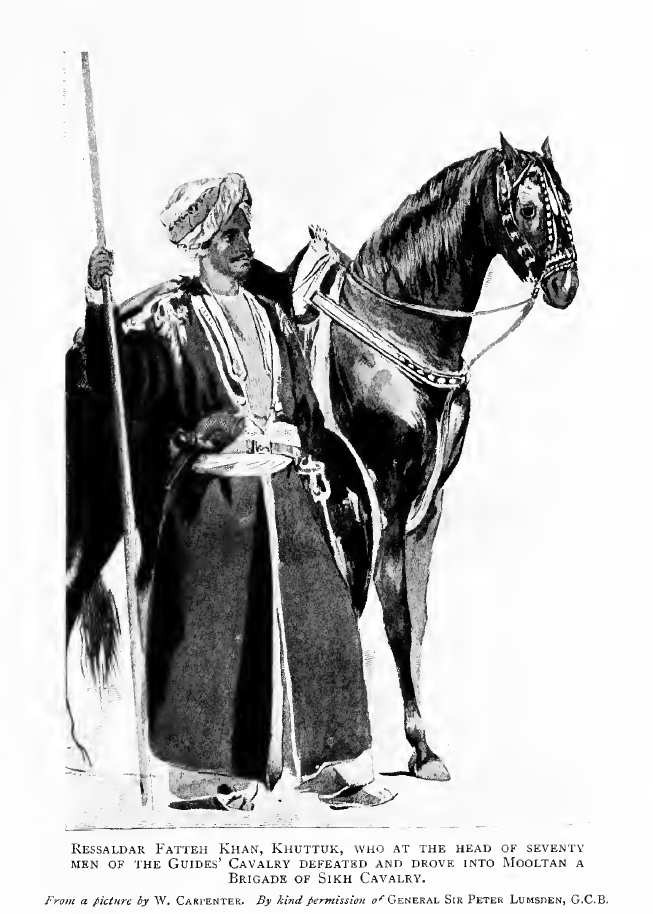
One August day news was brought hurriedly to the British camp that a party of Mulraj’s cavalry had driven off a herd of Government camels which were grazing in the open country some miles away. Lieutenant Lumsden was absent at the moment, but those of the Guides who were in camp (less than seventy horsemen in all) turned out under a gallant chief, Futteh Khan by name, and within a few minutes of the first alarm they were racing across the country in the direction taken by the marauders. A
gallop of three miles brought the troop suddenly within sight of the enemy, when instead of a small party, as they had expected, they found themselves confronted with the whole of Mulraj’s cavalry. The apparition of so superior a force might well have checked the ardour of the pursuers, but no odds were so great as to appal the Guides. Without check or hesitation the gallant little band charged straight at the opposing mass of horsemen, and before the latter had time to face them they had cut their way right through the midst. Rapidly rallying and wheeling about they charged back, as they had come, through the ranks of the confused and astonished enemy, dealing destruction as they passed. Stupefied by the impetuosity of the attack, the Seikhs still stood irresolute, when, before they could decide whether to retreat or retaliate, once again their dauntless foes bore down on them. This settled the issue of the combat. Before the whirling line of Guide horsemen could close with them a third time, the enemy broke and fled, closely pursued by Futteh Khan and his victorious band. Nor did either side draw rein till the walls of Mooltan gave shelter to the vanquished and checked the career of the pursuers.”
The Guides, like their leader had become well-skilled in the art of subterfuge, as shown by Subedar Rasul Khan (brother of the aforementioned Fatteh Khan) when sent with 140 Guides to reconnoitre Govindgarh Fort. Rasul Khan tricked his way in by tying up three of his men and then, pretending they were prisoners, offered them to the Sikhs. He and the others were allowed to remain standing guard over the “prisoners” and while the Sikhs were thus deceived, Rasul Khan took the opportunity, in the early morning to overpower the Sikh guards and open the gates for the rest of the Guides. When the British arrived later that morning, the fort was already in the hands of Rassul Khan.
They would be a part of Sir Hugh Wheeler’s force in early January 1849 in the operations on the Dullah Heights and then be back in Wazirabad in time to catch the Sikhs crossing the Chenab to turn the army’s right flank – the Guides had just arrived at the river bank when they came across a large detachment of irregular Sikh horse who had forded the stream close to Wazirabad. They were as astonished to see Lumsden as he was to see them but without hesitation, Lumsden ordered his Guides to ride straight a them. They drove the lot “helter-skelter through a deep ford and dismounting, set to work to make a breastwork, commanding the passage to be occupied by our infantry…They arrived about 4 p.m., and I instantly posted Hodson off to report what I had done to headquarters. So important was this discovery considered by the authorities there that Colonel Mackeson, now the Governor-General’s agent in camp, rode down the other side of the river as fast as his horse could carry him, and was ferried across on a “shurnai” * by a friendly boatman to my tent. During the night a general officer with a whole brigade turned up to occupy the position. We burnt the only two boats the enemy had in possession here, and remained watching these fords until the 19th of January, when the Guides were ordered to join army headquarters. I have always felt the poor Guides got scant credit for their share in this business.”
Then on the 21st of January, they took part in the Battle of Gujrat where the Guides took off in pursuit of the broken Sikh army to prevent their crossing the Jhelum to join the division of Sirdar Uttar Singh, then encamped on the right bank. They subsequently chased them all the way to Rawalpindi, where they surrendered.
By Government order issued on the 19th of June, 1849, the Guides were increased from one to three troops, and from two to six companies. A second in command (Lieutenant A. Hardinge) and an adjutant (Lieutenant H. N. Miller) were subsequently posted to the regiment. From here their history changes the Guides would eventually be attached to another newly raised body, The Punjab Frontier Field Force. Until 1857, their work along the frontier would continue uninterrupted, when, in that fateful year, Lumsden was sent on a mission to Kandahar and in April shortly before the mutiny broke out, they would have a new commander.
In the next chapter, we shall now follow The Ride of the Guides, a feat so phenomenal, it would be hard to find its equal in history,
Sources:
Twelve Years of a Soldier’s Life in India: being extracts from the letters of the late Major W. S. R. Hodson(1859)
Lumsden of the Guides – General Sir Peter Lumsden & George R. Elsmie (1899)
The Story of the Guides – Col. G.J. Younghusband (1908) The captioned photographs of the Guides feature in this book.
History of the Guides 1846-1922, Vol 1 – 1938 (HathiTrust Digital Library)
Soldier Sahibs – Charles Allen (2000)
Links:
https://www.houseoflumsden.com/
 Mutiny Reflections