The Men Make a Choice
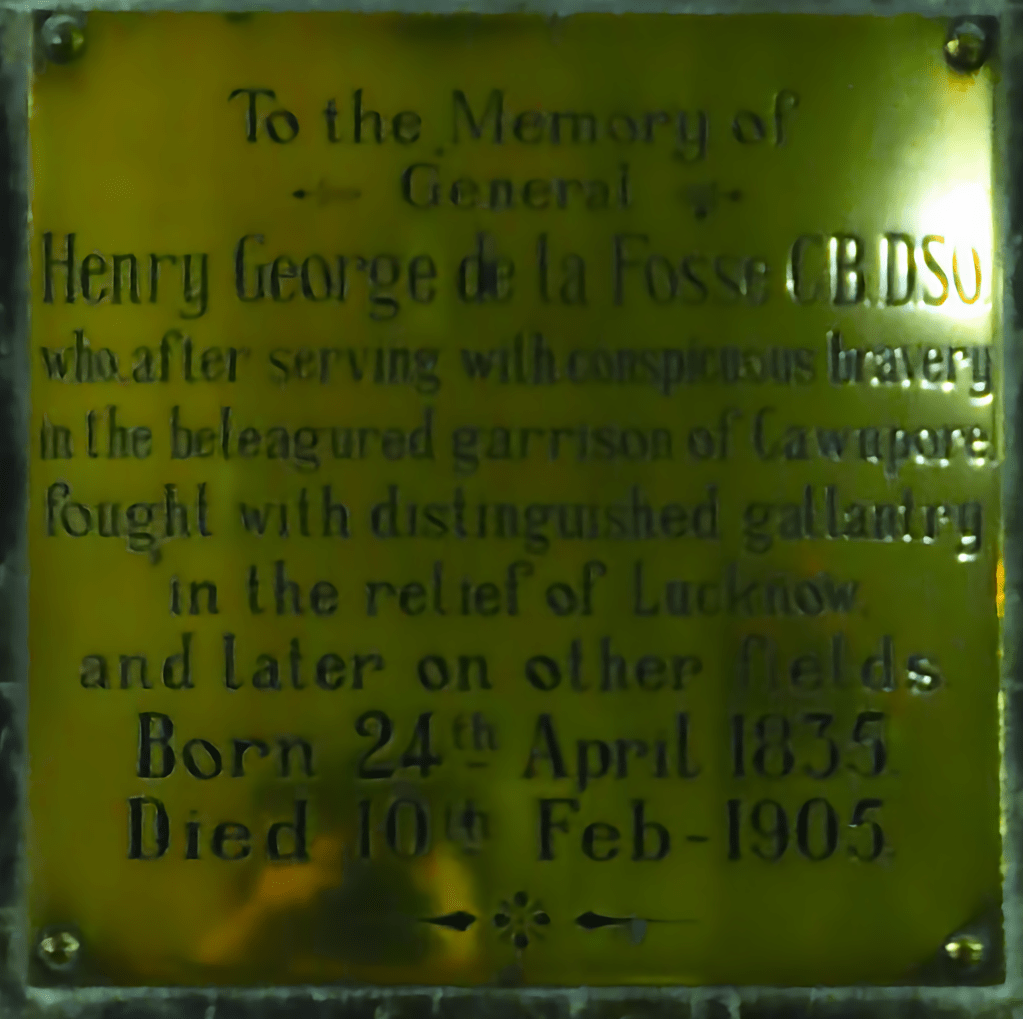
Realising there was no point in searching for the boat, the only choice left for the Delafosse, Murphy, Thomson and the others was flight.
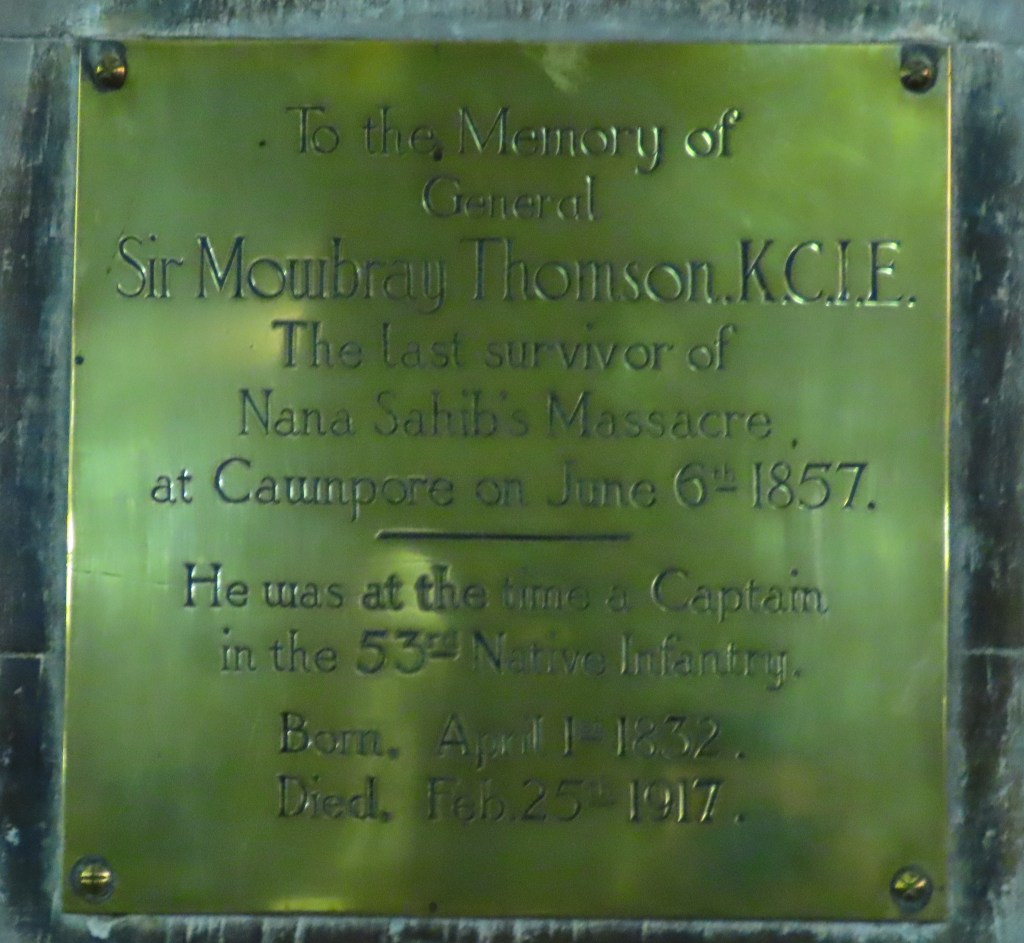
After retreating for some three miles, Thomson spotted a small temple and gave orders to the men to make for it. “To render us less conspicuous as marks for the guns, we had separated to the distance of about twenty paces apart, from time to time loading and firing as we best could upon the multitude in our rear. As he was entering the temple. Sergeant Grady was shot through the head. I instantly set four of the men crouching down in the doorway with bayonets fixed, and their muskets so placed as to form a cheval-de-frise in the narrow entrance. The mob came on helter-skelter in such maddening haste that some of them fell or were pushed onto the bayonets, and their transfixed bodies made the barrier impassable to the rest, upon whom we, from behind our novel defence, poured shot upon shot into the crowd. The situation was the more favourable to us, in consequence of the temple having been built upon a base of brickwork three feet from the ground, and approached by steps on one side.”
Delafosse again has a slightly different take. “On the bank of the river, just by the force in front, was a temple; we fired a volley, and made for the temple, in which we took shelter, losing one man killed and one wounded; from the door of the temple we fired on many of the insurgents that happened to show themselves; finding they could do nothing against us while we remained inside, they heaped wood all round, and set it on fire; when we could no longer stay on account of the smoke and heat, we threw off what clothes we had, and each taking a musket charged through the fire.”
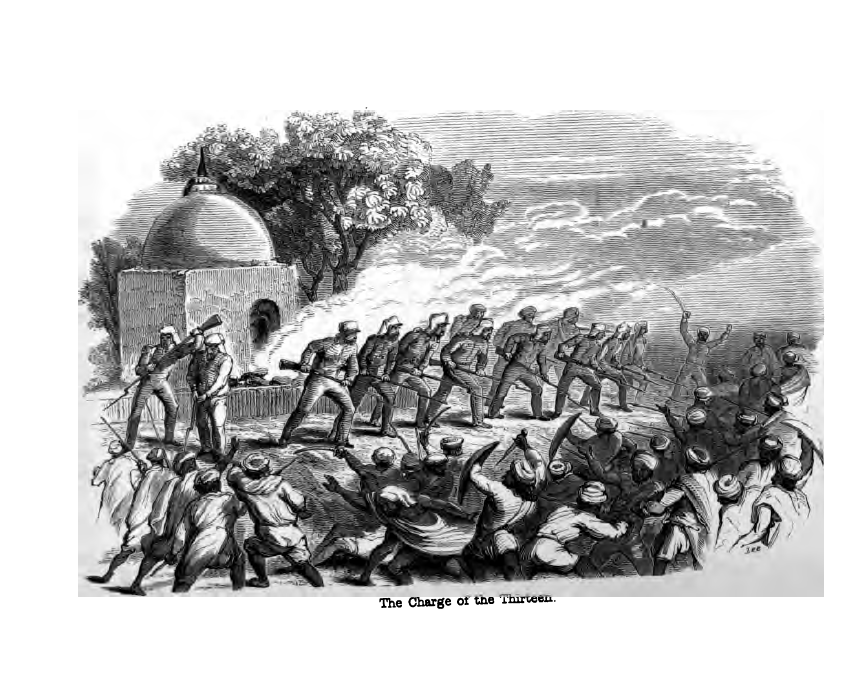
Private Murphy writes: So the fourteen of us had to retire and keep as close to the bank of the river as possible until we reached a small temple about six miles from where we left the boat. All this time, there was a party of the enemy firing at us as fast as they could, and during that time, we had muskets and ammunition with us. Still, we got to the temple and on trying the enter it, it was with great difficulty on account of a mob which lay waiting for us to give us a salute which they did by killing one sergeant and one man severely wounded in the thigh. They surrounded us and brought a large gun and loaded it with ammunition and commenced operations. They brought large bundles of dry brushwood and placed it across the entrance of the temple, which they set fire to and threw large bags of gunpowder into the blaze for the purpose of stifling us and burning us out. During the time, we kept the wood off as well as we could while others were employed firing at the bloodthirsty mob which were outside. And it was a considerable time when the Rajah of the place came mounted and about one hundred with him, and he immediately gave orders for the temple to be pulled down to the ground and, if possible, take us alive.
The men remained inside the temple until the wood had burned down to mere embers, and with it, some hope they would survive this ordeal. What happened next changed everything. Seeing it was impossible to burn the Englishmen out, the attackers decided that suffocating them instead would be more expedient and proceeded to throw bags of gunpowder on the ashes. Determined to sell their lives dearly, the besieged ran out of the temple, through the burning wood and jumping the parapet, threw themselves at the mob. Firing a volley and then letting their bayonets do the rest, seven of the men reached the river. Throwing away their guns, they plunged into the water, weighed down by the ammunition in their pouches.
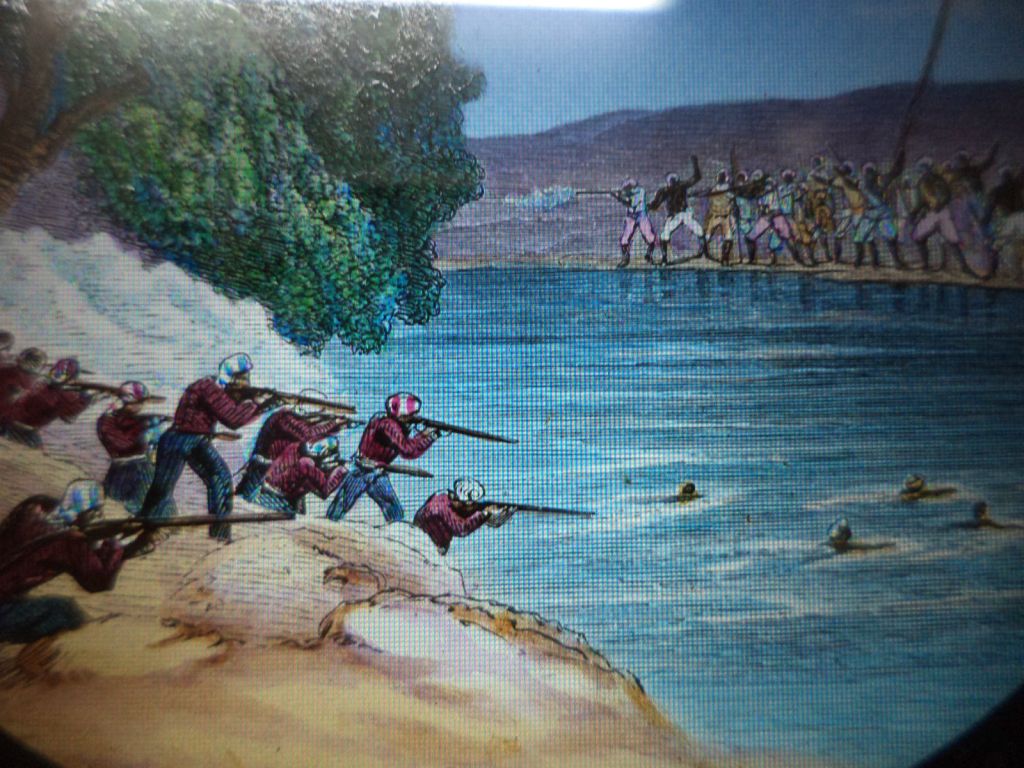
The quick submersion saved them from the first volley fired from the bank, but as they slipped off their belts and began swimming for dear life, the insurgents loaded their guns a second time. As each man came up for air, he became an instant target. Thomson turned around and saw the banks of the river crowded with people, all yelling and firing off their guns. The six remaining men who had not managed to get to the river lay dead on the ground, their bodies rifled over by onlookers. The party in the river was rapidly dwindling. Two privates were shot in the head, and Private Ryan, unable to swim anymore from exhaustion, made his way to the riverbank. Three men stood there, shouting out promises of fidelity and food – while Delafosse and Murphy declined their offers, Ryan did not. As soon as he reached the shore, they beat his brains out with clubs.
For the next two hours, the last four men swam – Allahabad was still 90 miles away.
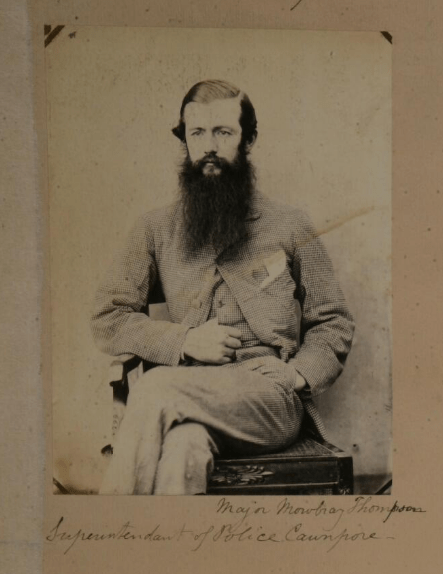
Their pursuers eventually left off – the last Thomson saw of them was a sowar on horseback who suddenly turned away. They had managed to swim out of hostile territory into that of Raja Dirigbijah Singh of Moorar Mhow in Oude. As the sowar disappeared, the swimmers decided to take a rest closer to the shore – their only enemies now were three long-nosed Ganges alligators who were basking in the sun on a sandbank. The rest was a short one.
On hearing voices and the crashing of footsteps on the shore, the four men, despite the alligators, quickly plunged back into the water. Their visitors presented a fearsome appearance, armed to the teeth with swords, matchlocks and shields, and they called out, “Sahib! Sahib! Why swim away? We are friends!”
Thomson replied they had heard that one before, and they were not inclined, at this point, to trust anyone. The men on the shore promptly offered to throw their weapons in the water – they were the retainers of Raja Dirigbijah Singh; their lord had heard of their plight and had sent them to the rescue.
Whether it was true or not did not really matter to the four men anymore. They had swum for 6 miles from Soorajpore, had been shot at and injured, burned their feet when running from the temple, had had nothing to drink but Ganges water, and they had no weapons and mostly no clothes. As for food, they had not tasted that since leaving Cawnpore.
Mowbray Thomson led the way, and the men swam following him up to the shore. The retainers pulled Thomson onto the sand first. He was only wearing a flannel shirt and had once been a bright pink – but the siege had taken much of the gaiety out of the colour, and the river had done the rest. His coat and trousers he had removed in order to swim less hindered. Delafosse came next, and he was wearing nothing but a cloth around his loins. His shoulders were so burned from the sun that the skin had puffed up in huge blisters. Gunner Sullivan and Private Murphy had no clothes at all. Only Murphy had some money – he had managed to tie a cap pouch of rupees to his right knee and was still wearing a gold ring. Not beyond temptation, the men took Murphy’s money when he offered it up to them, but seeing his ring was made of English gold, they let him keep it.
When the men tried to stand up, they found they couldn’t – their legs quivered and shook, and they fell to the ground.
“After we had rested a little, our captors proposed that we should go to the adjacent village; and, supported by a native on each side of us, with his hands under our arm-pits, we partly walked and were partly carried a distance that seemed to us many miles, though not, in reality, more than three or four furlongs. We were so enfeebled that in crossing a little current which had to be waded, they were obliged to use great strength to prevent our being washed away. As soon as we reached the village, they took us to the hut of the zemindar, who received us most kindly, commiserated with us upon our horrible condition, and gave us a hearty meal of dhal, chupatties, and preserves.”
Murphy remembers events with less of a positive tint.
“So we remained there about three hours when they sent a message to the Rajah about us. So we were to proceed to the Rajahs at once, but before this, they consulted together about casting me adrift on the river so that I could not tell the Rajah that they took the money from me. All this time, I could not tell what they were saying, but the officers did, and they told them that we were very sorry we could not do more for them at present, so after much persuasion, they let me off and did not send me adrift.“
On the evening of the 29th of June, they arrived at the fort of Dirigbijah Singh in Moorar Mhow. For the next weeks, they were treated with the utmost kindness and consideration, their wounds were tended to, and the Raja spent as much time as he could conversing with his impromptu guests. Three times he ignored the summons of Nana Sahib to hand over the Europeans, answering most emphatically he was tributary to the King of Oude, the Nana’s raj meant nothing to him. Fortunately, Nana Sahib and his cohorts were too busy to attack Morar Mhow.
“After we had been three weeks at Moorar Mhow, petted in this way by its generous proprietor, the tidings came that a steamer had gone up the Ganges. This was a vessel sent up by General Havcloek from Allahabad to explore the Cawnpore region. In consequence of this, and because a native who had been in the service of the railroad told him that if he did not make arrangements to send us away, our stay might be interpreted into a forcible detention, the Rajah had us conveyed down to a little hamlet within his territory, on the banks of the river. An elephant, escorted by a guard, conveyed us thither at night; the parting was quiet in order that the attention of the rebels in the neighbourhood might not be excited. With abundant expressions of thanks and some regret, we said farewell to the old brick. I am enabled, with sincere gratification, to add, that Dirigbijah Singh’s claims upon the gratitude of the Government of India have not been overlooked; and his loyalty to the Company at a time when almost the whole of Oude was in rebellion, and his generosity to us poor friendless refugees, have met with the well-deserved recognition of a handsome pension. “May his shadow never be less.” (Thomson)
The men were eventually handed over to the British reinforcements heading for Cawnpore. Among them were men of the HM’s 84th Regiment who greeted Private Murphy with cheers of surprise and wonder.
For the four men, there seemed only one thing to do – join Havelock’s Force. Cawnpore was behind them, and now, it was once again in front of them. Only Gunner Sullivan would not get the chance – two weeks after his final rescue, he succumbed to cholera. The others reported themselves for duty and would face desperate street fighting to reach another beleaguered garrison – Lucknow.
Sources:
Chick, Noah Alfred. Annals of the Indian Rebellion. Calcutta: Sanders, Cones and Co., 1859.
Kaye, John William. A History of the Sepoy Revolt. Vol. 2. London: Longmans, Green, and Co., 1896.
Shepherd, W. J. A Personal Narrative of the Outbreak and Massacre at Cawnpore. Lucknow: Methodist Episcopal Church Press, 1879.
Thomson, Mowbray. The Story of Cawnpore. London: Richard Bentley, 1859.
Trevelyan, G. O. Cawnpore. London: Macmillan and Co., 1866.
Ward, Andrew. Our Bones Are Scattered: The Cawnpore Massacres and the Indian Mutiny of 1857. New York: Henry Holt and Co., 1996.
 Mutiny Reflections