Then rose from sea to sky the wild farewell;
Then shriek'd the timid, and stood still the brave;
Then some leap'd overboard with dreadful yell,
As eager to anticipate their grave;
And the sea yawn'd around her like a hell;
And down she suck'd with her the whirling wave,
Like one who grapples with his enemy,
And tries to strangle him before he die.
- Lord Byron, "Don Juan" (Canto II, Stanza 52)

The SS Sarah Sands was chartered to the American-owned Empire City Line and subsequently purchased by the Pacific Mail Steamship Company. In 1851, she was sold again and returned to England to resume transatlantic voyages to Canada.
At the onset of the mutiny, the British were scrambling to send regiments from England to India. The 54th Regiment of Foot was sent out in three detachments, the first two arriving at Calcutta in November 1857. The headquarters was likewise on the way and set sail on 15 August 1857 on the SS Sarah Sands, from Portsmouth, carrying “Lieutenant-Colonel Bowland Moffat with wife and two daughters, Major W. F. Brett, Captain J.S. Thomson and wife. Captain Prideaux W. Gillum, Lieutenant and Adjutant Thomas Blackiston Houston, Lieutenant A. Galbraith, Lieutenant J. W. Hughes, Lieutenant G. Cronyn, Lieutenant P. Schlotell, Lieutenant J. A. Wood, Surgeon J. M. Grant, Assistant Surgeon M. O’Donovan, Pay-Master Sam. Daniel, Quarter-Master T. Hipkin and wife; the Grenadiers, No. 5, the Light Company, and the Band, strength 354 Non-Commissioned officers and men, with six women.” Several civilians also numbered among the passengers.
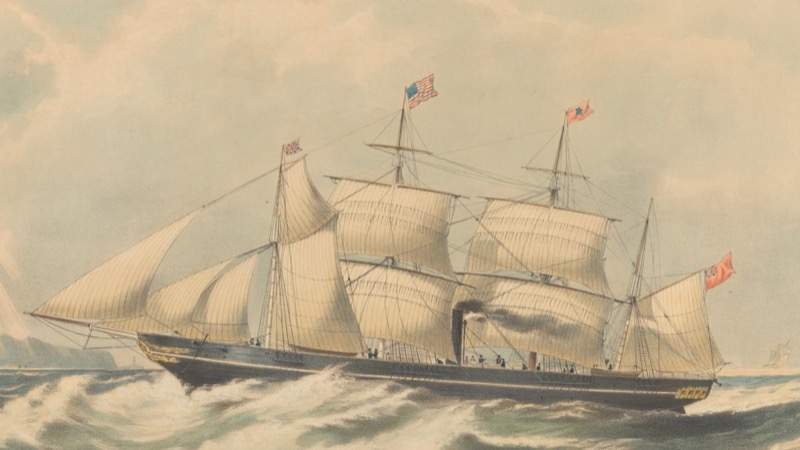
The Sarah Sands was classed as an auxiliary screw steamer, initially intended for transatlantic and Australian routes, Constructed in Liverpool (and named after the mayor’s wife), she was launched in 1846, a marvel of her times. At 1400 tons, she was the second largest screw vessel ever built, and measured 220 feet overall. Steel-hulled, she had three watertight bulkheads, and although she did have two 200 horsepower coal-fired engines, the ship was designed to travel primarily under sail, with the engines serving as a secondary backup. The technology of these engines, although greeted with enthusiasm, was still unreliable and prone to breaking down. Besides using massive amounts of coal to power them, it was considered to only use the engines when the ship was becalmed, for navigating in and out of tight harbours and to deal with headwinds.
She had already carried troops and munitions during the Crimean War, and this was no different. Her hold contained powder and ammunition in two powder magazines, and nothing was amiss until 11 November, when, for reasons unknown, a fire broke out on board. The ship was hundreds of miles away from land and out of the regular shipping lanes; in this age, before the advent of radio communications, had the Sarah Sands never reached port, it would have been considered yet another maritime mystery. The last time she had been seen in port was on 15 October when she arrived at Simon’s Bay, Cape of Good Hope. By this time, however, the Sarah Sands was already plagued by a mutinous crew.
However, this requires a little explanation.
The requisitioning of the Sarah Sands as a troop transport had been a hasty affair. The commander, Captain Castles, had trouble finding enough regular seamen to add to his crew and was therefore obliged to take anyone who volunteered. These happened to be anything but tried or even experienced seamen, or as Lieutenant Schlotel observed, “foreigners.” The men proved themselves to be lazy and insubordinate from the first, and the Quartermaster was obliged to clap several in irons well before the tedious two months’ journey to the Cape of Good Hope was completed. When she arrived, violent complaints issued from the sailors, who demanded more rations, for food had been so meagre, it had hardly sustained them. A fight broke out on shore, and the Naval Bluejackets were forced to step in to break it up, taking the two ringleaders away in irons. Even the men of the 54th admitted this was possibly the worst ship they had ever sailed on, as their accommodation was decidedly awful, which, considering that troop ships were not known for their comfort, life on the Sarah Sands must have presented a challenge. It can only be imagined what the crew was being subjected to. As it was, the cause of the fire was never adequately ascertained. Schlotel believes it was the result of carelessness on the part of the indifferent crew; another speculated someone had foolishly taken an unshaded candle into the hold and dropped it; others would theorise it was deliberately set, but what the crew hoped to gain, 1000 miles away from land in shark-infested waters, by setting their own ship on fire, renders this theory somewhat unlikely.
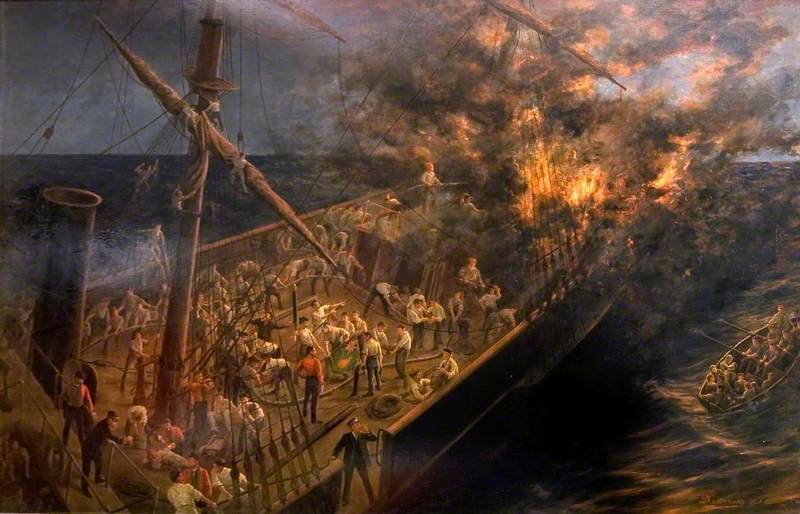
The fire was discovered by a fatigue party working in the hold, and Sergeant Murray reported fire “issuing from the after hatches.” The hatches were closed, and Captain Castles ordered the women, children and the drummer boys on board to be placed in the lifeboats. The boats were lowered with Lieutenant Colonel Moffat and Surgeon Grant likewise on board to assist the ladies in their time of distress. Back on board the ship, things were about to get very terrible indeed. A longboat was now launched, but to Castle’s disgust, his sailors jumped in it and pushed off. Schlotel believes their actions were not of mutinous men, but they had “yielded to panic and despair.”
The chief officer and the carpenter proceeded to the hatchway to ascertain where the smoke was coming from, but as soon as they opened it, they were greeted by a regular blaze of “smouldering material.” The smoke was so overpowering that the two men rushed back to avoid suffocating on it. Captain Castles, after securing a compass and a chart from his rooms, ordered the ship to be brought “hard to wind” and several officers and men climbed with him on the spanker boom to set the sail, but with so few hands left, it was now up to the men of the 54th to take the place of the missing sailors. However, the manoeuvre had no effect, and the smoke continued to billow out. Lengths of fire hoses were now fitted to the fire engine, but the water had little effect on the flames and none on the smoke, which now engulfed the saloon.

Lieutenants Houston and Hughes tried to save the regimental Colours that had been affixed to the saloon wall, but were unable to enter the room. The ship’s quartermaster Richmond tied a wet handkerchief to his face, rushed in and managed to cut down the Colours but fainted from the smoke before he could exit – Private W. Wiles of the 54th dragged both him and the Colours to safety.
“The Port Magazine was still uncleared. It was difficult of access, and the volumes of smoke belching from the hatchway showed that it was close to the seat of the fire. Volunteers were called for the duty. Lieutenant Hughes descended first, and passed up a barrel of ammunition; then the work went on with regularity; men were pulled on deck senseless, but others, with wetted handkerchiefs on their mouths, went down; and as barrel after barrel was hove overboard, Quarter-Master Sergeant Barwick noted the numbers in his pocket-book, till two barrels only were left. These, however, had fallen from the hands of fainting men, and rolling into a corner, were overlooked.”
None of the officers of the Sarah Sands stopped to consider the ship’s signalling powder, and they were unable to reach the final two boxes of ammunition. While men were desperately throwing the powder kegs overboard, some of the soldiers continued to empty the magazines and still others were trying to dampen down the coal by “pouring water through holes in the upper deck’s planking.”
“It was now 5 o’clock. At this moment the flames broke through the deck, illumining the sea and showing shoals of sharks already attracted to the devoted ship. Soon the flames leaped up the pitched rigging and drove the men from aloft. Meanwhile the pumps were working hard. Captain Gillum led a party to cut away the bridge and deck cabins and throw all inflammable lumber overboard. Mr. Walsh, first Lieutenant, assisted by soldiers, lashed together spars for rafts. At this time Captain Castles took Major Brett aside, and assured him that all hope of saving the ship was over, but advised that the men should be kept employed. Major Brett replied, “we shall fight till we are driven overboard.” But now the boldest held his breath.”
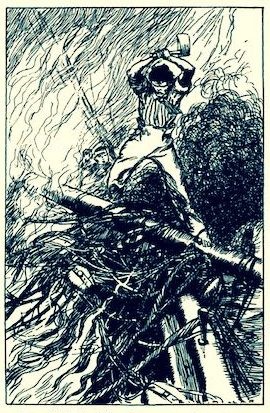
By 9pm, the fire blazed through the upper decks and the flames reached the mizzen rigging; shortly after, the mast fell with a crash over the ship’s side. It was a feat of singular bravery that a man, armed with a hatchet ran along the bulwarks and cut away the rigging to release the mast. The debris was causing the vessel to veer around to the wind – he succeeded in his task and the mast vanished into the sea.
No person,’ says the captain, ‘can describe the manner in which the men worked to keep the fire back; one party were below, keeping the bulkhead cool, and when several were dragged up senseless, fresh volunteers took their places, who were, however, soon in the same state. At about ten P. M., the main topsail-yard took fire. Mr. Welch, one quartermaster, and four or five soldiers, went aloft with wet blankets, and succeeded in extinguishing it, but not until the yard and mast were nearly burnt through.“ (https://www.fadedgenes.co.uk/SarahSands.html)
At midnight, the fire finally reached some of the powder.
“The Stern cabins ( at least what was left of them) were blown yards into the air, and a part of the port quarter was blown out. The ammunition exploded with the brilliancy of multitudinous sky-rockets, and while the flames were raging from the midships to the stern, gave to the vessel the appearance of a volcano in eruption. Awfully grand as the scene was, it was not the time for admiration, for we were in doubt as to whether the debris would fall upon us and destroy us; fortunately, the greater part of it fell overboard. The concussion caused by the explosion was so great, the stern of the vessel dipped, and for a moment was under water, and all believed she would settle down with all on board.” The force of the explosion threw Lieutenant Cronyn and Corporal Singer down a hatchway from which they emerged, dazed and injured.
There seemed no way to save the Sarah Sands now, but the chief engineer, Mr Frazer, who knew the ship better than most, came up with a plan. If they cut away the decks at one of the bulkheads that crossed the ship, they could then “make a stand” against the flames. Men with hatchets set to work hacking away at the deck, and others were then lowered with buckets of water in their hands to throw it on the burning mass below, to prevent the fire from spreading even further.
“The small number of men who could work below were, when exhausted, hoisted upon deck with ropes, and others lowered to supply their places. Their enemy was the fire; their weapons buckets of water passed rapidly from hand to hand. The men in many cases were brought upon deck quite insensible, and had the appearance of having been roasted. By such exertions the fire was kept in check, and even during this frightful scene no one gave way to despair, but worked as though only their individual endeavours would save the ill – fated vessel.”
By now, the Sarah Sands was without her mizzen mast and the main mast, although wrapped in wet blankets, was alight; the rigging and stays were gone, and the entire aft was in flames. It was not until 9 in the morning that it was found the fire had been contained and instead of smoke, vapour and steam had taken its place. The damage to the ship was extreme, and the fire had been so severe that the men would find that glass in the scuttles had melted and resembled so many icicles. Coins found in the debris were so disfigured it was impossible to tell either the image or the superscription.
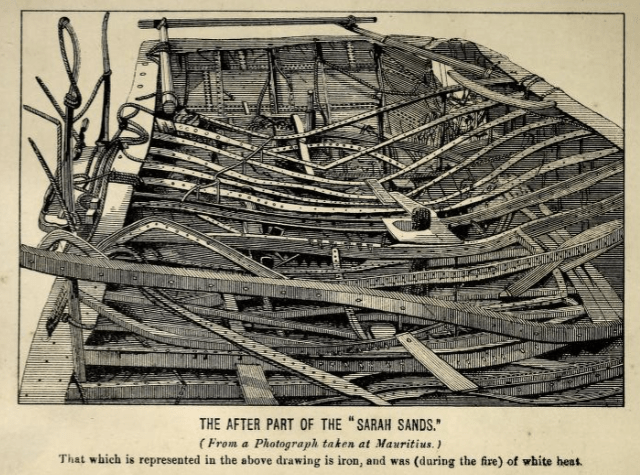
The ship, however, held. The thickness of the iron-plated sides neither buckled nor burst, and the engineer’s fire line had held. With the last of the fire finally out and two hours later, the boat crews, along with the ladies and children, returned to the ship. As they scrambled on board, sharks, disappointed they had been robbed of a meal, snapped at their ankles. The mutinous sailors likewise returned, expecting, as they should, the ire and wrath of the captain and the officers. However, there was too much work to do to waste any on punishing them, although the captain did consider simply setting them adrift.
Aft the main mast was a steaming chasm, with 17 feet of water in the after compartments. At every roll of the ship, four huge iron water tanks dashed against the sides, threatening to breach the bent and weakened plates. The port side of the stern was blown out to the water’s edge, and admitted every wave; the mizzen mast was gone, the main mast tottering. Work went on without relief. The pumps were plied as hard to get rid of the water as they had before been, to pour it in. The tanks were secured as soon as they were cool: sails were passed round the stern, and a barrier, formed of hammocks, sails and planks, effectually stopped the leak. So the second day and night passed. On the third day, a steering apparatus worked by fatigue parties was rigged up, and preparations made to leave the place, where the ship had till now helplessly drifted. No sail had been sighted since the fire. Charts, compasses, chronometers, all were gone; whilst the last observation marked the ship’s position about 600 miles from Ceylon and 800 from Mauritius. To the latter port the trade wind would serve, so sail was made on the one sound mast, and the ship’s head set for Port Louis.”
Captain Castles had not been able to save his instruments, but he still had his compass and one chart. Using the watches of the officers, he was able to make his subsequent calculations; if the weather held and no more disasters struck, they would eventually arrive in Mauritius, but it was not going to be a miserable voyage. After the fire, the captain was obliged to steer the ship by ropes. Attached to the horizontal bar at the stern, they could then be used to turn the rudder, but it took twelve men to do so. Six men sat on planks on either side, “pulling and loosening” as needed. Regular watches were set up to relieve them from the duty. Where the stern cabins had once been, a tent was fashioned for Captain Castles under which he could make his calculations. Ingenuity and unparalleled seamanship brought the Sarah Sands across the next 1000 miles of open sea, but it would not be without suffering. In despair of ever seeing land again, some messages had been thrown overboard, safely ensconced in corked bottles, but none of these was ever recovered.
Nearly all the stores had been destroyed, and all that was left was now distributed with some caution. A cask of rum, a quarter-cask of sherry, two barrels of salt beef and two of flour were all that remained after the fire. They had an abundant supply of rainwater which was collected in condensers, but as these had been damaged, the taste of the water was questionable; however, it also prevented them from dying of thirst before they reached Mauritius. As for clothing, just about all the baggage was gone. The ladies fashioned themselves dresses from the scraps of leftover sails, and for the sake of privacy, the men nailed up some canvas to create a partition for them in the ship’s fore. As for the men, they were obliged to wear the clothes they had had on during the fire as there was nothing to change into. As such, by the time they made port, all they had on was rags. Only once were the officers able to bathe for the remainder of the voyage when a “huge box” was filled with water in the engine room. The water, after the ablutions of so many men, Schlotel noted, was best imagined rather than described.
When Mauritius was finally in sight, Captain Castles requested Engineer Frazer’s advice on whether he should risk using one of the ship’s engines to bring her in. Until now, it had been feared that the vibrations of the engines would have ripped the ship to pieces, but with land so close, it was decided to put an end to this voyage once and for all. One engine was started up, and the men could watch, through the exposed deck, as the “naked screw-shaft pumped away at the bowels of the vessel.” Someone raised the tattered Colours as the Sarah Sands finally limped into Port Louis.
The people who had gathered to witness her arrival greeted the men, as they disembarked, with cheers and hearty handshakes – a public subscription was quickly got up, and the 54th were shortly after treated to a banquet in the market square. A great number of speeches were given, and the 54th were showered with accolades. When news reached England of their magnificent escape, the government and the Queen, too often greeted with miserable news from the sea, were ecstatic.
When they finally reached Calcutta, a General Order, by Field Marshal His Royal Highness the Duke of Cambridge (Commanding in Chief to the Army), was read out to the men.
“His Royal Highness the General Commanding in Chief, has great gratification in making known to the Army the substance of a report received from Major-General Breton, commanding the Troops at the Mauritius, recording the remarkable gallantry and resolution displayed by the Officers and Soldiers of the 54th Regiment on board the ship “Sarah Sands, ” on the 11th November, 1857, under circumstances of a most trying nature, namely, when that vessel took fire at sea, having at the time a large quantity of ammunition on board. It is under such emergency that presence of mind, high courage, and coolness – qualities which are the attributes of British Soldiers -are conspicuous, and are rendered particularly so when attended by the maintenance of that discipline which was evidently observed on the occasion.”
Rewards were conferred on the officers and the men mentioned in the General Order, resulting in promotions for Major Brett and Captain Gillum. Lieutenant Houston was promoted to a company in the 4th Foot while Lieutenant Hughes received a Brevet Majority after he received his company. The men also received an extra 6d a day extra pension on their discharge. Major Brett named the following men as having particularly distinguished themselves:
Serjeant Henry Robinson
Thomas Page
James Doyle
James Houston (Instructor of Musketry)
Private William Warren
Private Thomas Holland
Francis Glenny
George Lamb
James Carmichael
Lance Corporal John Westby
Private Philip Folland
John Doyle
James Buckingham
James Hopkins
Robert Denton
James Fitzpatrick
Bartholomew Canavon
George Dodd
James Gallagher
Lance Corporal John Stevenson
Private Michael Byrnes
William Wiles
Lance Corporal John M’Cullum
Private Stewart Hall
Andrew Walsh
“The Humane Society’s medal was presented to Lieutenant Colonel Brett and Private William Wiles, and the thanks of the Society was passed to those on board in these words: That the warmest thanks of this Committee are justly due, and are hereby presented to Major and Brevet Lieutenant-Colonel W. F. Brett, of Her Majesty’s 54th Regiment and the men under his orders, for their cool, courageous, and energetic exertions, displayed on the,11th November, 1857, when the Transport Sarah Sands was on fire in Latitude 14° S., Longitude 56° E., and by whose united, and admirable arrangements, not a life was lost.”
On 20 December, the Headquarters boarded the Clarendon and set sail, once again for India, but it was a grim affair. The Clarendon had been abandoned by all of her passengers at the Cape on the voyage from England and subsequently used for the transportation of labourers from India to Trinidad and Guyana, so-called coolie-emigrants, sent across the seas to take the place of freed slaves.
Yet, she was the only ship available to take the 54th to India. If conditions on the Sarah Sands had been questionable, those on the Clarendon were worse. Officers had no cabins at all but were obliged to sleep on the saloon tables and in chairs while the men shifted for themselves as best as they could. The ship, which had been used previously in transporting goods from South America, was awash with insects and spiders. An officer awoke to find a tarantula traversing his nose; another discovered a venomous centipede exploring his face. The creatures abounded throughout the ship, causing all manner of consternation. Another officer suddenly broke out in an unexplainable rash, which he compared to being covered in a mustard plaster that was then scraped off with furze brush.
The Clarendon itself was in such a deplorable condition, there were now doubts she would ever make land. On Christmas Day she nearly foundered in a hurricane, the anxiety of which killed her commander, Captain Thornhill. He had spent the entirety of the storm outside, expecting any minute to see his ship sink, and the strain proved too much for his constitution. A seaman of some 50 years’ experience had been, without question, executed by his ship. He had had enough worries over the past days, for if the storm did not get the Clarendon, her miserable engines would. They could not be coaxed to work for more than an hour at a time, and then broke down repeatedly. When she finally made it to the mouth of the Hoogley, the cylinder cover of the engine blew off and had to be repaired before the ship could proceed. While they waited with impatience, an American vessel was seen approaching, and it was at once suggested that someone should lower a boat and ask the Americans for some tobacco. The men had been reduced to smoking weed rope yarn, and their tempers were as frayed as their clothes.
“The American commander received us with great cordiality, invited us into his cabin, gave us grog, and in fact did everything in his power to make us comfortable while we explained the object of our visit and what had befallen us. ‘Well,’ he said, ‘thank God you are all safe; I am glad you have come to ask me for tobacco, as I can give it you.’ He then asked how many men we had on board. We said 300. He ordered one of his men to get 400 pounds weight of tobacco (the finest Cavendish) and 1000 Manillas for the officers. We then asked how much we were indebted to him, when he replied, ‘Not anything, Americans never take anything from shipwrecked people, but always give them whatever they may have which they require.’ We found it a useless endeavour to persuade him to receive payment.
Upon returning to our ship, and informing the commander the result of our expedition, he requested us to go back and insist upon the American commander receiving payment, which we did, and dare say need not add was to no further purpose than giving rise to the consumption of a few more glasses of grog, which caused it to be dark when we returned to our ship. Our band played “Yankee Doodle,” blue lights were burnt, rockets sent up, the signal-gun fired, and every display in our power was had recourse to, so as to convey to our American cousins our appreciation of their kindness. The American sailors returned the compliment by sending up rockets, and climbing the rigging and giving three cheers for old England.”
On 25 January 1858, the Headquarters of the 54th Regiment of Foot finally arrived in Calcutta. They were shortly after reunited with the three companies that had been sent to East Bengal following the mutinies in Dhaka and Chittagong. Too soon would they begin their vagabond life, and although their service in India would be short, it would nonetheless be eventful.
As for the SS Sarah Sands, she was put into a state of repair that allowed her to proceed back to England. After extensive work, she was back in business. On 7 April, 1869, she ran aground on Kalpeni reef, in the Lakshadweep Islands. The crew were saved and brought to Calicut, but the ship and her cargo of coal were lost, thus ending her life beneath the wild waves of the Indian Ocean.
Sources:
Records of the 54th West Norfolk Regiment. Roorkee: Thomason Civil Engineering College Press. 1881
Schlotel, Frederick. Narrative of the Burning of the Sarah Sands Screw Steam Ship, with the Head Quarters of H.M. 54th Regiment on Board. London: Bemrose & Sons, 1870.
Todrig, Louise N. The Ballad of the Good Ship Sarah Sands. Buffalo, N.Y.: Carrell & Nisell, 1884
Links:
https://www.fadedgenes.co.uk/SarahSands.html
https://www.kiplingsociety.co.uk/tale/the-burning-of-the-sarah-sands.htm
https://www.warandson.co.uk/war-memorabilia-history/22-mutinous-before-the-mutiny-sarah-sands-disastrous-journey.html
https://guyanachronicle.com/2009/05/05/the-coolie-ships/
 Mutiny Reflections