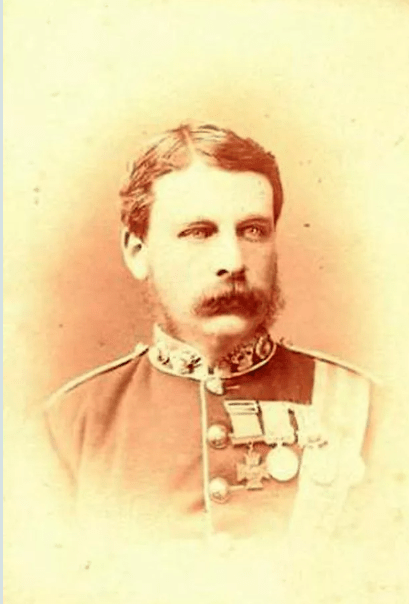
Born in 1833 to Lieutenant Colonel William Gordon Cameron and his wife Caroline (née Edwards), Aylmer Spicer Cameron was commissioned as an ensign to the 72nd Highlanders in 1852, gaining his promotion to lieutenant in 1854. Unsurprisingly, he served in the Crimean War and was present at both assaults on the Redan at Sevastopol. Following the end of the war, the regiment returned home.
In August 1857, an “order of readiness” called for the immediate embarkation for India. Shortly before departure, HRH the Duke of Cambridge inspected the regiment and presented them with new Colours. Two days later, on 26 August, the first detachment consisting of 296 men and 14 officers embarked the Matilda Atheling and sailed for Bombay. On 8 September, the headquarters of the regiment set sail on the screw-streamer Scotia and reached Bombay on 9 December. On the 28th December, the steamer Prince Albert, with a detachment of three companies of the regiment
under Major Mackenzie, followed on 5 January 1858 by the Matilda Atheling. Two companies remained briefly in Bombay before rejoining the rest of the regiment, a Baroda. Their work was somewhat ominous for, “They were not, however, kept together, but were moved by companies from village to village, collecting arms and carrying out executions.” Six companies now marched from Baroda to Deesa and then onto Nasirabad. They left their more delicate men to seek recovery from their ailments at the Mount Abu sanatorium; unfortunately, Major Mackenzie of Glack succumbed to smallpox during the march to Nasirabad and his earthly remains were buried at a village named Burr.
It must have been an interesting time for Lieutenant Cameron — he was, after all, already the third generation of Camerons to set foot in India, and he would hardly be the last.
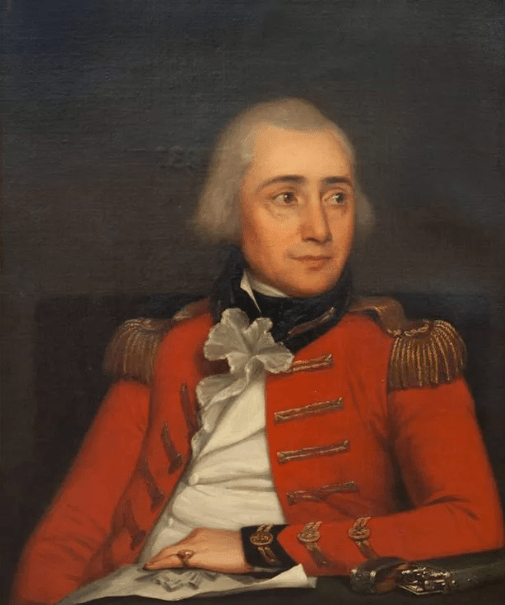
This particular branch of the Camerons descended from William James Cameron, an Episcopalian Minister of Inch, Wigtownshire, who went to Ireland in 1692 with his family. His son William Cameron, an Irish Anglican priest, would serve as Archdeacon of Ardfert, Co. Kerry (1738 to 1765). Married to Judith Somerville, who also happened to be his cousin (being the daughter of Reverend William Somerville, rector of Castlehaven, Co Cork), they would in their time have several children, but one of them certainly took a shine to India.
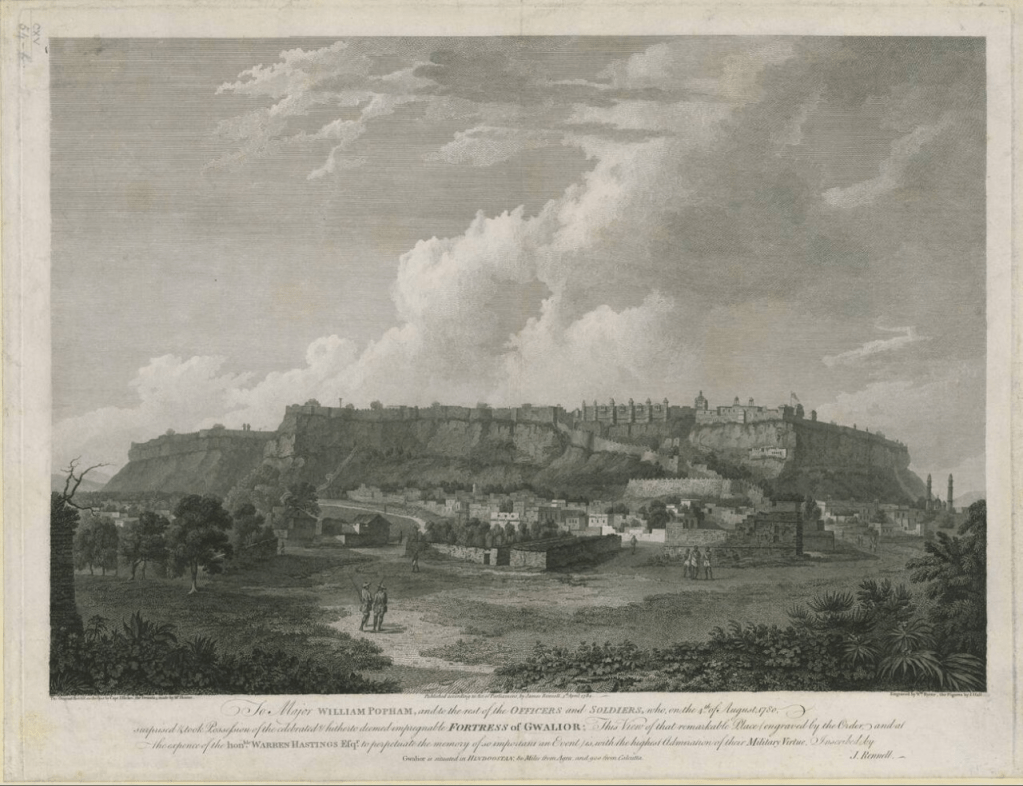
Born in 1755, William Neville Cameron joined the Bengal Engineers as a cadet in 1772. He was nominated as an assistant engineer and employed at Buxar Fort until 1774, when he joined the “Select Picket” serving with the army in the Rohilla War and was employed under the Field Engineer. Cameron then fought through the First Maratha War (1779-81) and the capture of Gwalior, where he served as engineer with the force under Major William Popham.
In 1787, he was appointed commanding engineer at Chunar Fort, and six years later, as Chief Engineer at Fort William, Calcutta. Now a Major General, William Neville chose to return home on furlough in 1805, and never set foot in India again. He died in 1837, at the grand age of 82, with his final rank of Lieutenant General having been bestowed on him in 1808.
Of course, he had taken the time to marry in 1789 in Calcutta to one Charlotte Gordon, the younger daughter of Sir William Gordon, 7th Bart., of Embo. As her brother John (the 8th Bart., soon to be dead in Penang was the 5th but eldest surviving son of Sir William Gordon, who had been a Captain in the 19th Regiment of Foot) had but recently joined the Bengal Engineers, there may well have been a social acquaintance; however, her eldest sister, Judith married Major Jabez Mackenzie of the 5th BNI (who had served, like Cameron, in the Maratha War) at Chunar on 10 August 1789; only six days later, Charlotte found herself walking down the aisle in Calcutta with Cameron. Another sister, Amelia, followed suit in 1795, snagging herself Lieutenant Charles Stewart of the 11th BNI, who would eventually become a noted Orientalist.
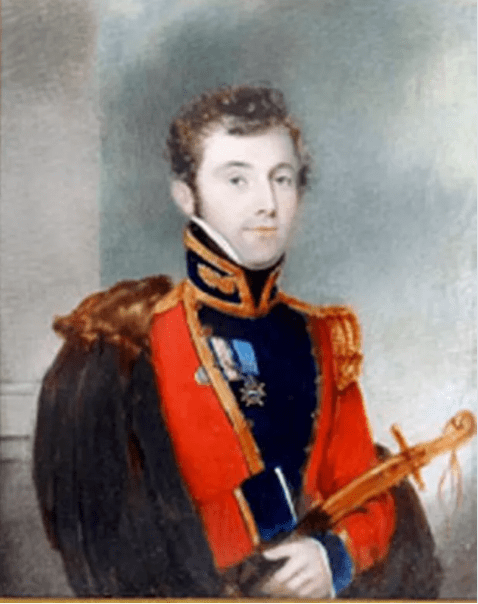
The marriage of William and Charlotte was certainly a fruitful one, but it was most noted for Aylmer Spicer Cameron’s father, Lieutenant Colonel William Gordon Cameron of the Grenadier Guards. Born in Chunar in 1790, it would appear that life in the army appealed to him when he became an ensign by purchase in 1809 in the 1st Regiment of Foot. As his regiment was busily engaged in the Peninsular War at the time, William rushed to join them and in 1811 was severely wounded at the Battle of Barossa. He recovered enough to join the staff of the Duke of Wellington in 1815 at Waterloo. Unfortunately, the battle ended rather abruptly for Captain Cameron when he was so badly wounded that he ended up with an amputated arm. This put something of a halt to his military career, but Cameron retained his commission and eventually gained the rank of Lieutenant Colonel. In 1831, he married Caroline Edwards, with whom he sired ten children.
His brother, Neville Somerville Cameron (b. 1792), had taken a different route and joined the East India Company’s Civil Service in the Madras Presidency. Although his career had begun on a good footing, it ended quite abruptly in 1833, when, as Principal Collector and Magistrate of Madura, he died on 12th December 1833, at the Cape of Good Hope. A long sea voyage was usually the last prescription left for an ailing man, and he sadly died unmarried at the age of 41. His sisters, however, married well. Charlotte formed her alliance with Thomas Dean Shute, a magistrate, while the youngest, Maria, married Colonel John Hogge.
The Sons of the Lieutenant Colonel
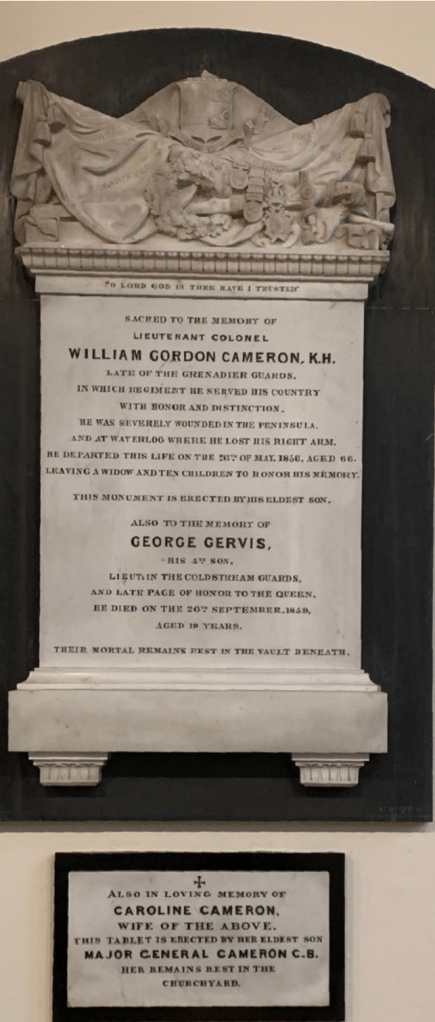
Whether they were inspired by their father’s derring-do, one cannot say for sure, but the five Cameron brothers joined the armed services. The eldest, William Gordon, was commissioned into the 42nd Regiment of Foot in 1844. He transferred to the Grenadier Guards in 1847 and, like his younger brother Aylmer, would see service in the Crimea, where he took part in the Battle of Alma. He was subsequently appointed commanding officer of the 3rd Regiment of the British German Legion in 1855. In 1867, he commanded the 1st Battalion, 4th King’s Own Royal Regiment and led the capture of Magdala during the Abyssinian Expedition 1867. Since there was much more to do, William Gordon was brigade commander at Malta in 1875, but in 1884 he became Commander of the British Troops in China, Hong Kong and the Straits Settlements, briefly governing Hong Kong in 1887. A final posting as an administrator of the Cape Colony finalised his career, and he retired in 1895 with several places in Hong Kong named after him and a GCB.
Captain Orford Somerville Cameron (b. 1836) would serve in the Boer War in the artillery, another brother, George Gervis (b. 1840) would not see any active service, dying tragically at the age of 19 as lieutenant in the Coldstream Guards; the last brother, Abney Hastings Cameron (b. 1842) too met an early death, as Lieutenant in the 19th Regiment of Foot. He did fight in the Ashanti War, but he died at Parkhurst Barracks on the Isle of Wight at the age of 35, of a fever contracted on those rugged fields.
The marriage of their Aunt Charlotte to Thomas Dean Shute gave the Camerons four cousins, two of whom served in the Crimea. Charles Cameron Shute, later General Sir Charles Cameron Shute, KCB, DL. With the 6th (Inniskilling) Dragoons, Shute served at Balaclava, the Battle of Inkerman and the Siege of Sevastopol. His brother, Lt. William Gordon Shute (28th Regiment), served in the Eastern campaign of 1854-55, until 25th January 1855, including the battles of Alma and Inkerman, and the Siege of Sevastopol. Further afield, in India, Captain Neville Hill Shute of the 64th Regiment would be blockaded in the Lucknow Residency, having come in with Havelock and Outram. Their younger brother, Henry Douglas Mackenzie Shute, would arrive in India in 1858 with his regiment, the 57th Regiment of Foot. The 28th Regiment, too, would return to India in 1858; however, it is not clear whether William Gordon was with them.
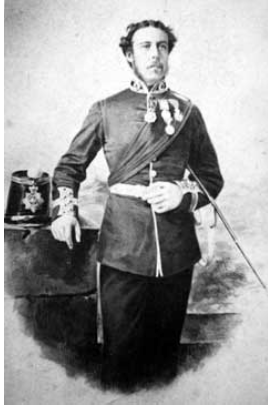
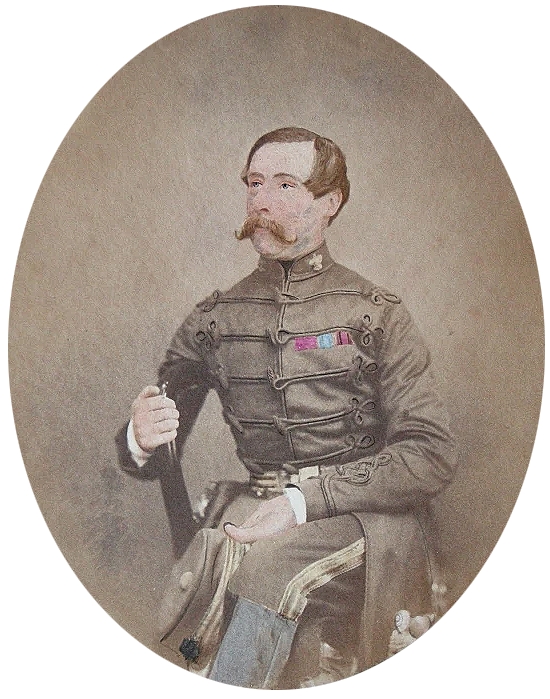
Lieutenant Aylmer Spicer Cameron, VC
The 72nd Regiment marched up to Kotah with the Rajputana Field Force — they had by now seen something of the country, and apart from the dismal work of “collecting arms and carrying out executions,” there had been no fighting. The assault on Kotah would be their first battle. Although it was clear that the Maharao of Kotah had failed to protect the Burtons when they had returned in October, he had since refused to take up arms against the EICo. For the men of the 72nd, the Maharao was of little consequence. They were here to “avenge the foul murder of the British resident,” while the politicos could decide what to do with the Maharao.
Following the blowing up of the main gateway, the column to which the 72nd was attached proceeded along the top of the outer wall towards the Surajpol Gate, through which a considerable body of insurgents was making a hasty retreat. The gate was taken, and the column entered the city.
“No sooner, however, had the regiment left the walls than a fire of matchlock men was opened from a strongly built stone house facing the gateway. An entrance was attempted by Lieutenant Cameron of the 72d, with a small party of men. This officer, in a very gallant manner, at once dashed up a narrow passage and staircase leading into the upper part of the building; he was met by a determined band of rebels, headed by the brother of Jydial, surnamed ‘the Lala,’ the commander-in-chief of the rebels. Lieutenant Cameron was cut down and severely wounded; one man of 72d, one of Royal Engineers, and one of 83d, who happened to be with the party, were killed, and one 72d wounded.”
Lieutenant Cameron, after killing two men in the melee, was struck by a tulwar, which effectively slashed his hand in half. Along with a further three wounds, the action at Kotah put an end, at least for now, to his fighting days. His citation read as follows:
For conspicuous bravery on the 30th of March, 1858, at Kotah, in having headed a small party of men, and attacked a body of armed fanatic rebels, strongly posted in a loop-holed house, with one narrow entrance. Lieutenant Cameron stormed the house and killed three rebels in single combat. He was severely wounded, having lost half of one hand by a stroke from a tulwar. (No. 22324″. The London Gazette. 19 June 1860. p. 4032.)
His Victoria Cross would be the only one awarded to the 72nd Regiment for the entire course of the mutiny.
He was also mentioned twice in despatches:
I must not omit a conspicuous act of gallantry performed by Lieutenant Cameron, Her Majesty’s 72d Highlanders, reported by Brigadier Parke, as having headed an attack up a narrow entrance of a house, defended by a party of desperate men, two of whom he slew, and was himself desperately wounded. (H.G. Roberts, Major-General, Commanding Rajpootana Field Force )
Towards the end of 1858, Cameron was back at work, chasing Tantia Tope through Rajputana.
“I received the most ready assistance from the officers commanding the several detachments, viz., Major Simpson, 2nd Bombay Light Cavalry; Captain Adams, 13th Regiment Native Infantry; Captain Bolton, Royal Artillery; Captain Brooke, 95th Regiment; Lieutenant Cameron, 72nd Highlanders; Lieutenant Bannerman, Sikh Horse; also from Captain Malcolm, Bombay Engineers, who acted as my Staff Officer.” (Major R. Rocke of the 72nd Highlanders, Commanding Field Force)
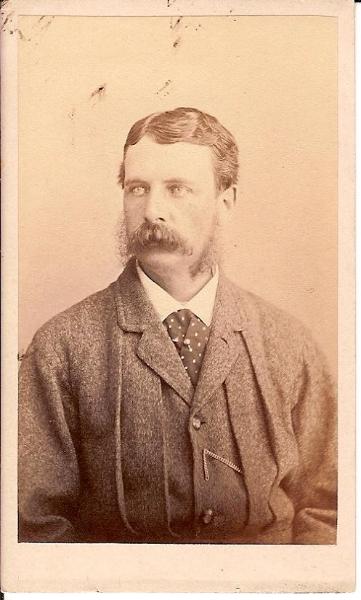
The pursuit of Tantia Tope would not end until the leader’s capture in April 1859, and Cameron took part in the action at Banass in November and commanded a detachment of the 72nd at Pretabgarh on 24 December 1858. He was invested with the Victoria Cross on 9 November 1860 by Queen Victoria. He was subsequently promoted to Captain in the 2nd Battalion, 25th Regiment of Foot on 13 December 1859, having obtained his exchange from the 72nd.
With the 25th regiment, Cameron went to Ceylon in 1865; promoted to major in 1871, he served for a time in Bengal, firstly as an infantry instructor in Bengal. With a promotion to lieutenant colonel in 1877 and to colonel in 1881, in June 1883, he went on half-pay but still took up another posting, as A.A.G. in Canada from 1879 to 1881. Hen then commanded the 25th from 1881 to 1883, followed by Chief of the Intelligence Branch at Headquarters from 1883 to 1886, and Commandant of the Royal Military College at Sandhurst, 1886 to 1888. He was made a Companion of the Order of the Bath in May 1886. After 35 years of service, Colonel Aylmer Spicer Cameron retired in 1888. He died at home on 10 June 1909 after a long bout of ill health. He was buried at St. Mark’s Churchyard, in Highcliff, Dorset.
 Mutiny Reflections